Indrechtach’s Death707 CE
Annals for 707 record political, ecclesiastical and environmental developments in a divided, rural Ireland. Indrechtach mac Dúnchado, overking of Connacht, was killed by northern Uí Néill leaders and allies, demonstrating continuing rivalry without proving conquest. Congal Cennmagair, king of Tara, led a host against Leinster, though no outcome is known. Dúnchad became superior of Iona, reinforcing the monastery’s Irish Sea importance, while Bishop Coibdenach of Ardstraw died and Béc of Bairche undertook religious pilgrimage. Two northern tremors occurred in December. These sparse notices illuminate interconnected kingship, church networks, mobility and agrarian society, while leaving everyday conditions largely unrecorded to historians.
Dateline
The year 707 is best understood through a small cluster of tightly recorded events rather than as a year with a single island-wide turning point. Ireland remained a patchwork of competing kingdoms, kin-groups and ecclesiastical federations. Its people lived overwhelmingly in dispersed rural settlements, but the politics of those settlements reached far beyond their local boundaries: kings assembled hosts, cattle and food sustained both households and war-bands, and monasteries connected Ireland to western Scotland, Britain and the Latin Christian world.
Several principal notices for the year survive in the Irish annals. They need handling with care. The annals preserve material of great value, yet their surviving manuscripts were compiled later and their chronological headings can be offset. In this case, the Annals of Ulster place the principal notices under U707 while giving an inconsistent calendrical heading. Modern historians nevertheless conventionally place the killing of Indrechtach son of Dúnchad, the northern earthquakes, Congal’s expedition against Leinster and Dúnchad’s accession at Iona in 707. Where the evidence is firmer, the events below are treated as events of that calendar year; where it is not, the limits of the record matter.
An Overking Killed
The most consequential political event recorded for 707 was the killing of Indrechtach mac Dúnchado of Muirisc, a ruler of Connacht. Muirisc lay on the Atlantic coast around modern Clew Bay in County Mayo, but Indrechtach’s position extended beyond one coastal people. He belonged to the Uí Fiachrach Muaidhe, a powerful Connacht lineage, and is described in historical scholarship as overking of Connacht. The Annals of Tigernach’s tradition styles him king of the ‘Three Connachts’, a formulation which suggests a claim to provincial pre-eminence rather than a merely local lordship.
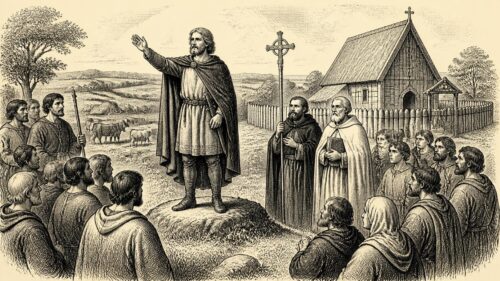
The Annals of Ulster name the men responsible: Fergal son of Máel Dúin of Cenél nÉogain, Fergal son of Loingsech, and Conall Menn, king of Cenél Cairpri. This was not presented as an accidental death or obscure feud. It was a concerted killing by leaders associated with the northern Uí Néill and their western allies. The wording does not preserve the location of the encounter, the numbers involved, or the manner of Indrechtach’s death. It would be unsafe to invent a battlefield or describe a set-piece campaign. Yet the identities of the killers make clear that the event belonged to the continuing contest between Connacht rulers and northern Uí Néill dynasties for influence across the north and west of the island.
Its immediate background lay in the Battle of Corann in 703, when Cellach son of Rogallach, then ruler in Connacht, defeated and killed Loingsech son of Óengus, a northern Uí Néill king reckoned king of Tara in the annalistic tradition. Indrechtach did not fight at Corann as far as the surviving notices reveal, but he inherited a politically charged kingship. His killing in 707 gave Fergal son of Máel Dúin, an ambitious Cenél nÉogain prince, a notable early success. The episode should not be mistaken for the conquest of Connacht: no source says that the northern Uí Néill annexed the province or imposed a lasting administration. Rather, it demonstrates that provincial overkingship was vulnerable to armed intervention and that inter-provincial alliances could be rapidly assembled.
Congal’s Host Against Leinster
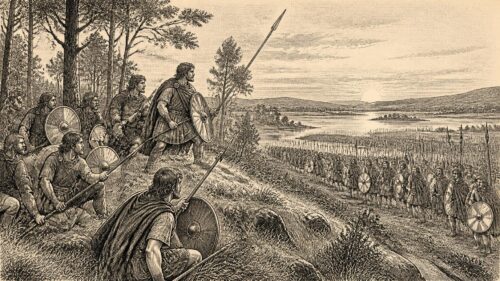
Another annalistic entry records ‘the hosting of Congal son of Fergus against the Laigin’. A hosting was the mobilisation and movement of an armed force, not necessarily a pitched battle. The annal gives no battle-name, casualty list, settlement seized or treaty concluded. The responsible conclusion is therefore modest: Congal mounted, or led, an expedition against Leinster during 707.
This Congal was Congal Cennmagair of Cenél Conaill, who held the kingship of Tara in the sources’ terminology. The title ‘king of Tara’ expressed supremacy and aspiration within Uí Néill politics, but it did not mean rule over a territorially united Ireland. Congal’s authority depended on personal alliances, tribute, hostages, military reputation and the acquiescence—or submission—of other kings. An expedition against the Laigin thus belonged to the ordinary but serious business of maintaining status. It indicates pressure on Leinster, not proof that Leinster had been subdued.
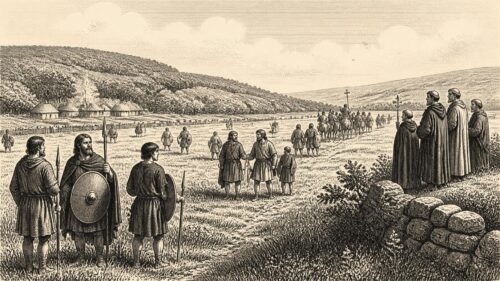
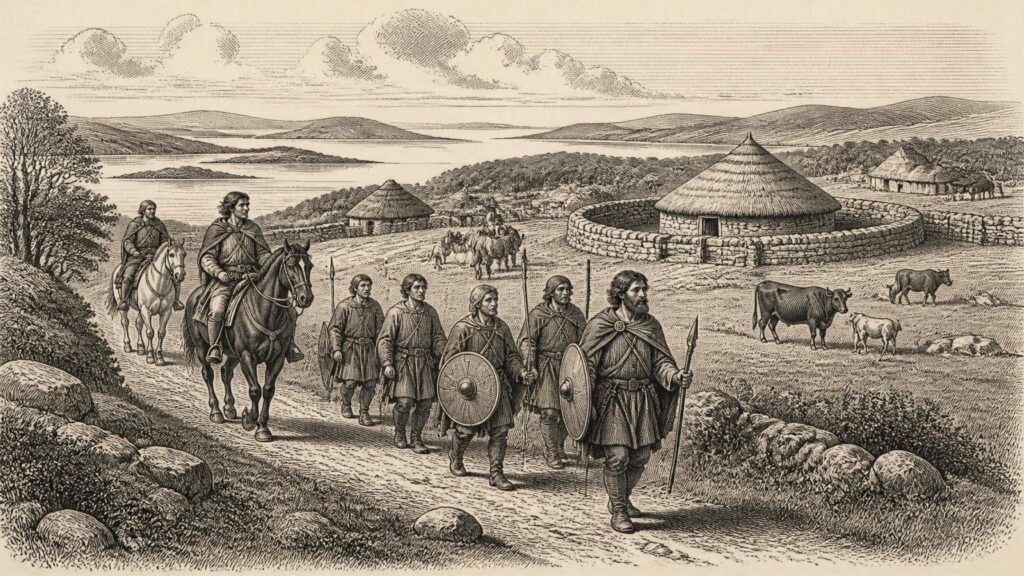
For communities in the route of such a force, even an expedition that ended without a famous battle could be disruptive. Men liable for service might have left farms at a demanding time of year; food, animals and accommodation had to be found for a moving host; and rival local rulers had to calculate whether to resist, negotiate or keep clear. The annal’s brevity is itself revealing. Its compilers generally cared most about a ruler’s death, a battle’s result or a striking ecclesiastical occurrence. A bare notice of hosting registers an exercise of political power while leaving ordinary people’s experience almost wholly unrecorded.
Iona and Ecclesiastical Authority
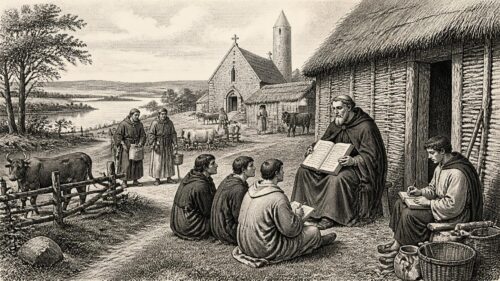
In the same year Dúnchad ‘assumed the office of princeps at Í’, the island monastery better known as Iona. Although Iona lies off the coast of modern Scotland, its history was directly entwined with Ireland. It had been founded by Colum Cille from the Irish kingdom of Cenél Conaill, maintained daughter-houses and relationships on both sides of the Irish Sea, and was a major centre of religious authority, learning and manuscript culture. The Latin princeps here means the head or superior of the community, not a secular prince.
Dúnchad’s accession mattered because Iona was no isolated retreat. Its leader governed a substantial religious familia: a network of associated churches, clergy and communities shaped by Columban tradition. Leadership at such a house also had political resonance. Dúnchad himself was of Uí Néill royal descent, an illustration of the close relationship between leading kindreds and major churches. That relationship was not simply one of kings controlling monks. Religious institutions held land, protected dependants, educated clerics, offered sanctuary and could confer prestige and legitimacy upon secular patrons.
The annal does not say that Dúnchad’s appointment brought an immediate reform. Later evidence associates his abbacy with Iona’s acceptance of Roman Easter observance, but that development belongs to the following decade and should not be dated to 707. What can be said for this year is that a new head took charge of an institution whose Irish connections were extensive and whose standing reached across the sea.
Elsewhere, the death of Coibdenach, bishop of Ard Sratha—Ardstraw in the valley of the River Derg in present-day County Tyrone—records another change in the ecclesiastical landscape. The use of the title bishop is important. Early medieval Irish Christianity was not a simple, uniform hierarchy of territorial dioceses in the later medieval sense. Bishops, abbots, churches and monastic confederations overlapped in authority. Coibdenach’s obituary shows episcopal office operating within that varied system, in a northern region also affected by dynastic competition.
Staff, Journey and Devotion
The annals also state that Béc of Bairche ‘assumed the pilgrim’s staff’. Bairche refers to the Mourne district in modern County Down. The formula is unusually compact but significant. A staff marked a religious journey or a more lasting form of penitential wandering; Irish Christian peregrinatio could mean voluntary exile for God as well as travel to a shrine. The entry does not tell us where Béc went, whether he travelled overseas, or whether he ever returned. It should not be expanded into a fictional voyage. It does, however, offer a rare dated glimpse of an ideal that gave movement, renunciation and sacred discipline a recognised place in early Irish religious life.
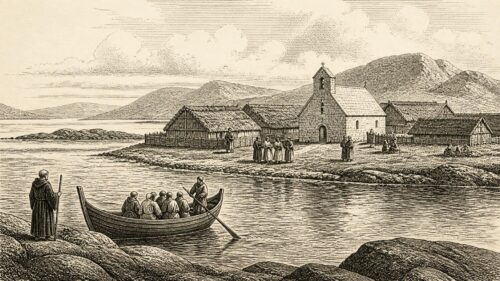
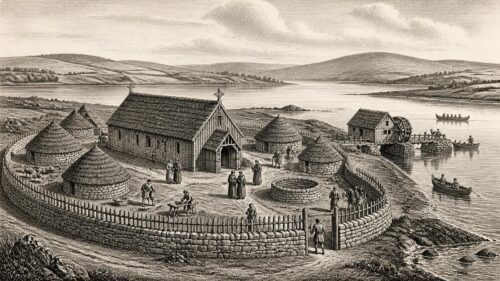
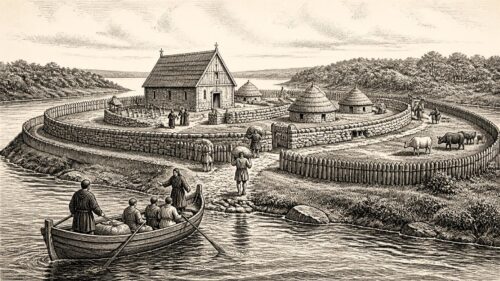
Such mobility rested on real maritime and overland connections. Boats, coastal communities and monastic landing places linked Ireland with Iona, western Britain and other Irish Sea shores. Clerics, students, books and messages could travel along these routes, while kings and monasteries alike cultivated relationships beyond their immediate territories. The year’s notices—an Iona accession and Béc’s taking of the staff—therefore point to an Ireland that was rural and regionally divided, yet far from cut off.
December Tremors
The Annals of Ulster record that two earthquakes occurred in the same week in December in the northern part of Ireland. This is the year’s only explicitly dated environmental event. It should be taken seriously as a contemporary report of disturbing physical phenomena, but not treated as a modern seismological measurement. The text gives neither location, damage nor magnitude, and specialists in historical seismicity warn that the word may conceivably refer to related ground disturbances such as landslips. Two shocks in one week are compatible with earthquakes and aftershocks, but certainty is impossible.
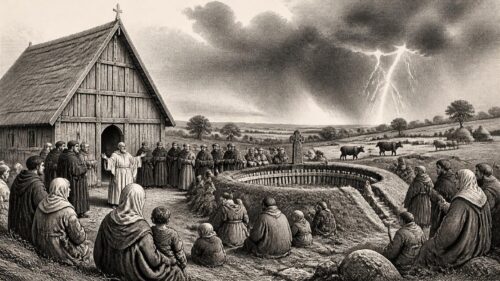
Whatever their precise cause, the tremors were memorable enough to enter the annal. For inhabitants of timber-and-earth settlements, churches and farmsteads, unusual movement of the ground would have been alarming. The report also reminds us that environmental history is not only a matter of harvests and disease. Sudden local events could enter collective memory, especially when interpreted in a Christian society accustomed to read extraordinary occurrences as morally or spiritually meaningful.
Life Beyond the Annals
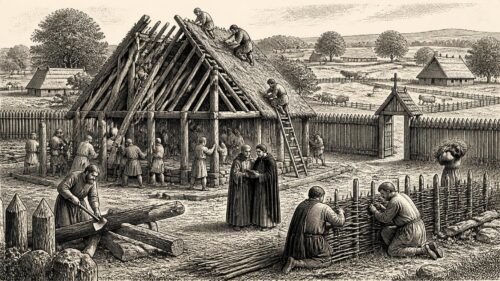
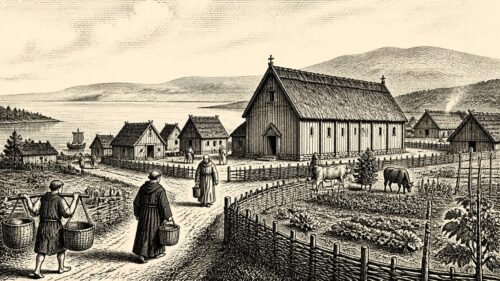
The annals say nothing directly about the harvest, prices, trade or weather of 707. No responsible history can fill that silence with invented famine, prosperity or demographic change. Archaeology nevertheless supplies the closely connected setting in which the year’s politics unfolded. Early medieval Ireland was overwhelmingly rural. Most people lived and worked in dispersed farmsteads, including enclosed raths or ringforts and, in some regions, crannogs. Cattle were central to wealth, food production, lordship and compensation, but mixed farming also required cereal cultivation, dairying, pig-keeping, sheep husbandry, milling, textile work, woodcraft and ironworking.
That material world helps explain why hosts and kings mattered. A ruler’s capacity to summon followers, demand provisions and reward allies rested on agricultural surplus and control over people, animals and land. Conversely, political violence exposed those resources to loss. The killing of Indrechtach, Congal’s expedition and the appointment of Dúnchad were elite events, but their consequences depended on households whose labour fed warriors and religious communities alike.
Thus 707 presents a sharply textured but incomplete picture: Connacht lost an overking to a northern alliance; a king of Tara led a host towards Leinster; Iona received a new superior; a man of Bairche took up a pilgrim’s staff; a northern bishop died; and December brought two reported tremors. None made Ireland a single kingdom. Together they reveal an island in which power was local, competitive and mobile, and in which church, kinship, landscape and livelihood were inseparable.

Primary Sources
- The Annals of Ulster
- Annals of the Four Masters, Part 54
- Annals of Inisfallen
- Congal Cennmagair
- Fergal
- Dúnchad
- Chronological Synchonisation of the Irish Annals
- Historical Seismicity of Britain to 1600: December 707 Ulster
- Exploring the Irish Annals
- Irish Texts at CELT
- Early Medieval Ireland: Archaeological Excavations, 1930–2009
- Agriculture, Settlement and Society in Early Medieval Ireland
- The Economy of Early Medieval Ireland
- Early Medieval Ireland: Investigating Social, Economic and Settlement Change, AD 400–1100
- The Archaeology of Early Medieval Ireland, c.400–1169: Settlement and Economy
- The Concept and Practice of Pilgrimage in Early Medieval Ireland: From the Fifth to the Ninth Century
- Early Irish Pilgrim Archaeology in the Dingle Peninsula
- Ireland in the Seventh Century: A Tour
- Í > IOUA > IONA – Iona’s Namescape
- Fragmentary Annals of Ireland