Tailtiu’s Relic Riot830 CE
In 830, Ireland’s fragmented political and ecclesiastical powers collided at Tailtiu, where a dispute over Mac Cuilinn’s shrine and Patrick’s relics caused many deaths during the major assembly. Diarmait, abbot of Iona, returned with Columban sacred objects, illustrating ecclesiastical connections across the North Channel. Scandinavian raiders captured Conaille’s king and brother, and defeated Armagh’s community at Aignig. Armagh also suffered royal coercion from Conchobor of Tara. Feidlimid of Cashel campaigned into Meath, provoking Conchobor’s counter-raid. Death notices for Kildare, Movilla and Armagh leaders, alongside Óengus’s Martyrology, reveal enduring religious learning amid instability. The annalistic chronology itself remains uncertain and reconstructed.
Dateline
The events assigned to 830 reveal an Ireland in which political authority, religious prestige and violence were closely entangled. This was not a country ruled from a single capital. Kings exercised power through kin-groups, clientships, tribute, military following and control of important meeting places; major churches, likewise, possessed lands, dependants, learning and portable sacred treasures. In this setting, a dispute at the great fair of Tailtiu became deadly, Scandinavian raiders struck in the north-east, and rival overkings answered one another’s movements with campaigns across the midlands.
A Note on the Year
The principal contemporary-style record is the Annals of Ulster. Its sequence conventionally numbered U831 carries a calendar notice identifying the year as AD 830. That discrepancy is a reminder that early Irish annals were copied, synchronised and reworked over centuries, and that their numbering cannot always be treated as modern dating. The events discussed here are therefore placed in the calendar year 830, while the evidence does not normally supply a day, month or season. Several are preserved only as very short notices. Where motives, locations or consequences are uncertain, certainty should not be manufactured.
A Fatal Fair at Tailtiu
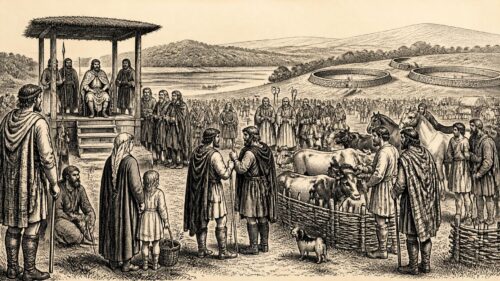
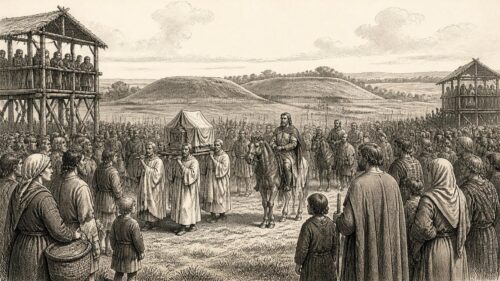
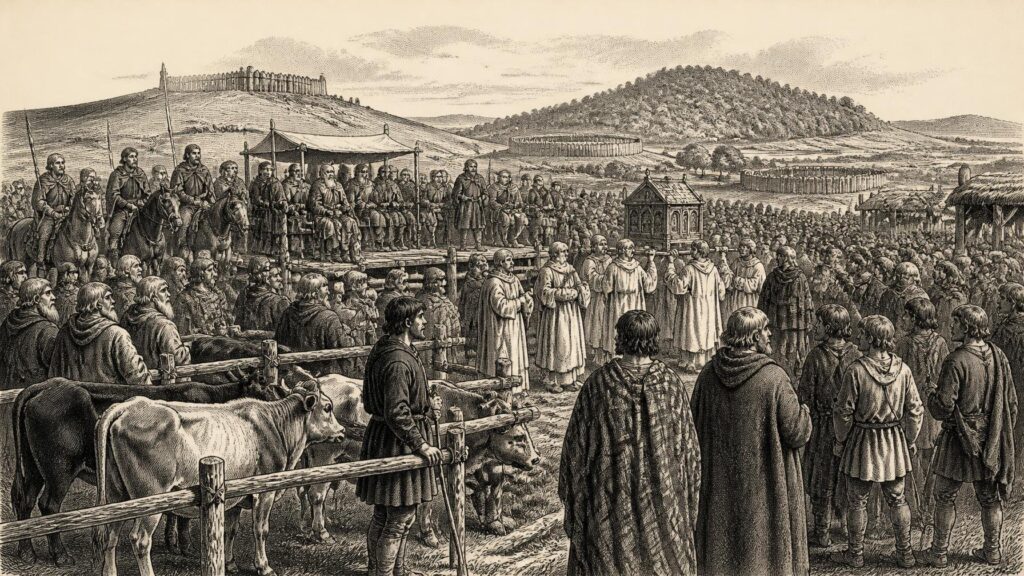
The most striking entry concerns the fair of Tailtiu, near modern Teltown in County Meath. The annalist says that the fair was disrupted “at the platforms” because of dissension over the shrine of Mac Cuilinn and the relics of Patrick, and adds with unusual bluntness that many people died. No narrative survives to explain who initiated the quarrel, whether the dead fell in a fight, a stampede or subsequent disorder, or who gained possession of the contested holy objects. Yet the terseness makes the fact of a serious disturbance difficult to evade.
Tailtiu was far more than a market. An óenach, often rendered as a fair or assembly, brought together commercial exchange, games, public proclamation, legal business and political display. It was associated particularly with the kingship of Tara and the southern Uí Néill, whose authority rested heavily on the midlands. Such gatherings gave rulers opportunities to receive dependants and gifts, settle disputes, show military strength and present themselves as guardians of order. They also concentrated people, wealth, animals and rival interests in one exposed place. The disorder of 830 therefore represented an assault on a public institution as well as a local confrontation.
The object called the shrine of Mac Cuilinn is not securely identifiable from the notice alone. Patrick’s relics, however, carried a more immediately intelligible weight. Relics were not private devotional keepsakes: they could embody a church’s title, its saint’s protection, the authority of its clerics and its right to receive honour or payments. Their presence at Tailtiu indicates that ecclesiastical communities could bring sacred objects into the centre of secular assembly and competition. The incident should not be reduced to a clash between “religion” and “politics”. In ninth-century Ireland, sacred prestige was itself political capital.
Relics on the Move
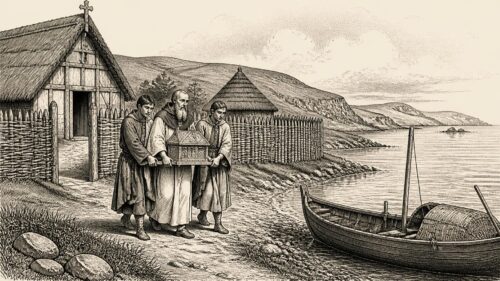
Another notice records that Diarmait returned to Ireland with the minda, or holy objects and relics, of Colum Cille. The annals had earlier recorded Diarmait, abbot of Iona, travelling to Scotland with the same relics. Modern discussion plausibly treats the notices as parts of one journey, but the precise objects, route and purpose remain uncertain. They need not have been bodily remains; mind could refer to a venerated object associated with a saint.
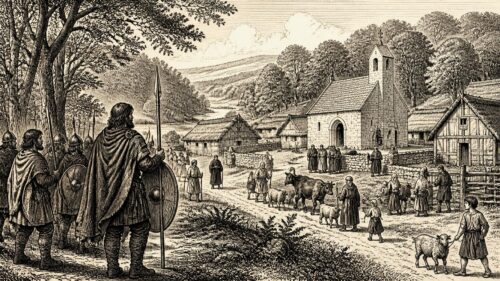
Even so, the return points to the practical mobility of the Columban church across the North Channel. Irish Sea travel linked Iona, Irish monasteries and wider ecclesiastical networks at a time when seaborne raiding had made coasts and islands insecure. Moving a shrine or relic collection could be an act of devotion, a visitation of dependent churches, a means of asserting institutional claims, or a precaution. The annal does not choose among these possibilities. What it firmly shows is that revered objects travelled with people, and that the spiritual geography of Ireland extended beyond the island.
Raiders in Conaille and Armagh’s Defeat
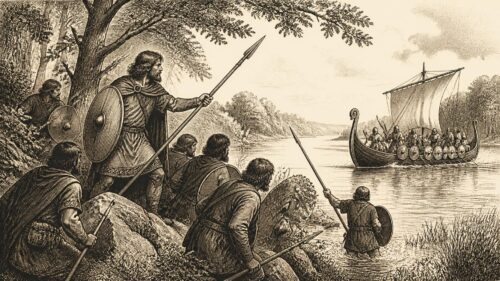
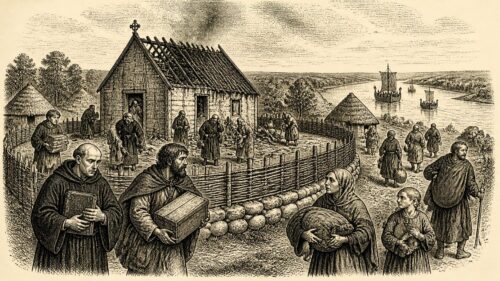
The annalist calls the raiders gentiles, “heathens”, rather than supplying a Scandinavian ethnic label. They invaded Conaille, a kingdom in the north-east, seized its king Máel Brigte and his brother Canannán, and carried both men away to their ships. Captivity was central to the raiding economy. A king and his close kinsman were valuable hostages, possible sources of ransom, and a means to humiliate or destabilise a local ruling line. The wording also demonstrates that the attackers retained ships close enough to remove prisoners quickly; it does not, by itself, prove a permanent settlement at any named site.
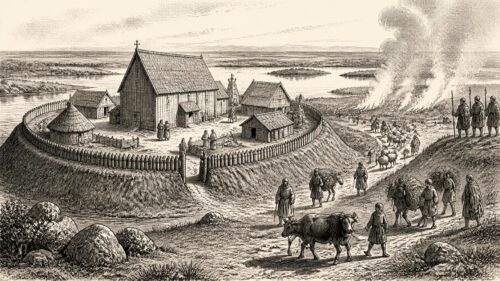
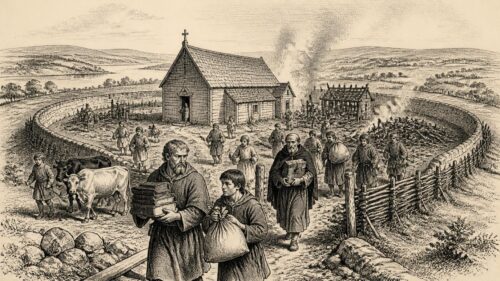
The same year, the community of Armagh was defeated by heathens in a battle at Aignig, where many were captured. The exact location of Aignig is not securely established, but the entry is important for what it says about the character of the attack. Armagh was not merely a church of clergy and manuscripts. It was an organised community with lay dependants, resources and men capable of meeting an armed force. Its defeat and mass capture expose the vulnerability of even the island’s most prestigious Patrician centre when raiders could choose their ground and withdraw by sea.
These attacks should not be imagined as a simple encounter between an otherwise unified “Irish” people and outsiders. Ireland’s kingdoms were already accustomed to raiding, hostage-taking and competition for churches. Scandinavian raiders intensified the danger by connecting violence on land to fast maritime movement, while Irish rulers could exploit, resist or simply be overwhelmed by the changing circumstances. In 830, the victims included both a small regional kingship and a major ecclesiastical community.
Armagh and Royal Pressure
Armagh was also embroiled in internal Irish power politics. Eógan of Mainister, its abbot, was dishonoured by Conchobor son of Donnchad over a legal judgement, according to the annalist’s guarded wording. Eógan’s followers were taken prisoner and his horses seized. The episode was not a Viking raid, but it is no less revealing. Horses were costly and politically meaningful assets, while the detention of a cleric’s following amounted to a public coercion of an ecclesiastical household.
Conchobor, king of Tara and leading figure of Clann Cholmáin among the southern Uí Néill, could not treat Armagh as irrelevant to royal authority. The church’s Patrician associations reached far beyond its immediate territory, and control of its leadership or legal decisions mattered. The annal’s question mark over the nature of the judgement is itself valuable: it warns that the record preserves an event without fully preserving its legal background. We can say that Conchobor pressured an Armagh faction; we cannot responsibly reconstruct the case that prompted him.
Feidlimid and Conchobor
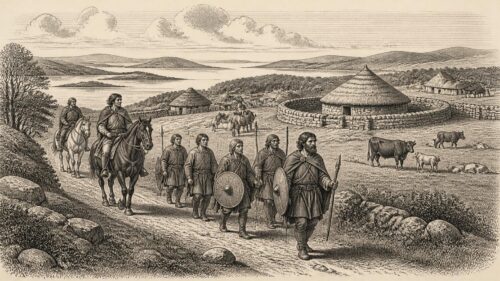
Meanwhile, Feidlimid son of Crimthann, king of Cashel, advanced northward with an army drawn from Munster and Leinster. He came to Fiambur, generally identified with Fennor in Meath, intending to plunder the men of Brega. The scale of the force is not given, but the reference to Munstermen and Leinstermen indicates that Feidlimid could mobilise support beyond his own provincial heartland. His Leinster connections had strategic value: they opened a route towards the Uí Néill-dominated midlands and placed pressure on Conchobor’s allies.
Conchobor answered by plundering Life, the Liffey plain. The reciprocal pattern matters more than any lost tactical detail. It shows two ambitious rulers using devastation as a political language: livestock, food stores, dependants and productive land were exposed to attack, while a raid proclaimed that an opponent could not protect his clients. Feidlimid’s challenge was not a claim to rule a unified modern nation-state. It was a contest over precedence, submission, alliances and the right to exact obedience across the shifting boundary between the northern and southern halves of Ireland.
Churches, Learning and Loss
The annals also mark quieter but consequential changes in institutional life. Muirenn, abbess of Kildare, died; Airmedach, superior of Movilla, drowned; and Cernach son of Dunchú, described as a scribe, learned man and priest of Armagh, died. Such notices show women as heads of major ecclesiastical communities and identify scholarly accomplishment as a distinction worth recording. Leadership did not reside only in kings and warriors.
At roughly this time, between 828 and 833 according to modern dating of the text, Óengus of Tallaght’s Martyrology was being composed or completed. It cannot be pinned securely to 830 alone, but it belongs closely to this moment of Irish religious culture: a learned Old Irish verse calendar joining local saints to a universal Christian commemoration. The deaths of abbots, an abbess, a scribe and a priest in the annals underline the human institutions that sustained such learning.
Thus 830 was shaped by movement: relics crossed the sea, raiders carried captives to ships, armies entered rival territories, and sacred objects were fought over at a national assembly. The year’s record is fragmentary, but its fragments expose a society in which religious communities were centres of wealth and knowledge, rulers depended on visible dominance, and violence could erupt at the very places intended to bind Ireland’s many peoples together.
Primary Sources
- The Annals of Ulster, Year U831
- The Annals of Ulster, Year U830
- The Annals of Ulster, Year U829
- The Annals of Ulster, Year U833
- Chronicon Scotorum, Annals CS827–CS829
- Annals of Inisfallen, Annals AI830–AI839
- Annals of Inisfallen
- Annals of the Four Masters, Volume 1
- Vikings in Irish Chronicles, 794–902: Data
- Vikings in Irish Chronicles, 794–902: Introduction
- Fedelmid (Feidlimid)
- Artrí
- The Martyrology of Oengus the Culdee
- Iona and the Shrine of Columba, c. 800–1200
- The Vikings in Ninth-Century Ireland: Sources and Settlements
- The Chronology and Sources of the Early Irish Annals
- Early Christian Ireland
- Charles-Edwards Final Version
- Geophysical Investigation of the Site of the Former Monastic Settlement, Clonard, County Meath, Ireland
- Fore Abbey
- Early Medieval Archaeology Project
- Vikings in Early Medieval Ireland: Church-Raiding, Politics and Kingship