Clonmacnoise’s July Burning777 CE
Records for 777 illustrate the difficulties of early Irish chronology. The Annals of Inisfallen report Nia son of Cú Allaid killed at Sliab Mis, the death of Connacht king Flaithrí son of Domnall, and the drowning of more than one hundred Connachta at Tír dá Glas. The Annals of Ulster’s associated dossier, conventionally dated 778, describes Donnchad Midi’s victory at Forchalad, Clonmacnoise’s burning on 10 July, illness and cattle disease, and promulgation of Columba’s law. It also notes deaths and conflict. Together the evidence depicts interconnected yet politically fragmented communities vulnerable to warfare, accidents, disease and monastic disaster across Ireland.
Dateline
The year labelled 777 presents an unusually clear warning about the limits of early Irish chronology. The surviving annals preserve several notices under this year, yet their systems of dating do not always align with one another or with modern historical reconstruction. The Annals of Inisfallen explicitly place a battle in Sliab Mis, the death of a Connacht king and a mass drowning at Tír dá Glas in 777. The Annals of Ulster, meanwhile, head their entry U778 as AD 777, but modern scholarship dates its major political episode, the battle of Forchalad, to 778. The events in that Ulster dossier are therefore indispensable context for the late 770s, but should not be presented as securely occurring within the calendar year 777.
Events Recorded at 777
The Inisfallen annalist records a battle at Sliab Mis in which Nia, son of Cú Allaid, was killed. Sliab Mis is the mountainous district of Slieve Mish in what is now County Kerry. The terse notice supplies neither the opponents nor the victor, and it would be wrong to create a larger campaign from it. It does, however, show that conflict reached Munster’s south-western uplands. Such entries are reminders that warfare in early medieval Ireland was not confined to the better-documented struggles of the midlands and eastern provinces. Local kings, their followers and client communities could be drawn into fighting whose causes are now lost.
Inisfallen also records the death of Flaithrí son of Domnall, king of Connachta. His obit marks a change at the head of a major western overkingship, but the annal gives no account of accession, burial or immediate succession. Kingship was personal and kin-based rather than an office attached to a fixed territorial state. A king’s death could alter the balance among rival branches of a dynasty, their church allies and subordinate peoples, even when no battle followed. The annalist’s silence is significant: it preserves the fact of Flaithrí’s death, not a narrative of its consequences.
A third Inisfallen notice is more startling. More than a hundred Connachta, it says, were drowned at Tír dá Glas, the great ecclesiastical settlement at Terryglass near Lough Derg and the Shannon system. The record does not say whether they were travelling by water, fleeing danger, engaged in a military movement or caught by an accident. Nor can the number be independently checked. Yet the entry supports a sober conclusion: rivers and lakes were essential routes through Ireland, but they could be dangerous on a scale that affected whole groups. It also points to the practical importance of Tír dá Glas as a place reached by people from Connacht, across or along the Shannon corridor.
A Disputed Annalistic Dossier
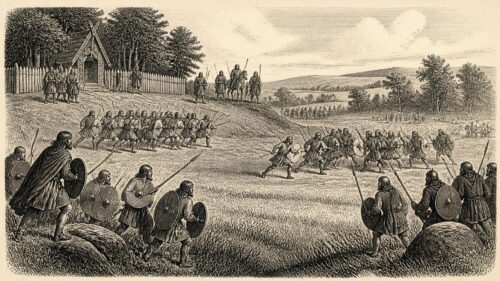
The best-known cluster of notices attached by the Annals of Ulster to its AD 777 entry belongs, in modern accounts, to 778. Its opening item describes a continuing war between Donnchad Midi, the dominant ruler of the southern Uí Néill, and Congalach son of Conaing. It ended at Forchalad, where Congalach and several named allies were killed and Donnchad prevailed. A short verse added to the annal places the battle on a sorrowful Sunday and imagines mothers mourning on the following Monday. This is exceptional emotional colouring for such a compressed source, but it does not allow the modern reader to reconstruct the experience of particular families.
The political stakes were substantial. Donnchad, based in Mide and associated with the kingship of Tara, was consolidating authority across the Uí Néill world. Congalach was king of northern Brega, a region whose ruling kindreds had long been formidable rivals of Clann Cholmáin, Donnchad’s dynasty. Modern scholarship identifies Leinster support for Donnchad at Forchalad. That alliance shows that overlordship was achieved not by a permanent national administration but through negotiated, unstable combinations of kings and military followings. Nevertheless, because the battle is normally dated 778, it should illuminate 777’s immediate political horizon rather than be counted as an event firmly dated to 777 itself.
The Fire of 10 July
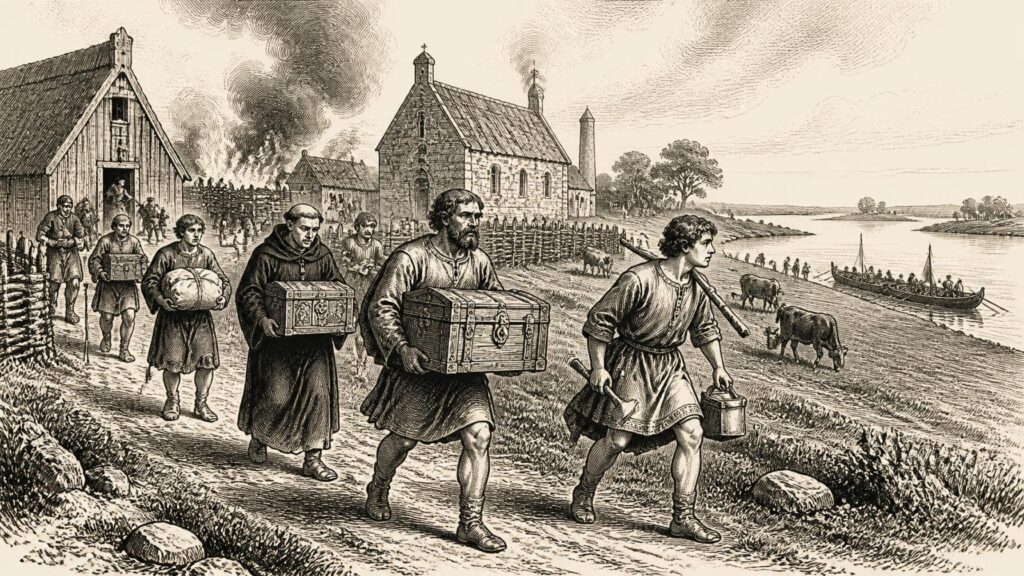
The same Ulster dossier gives a precise day for the burning of Cluain Moccu Nóis, Clonmacnoise: the sixth of the Ides of July, 10 July. The day-date is unusually exact; the calendar year remains tied to the annalistic problem just described. Nothing in the notice identifies an attacker, explains the cause of the blaze or specifies which buildings were destroyed. It is tempting to assume a raid, but fire could arise in many ways in a densely occupied settlement where timber structures, workshops, kitchens, stores and religious buildings stood close together. The responsible conclusion is simply that Clonmacnoise suffered a damaging fire recorded on 10 July in the annal’s disputed 777/778 sequence.
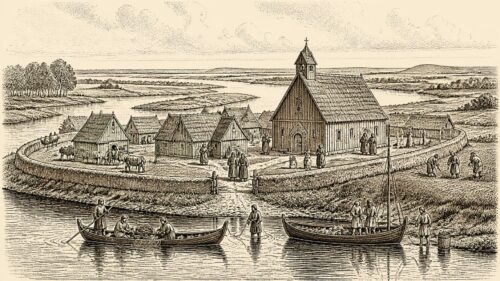
That was no minor location. Founded beside the Shannon in the sixth century, Clonmacnoise stood at a strategic meeting point of waterways and provincial interests. It was a religious community, a place of learning and craftsmanship, and a recipient of royal patronage. A fire there would have endangered housing, food supplies, books, tools, ecclesiastical objects and the livelihood of lay dependants as well as clerics. The surviving record cannot measure the loss or demonstrate how quickly rebuilding occurred. Its very inclusion, however, indicates that the destruction of this major monastery mattered far beyond its immediate enclosure.
Illness, Cattle and Household Security
The Ulster entry continues with “bloody flux” and a great murrain of cows. These reports too belong to the same chronologically uncertain dossier, but they convey the vulnerabilities of the period sharply. Bloody flux was a grave intestinal illness; “murrain” is an annalistic term for a destructive cattle disease rather than a modern veterinary diagnosis. No source permits an estimate of mortality, duration or geographical range. It would be unsafe to claim a nationwide epidemic.
Even so, cattle sickness was an economic and social emergency in eighth-century Ireland. Cattle were central to status, food production and exchange: milk and dairy products sustained households, while herds represented movable wealth and were fundamental to tribute, compensation and political power. Research also shows growing cereal production and investment in mills and grain-drying from the eighth century, but this did not make livestock losses trivial. For farmers and rulers alike, a serious outbreak could reduce food security, diminish rents and tribute, and make communities less able to recover from warfare or fire.
Columba’s Law
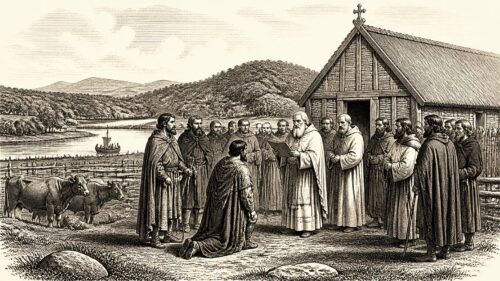
The same notice says that the law of Colum Cille was promulgated by Donnchad and Bresal, abbot of Iona. Its contents are not known. It must not be equated automatically with a surviving law code, nor can its precise obligations be recovered from the brief record. What can be said is that the act joined a powerful Irish overking with the head of Iona’s Columban community. Earlier annals record other occasions on which Columba’s law was enforced, suggesting a recognised religious and political institution whose authority could be renewed publicly.
Iona was far from Ireland only in modern geographical imagination. Founded by Columba from Ireland in 563, it was linked by sea routes, kinship and religious networks to communities across Ireland and western Scotland. Its eighth-century artistic, scribal and ecclesiastical standing gave a Columban proclamation significance in both regions. The law’s promulgation thus illustrates how kingship and church authority could reinforce one another, while the uncertainty surrounding its provisions demonstrates the limits of the evidence.
Deaths and Regional Change
Ulster’s disputed dossier also records the deaths of several rulers and church figures: Etarscéle of Uí Cheinnselaig; Niall Frossach in religious retirement on Iona; Niall of southern Brega; Tuathal of Cuala; Flannabra of Uí Máil; and Áed Find of Dál Riata. It names Síth Maith, abbess of Cluain Bairenn, Fínán of Clones and Constans of Lough Erne among the religious dead, and records Artgal’s victory in a slaughter of Uí Maine at Mag Dairben. Modern chronology places Niall Frossach’s death in 778, reinforcing the need not to transfer this whole sequence uncritically into 777.
What can be securely said of 777 is therefore modest but meaningful. Inisfallen’s entries show violence in Sliab Mis, royal mortality in Connacht and a disastrous drowning at Tír dá Glas. The neighbouring Ulster dossier, though probably a year later in modern dating, reveals the political, ecclesiastical and environmental pressures surrounding those events: contested power in Brega, the vulnerability of monastic centres, disease among people and cattle, and the continuing force of Columban institutions. Ireland was not a single kingdom moving to one rhythm. It was a connected island of local polities, monasteries, river routes and pastoral communities, in which a death, a battle, a fire or a failed crossing could have consequences far beyond the place where it occurred.
Primary Sources
- The Annals of Ulster, U778
- The Annals of Ulster: CELT Project Bibliographic Record
- Annals of Inisfallen
- Annals of Inisfallen: CELT Project Bibliographic Record
- Annals of the Four Masters, M777
- Annals of the Four Masters, Volume 1
- Chronicon Scotorum
- Donnchad Midi
- Niall Frossach
- Ciarán
- The Dating of the Irish Annals
- Agriculture, Settlement and Society in Early Medieval Ireland
- Changing Human-Cattle Relationships in Ireland: A 6000-Year Isotopic Perspective
- Early Medieval Ireland: Investigating Social, Economic and Settlement Change, AD 400–1100
- Early Medieval Ireland: Archaeological Excavations, 1930–2009
- Clonmacnoise Monastic Site
- Clonmacnoise Monastic Site Highlights
- Irish School of Illumination, c. 650–1100
- Iona Abbey and Nunnery: History and Stories
- St Mary’s Abbey, Iona, Monastic Settlement