Archived: 26 September 2026
Abstract
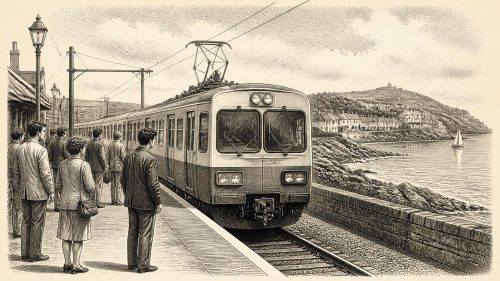
In 1984, recession, unemployment and industrial closures, including Ford Cork and Irish Shipping, shaped Irish life, while DART and the East-Link bridge improved Dublin transport. The New Ireland Forum developed a shared nationalist approach to Northern Ireland, although Thatcher rejected its options and violence continued, notably the Brighton bombing and supergrass case collapses. Reagan’s visit prompted both celebration and protest. Ann Lovett’s death in Granard and the Kerry babies investigation exposed harsh attitudes and institutional failings affecting unmarried pregnant women. Dunnes Stores workers began an anti-apartheid strike, while the GAA centenary provided a significant cultural celebration in Thurles that year.
Read Article

Archived: 8 October 2026
Abstract
In 1959 Éamon de Valera left the Taoiseachship to become Ireland’s third president after defeating Seán Mac Eoin, while Seán Lemass succeeded him without an election. A simultaneous referendum to replace proportional representation was rejected. Lemass inherited emigration, unemployment and rural decline, but advanced economic expansion, industrial exports, infrastructure and skills training, including the Apprenticeship Act. Trade unions reunited as the all-island Irish Congress of Trade Unions. The IRA Border Campaign continued amid weak republican electoral support. Cultural life featured John B. Keane’s Sive and George Morrison’s Mise Éire. The year combined revolutionary memory and partition with tentative social modernisation.
Read Article
Archived: 9 October 2026
Abstract
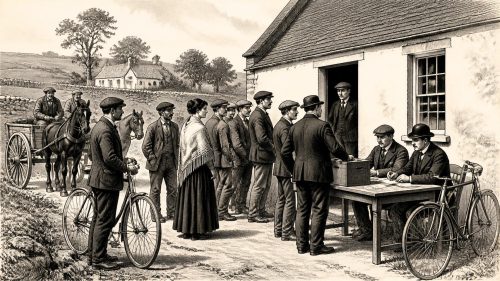
In 1923, the Irish Free State moved from civil war towards constitutional government, though division and repression persisted. After Liam Lynch’s death, Frank Aiken suspended IRA operations and ordered Volunteers to conceal arms, ending organised anti-Treaty resistance without reconciliation. Internment continued, and an eight-thousand-strong hunger strike caused two deaths. Cumann na nGaedheal won the August election, while abstentionist Sinn Féin left parliament incomplete. The state expanded administration through Garda, land, electoral and censorship legislation, and customs barriers made partition economically tangible. League of Nations admission and Yeats’s Nobel Prize brought international recognition, while bereavement, imprisonment and political bitterness endured deeply.
Read Article
Archived: 10 October 2026
Abstract
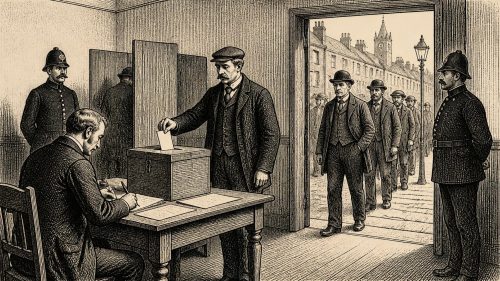
In 1872, the Ballot Act introduced secret voting for Irish parliamentary and municipal elections, first tested at Londonderry City, where Conservative Charles Lewis won a four-cornered by-election. Franchise restrictions and local religious, social and political influence nevertheless persisted. Isaac Butt’s Home Rule movement expanded through contested elections, linking constitutional reform with tenant grievances. Repeal of the Party Processions Act enabled nationalist demonstrations: Derry’s passed peacefully, but Belfast’s Hannahstown procession preceded severe sectarian rioting, deaths and displacement. Religious education, Church affairs, agricultural change, urban institutions and literary publication reflected pressures. Lord Mayo’s assassination in India highlighted Ireland’s connections to imperial government.
Read Article
Archived: 10 October 2026
Abstract
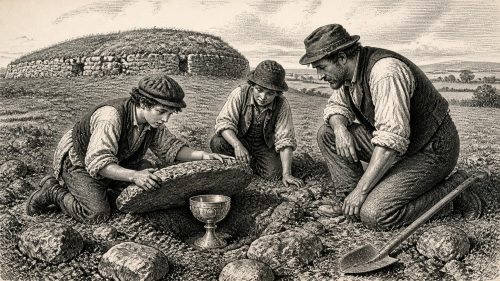
In 1868, Ireland faced a constitutional crisis over the Anglican Church of Ireland, whose privileged status conflicted with the Catholic majority and Presbyterian presence. Gladstone’s resolutions, Commons victories and Liberal election gains made disestablishment unavoidable, although legislation followed in 1869. Franchise reform enlarged, but did not democratise, the male electorate, while Gladstone’s ministry symbolised reform through Catholic lord chancellor Thomas O’Hagan. Fenian prosecutions sustained security fears. National schools expanded amid attendance, and industrial schools extended state control. Emigration, pastoral change and poverty persisted. St Colman’s Cathedral began at Queenstown, Valentia Observatory opened, and the Ardagh Chalice discovered during potato digging.
Read Article

Archived: 10 October 2026
Abstract
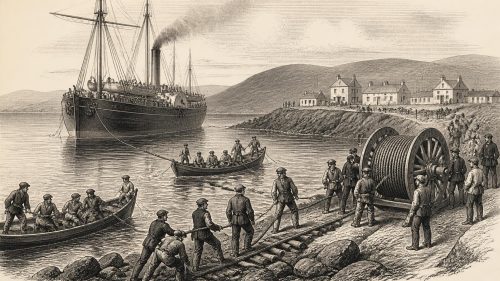
In 1866, Ireland experienced political repression alongside religious, educational and technological change. Parliament suspended habeas corpus amid fears of Fenian conspiracy, enabling 752 arrests and weakening republican organisation before the failed 1867 rising. Fenian raids into Canada highlighted nationalism’s Atlantic dimension, while Paul Cullen’s elevation as Ireland’s first cardinal symbolised Catholic institutional confidence, also visible in Belfast’s St Peter’s Church. Anne Jellicoe founded Alexandra College, extending advanced educational opportunities for women. Railway expansion to Westport and changing livestock agriculture altered rural life. Most dramatically, the successful Valentia–Newfoundland telegraph cable connected Ireland to North America, making Kerry a global communications hub.
Read Article
Archived: 10 October 2026
Abstract
In 1858, Ireland experienced political, technological and social change. James Stephens founded the secret Irish Republican Brotherhood in Dublin, supported by Irish-American networks and committed to republican revolution. Valentia Island became the Irish terminus of the first transatlantic telegraph cable, briefly linking Britain and North America before failure. Post-Famine society continued to be reshaped by emigration, altered farming, poverty administration and Griffith’s Valuation. Infrastructure included Ballinacourty lighthouse, while Edward James Harland acquired Belfast’s Queen’s Island shipyard. Dundalk opened a free public library. These developments revealed uneven modernisation, connecting Ireland more closely with Atlantic migration, imperial commerce, industry and revolutionary politics.
Read Article
Archived: 11 October 2026
Abstract
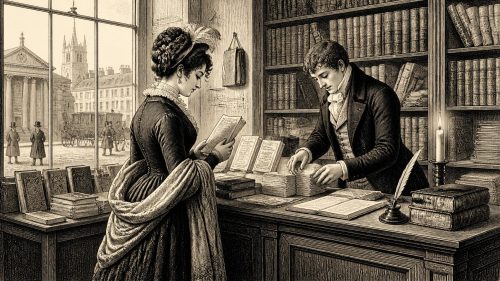
In 1806, five years after the Union, Ireland was governed increasingly through Westminster, while Catholic emancipation remained unrealised despite Lord Grenville’s sympathetic ministry. The United Kingdom election returned Irish MPs through restricted, patronage-driven constituencies, and wartime administration integrated Irish finance, trade and defence into imperial structures. Legislation regulated butter exports, excise, and charitable hospitals, illustrating expanding state oversight without comprehensive poor relief. Coastal defences reflected continuing fear of French invasion. Dublin retained elite social importance, marked by Arthur Wellesley’s marriage. Literary publishing proved significant: Sydney Owenson’s The Wild Irish Girl articulated Gaelic cultural survival, alongside satire and Ulster vernacular verse.
Read Article
Archived: 12 October 2026
Abstract
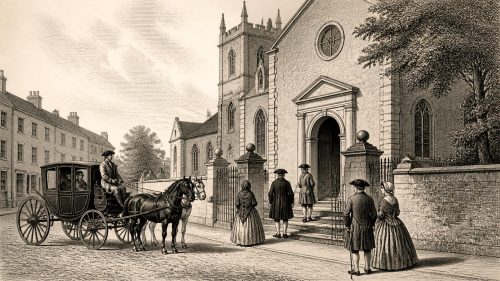
In 1787, Ireland’s Dublin parliament responded to agrarian unrest by passing the general Riot Act, amid Rightboy disturbances and attacks on property, tolls and officials. It also promoted manufactures, linen, trade and maritime regulation, while fiscal measures extended state oversight. Thomas Orde’s proposed nationwide school system, including free parish education, failed amid confessional distrust. John Butler, Catholic bishop of Cork and heir to Dunboyne, conformed to the Church of Ireland, an exceptional conversion reflecting Protestant privilege. Lord Lieutenant Rutland died in October, disrupting Castle politics. Cultural life saw Dublin theatre reorganisation and Prince William Henry’s visit to Curraghmore in December.
Read Article

Archived: 12 October 2026
Abstract
In 1781, wartime pressures, commercial controls and constitutional unrest shaped Ireland. James Gandon began Dublin's Custom House, a decade-long project intended to strengthen revenue collection and redirect trade eastwards along the Liffey. Embargoes, quarantine measures and maritime crime exposed ports to imperial conflict. The Protestant-led Volunteers, initially raised for defence, increasingly demanded commercial freedom and Irish legislative autonomy, while parliament acknowledged influence without granting settlement. An Armagh meeting prepared the 1782 Dungannon convention. Meanwhile, Granard founded its harp festival, supporting endangered traditional musicians. Measures associated with the parliamentary session did not establish the Bank of Ireland, which opened in 1783.
Read Article
Archived: 19 October 2026
Abstract
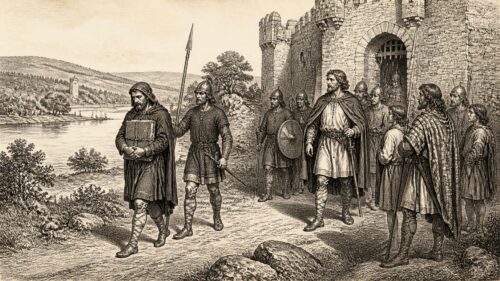
In 1470, Ireland remained politically fragmented, with the English lordship largely confined to the Pale while Gaelic and Gaelicised dynasties contested power through warfare, alliances, tribute and inauguration. Enrí Ó Néill campaigned in Clandeboye and faced internal rivalry; plague struck Fermanagh amid Maguire succession disputes. Aodh Ruadh Ó Domhnaill captured Sligo Castle, gained Lower Connacht’s submission and recovered Leabhar na hUidre and other dynastic treasures, though his Breifne intervention failed. Thomas FitzGerald became chief governor as parliament addressed local Pale concerns. John Ó Conchobair Kerry founded the Franciscan house at Lislaughtin there, illustrating lordly patronage alongside conflict and cultural prestige.
Read Article
Archived: 20 October 2026
Abstract
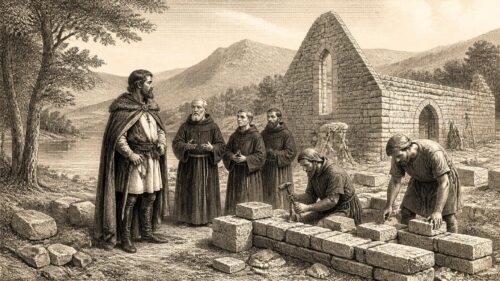
Records for 1448 depict Ireland as a patchwork of lordships, religious houses and learned networks rather than a single national story. A severe plague in Meath caused deaths among laymen, a ruling family and friars. Killings in Leinster and Connacht, alongside changes in regional lordships, reveal persistent rivalry within and between political communities. Bishops, abbots and aristocrats died, while a couple drowned on an Ulster waterway, underlining travel’s hazards. Donal Mac Cárthaigh Mór supported the Observant Franciscan foundation at Muckross. The deaths of poets Tadhg Óg Ó hUiginn and Diarmait Ó Dálaigh highlighted institutions of education, hospitality, patronage and commemoration.
Read Article
Archived: 21 October 2026
Abstract
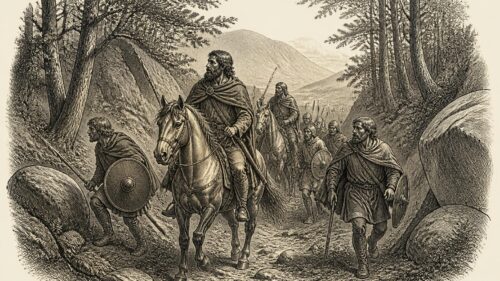
In 1391, Irish annals recorded fragmented but revealing struggles for power. Tigernán Mór Ó Ruairc escaped an ambush at a Breifne pass while travelling to meet John Ó Raighillaigh, defeating attackers despite conflicting accounts of their numbers. Diarmaid Mac Eochagáin, lord of Cenél Fiachach, died in January. Domhnall Óg Mac Carthaigh Mór, king of Desmond, died and was succeeded by his son Tadhg. In Ulster, Mac Gilla-Muire of Uí nDerca-Céin and Ó hAnluain of Oirthir were killed by kinsmen. Poet-scholar Tadhg Ó hUiginn and Bébhinn Ó Maelconaire died. English statutes applied in the Dublin lordship, but Gaelic authority remained decisive.
Read Article

Archived: 24 October 2026
Abstract
In 1303, Ireland contributed significantly to Edward I's Scottish campaign under Richard de Burgh, earl of Ulster, who led an estimated 3,000 Gaelic and Anglo-Irish troops. Their service demonstrated cross-channel aristocratic connections and required continued Irish administration, including replacement of absent officials and financial management. In Tír Conaill, Áed Ó Domnaill killed his brother Toirrdelbach after prolonged conflict, becoming lord amid widespread devastation. Church leadership also changed: Archbishop Nicholas Mac Maoil Íosa of Armagh and Bishop Máel Sechlainn Mac Briain of Elphin died, prompting succession processes. Despite uncertain annalistic dating, records portray Ireland as politically divided yet engaged with Britain.
Read Article

Archived: 26 September 2026
Abstract
In 1158, Ireland remained politically fragmented, though Muirchertach Mac Lochlainn of Cenél nEógain dominated the high-kingship contest against Connacht’s Ruaidrí Ua Conchobair. Raids, rebellions and struggles in Tethbae, Meath, Tír Conaill and Munster exposed limits of overlordship, while annalistic dating leaves some campaigns uncertain. The Synod of Brí Mic Taidg, led by Armagh’s archbishop and a papal legate, promoted church reform and elevated Derry’s Flaithbertach Ua Brolcháin as arch-abbot of Columban churches. Yet travelling bishops were attacked. Munster saw dynastic violence, whereas Amhlaoibh Ó Donnchadha completed Aghadoe’s church before his death. Cattle-based wealth, rural life, towns, and destructive flooding underpinned.
Read Article
Archived: 28 October 2026
Abstract
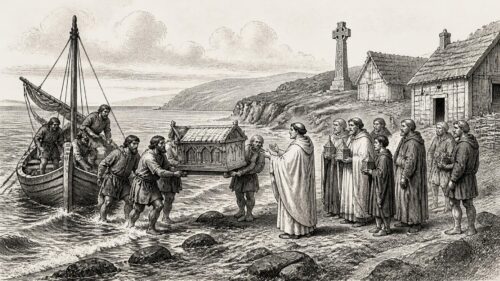
In 878, whose annalistic dating requires caution, Ireland experienced local political instability, disrupted public ceremony, unusual weather reports and significant religious refuge. Gairbíth of Conaille and Cumuscach of Uí Chremthainn were killed in northern conflicts, while Congal of Ciarraige Luachra died in Munster. Tailtiu’s major fair was cancelled without stated justification, signalling a failure of collective order and lost opportunities for trade and negotiation. Annals recorded a great wind, lightning, supposed blood-rain, and lunar and solar eclipses in October. Most notably, Colum Cille’s shrine and relics reached Ireland, removed from danger posed by Scandinavian foreigners, affirming Columban resilience and continuity.
Read Article
Archived: 30 October 2026
Abstract
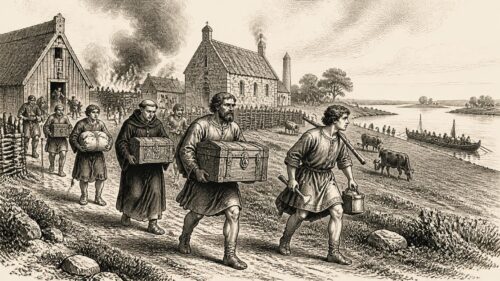
Records for 777 illustrate the difficulties of early Irish chronology. The Annals of Inisfallen report Nia son of Cú Allaid killed at Sliab Mis, the death of Connacht king Flaithrí son of Domnall, and the drowning of more than one hundred Connachta at Tír dá Glas. The Annals of Ulster's associated dossier, conventionally dated 778, describes Donnchad Midi's victory at Forchalad, Clonmacnoise's burning on 10 July, illness and cattle disease, and promulgation of Columba's law. It also notes deaths and conflict. Together the evidence depicts interconnected yet politically fragmented communities vulnerable to warfare, accidents, disease and monastic disaster across Ireland.
Read Article

Archived: 8 October 2026
Abstract
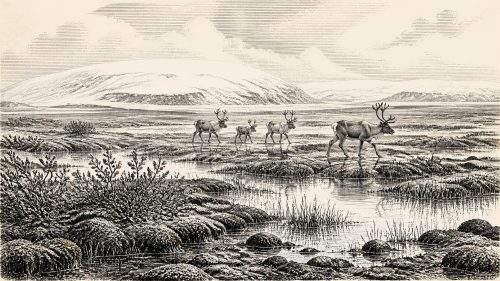
Ireland around 30,117 BCE lay within the climatically unstable Late Pleistocene, as the British–Irish Ice Sheet expanded unevenly and low sea levels reshaped coasts and possible dispersal routes. Derryvree, County Fermanagh, preserves freshwater organic deposits between glacial tills, indicating a treeless, wet tundra-like mosaic during a local ice-free interval. Castlepook Cave, County Cork, contains a time-spanning fauna including reindeer, mammoth, giant deer, predators and cold-adapted small mammals, demonstrating ecological richness but not a single contemporary assemblage. A cut-marked reindeer bone may suggest human carcass processing, yet no secure evidence proves settlement. Regional records reveal ice, water, vegetation and animal movements.
Read Article
Archived: 8 October 2026
Abstract
At approximately 30,119 BCE, Ireland lay within the climatically unstable later Marine Isotope Stage 3, beyond precise calendar dating or historical record. At Derryvree, County Fermanagh, organic sediments between two glacial tills document an ice-free local landscape of shallow pools, mosses, sedges, herbs and tundra-like vegetation. They demonstrate regional climatic fluctuation, not an ice-free island. Lower seas and shifting ice altered coasts, while Crag Cave records intermittent conditions. Faunal remains at Castlepook Cave indicate open-country mammals. A marked reindeer bone suggests tentative Upper Palaeolithic human activity, but no secure settlement evidence exists. Environmental change and renewed glaciation define this period.
Read Article

Archived: 7 October 2026
Abstract
Around 30,160 BCE, Ireland experienced unstable Late Pleistocene conditions during Marine Isotope Stage 3, rather than a datable historical year. Derryvree, County Fermanagh, records a cold freshwater interval between glacial advances, with tundra vegetation, wetlands and sparse treeless terrain. Crag Cave speleothems indicate intermittent milder phases. Castlepook Cave, County Cork, preserves fauna including mammoth, reindeer, giant deer and carnivores, though its disturbed deposits limit precision. A cut-marked reindeer femur may suggest an early human visit, but cannot prove permanent settlement. Changing ice, sea levels and landscapes allowed occasional animal movement, while evidence remains fragmentary and regionally specific in character overall.
Read Article

Archived: 6 October 2026
Abstract
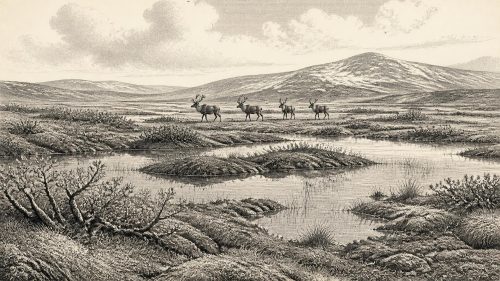
About 30,182 BCE, Ireland lay within the unstable, cold Late Pleistocene. At Derryvree near Maguiresbridge, County Fermanagh, freshwater sediments between till layers document an ice-free interval, broadly dated to 34,950–29,750 BCE. Fossils reveal treeless periglacial wetlands of grasses, sedges, dwarf willow, aquatic plants and insects. Conditions varied regionally as ice expanded, sea levels fell, and coastlines shifted. Castlepook Cave preserves cold-stage fauna, including mammoth, reindeer and hyaena. A possibly tool-marked reindeer bone may indicate brief human presence, but no secure settlement evidence exists. Glaciation destroyed much evidence, leaving a fragmented record of dynamic environments, mobile animals and uncertain human activity.
Read Article
Archived: 6 October 2026
Abstract
Around 30,203 BCE, a modern chronological label within a broad calibrated range, Ireland lay in the climatically unstable Late Pleistocene. At Derryvree, County Fermanagh, organic freshwater sediments between glacial tills preserve evidence of a treeless, periglacial wetland with sedges, mosses, grasses and aquatic plants, later overridden by ice. Crag Cave indicates episodic liquid-water conditions in Kerry. Castlepook Cave preserves cold-stage fauna, including mammoth, reindeer and predators, plus a reindeer bone possibly cut by humans, though it proves neither settlement nor sustained occupation. Dynamic ice, sea and climate shaped access and habitats as Ireland moved towards the later Last Glacial Maximum.
Read Article
Archived: 6 October 2026
Abstract
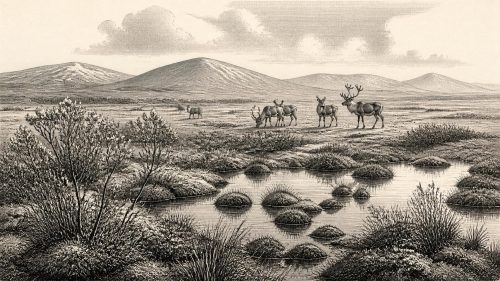
Around 30,214 BCE, Ireland lay within the fluctuating cold of Marine Isotope Stage 3, preceding Last Glacial Maximum ice cover. Derryvree, County Fermanagh, preserves freshwater organic sediments between glacial tills, indicating treeless, open wetland with mosses, sedges and aquatic plants during an ice-free interval. Greenagho and Crag Cave likewise indicate episodic environmental improvement. Castlepook Cave demonstrates a diverse MIS 3 fauna, including mammoth, reindeer, predators and cold-adapted mammals, although dates and associations remain uncertain. Lower sea levels altered coasts and possible routes. No secure evidence proves settlement; a modified reindeer bone only tentatively suggests human activity. Later ice buried evidence.
Read Article

Archived: 6 October 2026
Abstract
Around 30,216 BCE, a modern calendar label rather than a recoverable date, Ireland experienced unstable MIS 3 conditions before the Last Glacial Maximum. At Derryvree, County Fermanagh, freshwater silts between two glacial tills, radiocarbon dated broadly to 36,900–31,700 years ago, preserve tundra wetland plants and small-animal evidence. They show a locally ice-free interval, not island-wide conditions. Cave fauna from Castlepook, County Cork, indicates varied cold-country mammals, although deposits span long periods. A possibly tool-marked reindeer bone suggests early human visitation, but no secure settlement evidence exists. Advancing ice, ecological patchiness and subsequent erosion left only exceptional, fragmentary records for Ireland.
Read Article

Archived: 5 October 2026
Abstract
Around 30,229 BCE, Ireland lay within the unstable Late Pleistocene, not a documented historical year. Derryvree, County Fermanagh, preserves freshwater sediments indicating an ice-free tundra wetland during a broadly comparable interval, with mosses, sedges, herbs and sparse woody plants. Crag Cave records climatic fluctuations, while Castlepook Cave’s mixed faunal deposits show mammoth, reindeer, giant deer, predators and other cold-adapted animals. A possibly stone-tool-marked reindeer bone suggests occasional Upper Palaeolithic human activity, but permanent settlement remains unproven. Lower sea levels altered access routes. Later glaciation reshaped landscapes and limited surviving evidence, leaving environmental traces rather than records of communities or events.
Read Article
Archived: 5 October 2026
Abstract
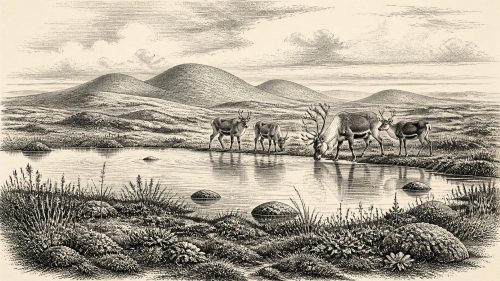
At 30,234 BCE, Ireland cannot be described through events or precise calendar dating. Derryvree, County Fermanagh, preserves organic freshwater sediments between glacial tills, dated broadly to Marine Isotope Stage 3 and demonstrating a temporary ice-free wetland. Its plants, mosses, insects and aquatic species indicate treeless tundra, pools and saturated ground amid severe, fluctuating conditions. Cave faunas, including mammoth, reindeer and hyaena, show connections with wider cold-stage ecosystems, but accumulated over long periods. A possibly butchered reindeer bone suggests earlier human visits, yet proves neither settlement nor presence in this year. Ireland’s record is changing ice, water, habitats and uncertainty alone.
Read Article

Archived: 5 October 2026
Abstract
Around 30,238 BCE, Ireland has no annual human history, only fragmentary Late Pleistocene evidence. At Derryvree, County Fermanagh, freshwater sediments between two glacial tills show that ice retreated or margins shifted long enough for wetlands, vegetation and animals to flourish before renewed glaciation. Radiocarbon dating places this interval broadly around the nominal date, but cannot identify a specific year. Fossils indicate open tundra, saturated ground, pools and harsh seasonal conditions. Cave faunas show reindeer, mammoth and other cold-adapted animals. A modified Castlepook bone suggests fleeting visits, not settlement. Ireland remained environmentally dynamic with changing ice and habitats across the island.
Read Article
Archived: 5 October 2026
Abstract
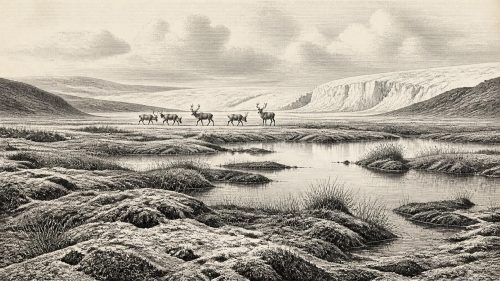
Thirty thousand years BCE is not recoverable as a precise Irish historical year, but falls within a broadly dated, unstable Marine Isotope Stage 3 interval. At Derryvree, County Fermanagh, organic freshwater sediments between glacial tills, including BIRM-166, record a treeless tundra wetland during an ice-free phase. Plant and insect remains indicate pools, sedges, mosses and severe periglacial conditions. Speleothems at Crag Cave show episodic milder conditions. Castlepook fossils demonstrate intermittent access by cold-adapted mammals, but cannot provide a contemporary national fauna. No secure evidence establishes human settlement, culture, politics or economy. Later glaciation obscured landscapes, leaving environmental archives not events.
Read Article
Archived: 5 October 2026
Abstract
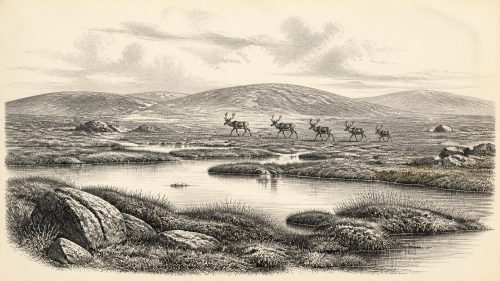
Although 30,245 BCE cannot denote a recoverable Irish calendar-year event, evidence places it within a volatile Late Pleistocene interval. Derryvree, County Fermanagh, preserves freshwater sediments between glacial tills, dated broadly to 34,950–29,750 BCE, indicating cold, treeless tundra-like conditions during an ice-free phase. Castlepook Cave, County Cork, yielded disturbed remains of reindeer, mammoth, giant deer, bears, foxes, wolves, lemmings and hyaenas, documenting changing fauna before the Last Glacial Maximum. A cut-marked reindeer femur may indicate human carcass processing around 31,000 BCE, but remains unconfirmed. No evidence supports settled communities, political events, farming, or a continuous land bridge at this particular time.
Read Article
Archived: 5 October 2026
Abstract
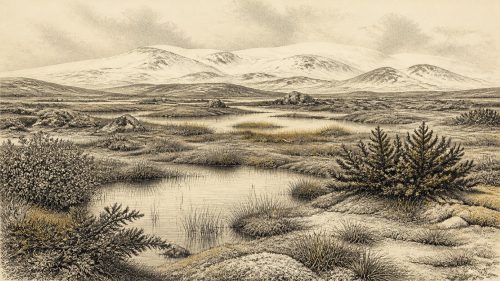
About 30,253 BCE, Ireland lay within a fluctuating Late Pleistocene landscape rather than a dateable historical year. At Derryvree, County Fermanagh, freshwater silts between glacial tills record a locally ice-free cold wetland, dated broadly to 36,900–31,700 cal BP. Plant, pollen and insect remains indicate open tundra-like ground with mosses, sedges, juniper, pools and sparse shrubs. Crag Cave demonstrates episodic groundwater infiltration, while Castlepook fauna attest to cold-adapted mammals but mixed deposits complicate chronology. No secure evidence confirms human settlement. A possibly cut-marked reindeer bone suggests tentative Upper Palaeolithic visits. These fragmentary records reveal regional climatic instability, approaching glaciation, and uncertainty.
Read Article


