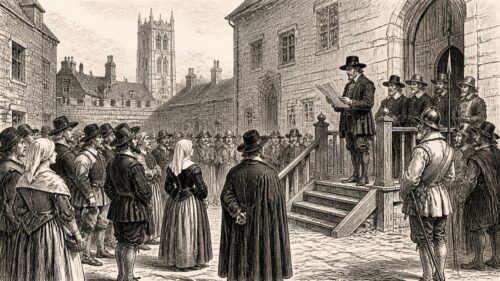
The Tholsel Election1713 CE
In 1713, Ireland marked the Peace of Utrecht with proclamations and thanksgiving, while remaining politically unstable. Queen Anne’s administration dissolved parliament, held elections and faced violent disorder during Dublin’s disputed Tholsel contest between Whigs and Tories. The new parliament, constrained by Poynings’ Law, passed only temporary supply legislation before prorogation. Authorities continued to fear Jacobite recruitment despite France’s withdrawal of support for the Pretender. Rural tensions appeared in Connacht through cattle houghing linked to land-use conflicts. The Church of Ireland reinforced political authority, Jonathan Swift became dean of St Patrick’s, and government addressed quarantine, mail security and post-war military retrenchment.
Dateline
In 1713 CE, Ireland experienced a year in which imperial peace, electoral fury and rural unease converged. Queen Anne’s Irish administration proclaimed the Peace of Utrecht, held public thanksgiving for the end of a long European war, dissolved an old parliament and summoned a new one. Yet the most vivid event in Dublin was not peaceful: a disputed city election at the Tholsel descended into violence. The year makes clear that Ireland’s apparent post-war stability rested on a narrowly based Protestant political order, sharp party rivalry and an administration alert to threats in town and countryside.
A Parliament Dissolved
The old Irish parliament, elected in 1703 and last assembled in 1711, had been repeatedly prorogued before its final dissolution on 6 May 1713. This was a consequential constitutional act, rather than a routine clearing of the calendar. Ireland retained its own parliament at Dublin, with Lords and Commons, but it operated within the restrictions of Poynings’ Law: proposed legislation had to pass through the Irish and English privy councils before it could be introduced in Dublin. The crown’s Irish executive therefore had considerable control over when parliament met and what legislative business it received.
The election that followed took place in a kingdom whose formal political nation was deliberately small. Roman Catholics, who formed the great majority of the population, were excluded from parliamentary life by the settlement and penal legislation that followed the Williamite war. Political contest instead occurred within the Protestant establishment: between Whigs, broadly identified with the Hanoverian succession and the political legacy of the Revolution of 1688, and Tories, who defended the Church of Ireland and enjoyed substantial support among clergy, landed interests and many corporation electors. These labels were neither simple social blocs nor fixed programmes, but in 1713 they mattered intensely.
Utrecht Proclaimed in Ireland
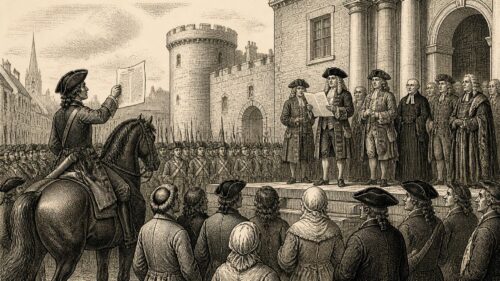
International diplomacy reached Ireland directly in May. The treaty between Britain and France was concluded at Utrecht on 11 April 1713, ending Britain’s participation in the War of the Spanish Succession. On 15 May the Irish government proclaimed the peace. A second proclamation ordered public thanksgiving throughout Ireland on 16 June. Such ceremonies gave the crown’s message a local form: parish clergy, municipal authorities, soldiers and civilians were expected to mark a peace negotiated far beyond the island but proclaimed in its towns and parishes.
For Ireland, the immediate significance of Utrecht was less a single dramatic local change than the end of a wartime framework. The conflict had tied Ireland to British military finance, Atlantic and European commerce, and fears of French-backed Jacobite intervention. The treaty’s terms were also politically charged because France undertook not to support the Jacobite claimant, James Francis Edward Stuart. That did not remove Irish official suspicion of Jacobitism. On 2 February, before the peace proclamation, the Irish authorities had already issued a proclamation against people recruiting Queen Anne’s subjects for the Pretender’s service. Peace therefore brought relief from war without ending the political anxieties created by disputed dynastic succession.
There were practical consequences too. An order of 16 January placed officers on half-pay, an early indication of post-war retrenchment. For officers and their families, the transition from active service to reduced income could be immediate and personal. For the government, retaining trained men at half-pay was a means of reducing expense without wholly discarding military capacity. Ireland remained heavily shaped by the army and by the memory of the seventeenth-century wars, even in a year officially devoted to thanksgiving.
The Tholsel Contest
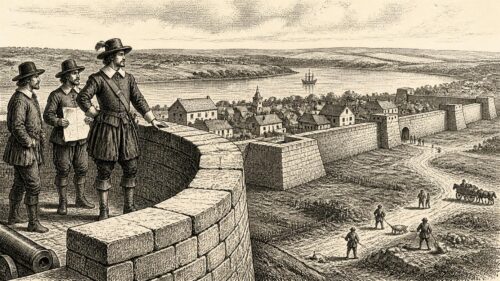
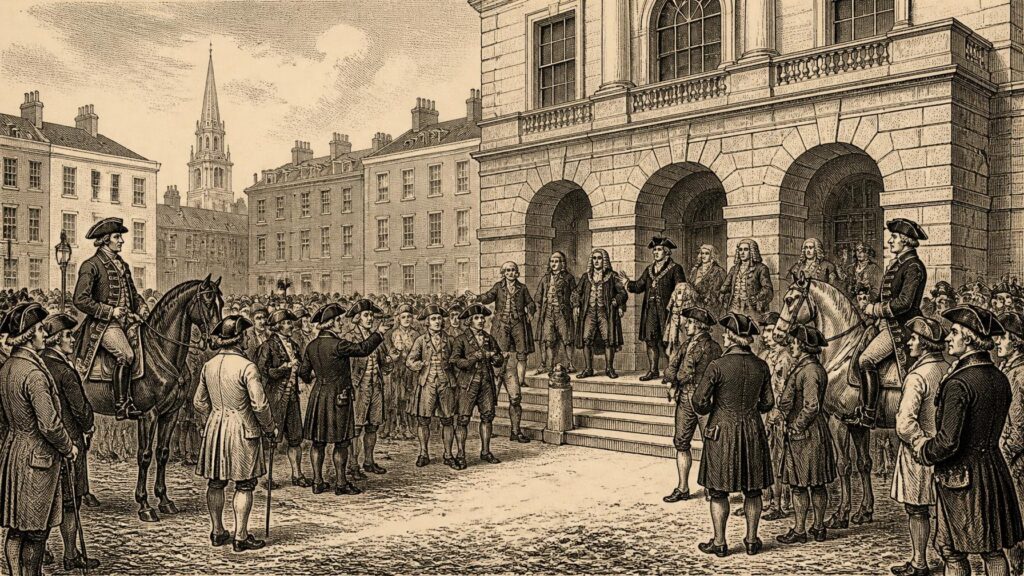
The Irish general election of 1713 brought party conflict into Dublin’s streets. The capital returned two members for Dublin City, and the contest was closely fought between Whig and Tory interests. Voting was conducted at the Tholsel, the civic building near the centre of the city, rather than at the Blue Coat School, the more customary venue. The decision itself became contentious. The Tholsel was regarded as advantageous to the Whigs, while Tory supporters believed that access and procedure favoured their opponents.
During polling in November, disorder erupted. Tory supporters forced their way into the building, wrecking the electoral platform and turning a contest over representation into a physical confrontation. Later accounts conventionally call this the Dublin election riot. The surviving evidence does not justify treating it as a popular democratic rising: parliamentary elections were governed by restrictive franchises, and the combatants were organised political interests and their adherents. Even so, the riot shows that elections could mobilise crowds, anger and intimidation beyond the limited body legally entitled to vote.
The violence also exposed deeper fears. Whigs associated their opponents with Jacobite sympathy; Tories argued that Whigs manipulated office, corporations and electoral machinery. Catholic Jacobites could find common cause with Tory candidates in opposition to Whig dominance, although Catholics could not themselves participate on equal political terms. The danger, from the government’s perspective, was that partisan organisation might open into wider religious and dynastic unrest. Dublin was the seat of administration, the largest city and the main political stage; a riot there carried symbolic weight far beyond the damaged polling place.
A Short, Difficult Session
The new parliament was summoned to meet in Dublin on 20 November, but a proclamation of 19 November postponed the meeting to 25 November. Charles Talbot, duke of Shrewsbury, arrived as lord lieutenant in the autumn to preside over affairs that contemporary observers described as highly agitated. The elections had given the Tories an advantage in the Commons, while the wider ministry in London had its own calculations about Irish office-holders, church politics and the reliability of local allies.
The session demonstrated both the importance and the limitations of the Irish parliament. Under the Poynings’ Law procedure, the government’s causes and considerations contained only two proposed bills. One concerned supply: the continuation, for three months, of existing additional duties. These taxes touched everyday consumption and commerce, including beer, ale, spirits, tobacco, muslin and silk. Their impending expiry on 25 December made a temporary measure necessary while longer-term revenue arrangements were considered.
Only that short supply measure became law. Party conflict prevented a wider legislative programme from advancing, and parliament was prorogued on 24 December. This was not an empty constitutional ritual. Supply determined the government’s capacity to pay for administration and defence, while control of it gave the Commons leverage. But the narrow result also revealed an Irish political system in which electoral victory, executive management and legislative consent did not automatically align. The surviving lists of members and election correspondence preserve a picture of strenuous bargaining, contested returns and close attention to who could command each house.
Connacht Cattle and Rural Strain
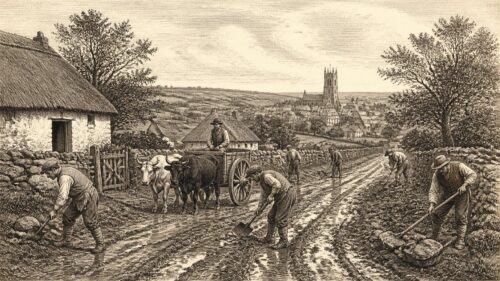
Events outside Dublin point to a less visible but important strain in rural society. On 4 February the government issued a proclamation for suppressing houghing in Connacht: the malicious cutting of the tendons of cattle, horses or sheep. The offence was grave both for the immediate suffering caused and for the economic damage it inflicted on owners. Its appearance in an official proclamation confirms that the authorities considered it a serious problem in the west during 1713.
Houghing had emerged amid disputes over land use in the early 1710s. Expanding pasture and livestock farming could conflict with the needs of cottiers, smallholders and labourers dependent on tillage, common rights and access to land. It would be unsafe to assign every attack to one coherent movement or to identify all perpetrators with a single social group. The proclamation records the government’s concern, not the private motives of every offender. Nevertheless, the episode offers a rare direct glimpse of rural resistance and insecurity in a society where large landowners, middlemen, tenants and landless workers possessed sharply unequal power.
Church, Culture and Administration
The established Church of Ireland remained intertwined with government. Its bishops sat in the House of Lords; its clergy helped give public shape to royal proclamations, fasts and thanksgivings; and its privileged position stood in marked contrast to the disabilities imposed on Catholics and the limited security enjoyed by Protestant dissenters. Religious identity was therefore inseparable from political authority. The concern over recruitment for the Pretender, and the rancour visible in the election, were understood through the inherited divisions of the Williamite settlement.
1713 also belongs to the history of Dublin’s intellectual and ecclesiastical life because Jonathan Swift became dean of St Patrick’s Cathedral. His appointment did not yet make him the famous public critic of Irish economic policy that he would become in the 1720s. In this year, he was a newly installed dean whose career linked the cathedral, literary culture and high Tory politics. His presence at St Patrick’s is a reminder that Dublin’s institutions were centres not only of worship and administration but also of writing, patronage and argument.
Government notices from the later months show the ordinary reach of the state alongside its high politics. A proclamation of 15 September strengthened quarantine precautions against plague. It does not demonstrate that plague had arrived in Ireland; rather, it shows official attention to the danger posed by shipping and overseas connection. In December, another proclamation concerned the protection and security of the mail. Peace had enlarged expectations of regular communication and commercial movement, but the government still had to secure roads, posts and routes of information.
Peace Without Ease
By the close of 1713, Ireland had celebrated European peace but had not achieved political calm. The Tholsel riot, the cramped parliamentary session, official anxiety about Jacobite recruitment and the campaign against houghing all show different pressures within the kingdom. Utrecht ended a major war; it did not settle the question of whose interests the Irish state served, who could share in political life, or how securely ordinary people could hold land, work and livelihood. Those unresolved tensions gave this apparently transitional year its distinctive force.
Primary Sources
- Statute Law Revision Act 2015, Schedule 2
- The Proclamations of Ireland 1660–1820, Volume 1 preview
- Government, Parliament and the Constitution: The Reinterpretation of Poynings’ Law, 1692–1714
- Central Aspects of the Eighteenth-Century Constitutional Framework in Ireland: Government Supply
- The Crisis in Ireland and the Disintegration of Queen Anne’s Last Ministry
- Party and Management in the Irish House of Lords, 1713–15
- Irish Legislation Database: Sources for Irish Legislation, 1692–1800
- Irish Legislation Database: General Index of Bills in the Commons’ Journals
- Journals of the House of Commons of the Kingdom of Ireland [First Series]
- Journals of the House of Commons of the Kingdom of Ireland archives
- Add MS 61637 A: List of Members of the Irish Parliament, after 24 December 1713
- Queries to the Electors of the City of Dublin
- State Papers Ireland 1509–1782: Government Papers on Irish Affairs
- Talbot, Charles (1660–1718), 15th Earl and 1st Duke of Shrewsbury
- Swift, Jonathan
- Jonathan Swift, Dean 1713–1745
- The Muniments of Swift’s Cathedral
- Letter of Dean Swift to Rev. Mr Chamberlayn; Letter of Swift to Dr Sheridan; Letter of Swift to Rev. Mr Worral
- House of Commons List re Donegal Elections, 1713
- The Whole Articles of Peace, with the Treaty of Trade and Commerce, between Queen Anne and Louis XIV
- Traitez de paix et de commerce, navigation et marine, entre la France et l’Angleterre, conclus à Utrecht le 11 avril 1713
- Tractatus pacis & amicitiae: Treaty of Peace and Friendship, Utrecht, 1713
- Maxwell, Henry