Worcester’s Parliament1467 CE
In 1467, John Tiptoft, earl of Worcester, returned as Edward IV’s deputy in Ireland and summoned a Dublin parliament, asserting royal authority within the limited reach of the English lordship. Its programme addressed coastal defence at Lambay, black rents, coinage, church affairs and Meath, while revealing dependence on local cooperation. Desmond’s later execution belonged to 1468, though Worcester’s arrival initiated the crisis. Beyond the Pale, dynastic successions, raids and warfare shaped politics, notably a bloody Connacht battle involving Clanricarde, Ó Ceallaigh and Burke factions. Annals also recorded plague, clerical deaths, learned men and hospitality, illustrating regional institutions and overlapping jurisdictions.
Dateline
In 1467, Ireland’s political landscape was shaped less by a single national turning-point than by several simultaneous contests for authority. The English lordship centred on Dublin was being recast under a new deputy, John Tiptoft, earl of Worcester; Gaelic and Gaelicised dynasties continued to fight, bargain and replace one another across Ulster, Connacht and the midlands; and the annals recorded the deaths of rulers, clerics, poets and household leaders whose standing rested on lordship, learning and hospitality. The year is therefore best understood as one in which formal government tried to assert itself while power on the ground remained dispersed among regional communities.
A New Deputy in Dublin
Edward IV was lord of Ireland, but royal government did not command the island as a whole. Its effective reach was strongest in and around Dublin and the towns and lordships linked to the Pale. Beyond that area, English, Anglo-Irish and Gaelic magnates exercised authority through their own affinities, tenancies, military followings and negotiated relationships. The great earls of Kildare and Desmond, both FitzGeralds, had considerable influence in this world; meanwhile, many lordships conventionally described as Gaelic had long dealt with the Dublin administration when it suited their interests.
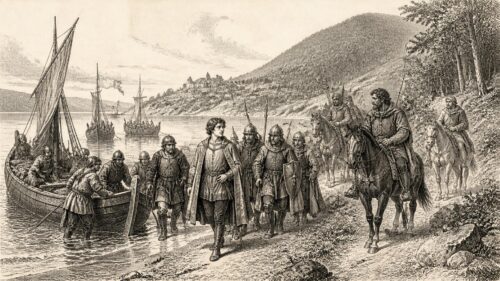
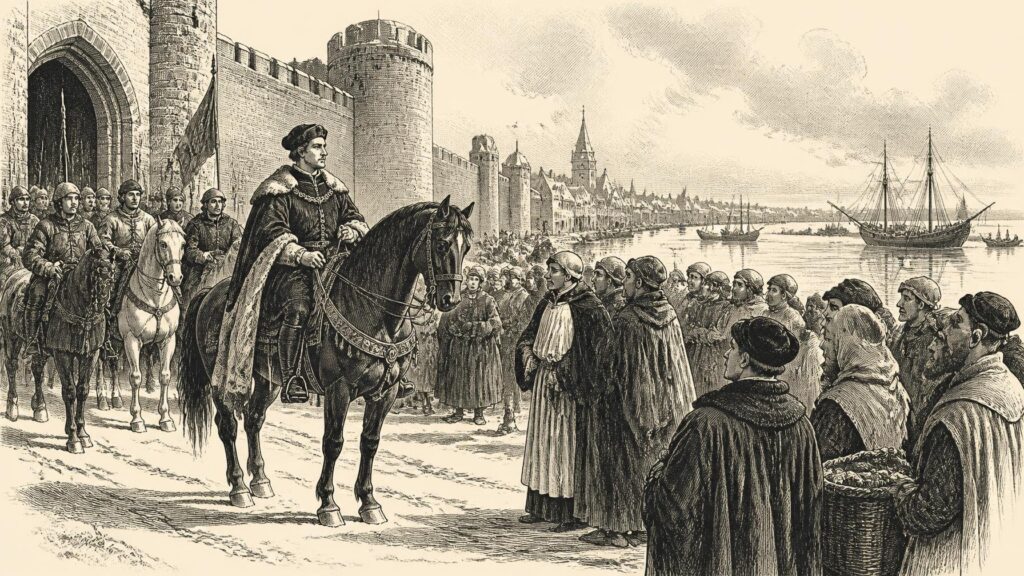
John Tiptoft, earl of Worcester, returned to the Irish administration in the spring of 1467 as deputy lieutenant and was in Ireland by October. He was an unusually learned English magnate, but also a notably severe royal servant. In December he summoned a parliament to Dublin. This was a significant assertion of central authority after the politically active deputyship of Thomas FitzJames FitzGerald, earl of Desmond. Yet it should not be projected backwards as the sudden establishment of a strong, island-wide state: the deputy’s government depended on cooperation from magnates, clergy, towns and local office-holders, and its writ had clear geographical limits.
The parliamentary legislation associated with the session of 1467–68 reveals practical worries within the lordship. Its surviving statutory record includes provisions concerning Lambay Island, payments described as “black rent” to the king’s enemies, defective coin, coinage, church obedience, municipal and ecclesiastical rights, and the administration of Meath. Not every measure can safely be placed on a particular day in calendar year 1467, since the parliament continued into 1468; nevertheless, the programme belongs directly to the governmental initiative launched that December.
Lambay, off the north Dublin coast, was granted to Worcester to be fortified. The statute treated the island as an undefended refuge from which the king’s enemies could threaten the mainland, naming Britons, Spaniards, French and Scots. This language should not be mistaken for proof of an attack by each of those peoples in 1467. It does, however, show how officials imagined the vulnerability of the Irish Sea coast: creeks and islands could shelter raiders, pirates or hostile shipping, while Dublin depended on maritime connections for defence, trade and communication.
The coinage provisions are equally revealing. A statute stated that Ireland lacked silver and that silver coin was being carried abroad, leaving people to accept clipped money. It authorised a new silver “double”, marked with a crown and the titles of Edward IV as lord of Ireland on one face, and with a sun and rose and “Civitas Dublinie” on the other. This was an attempt to regulate a troubled monetary circulation, not evidence that all Irish exchange was cash-based. Across much of the island, cattle, grain, labour services, credit and customary dues remained vital. But the decision shows the importance of coined money to Dublin, towns, soldiers, imports and official revenue.
The Desmond Question
Later events cast a long shadow over 1467. Worcester’s administration became associated with the prosecution of the earls of Desmond and Kildare and of Edward Plunket on accusations that included alliance and fosterage with the Irish, supplying them with horses and arms, and acting against the king’s faithful subjects. These charges expose the political meaning of cultural connection in late medieval Ireland. Fosterage, marriage alliances, military employment and bilingual lordship were ordinary instruments of power, especially for magnates ruling frontier regions. In a hostile political setting, however, they could be represented as treasonous “Irishness”.
It is important to separate the year from its aftermath. Desmond was replaced as deputy in 1467, and Worcester’s parliament was summoned in December. But the arrest, attainder and execution of Desmond belong to February 1468, not to 1467. A near-contemporary Irish annalistic fragment places dramatic material about Desmond and the Dublin administration under its heading for 1467, illustrating both the intensity of the crisis and the hazards of treating medieval annal headings as exact modern dates. The securely dated execution on 15 February 1468 should not be transferred into this year. What 1467 unmistakably contains is the arrival of the deputy and the political machinery from which that catastrophe soon emerged.
War and Alliance Beyond the Pale
While legislation and high politics unfolded around Dublin, the Irish annals describe a far wider pattern of regional war. In Ulster, Enrí Ó Néill, lord of Tír Eógain, led an army into the territory of the Ó Catháin. Philip Maguire, praised by the Annals of the Four Masters as the best man of his country in his time, was killed on that expedition. The record gives no tidy strategic explanation, but the episode demonstrates the cost of campaigning even to the victors. Tír Eógain’s military reach depended upon retaining the support of subordinate and allied kindreds, among them branches of the Maguires of Fermanagh.
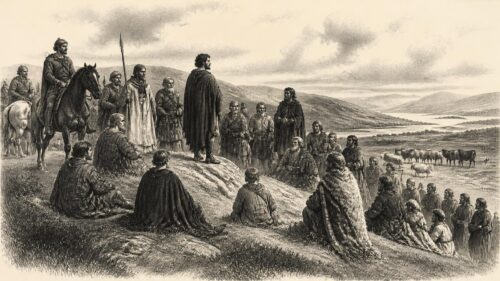
Successions also altered the balance of local power. Eoghan Mac Mathghamhna, king of Airgialla or Oriel, died and was succeeded by his brother Redmond. Cathal Ó Raghallaigh died, and Toirdelbach Ó Raghallaigh succeeded in east Bréifne. In Uí Maine, centred in parts of modern east Galway and south Roscommon, Aodh Ó Ceallaigh died and another Ó Ceallaigh was installed. These notices are brief, but they matter: lordship was not inherited automatically by the eldest son according to an English rule of primogeniture. Election or selection within a ruling kin-group, supported by leading relatives and clients, could decide the successor. That process created both flexibility and danger.
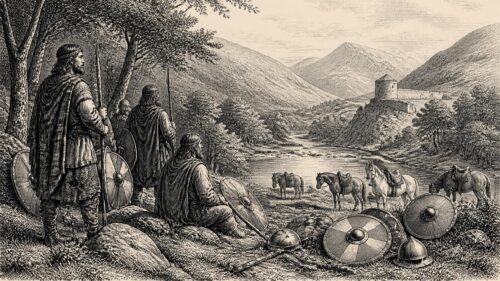
The most vividly recorded conflict of the year occurred in Connacht at Cros Moighe-Croin, rendered in English translations as the Cross of Magh-cronn. Mac William of Clanricarde and the Ó Briains defeated an alliance of Ó Ceallaigh and the sons of William Burke. William “Caech” Burke, two Ó Ceallaighs, a constable of gallowglasses and other gentlemen were killed; the annals put the dead gallowglasses at 160, besides many others. Medieval casualty figures require caution, but the entry nevertheless indicates a serious defeat rather than a minor cattle raid. Gallowglasses were heavily armed professional soldiers whose presence connected local dynastic war to the wider military culture of Ireland and the Gaelic west of Scotland.
The battle did not settle Connacht. Aodh Ruadh Ó Domhnaill of Tír Chonaill came south to avenge his friends and allies, Mac William and Ó Ceallaigh, and compelled the Clanricard faction to make peace before returning safely north. The sequence is a useful corrective to any simple contrast between “Irish” and “English” Ireland. Burke factions, descended from Anglo-Norman settlers, were embedded in Gaelic political networks; Ó Briain and Ó Domhnaill intervention crossed provincial boundaries; and alliances were shaped by kinship, profit, rivalry and opportunity rather than ancestry alone.
Other entries show the persistent pressure placed upon ordinary communities. O’Conor Don and the grandsons of Felim seized an island in Lough Cairrgin from its keepers. Teige Ó Conchobair, Mac Geoghegan and Mac Feorais Bermingham carried out extensive depredations in the plain of Teffia, plundering from Imper to Baile-mhic-William. The sons of Cormac Ballagh Mac Donough captured Cuil Maoile castle from their own wider kindred. Such notices usually foreground leaders and prizes, but their practical meaning included livestock driven away, crops and stores consumed, households displaced, and rents interrupted. Castles, lake islands and fortified settlements mattered because they controlled people, produce, routes and refuge.
Faith, Learning and Household Reputation
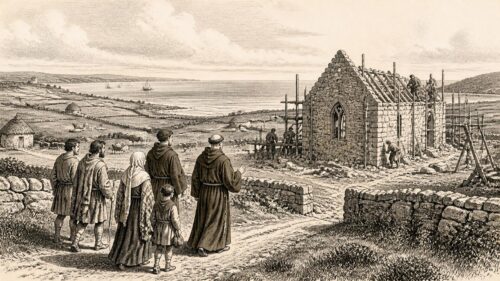
The year’s obituaries open a quieter view of society. Donough Ó Fearghail died while travelling to Rome, a reminder that Irish clerics and lay elites still looked to the papal centre despite the expense and danger of the journey. Niall Mac Mathghamhna, official of Lough Erne and parson of Inis Cain, died on 31 December. The precise date is exceptional in the annals, while his offices show that ecclesiastical administration was rooted in local churches and communities as well as in distant diocesan structures.
Plague was reported among several prominent figures: Christopher Plunkett, members of the Dalton family, and the prior of Mullingar. These deaths support the limited conclusion that plague was present in the recorded social world of the midlands in 1467. They do not, by themselves, establish the scale of mortality among the wider population. Annalists most often named those whose families, offices or rank made their passing politically memorable.
A fragment of Irish annals, probably compiled in or soon after 1467–68, commemorates Torna Ó Maoil Chonaire, ollamh of Síl Muiredaig, as a master of history and poetry; it also records the death of William Mac Carroll, an ollamh of Bréifne, and of a distinguished musician of the Mac an Ghabhann kindred. These notices attest to learned professions sustained by aristocratic patronage. Genealogy, praise-poetry, historical memory, music and legal learning were not decorative extras: they helped define rank, preserve claims and furnish the public culture of lordship.
The same values appear in the death notice for Conaing Ó Cléirigh, described as eminent in history and as keeper of a general guest-house. Hospitality was a moral obligation and a political resource. A household able to receive travellers, clients, clerics, poets and the poor advertised both wealth and legitimate authority. In 1467, as in other years, warfare could destroy such resources; yet the annals’ praise for learning, almsgiving and open hospitality shows what contemporaries believed a well-governed lordship ought to sustain.
Thus 1467 joined government reform, monetary concern and coastal defence to older patterns of dynastic competition and local obligation. Worcester’s arrival and Dublin parliament marked a new, potentially confrontational phase in the English lordship. Elsewhere, successions, raids, castles, alliances and the catastrophic battle in Connacht determined political life more immediately. The year did not produce a unified Ireland. It reveals instead an island of overlapping jurisdictions, vigorous regional cultures and institutions whose stability depended on relationships that could be remade with startling speed.
Source References
Hover over a number to see the source. Select it to open the source.

- [1] The Annals of Ulster, Year U1467
- [2] Annals of the Four Masters, Annals M1463–M1472
- [3] A Fragment of Irish Annals: Text
- [4] A Fragment of Irish Annals: Document Details
- [5] Statute Law Revision Act 2007, Schedule 2
- [6] Statute Rolls of the Irish Parliament: Edward IV
- [7] Tiptoft, John
- [8] FitzGerald, Thomas fitz James
- [9] FitzGerald, Thomas ‘fitz Maurice’
- [10] O'Neill (Ó Néill), Enrí
- [11] O'Kelly (Ó Ceallaigh), Tadhg
- [12] English Lordship of Ireland and the Irish Sea World: Re-assessing the Origins of the Kildare Ascendancy, c.1390–c.1513
- [13] ‘Irish’ Ireland and ‘English’ Ireland
- [14] The Coinage of Ireland in Copper, Tin, and Pewter
- [15] Edward IV Issues Irish Coins of a Lower Standard (1467)
- [16] Lambay
- [17] Colouring Fingal's Heritage
- [18] The Commonwealth of Ireland
- [19] Chronicon Scotorum
- [20] A Discovery of the True Causes Why Ireland Was Never Entirely Subdued
- [21] The Annals of the Four Masters
- [22] Exploring the Irish Annals
Primary Sources
- The Annals of Ulster, Year U1467
- Annals of the Four Masters, Annals M1463–M1472
- A Fragment of Irish Annals: Text
- A Fragment of Irish Annals: Document Details
- Statute Law Revision Act 2007, Schedule 2
- Statute Rolls of the Irish Parliament: Edward IV
- Tiptoft, John
- FitzGerald, Thomas fitz James
- FitzGerald, Thomas ‘fitz Maurice’
- O'Neill (Ó Néill), Enrí
- O'Kelly (Ó Ceallaigh), Tadhg
- English Lordship of Ireland and the Irish Sea World: Re-assessing the Origins of the Kildare Ascendancy, c.1390–c.1513
- ‘Irish’ Ireland and ‘English’ Ireland
- The Coinage of Ireland in Copper, Tin, and Pewter
- Edward IV Issues Irish Coins of a Lower Standard (1467)
- Lambay
- Colouring Fingal's Heritage
- The Commonwealth of Ireland
- Chronicon Scotorum
- A Discovery of the True Causes Why Ireland Was Never Entirely Subdued
- The Annals of the Four Masters
- Exploring the Irish Annals