Sléibéne’s Irish Crossing754 CE
In 754, Irish annals recorded Sléibéne, abbot of Í (Iona), arriving in Ireland, illustrating Columban influence across the Irish Sea. Although chronology is uncertain, the associated notices portray fragmented political authority and interconnected ecclesiastical networks. Flann of Mag Aí and Loingsech of Cenél Conaill died, affecting important regional dynasties. Warfare included Osraige’s destruction of Fotharta Fea, heavy losses between Uí Briúin and Cenél Cairpri at Ard Naescán, and internal conflict among the Uí Thuirtri. The annals also noted local and religious deaths. Together, these brief records reveal an agricultural society shaped by local kingship, monasteries, violence and wider Gaelic connections.
Dateline
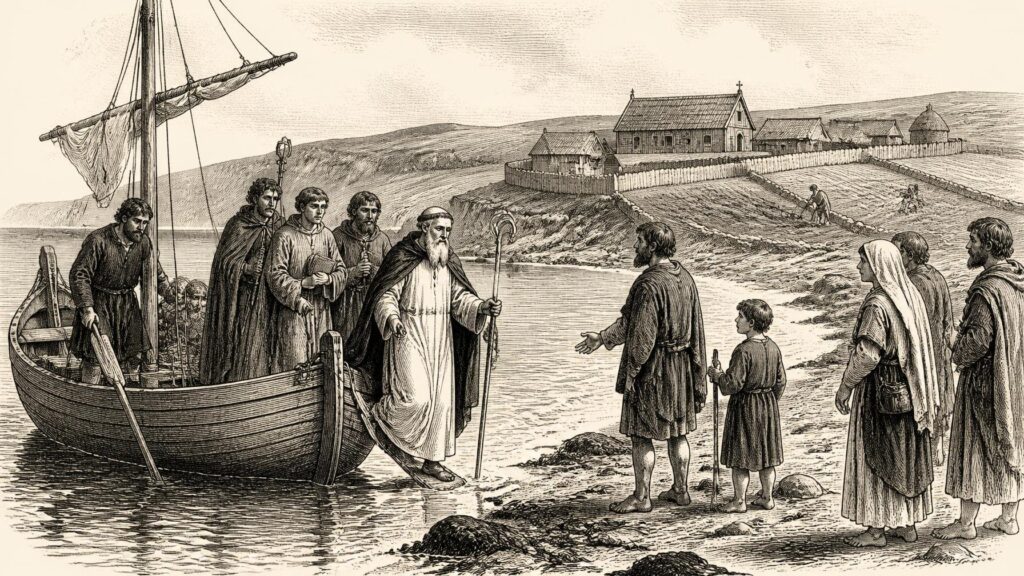
In 754 CE, the annalistic record conventionally assigned to this year places Ireland within a web of small but consequential political upheavals, dynastic deaths and ecclesiastical movement. Its most revealing entry is brief: Sléibéne, abbot of Í—modern Iona—came to Ireland. Around it stand the deaths of two regional kings, the destruction of Fotharta Fea by the Osraige, a bloody encounter at Ard Naescán, and conflict within the Uí Thuirtri. No single event remade the island. Together, however, they show an Ireland whose authority was dispersed among many kingdoms, and in which a journey by the head of a major monastery could carry political as well as devotional weight.
A Year Preserved in Annals
There is an important caution about the date. Medieval Irish annals did not originate as modern calendars, and surviving compilations preserve chronological problems, including shifts between annal headings and later Anno Domini labels. The Annals of Ulster places these notices under its year U754, while its manuscript-derived heading gives AD 753; modern reference scholarship nevertheless connects Sléibéne’s first return to Ireland with 754 CE. It is therefore safest to treat the events below as the securely associated annalistic dossier for 754, rather than pretend that the sources provide day-by-day precision. The independent Annals of Inisfallen also records the death of Flann son of Conchobar in its entry for 754, lending support to the year’s broad placement.
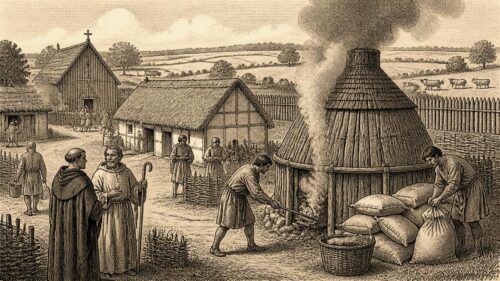
The surviving notices are terse and selective. They do not tell us what the weather was like, whether harvests failed or prospered, or how prices and local exchange moved during the year. Nor do they provide a continuous narrative of ordinary households. That silence matters. Annals generally remembered deaths of rulers and churchmen, warfare, raids and events at institutions with literate interests; they were not designed as a full social survey. Archaeology gives the necessary wider setting: most people lived in agricultural communities, often associated with enclosed farmsteads, while monastic sites were simultaneously religious centres, places of learning, workshops, landholders and nodes in wider networks.
Sléibéne From Í
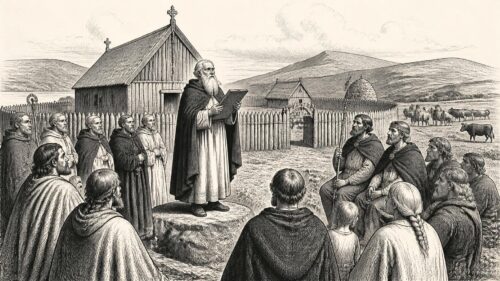
Sléibéne’s arrival is the year’s most internationally connected Irish event. Í, better known by its later name Iona, lay off the western coast of present-day Scotland, but it belonged to a Gaelic world tied closely to Ireland through sea routes, kinship, scholarship and the cult of Colum Cille. The island monastery had been founded by Columba in the sixth century and stood at the heart of a Columban religious federation extending across the Irish Sea. Sléibéne himself was a member of the Cenél Loairn of Dál Riata, not of the Cenél Conaill kin-group from which Columba came—an instructive reminder that the Columban community’s influence exceeded one dynasty.
The annal merely says that the abbot “came to Ireland”; it does not name his destination, companions, route or immediate business. Those gaps should not be filled with invented ceremony. Yet the journey was plainly significant enough to record, and it occurred amid a renewed assertion of Columban authority. Sléibéne’s later visit is linked explicitly with the promulgation of the Law of Colum Cille, a formal ecclesiastical protection and jurisdiction associated with the saint’s authority. Modern scholarship also considers that such a law could involve relics carried on circuit and the collection of dues. That later evidence cannot prove the precise purpose of the 754 journey, but it makes clear why an abbot’s presence in Ireland could concern both church organisation and secular rulers.
Iona’s importance rested on more than piety. Its community preserved texts, cultivated the memory of Columba, produced and commissioned prestige objects, and maintained relationships with kings in Ireland and northern Britain. The movement of abbots, books and relics across the sea made the Irish Sea a connective corridor rather than a frontier. By the mid-eighth century, an Irish visitor to Iona—or an Ionan abbot arriving in Ireland—moved within a shared Gaelic religious culture. The record of Sléibéne’s crossing captures that world in a single sentence: political borders existed, but they did not prevent ecclesiastical authority from operating across them.
Deaths and Dynastic Change
The annals record the death of Flann son of Conchobor, described as king of Mag Aí, and that of Loingsech son of Flaithbertach, king of Cenél Conaill. Mag Aí was the royal heartland of the Uí Briúin in Connacht, centred on the plain around Cruachain in what is now north Roscommon. Flann’s death therefore concerned a polity with deep royal associations, although the annal does not identify his successor or describe a succession struggle. The Annals of Inisfallen styles him king of the Uí Briúin, reinforcing the link between Mag Aí and that powerful Connacht dynasty.
Loingsech’s death was similarly consequential at a regional level. Cenél Conaill, based principally in the north-west, had long-standing associations with Columba and Iona. In eighth-century Ireland, kingship was neither a simple national office nor a settled hereditary inheritance. It was layered: rulers governed local peoples and territories, stronger dynasties sought provincial supremacy, and claims could depend upon ancestry, military backing, alliances and control of important ecclesiastical centres. The deaths of Flann and Loingsech may have altered the balance within their kindreds, but 754’s annals do not licence a detailed reconstruction of what followed. Their inclusion does, however, show the political importance assigned to regional kings beyond the better-known contenders for wider Uí Néill overlordship.
Violence Across Several Regions
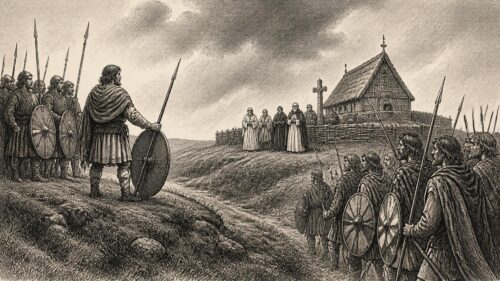
The year’s warfare was not one coordinated national conflict. The annal instead records separate outbreaks in different political landscapes. The Osraige “destroyed” Fotharta Fea, a phrase that almost certainly denotes a devastating military operation rather than a minor raid. Fotharta Fea belonged to the wider Fotharta population groups of Leinster, while Osraige occupied the strategically important territory between Munster and Leinster. The wording offers no casualty total, named commander or settlement list; nevertheless, destruction on this scale likely meant the seizure of cattle and foodstuffs, burning or dismantling of property, killings and the displacement or subordination of survivors. Such consequences are reasonable implications of early medieval raiding, but they are not individually documented for this campaign.
At Ard Naescán, the Uí Briúin fought the Cenél Cairpri, and “many fell”. This was a substantial enough loss for the annalist to emphasise, but neither a victor nor a cause is given. The opponents point to the competitive politics of Connacht and its borderlands, where overlapping dynastic interests could produce shifting coalitions and violent contests. A further battle took place “between the Uí Thuirtri themselves”. Internal war is especially revealing: kin-group names should not be mistaken for unified states. Rival branches, claimants and allied factions could fight under the same broad dynastic label. The Uí Thuirtri were part of the northern political mosaic associated with Airgialla and territories west of the Bann; their internal dispute demonstrates how fragmented power remained.
The killing of Cenn Faelad grandson of Cuiléne adds another personal act of violence, while the deaths of Cerpán of Dam Liac and Abél of Áth Omna show that religious and local figures, as well as kings, entered the annalistic memory. Yet titles are not supplied for every individual, and it would be unsafe to assign offices or motives that the text does not give. The compact list is valuable precisely because it reveals the annalists’ scale of attention: political violence, ecclesiastical personnel and the fortunes of regional rulers all belonged in the same yearly record.
What 754 Reveals
For most inhabitants, life in 754 CE would have remained rooted in cultivation, livestock, household labour, seasonal movement and local obligations. The political events recorded by clerical chroniclers mattered when armies entered a district, when a king died, or when a monastery asserted rights and protection; otherwise, they may have seemed distant. Ireland had no towns in the later medieval sense, and it was not governed from a single capital. Instead, power worked through a dense hierarchy of local kingdoms, royal places, churches and monastic communities. This is why the year can contain both an abbot’s sea crossing and several apparently unconnected conflicts without contradiction.
Sléibéne’s journey is therefore the best lens through which to view 754. It joins Ireland to Iona and Dál Riata, while the deaths and battles show the island’s internal divisions. The entry neither proves that Sléibéne negotiated peace nor that he personally directed the Columban law in this particular year. What it securely demonstrates is that the abbot of Í considered Ireland important enough to visit, and that Irish annalists considered his arrival worth preserving beside warfare and royal mortality. In a year with no single island-wide turning point, that crossing illuminates the reach of religious institutions in an intensely local political world.
Primary Sources
- The Annals of Ulster, Year U754
- CELT Project: The Annals of Ulster
- Annals of Inisfallen, Annals AI747–AI774
- CELT Project: Annals of Inisfallen
- Sléibíne
- Í > IOUA > IONA – Iona’s Namescape
- Chronological Synchronisation of the Irish Annals
- The Chronology and Sources of the Early Irish Annals
- Columba, Iona and Lindisfarne
- Early Christian Ireland
- A New Jerusalem ‘At the Ends of the Earth’: Interpreting Charles Thomas’s Excavations at Iona Abbey 1956–63
- The Alliance between Church and State in Early Medieval Alba
- The Library of Iona at the Time of Adomnán
- Residence, Ritual and Rulership: A State-of-the-Art for Royal Places in Early Medieval Ireland
- Agriculture, Settlement and Society in Early Medieval Ireland
- Early Medieval Ireland, AD 400–1100: The Evidence from Archaeological Excavations
- Ordinary People in Early Christian Ireland
- Early Christian Monasteries
- Churches and Ecclesiastical Enclosures / Shéipéil agus Ráthanna
- Cartlann Téacsanna: Fuathart / Fotharta Fea
- Medieval Ireland: Early Medieval Politics Map
- Exploring the Irish Annals