

Investment Republic
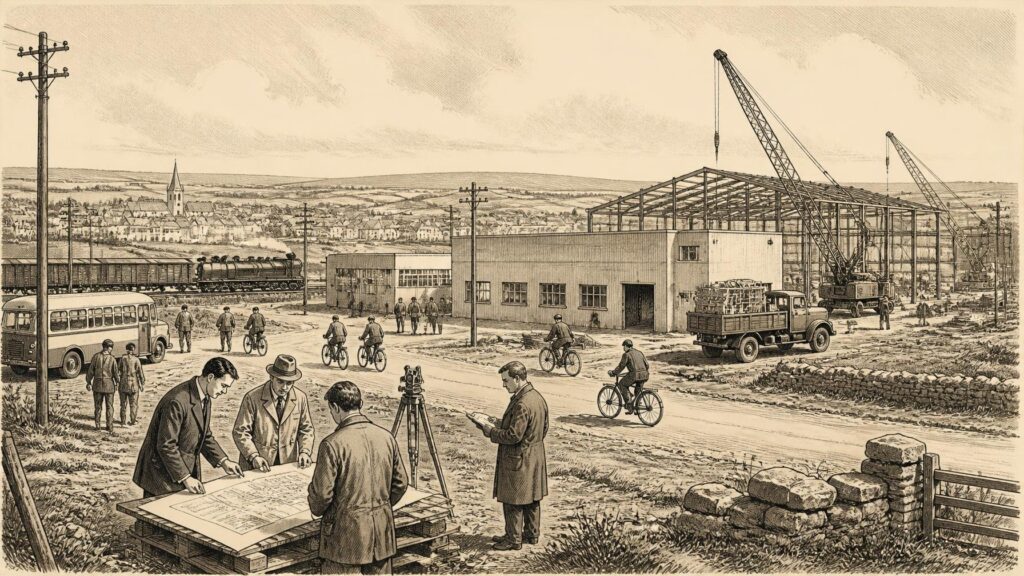
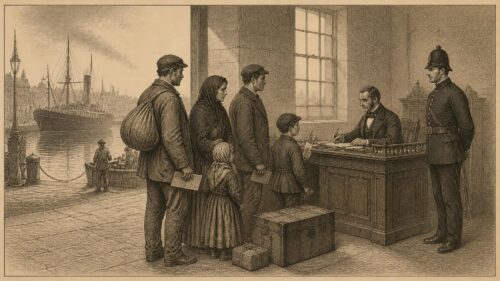
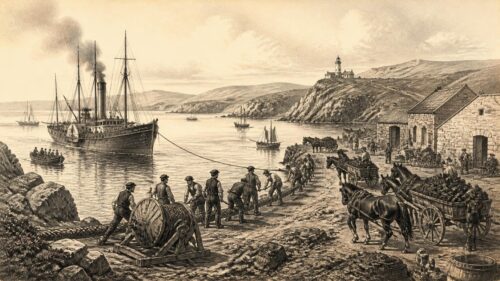
AI generated historical illustration, not a contemporary photograph.
At a Glance
Few changes altered the economic landscape of independent Ireland more thoroughly than the long turn from protected domestic manufacture towards export production and foreign direct investment. It was neither an overnight conversion nor a simple national success story. Rather, it was a sustained, adaptable and frequently contested programme of state action, in which officials sought overseas capital, built institutions, offered incentives and gradually connected a small peripheral economy to European and American business networks.
Protected Economy
For much of the early twentieth century, Irish industrial policy was framed by the political vocabulary of sovereignty. Independence had not removed the State’s profound commercial dependence upon Britain, nor had it created a large home market. Governments therefore faced a genuine difficulty: how could a predominantly agricultural country, with a modest population and limited industrial capital, create employment at home rather than see its people leave in search of it elsewhere?
The answer adopted during the 1930s was protection. Tariffs, quotas and licensing arrangements encouraged firms to produce for the domestic market. This approach had political force. It appeared to promise a material counterpart to political independence, allowing Irish-owned manufacturers to displace imports and giving the State a visible role in fostering national production. There were real enterprises created or enlarged under the shelter of protection, and it would be mistaken to describe the period as wholly devoid of industrial activity.
Yet protection also had structural limits. The domestic market was small, many firms operated at limited scale, and their capacity to compete abroad was often weak. The Oireachtas record later characterised policy from the 1930s into the 1950s as centred upon high tariff barriers intended to preserve a home market for Irish manufacturers. Such a description does not make protection irrational in its original setting; it does, however, explain why its shortcomings became increasingly apparent as post-war western Europe expanded more rapidly than Ireland.
By the 1950s, unemployment, emigration and slow growth gave urgency to the question of economic direction. The hardship was experienced locally—in farms unable to support succeeding generations, in towns with restricted opportunities, and in households for whom migration was a recurring family fact. The later legend of a single decisive intellectual revolution should be treated cautiously. Economic policy changed through political debate, administrative work and accumulated disappointments, not by one document alone. Still, the late 1950s undeniably marked a decisive shift in official assumptions about industry, trade and investment.
Policy Turning
T. K. Whitaker’s 1958 study Economic Development, and the First Programme for Economic Expansion published that same year, became enduring symbols of the new orientation. Whitaker’s work assessed the economy in unusually systematic terms and argued, in effect, that durable improvement required productive expansion and greater competitiveness. Seán Lemass, first as Minister and then as Taoiseach from 1959, supplied political authority to an emerging programme that looked outward rather than inward.
It is important, however, to separate documented sequence from retrospective simplification. Export tax relief had already been introduced in 1956. The dismantling of protection did not occur at a single stroke in 1958, and the broad transformation involved measures adopted across several years. The new policy was therefore an evolution with a clearer direction, rather than a complete repudiation enacted on one November day. Its central insight was nevertheless momentous: Ireland could not expect the home market alone to sustain the scale of industrial employment desired.
Government policy increasingly joined three connected objectives. It sought more exports, greater productive investment and industrial work outside the traditional centres of population. Foreign-owned enterprise was not imagined merely as a source of money. The hope was that new plants would bring markets, production methods, technical knowledge and regular wages, while domestic firms would gain as suppliers or through the circulation of skills. In practice, those hoped-for linkages varied greatly by firm and sector.
The shift also altered the meaning of economic independence. Earlier protectionists had associated independence with insulation from foreign goods and ownership. The later programme made a different claim: national autonomy could be strengthened by creating jobs, earning export income and participating in international markets. This was a real ideological reorientation, though it never removed the tension between national development and reliance upon enterprises ultimately directed elsewhere.
State Machinery
Institution-building gave the new approach practical form. The Industrial Development Authority, commonly known as the IDA, had been founded within the Department of Industry and Commerce in 1949 and placed on a statutory footing by the Industrial Development Authority Act 1950. In its earlier years the authority was part of a wider and still tentative effort to stimulate industry. Over time it became the best-known arm of the State’s inward-investment strategy.
The Industrial Development Act 1969 marked an important administrative development. From April 1970 the IDA operated as an autonomous state-sponsored body with national responsibility for industrial development. Autonomy mattered. It allowed the agency to develop specialist staff, cultivate commercial knowledge and maintain overseas representation while remaining publicly accountable. The State had created not simply a grant-giving office but an institution designed to seek, assess and negotiate investment projects.
The IDA’s task was never confined to attracting any available factory. It had to persuade companies that Ireland was a credible place in which to establish export-oriented operations, while also judging whether a proposed project offered employment and longer-term value. This required information: knowledge of corporate plans, markets, labour requirements, available sites and international competitors. The agency’s overseas offices and direct engagement with executives were therefore as historically significant as the grants themselves.
The institutional architecture broadened over time. Córas Tráchtála, established in 1959, supported export promotion. Later agencies separated and refined functions concerning indigenous enterprise, innovation, research and inward investment. The Industrial Development Act 1993 created Forfás, Forbairt and IDA Ireland; IDA Ireland was assigned a distinct focus upon high-quality foreign direct investment, while other bodies carried responsibilities for Irish-owned firms and the technological base of industry. This division expressed a recognition that foreign investment and domestic enterprise were related but not identical policy problems.
Fiscal Instruments
Taxation has been central to almost every historical account of Ireland’s foreign-investment strategy. Export Sales Relief, introduced in 1956, relieved manufacturing profits attributable to exports from corporation tax. It helped make export production more attractive at a time when Ireland was seeking firms able to sell beyond the domestic market. In 1981, the relief was replaced by a 10 per cent corporation tax rate on manufacturing profits, later extended in forms that helped establish Ireland’s reputation for a low and predictable corporate tax environment.
Tax was important, but the popular claim that Ireland’s success was simply purchased by low taxation is too narrow. The historical evidence points to a package: grants towards capital expenditure, prepared industrial sites, state provision of infrastructure, English-language access to European markets, a young labour force and an agency willing to work directly with investors. The relative importance of those elements changed across decades. Labour cost could be persuasive in one period, technical skills and research capacity in another.
Grants were similarly central. They lowered the cost and risk of establishing a new operation, particularly where a company had alternative sites in several countries. The industrial policy record of the 1980s shows substantial public expenditure on grants over the previous decades. The purpose was not charity but leverage: a public contribution was meant to bring private capital, jobs, exports and associated economic activity that otherwise might not arrive.
Such policies also raised enduring questions. Did the State sometimes subsidise employment that firms would have created regardless? Could public money be justified where the company’s strategic decisions remained abroad? Was the balance fair between assistance for multinationals and supports for small Irish firms? These are not merely modern objections. Parliamentary and policy discussions repeatedly considered the need for stronger local linkages, regional employment and indigenous capability. The historical record is therefore more searching than the uncomplicated celebration sometimes attached to the IDA model.
Regional Ambition
Regional development was built into the industrial strategy from an early stage. The political appeal was obvious. If new industry concentrated only in Dublin, foreign investment could intensify rather than ease the inequality between the capital and the rest of the country. The IDA consequently promoted industrial estates and sought projects for provincial towns and cities. The aim was to place employment near communities experiencing persistent out-migration.
There were notable successes. Manufacturing plants and later service operations became important employers in places where alternative work had been scarce. Industrial estates offered serviced sites; local authorities, training institutions and state agencies were drawn into the effort. This infrastructure was not incidental. An investor could be offered a location, utilities and an organised channel through which to recruit and begin production.
Yet regional balance proved difficult to secure. Companies weighed access to airports, ports, suppliers, housing, management labour and universities. Dublin possessed advantages that compounded with each additional investment, while Cork, Limerick, Galway and other centres developed specialised strengths of their own. Smaller towns could succeed when a particular plant arrived, but remained more exposed to corporate restructuring or closure. A regional strategy could influence investment decisions; it could not wholly override the commercial logic of the companies being pursued.
The persistence of regional policy is itself revealing. It shows that Irish industrial development was never only about aggregate national growth. It also concerned the social geography of opportunity. The State wanted foreign investment to diminish the compulsion to emigrate, but it also wanted the employment created to be broadly distributed. Outcomes were mixed, and the record should be read as an attempt to manage uneven development rather than as proof that it had been solved.
European Opening
Trade liberalisation and European integration gave the investment strategy a wider setting. The Anglo-Irish Free Trade Agreement of 1965 and membership of the European Economic Community in 1973 reduced the isolation of the Irish market. For overseas firms, Ireland increasingly offered more than a small national customer base. It could serve as a production location connected to a larger European market.
Membership also changed the discipline within which industrial policy operated. The State could not indefinitely preserve protected firms from external competition, and the indigenous industrial sector had to adapt to a more demanding trading environment. Some businesses developed; others struggled or disappeared. The historical transition carried costs for firms formed under the earlier regime, a point often obscured when later prosperity is projected backwards onto the 1960s and 1970s.
European membership did not automatically create the later pattern of investment. It combined with agency work, fiscal arrangements, education and international corporate strategies. But it increased credibility. Investors could see an English-speaking member state within the European Community, with access to a common market and a government actively seeking export-oriented production. The attractiveness of that combination increased as multinational firms reorganised their operations on a continental and global scale.
European rules also constrained the older, more discretionary forms of assistance. Over time, state aid rules encouraged policy to become more selective, transparent and focused on recognised objectives such as research, training, regional development and innovation. This was not the disappearance of industrial policy. It was its adaptation from broad protection and open-ended subsidy towards measures that could operate inside a regulated European framework.
Manufacturing Waves
The first major decades of inward investment concentrated heavily upon manufacturing. Foreign firms established export plants in areas including pharmaceuticals, chemicals, electronics and medical products. These firms helped expand exports and often offered more technically organised work than earlier low-productivity employment. Their presence also made visible Ireland’s new economic identity: a country attempting to manufacture for external markets rather than only for domestic consumption.
The results were substantial, but not uniform. A foreign-owned plant could be highly productive and export nearly all of its output while buying relatively little from Irish suppliers. In such cases its direct employment and wage effects might be important, but wider spillovers could remain restricted. Other firms created training opportunities, employed local professional staff and formed durable relations with contractors, logistics providers, educational institutions and service businesses. The degree of integration depended upon sector, scale, technology and corporate strategy.
By the 1980s, policy-makers were increasingly explicit about the need to integrate foreign industry more closely with Irish industry and education. This language acknowledged a limitation of the earlier model. Attracting a plant was not identical with building an industrial ecosystem. A national economy gained more from an investment when skills, research, procurement and management experience circulated beyond the company gates.
In the late 1980s and 1990s, the character of inward investment changed again. High-technology manufacturing gained prominence. Academic analysis of enterprise policy identifies the arrival of Intel in 1989 as an important event in the formation of an information and communications technology cluster. The significance was not only the plant itself. A major company could signal to other firms that Ireland possessed a workable talent pool, responsive public agencies and a credible industrial environment.
Skills Formation
Education was one of the quieter foundations of the investment strategy. A company may be attracted by a tax rate or a grant, but it cannot sustain complex production without people able to operate, maintain, manage and improve it. From the 1960s onward, expansion in secondary, technical and higher education gradually enlarged the pool from which modern industry could recruit.
The relationship was reciprocal. Foreign investors wanted engineers, technicians, scientists, accountants and multilingual service staff. Their requirements helped make investment in education and training more urgent. Regional Technical Colleges, later Institutes of Technology, played an important role in supplying technically trained graduates across the country. Universities increasingly became partners in research, recruitment and specialised instruction.
This is not a story in which education was designed solely to serve multinational firms. Its social purposes were wider: access, personal advancement, public capacity and cultural development. Nevertheless, industrial policy benefited immensely from the expanded educational system. The claim that Ireland’s attraction derived only from low wages became progressively less convincing as investment moved towards higher-value manufacturing, software, financial services and research activity.
Skill formation also helps explain policy continuity. When labour-intensive work became less competitive, the State and the IDA could seek different activities rather than defend every existing operation. The objective shifted towards functions considered more durable: product development, technical support, research, shared services, data operations and specialised manufacturing. Whether every such activity proved durable is another matter, but the strategy was to raise the quality of the work sought rather than to preserve an earlier industrial mix unchanged.
Service Transition
By the later twentieth century, Ireland’s foreign-investment profile extended beyond the factory. The International Financial Services Centre, international software operations, business services and corporate support functions indicated that foreign direct investment could arrive without the classic image of a large manufacturing plant. The IDA’s international services programme had begun in the early 1980s, though its earliest results were more modest than later accounts sometimes imply.
The growth of software and digitally mediated services transformed the terms of competition. Companies increasingly wanted access to skilled workers, telecommunications, reliable regulation and a business environment capable of supporting European or global functions. The State’s sales proposition therefore became more sophisticated. It included corporate taxation, but also the practical capacity to recruit, educate and retain people in specialised occupations.
Dublin became particularly prominent in this transition, benefiting from its international connections, population and concentration of institutions. This brought employment and international visibility, but also renewed concerns about spatial imbalance and housing pressure. The older regional question did not vanish when industry moved from smokestacks to servers and offices. It took new forms.
Academic work on Irish enterprise policy describes successive waves: ICT manufacturing associated with firms such as Intel, a subsequent emphasis on software, and a later expansion of internet-based companies. The interpretation of these waves is useful because it emphasises adaptation. Ireland’s industrial policy was not fixed in the form devised in the late 1950s. It continually tried to follow changes in corporate organisation and technology, seeking activities that matched the country’s developing capacities.
Indigenous Balance
The concentration on inward investment has always prompted an important question: what of Irish-owned enterprise? The answer cannot be that domestic business was ignored, for public agencies provided export, innovation and development supports to indigenous firms. Nor can it be said that the two sectors developed on equal terms. Foreign investment commanded extraordinary attention because it appeared capable of producing rapid gains in employment, exports and technology.
The relationship between the sectors was uneven. Some Irish firms grew through supplying foreign-owned companies, employing people trained in multinational workplaces, or selling into markets made more visible by Ireland’s export orientation. Others found that major overseas firms imported components and services through established global networks, leaving limited room for local suppliers. Spillovers were potential benefits, not automatic consequences.
This distinction matters historically because it counters both extremes. It is inaccurate to portray multinational investment as an enclave wholly detached from Irish society; it employed people, paid wages, trained workers and helped build professional networks. It is equally inaccurate to claim that every foreign investment seamlessly transformed into indigenous productive capacity. Industrial policy was most successful where public investment, education, local enterprise and foreign operations reinforced one another.
The creation of Enterprise Ireland and related agencies reflected a more explicit commitment to strengthening Irish-owned firms in international markets. That institutional separation was also an admission that attracting external capital could not by itself settle the national development question. A durable economy needed companies rooted in Ireland as well as foreign firms whose continued presence depended upon global boardroom decisions.
Measured Success
By the 1990s, Ireland’s experience was frequently presented internationally as a model of successful foreign-investment-led development. The description had a factual basis. Foreign-owned enterprises held a powerful position in manufacturing and export activity, employment had improved markedly, and Ireland had converged substantially with European living standards. The Forfás International Trade and Investment Report 2001 noted that Ireland’s inward investment was strikingly large in relation to the scale of its economy and that greenfield projects had particular significance because they created facilities and employment rather than merely changing ownership.
Nevertheless, the phrase “Celtic Tiger” can obscure chronology and causation. Rapid growth during the 1990s was not the mechanical result of one incentive or one agency. It followed decades of policy development and interacted with European integration, demographic change, education, international business cycles, domestic fiscal choices and world demand. Foreign direct investment was central, but it was part of a larger historical configuration.
Statistics also require care. In a globalised economy, recorded output and investment flows can be heavily affected by multinational corporate structures, intellectual property arrangements and the location of legal ownership. Measures of gross domestic product may not correspond neatly to income retained in Ireland. For historians, this is a warning against treating a large headline number as a transparent measure of national welfare.
The strongest conclusion is more modest and more convincing. Ireland built a state capacity unusually focused on securing and retaining internationally mobile investment. That capacity, joined to favourable external circumstances and improvements in education and infrastructure, changed the country’s industrial base. It did not eliminate dependence, inequality or vulnerability, but it altered the range of possibilities available to the State and its people.
Continuing Questions
The historical legacy remains relevant because the underlying dilemma persists. Foreign direct investment can bring capital, employment, skills and export access, yet it can also expose a small economy to decisions taken far away. A plant may expand, transfer functions or close according to a corporate strategy over which the host state has limited control. Public policy can make departure less likely by improving the quality of the location, but it cannot make global capital permanently local.
Modern policy therefore places greater emphasis on high-value, knowledge-intensive activities. Research on the island of Ireland has examined greenfield investment in fields ranging from biotechnology and medical devices to semiconductors, software, finance and business services. That work confirms both continuity and change: governments still compete for international investment, but the factors shaping location include skills, research capacity, sectoral ecosystems and cross-border coordination as well as financial incentives.
There is also a constitutional and social dimension to the story. Industrial policy in Ireland has been an exercise in democratic choice. Governments decided to spend public resources, create agencies, develop education, negotiate European obligations and pursue regional employment. Those choices may be criticised, defended or revised, but they were not simply imposed by an impersonal market. The State did not withdraw from economic life when it embraced openness; it acquired new, active functions.
Folklore often reduces the history to an IDA representative selling Ireland with charm, a low tax rate doing all the work, or a handful of famous corporate arrivals creating prosperity by themselves. Such stories contain fragments of truth, but they are insufficient. The documented history is one of institutions patiently accumulated, policies repeatedly adjusted and advantages deliberately cultivated. Its achievements were considerable; its unresolved questions are equally part of the record.
Historical Verdict
Industrial policy and foreign direct investment became central to the making of modern Ireland because they offered a response to the economic constraints of independence: a small market, limited capital, emigration and dependence on a narrow range of activities. The response was to seek a place in international production rather than stand apart from it. The IDA, fiscal incentives, industrial sites, export promotion, educational expansion and European membership formed the practical machinery of that choice.
The policy did not produce an uncomplicated national redemption. It brought dependence alongside opportunity, uneven regional gains alongside new employment, and very high recorded output alongside difficult questions about ownership and measurement. But it changed the terms on which Ireland engaged the world. The historical importance of the strategy lies not in any single firm, tax rate or celebrated official, but in the State’s sustained attempt to convert international mobility of capital into domestic economic capacity. That remains its achievement, and its enduring challenge.
Most strikingly, the article presents Irish development as a contested settlement rather than a simple triumph of low taxation or foreign investment. IDA incentives, European market access and educational expansion created employment, but benefits varied regionally, while some multinational firms maintained limited local purchasing and strategic control overseas. This raises uncertainty about whether export figures and job totals adequately measure durable development, especially when globalised accounting can distort national indicators. Ireland’s experience suggests that attracting investment differs from building domestic capability. How might education, procurement and support for indigenous firms strengthen linkages and resilience while retaining Ireland’s appeal to investors?