

Island Exiles
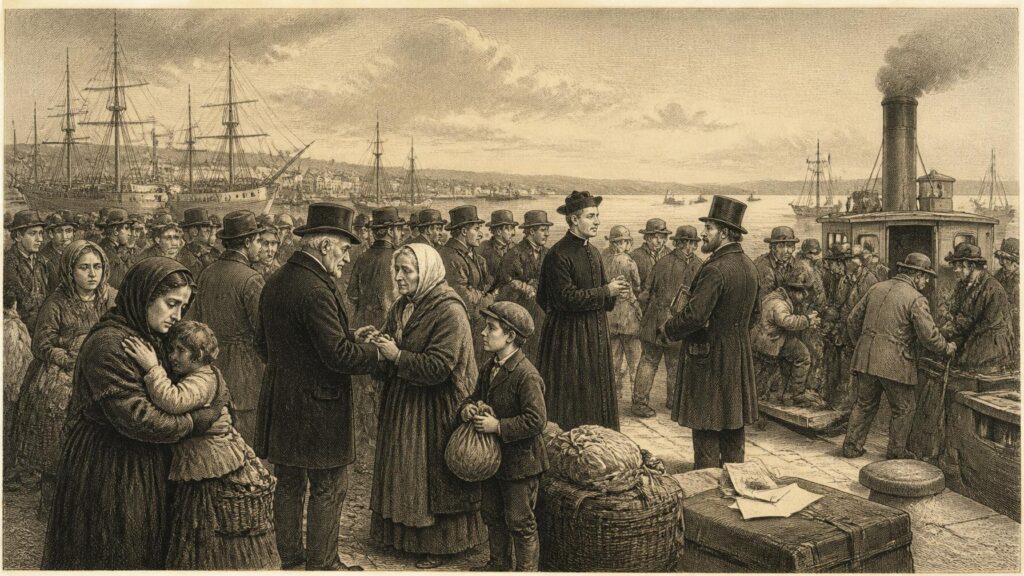
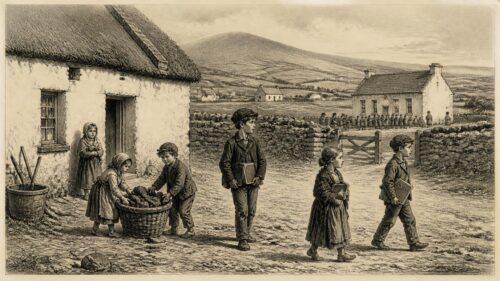
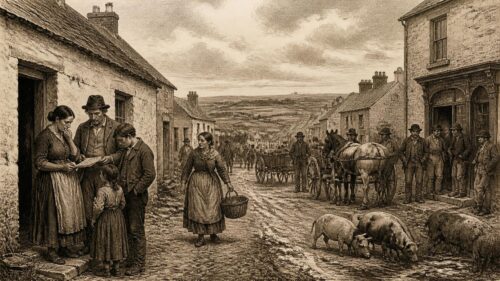
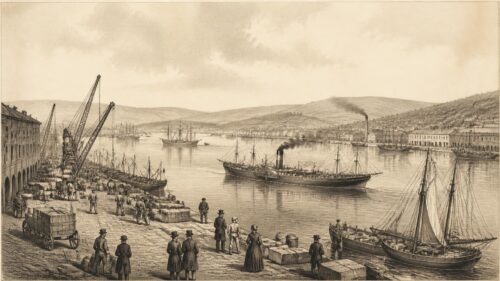
AI generated historical illustration, not a contemporary photograph.
At a Glance
“Shared Island and Diaspora” joins two ideas which can sound reassuringly simple but are, in historical terms, crowded with argument. Ireland has been connected to a wider world by migration for centuries; it has also been politically divided since the early twentieth century. Neither the island nor its emigrant descendants has ever formed a single, uniform community. The history is instead one of attachment and estrangement, remittances and departures, rival loyalties, inherited memories and practical cooperation. To understand the language of a shared island, it is necessary to reckon with the many ways Irish people have left, returned, remembered and disputed the place from which they or their forebears came.
Terms Matter
The phrase “Shared Island” has a specific modern public meaning. It is the title adopted by the Irish Government for a programme intended to deepen cooperation, connection and understanding among all communities and traditions on the island. Its stated framework is the Belfast or Good Friday Agreement of 10 April 1998. That agreement did not settle every disagreement about sovereignty, identity or the past. Rather, it created institutions and principles through which competing constitutional aspirations could be pursued peacefully.
“Diaspora” is older as a scholarly word, though its widespread Irish public use is relatively recent. In its broadest sense it means a population dispersed from an ancestral homeland, together with the networks, memories, cultural practices and political claims that may survive dispersal. Yet the term can be misleading if it implies that all people of Irish descent feel the same bond with Ireland, or feel any bond at all. Some migrants wished to return; others never did. Some retained Irish languages, faiths, county associations or political causes. Others assimilated rapidly, intermarried and passed on only fragments of family memory. Descendants may identify as Irish, British, Irish American, Ulster Scots, Australian, Canadian or something else entirely, sometimes at the same time.
Historical evidence therefore requires precision. There have been many diasporas from Ireland, not one homogeneous Irish diaspora. Catholic migrants from Connacht, Presbyterian emigrants from Ulster, Protestant settlers and their descendants, urban labour migrants to Britain, women entering domestic service, transported prisoners, missionaries, soldiers, professionals and later students all travelled in differing circumstances. They encountered different receiving societies and made different meanings from their origins. The island’s history cannot be compressed into a single tale of exile, however moving the language of exile may be.
Before Partition
Migration from Ireland did not begin with the Great Famine. Seventeenth-century war, conquest, religious change and colonial expansion produced movements to Britain, continental Europe, the Caribbean and North America. Catholics left for military service and religious life; Protestant dissenters and Quakers developed Atlantic links; merchants and labourers followed trade. From the early eighteenth century, substantial Presbyterian migration from Ulster to North America established communities whose descendants would often preserve a distinctive memory of Ulster rather than a generalised Irish identity.
This matters because later popular accounts frequently treat Irish migration as exclusively Catholic, rural and Famine-driven. Those elements are indispensable, but they are not the whole record. Ulster migration helped form the Scots-Irish or Ulster-Scots tradition in North America. The terminology itself is historically and politically charged. It has sometimes been used to stress Scottish Protestant ancestry and attachment to the British world; it has also obscured the ways emigrants from Ulster were classified as Irish in many contemporary contexts. Neither description entirely cancels the other. The history shows overlapping identities shaped by religion, locality, language and politics.
By the nineteenth century Ireland was tied tightly to the wider United Kingdom and Atlantic economy. Seasonal and permanent migration to Britain was a major part of working life. Liverpool became particularly important: it was both a destination and a staging point for transatlantic passage. Labourers crossed the Irish Sea for harvest work, construction, docks, factories and domestic employment. Such mobility made Ireland less isolated than later nationalist imagery sometimes suggests. It also meant that a family in Mayo, Cork, Tyrone or Down could be connected by letter, money order and chain migration to several cities abroad.
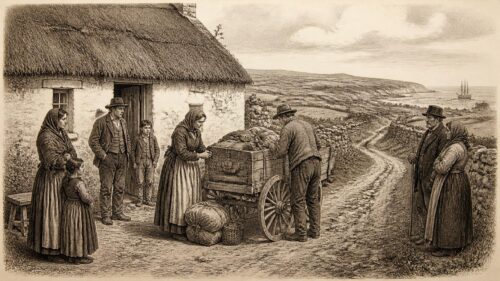
Emigration altered the island before migrants reached any distant shore. A departure could redistribute land, postpone marriage, remove a wage earner or enable relatives to survive through money sent home. It could also change expectations. For many young people, especially in the later nineteenth century, leaving became a recognised stage of life rather than an exceptional rupture. That normalisation did not remove sorrow. Farewell rituals and family narratives made separation emotionally powerful, but they should not be mistaken for evidence that every emigrant was coerced or permanently bereft.
Famine Departures
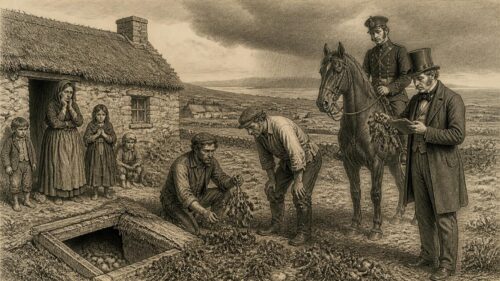
The Great Famine transformed both the scale and the memory of Irish emigration. Potato failure, poverty, disease, eviction and the inadequacy of relief systems created a catastrophe between the mid-1840s and early 1850s. Death and emigration together reshaped society. The Famine neither invented outward migration nor sent every emigrant directly to the United States, but it made departure a defining fact of modern Irish history.
The documentary record reveals several routes. Migrants sailed from Irish ports including Belfast, Dublin, Derry, Cork and smaller western harbours; many travelled first to Liverpool, where cheaper and more frequent transatlantic sailings were available. Britain itself received vast numbers of Irish migrants. Canada and the United States were crucial destinations, while Australia and other parts of the British Empire also drew emigrants. The journey could be dangerous, especially where overcrowding, poor provisioning and disease met weak regulation or unscrupulous operators.
“Coffin ship” is the best-known phrase associated with Famine crossings. It conveys a real history of suffering and death, and it remains embedded in commemoration. Yet it needs careful handling. Not every vessel carrying Irish migrants was exceptionally lethal, and mortality varied by ship, route, season, port and disease conditions. To use the phrase as if every emigrant vessel were identical turns evidence into folklore. The phrase is historically valuable as a memorial expression; it is not a substitute for examining records of particular voyages.
Migration during the Famine was also supported by the migrants themselves and by the people who had already gone. Remittances and prepaid passages made family reunification possible. This was the machinery of chain migration: one departure enabled another, and a settlement abroad became a practical resource for a village at home. Landlords, Poor Law authorities, charitable bodies and private schemes at times financed or encouraged emigration, particularly for those considered burdens on local poor relief. Such schemes cannot be described simply as humanitarian rescue or simple expulsion. The motivations of sponsors differed, while the choices available to the people leaving were often desperately narrow.
The Famine’s place in diaspora memory is profound. In Ireland and abroad it has been remembered through monuments, songs, wakes, family stories and political speech. Some of this remembrance has helped preserve the names and experiences of people whom official records ignored. Some has also encouraged an uncomplicated moral script in which every migrant becomes a passive victim and every departure a final banishment. Historical interpretation must hold both truths: migration was frequently born from structural deprivation and acute grief, while migrants also made decisions, sustained families, built organisations and shaped new lives.
Diaspora Politics
Irish communities abroad became important to politics on the island. The relationship was neither automatic nor always harmonious. Nineteenth-century nationalist movements drew funds, organisers, journalists and recruits from emigrant communities, particularly in the United States. Fenian networks operated across the Atlantic; constitutional nationalists cultivated overseas support; cultural nationalism found audiences among emigrants eager to preserve or recover links with Ireland.
However, diaspora involvement did not always correspond neatly with the strategies favoured in Ireland. Distance could encourage uncompromising rhetoric, while people living through British administration in Ireland had to calculate risks differently. The Irish Parliamentary Party, revolutionary republicans, labour organisers, constitutional reformers and opponents of Irish self-government all sought overseas audiences. Irish America was politically influential but internally divided by class, religion, generation, party allegiance and attitude to Britain. To describe it as a single national force is historically inaccurate.
The 1916 Proclamation expressly appealed to Ireland’s “exiled children in America”, showing how revolutionary language imagined the nation as extending beyond the island. That appeal was not merely sentimental. Overseas money, publicity and political contacts mattered. Yet the Proclamation’s invocation cannot prove that emigrants collectively endorsed the Rising or its consequences. Many did not. Nor did overseas support alone create the revolutionary crisis. The struggle for independence arose from forces within Ireland, including constitutional conflict, war, social change and the decisions of British and Irish political actors.
The diaspora’s political influence continued through the struggle for independence and the Civil War. American opinion and fundraising affected Irish arguments, but emigrant communities were divided over the Anglo-Irish Treaty and the legitimacy of the Irish Free State. Partition exposed another complexity. A politics that spoke of “Ireland” as an indivisible national unit met communities, especially in the North-east, whose political imagination was British, unionist or both British and Irish. Overseas descendants inherited these disputes in different forms.
Divided Allegiances
The partition settlement of 1920–22 did not divide an otherwise undifferentiated island. It formalised and intensified long-standing political, religious, economic and regional divisions. Northern Ireland remained within the United Kingdom, while the Irish Free State emerged from the Treaty settlement and later developed into the present Irish state. For nationalists, partition was commonly understood as an imposed severance of the island. For unionists, continued membership of the United Kingdom represented a democratic and legitimate constitutional preference. Historical writing should not conceal the unequal power of the British state in the creation of partition, but neither should it erase unionist agency or aspiration.
Partition affected diasporic identities. A person from Belfast, Armagh or Derry might describe himself or herself abroad as Irish, Northern Irish, British, Ulster Protestant, Ulster Scots or some combination. The choice could shift according to family story, destination and political circumstance. Many migrants from Northern Ireland went to Britain, where they were part of an internal United Kingdom movement rather than international emigrants in a legal sense. Nevertheless, they could experience dislocation, prejudice or a sharpened regional identity.
The Irish in Britain demonstrate why a shared-island history must also be an east-west history. Large-scale movement across the Irish Sea produced densely connected families, workplaces and neighbourhoods. Irish migrants contributed greatly to British industrial and civic life, while often facing anti-Irish and anti-Catholic discrimination. Recent scholarship based on long-run civil and probate evidence suggests that disadvantage among people identifiable through Irish surnames persisted in England across a strikingly long period. Such research complicates celebratory accounts of seamless assimilation.
At the same time, the history of Irish people in Britain cannot be told only through discrimination. They founded businesses, joined trade unions, served in armed forces, shaped churches and sports clubs, entered local government and became part of the ordinary social fabric of cities from London to Glasgow, Liverpool, Manchester and Birmingham. The same migrant networks that transmitted hardship transmitted opportunity, language, music and political debate. The diaspora was not external to British and Irish history; it was a bridge within it.
Northern Departures
The northern dimension deserves particular care because public memory has often privileged the Catholic Famine diaspora. Protestant and unionist migration was also extensive, and it produced its own institutions, commemorations and political loyalties. Ulster emigrants helped develop transatlantic Presbyterian networks and maintained connections with towns, congregations and kin. In some settings, their descendants expressed a distinctive regional tradition rather than an all-Ireland nationalism.
There is no contradiction in acknowledging that people from the same island carried incompatible constitutional convictions abroad. A shared island cannot mean that historical differences were imaginary or that one community’s story should be folded into another’s national narrative. The more defensible interpretation is that the island has long contained intertwined but unequal and contested communities, linked by geography and movement even when divided by political allegiance.
The Troubles added fresh layers of migration and memory. Violence, fear, economic uncertainty and political polarisation affected decisions to leave Northern Ireland, though migration cannot be reduced to conflict alone. People departed for education, careers, marriage and ordinary ambition as well as for safety. Abroad, the conflict generated fundraising, lobbying, public argument and cultural identification. It also produced harmful simplifications. Some external supporters romanticised armed struggle, while others saw Northern Ireland solely through a unionist security narrative. Both approaches could flatten the experience of civilians who endured violence from state and non-state actors.
For historians, it is important to separate evidence from inheritance. A family tale may accurately preserve a remembered eviction, a dangerous crossing, sectarian exclusion or a political affiliation. It may also compress several generations into one story, misdate an event or transform a relative’s choice into a legend of forced exile. Oral history is not lesser evidence; it is evidence of memory as well as experience. It gains strength when placed beside passenger lists, census returns, letters, newspapers, parish registers and official records.
Agreement Framework
The Belfast or Good Friday Agreement offered a new language for relationships on the island and between Britain and Ireland. Approved in referendums held north and south on 22 May 1998, it recognised the legitimacy of differing constitutional choices. It confirmed that Northern Ireland’s status could change only with the consent of a majority there, while also recognising the right of the people of the island to pursue a united Ireland by concurrent consent north and south.
Its importance for diaspora history lies in its refusal to make identity a zero-sum category. The Agreement affirmed the birthright of the people of Northern Ireland to identify and be accepted as British, Irish or both, and to hold British or Irish citizenship accordingly. This did not make identity uncomplicated. It did, however, establish a constitutional recognition of plural belonging that earlier state structures had often handled poorly.
The Agreement also built North-South and east-west institutions. This architecture matters because the phrase “shared island” can be misunderstood as a covert synonym for an immediate constitutional outcome. Historically and legally, the Agreement distinguishes practical cooperation from a predetermined constitutional destination. It supports shared work on matters of common concern while protecting the principle of consent. Any account that presents it as a mandate for one side’s preferred future misreads its balancing purpose.
The modern Shared Island initiative operates within this post-1998 setting. Its projects and dialogues encourage cross-border work in infrastructure, research, culture, health, heritage and community life. Their significance should not be exaggerated: funding and dialogue cannot by themselves resolve historical grievance, socioeconomic inequality or distrust. Yet historians can recognise a continuity with older forms of connection. Farmers, traders, workers, families, churches, sports clubs and artists have long crossed or ignored political boundaries. The difference is that current cooperation is consciously framed as reconciliation rather than merely necessity.
Memory Claims
Diaspora remembrance has often been a source of generosity and renewal. Overseas relatives sent money home, financed education, supported voluntary organisations and sustained cultural associations. In later generations, descendants visited ancestral places, researched family histories and contributed to archives and local heritage. Such acts can restore visibility to people omitted from official narratives.
They can also create difficulties. Genealogy sometimes encourages a search for a pure, singular origin that the historical record cannot support. Ireland’s population history includes movement into as well as out of the island, and family backgrounds may cross religious, linguistic and political boundaries. A surname is not a constitutional creed. County ancestry does not automatically confer authority over present-day political decisions. The descendants of emigrants may have a legitimate emotional stake in Ireland, but the constitutional future of Northern Ireland is governed by the people entitled to decide it under the Agreement’s consent provisions.
Folklore deserves respect without being promoted to proof. The “American wake”, in which an emigrant’s departure was marked with rituals resembling mourning, captures a genuine emotional truth: migration could feel like a death in the family. Yet practices varied across time and place. Not every household held such a gathering, and not every emigrant vanished from contact. Letters, remittances and eventually cheaper travel often made migration a continuing relationship rather than an absolute disappearance.
Likewise, the widespread claim that Ireland’s chief export was its people is a powerful political aphorism, not a statistical category. It conveys the extraordinary scale of departure and the sense of national loss that emigration produced. But it can obscure the agency of migrants and the material complexity of Ireland’s economy. It can also make migrants appear as a resource extracted from the country rather than as people who formed new families, loyalties and identities elsewhere.
Present Meanings
Today, “diaspora” is often used positively: as a global network of culture, commerce, tourism, diplomacy and kinship. This language corrects older assumptions that emigration was simply shameful national failure. Ireland is now also a country of immigration, and the histories of people arriving from elsewhere increasingly belong to the story of the island. A historically serious shared-island outlook must notice this change. It cannot define Irishness solely through descent from earlier emigrants while overlooking people who have made their homes in Ireland more recently.
The most constructive connection between shared-island work and diaspora history is not a claim that overseas communities possess a unified answer to constitutional questions. It is the recognition that mobility has repeatedly made identities plural. Migrants learned to inhabit several worlds: a parish and a city, an island and an empire, Ireland and Britain, an ancestral county and an adopted nation. That experience does not erase conflict, but it undermines the assumption that belonging must be singular.
There are risks in this interpretation. Cosmopolitan language can sound detached from communities whose experience of the border has been shaped by violence, discrimination or economic neglect. Appeals to shared heritage may feel hollow if they avoid difficult questions about commemorations, symbols, language rights, policing, victims and inequality. History offers no guarantee that contact produces trust. It does show, however, that separation has never been complete. The Irish Sea, the Atlantic and the border have connected as well as divided.
Historical Balance
The history of a shared island and its diasporas is therefore not a triumphal story of inevitable reconciliation. Nor is it a tale in which partition made mutual understanding impossible. It is a record of people moving through constrained choices, building ties across distance, carrying rival interpretations of home and adapting those interpretations to new places.
Documented evidence supports several firm conclusions. Emigration from Ireland has been vast and long-lasting; the Great Famine was a decisive acceleration rather than an absolute beginning; migrant communities were differentiated by class, region, religion and politics; partition reshaped identities without severing human connections; and the Belfast Agreement created a consent-based framework in which British, Irish and dual identities possess recognised legitimacy. These points are stronger than broad claims about a single national character or diaspora will.
Interpretation begins where historians ask what these facts mean. One may see diasporic networks chiefly as evidence of national endurance. Another may see them as evidence that Irish identity has always been multiple and transnational. Both can be useful if they remain answerable to records and if neither erases the experiences of unionists, nationalists, migrants, returnees and newcomers. Folklore, finally, retains its place: in the songs, wakes, stories and inherited phrases through which families make emotional sense of departure.
A shared island worthy of the name need not demand a shared conclusion about the past. Its historical foundation may be more modest and more durable: an acknowledgement that the island’s people have never been isolated from one another or from the wider world; that their differences have had real consequences; and that memory is richest when it allows room for more than one journey home.
The article’s insistence that diaspora is plural rather than a single inherited constituency is especially important for contemporary Shared Island initiatives. It suggests that overseas connections may offer resources, memories and dialogue, yet cannot straightforwardly represent the constitutional preferences of people living on the island. The Belfast Agreement’s recognition of British, Irish and combined identities provides a useful framework for avoiding simplistic appeals to ancestry. How should policymakers and community organisations involve diverse emigrant and descendant voices in cross-border projects while ensuring that historical memory enriches cooperation without being treated as a political mandate by those directly affected locally today?