

Guarded Harvests
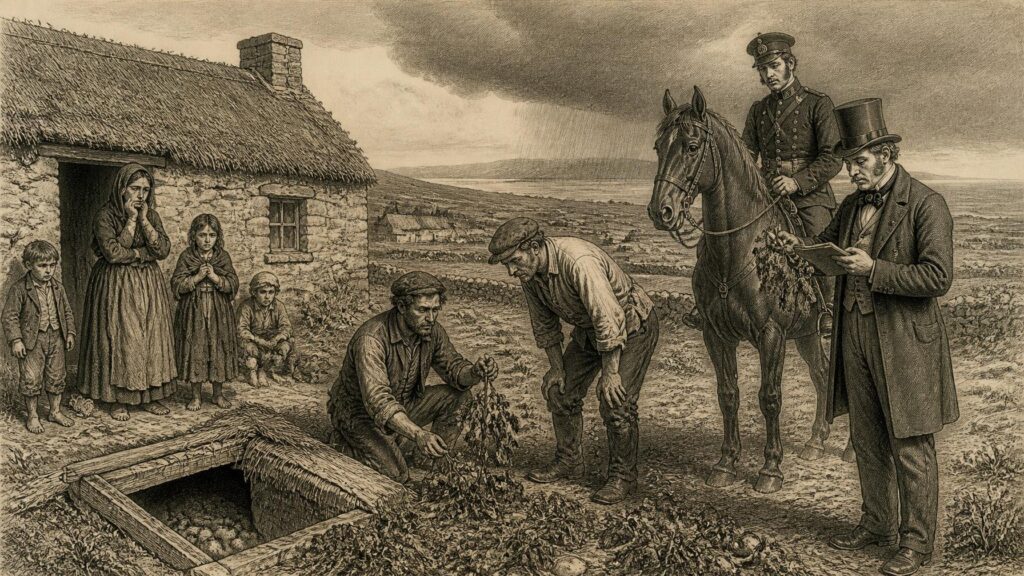
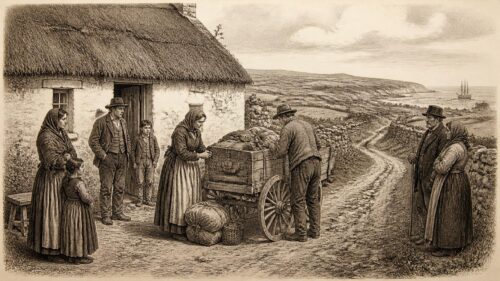
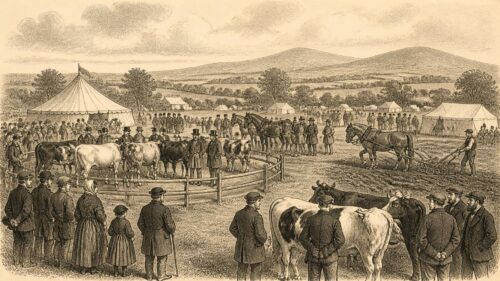
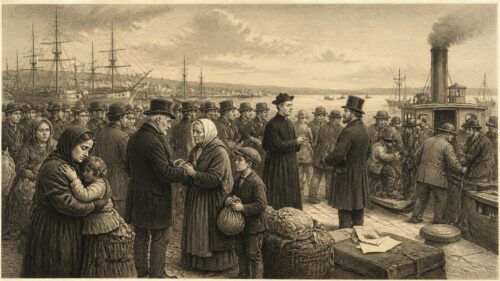
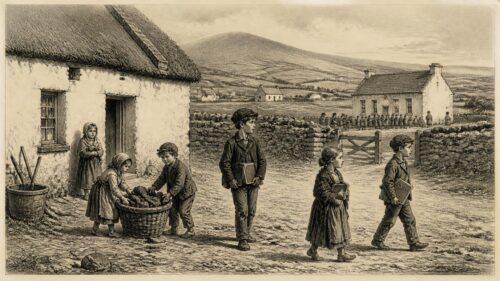
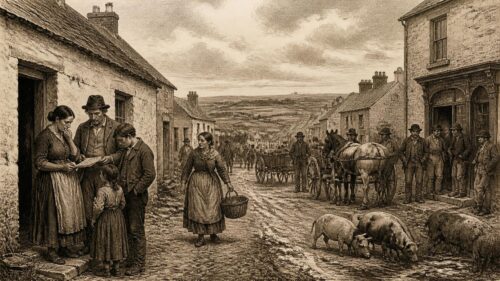
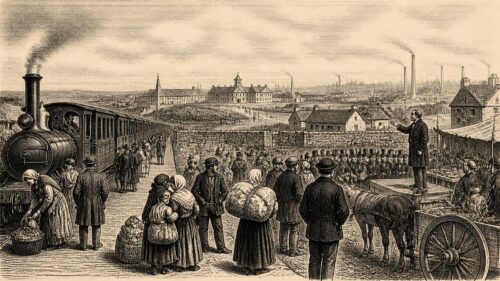
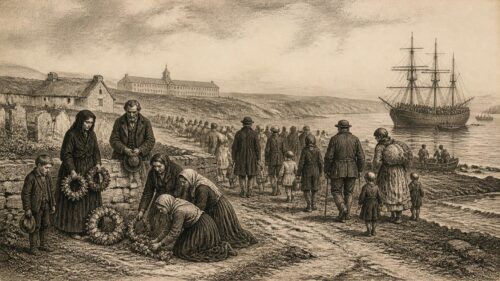
AI generated historical illustration, not a contemporary photograph.
At a Glance
Irish farming has repeatedly been tested not merely by bad weather or poor prices, but by invisible threats: the blight spore, the infected animal, the contaminated feedstuff and the unwitting movement of disease across a gate, market, port or border. The modern word “biosecurity” is comparatively recent, yet the historical problem is old. Ireland’s experience shows that agricultural disease is never only agricultural. It can expose dependence, poverty, failures of administration, limits of scientific knowledge and the difficult relationship between private livelihoods and public authority.
Defining Biosecurity
Biosecurity is now commonly understood as the practical organisation of measures intended to prevent, limit or manage the entry and spread of harmful organisms. On a farm, that may mean controlling purchases, isolating incoming stock, cleaning vehicles and equipment, managing feed, limiting visitors, testing animals, dealing safely with fallen stock, or stopping disease moving from wildlife to domestic animals. At national level it includes surveillance, laboratory diagnosis, import controls, notification rules, movement restrictions, compensation, slaughter policy and communication between farmers, veterinarians and the State.
That language should not be projected too simply backwards. A tenant farmer in the 1840s would not have spoken of biosecurity in the modern sense, and nineteenth-century officials did not possess today’s epidemiology, microbiology or systems of animal traceability. Yet they confronted recognisable predecessors of its central questions. What was causing loss? How did it travel? Could it be contained? Who had authority to order action? Who would bear the immediate cost of prevention? And what happened when the people most exposed to danger lacked the resources to act upon official advice?
Irish history is unusually revealing because the island’s agricultural economy was repeatedly shaped by dependence on particular species and markets. The potato was central to the sustenance of much of the rural poor before the Great Famine. Cattle, dairy produce, pigs, sheep and poultry later became vital to commercial agriculture and export. Such concentration brought efficiency and income, but it also created vulnerability. A biological threat aimed at a staple crop or a major animal sector could become a social crisis, especially where households had few reserves.
The history discussed here is principally that of the Republic of Ireland after independence, while necessarily reaching back to the whole island under the Union and acknowledging all-island agricultural realities. Disease organisms do not recognise constitutional frontiers. Nonetheless, regulation, public administration and political accountability have differed across jurisdictions, and that distinction matters when interpreting later measures.
Potato Dependence
The best-known Irish farming crisis remains the failure of the potato crop in the 1840s. It is tempting to tell that catastrophe as a story in which a single plant disease directly produced famine. That is true only in the narrowest biological sense. Late blight destroyed a principal food crop, but hunger on the scale experienced in Ireland arose because a very large and impoverished population was heavily dependent upon that crop, because access to land and food was unequally organised, and because relief policy was constrained by political assumptions and institutional choices.
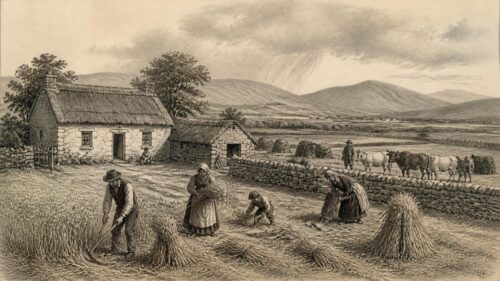
Before the blight, the potato had been an exceptionally productive food for many smallholders and labourers. It could yield heavily on small plots and, combined with milk or other foods where these were available, helped sustain families who possessed little land and little cash. That usefulness concealed a structural peril. A household that relied on one crop for most of its food had limited room to absorb a general failure. Unlike grain, potatoes were bulky, perishable and difficult to store over long periods. Seed itself was also food: in a crisis, eating the seed stock might be the difference between immediate survival and the loss of next year’s crop.
Contemporary and later evidence makes clear that observers had long worried about the precariousness of excessive potato dependence. Such warnings did not remove the underlying conditions that made the potato indispensable. Historical interpretation therefore requires care. It would be wrong to blame poor people for cultivating the crop most capable of feeding their households on limited ground. It would be equally wrong to describe the disaster as an inevitable natural event detached from landholding, employment, food distribution, public relief and governmental decisions.
In this sense the Famine was an early and terrible lesson in agricultural resilience. Resilience does not mean merely identifying a pathogen. It means whether people possess alternative food, savings, secure access to land, functioning public assistance and a realistic ability to follow protective instructions. The biological event was a trigger; the social order determined how ruinously it would be felt.
Blight Arrives
Late blight, caused by Phytophthora infestans, reached Ireland in 1845. Modern science classifies the organism as an oomycete rather than a true fungus, though it has long been described in everyday language as a fungal disease. Its arrival followed wider transatlantic movements of crops and trade. Teagasc research has emphasised that the pathogen was not native to Ireland and that its devastating historical significance came from its encounter with a crop population and rural society profoundly vulnerable to its effects.
The first season did not appear everywhere with uniform severity. This variation encouraged uncertainty. Reports disagreed about the extent of loss, and many people hoped that the damage might prove partial or temporary. The National Archives preserves evidence of officials, constabulary officers, boards of guardians, landlords, clergy and local observers attempting to measure what was happening. Their correspondence is valuable not because it provides one flawless national picture, but because it records uncertainty itself: differing local assessments, rising prices, apprehension about winter, and anxious arguments over what relief should be provided.
In 1846 the destruction was much more severe. Potatoes which had seemed healthy could blacken and decay with alarming speed. The crop’s apparent abundance in summer gave way to scenes of devastation, while stored tubers also deteriorated. The physical signs were vivid enough to become part of Irish cultural memory: blackened foliage, foul-smelling pits and the sight of families watching their food supply collapse. Such memories have often taken on a near-apocalyptic quality. They should be respected as testimony to suffering, but historical explanation must distinguish remembered image from proof of universal experience. The disease’s effects varied by locality, season, variety, soil and household resources; the social consequences were nevertheless catastrophic on a national scale.
There is no need to invoke superstition to understand why people searched for causes. The germ theory of disease was not yet established in the form later generations would recognise, and plant pathology was still developing. Damp weather, atmospheric conditions, soil, storage methods and cultivation practices were all debated. Many proposed remedies were ineffective, but such experiments were not necessarily foolish. They represented attempts to act under conditions of incomplete knowledge, when an unknown agent had undone the foundation of subsistence.
Scientific Responses
The governmental response included attempts to understand and preserve the remaining crop. A scientific commission considered methods for storing sound potatoes, making use of diseased ones and obtaining seed for the following year. The archival record described by the National Archives includes proposals for ventilated pits, the use of lime, experiments intended to extract usable food from damaged tubers, and repeated official enquiries into crop condition and local distress.
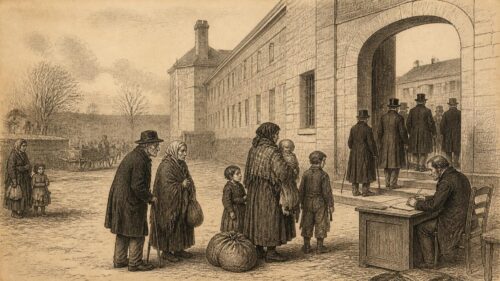
These efforts reveal an important feature of crisis management: observation and intervention often proceed together. Officials wanted knowledge of disease incidence, food prices, acreage, workhouse admissions, wages and the proportion of people dependent on potatoes. Such data collection was an ancestor of later agricultural surveillance. Yet information did not ensure an adequate response. A report could reach Dublin Castle; it could not, by itself, restore a harvest, alter a tenant’s access to food or replace income lost through crop failure.
Ventilation pits are especially instructive. Advice to improve storage assumed that sound potatoes might be separated from decaying ones and protected from damp. In some circumstances better storage could reduce losses. But the archive also records the failure of many pits. This was not simply a technical defect. Poor households often lacked the capital, labour, secure tenure or sound crop needed to carry out recommended measures successfully. A biosecurity measure that is materially unavailable to those expected to implement it is not a complete safeguard.
The blight crisis also helped generate a lasting scientific legacy. The attempt to identify the cause of potato disease formed part of the emergence of modern plant pathology. Later researchers came to understand that crop health required attention to pathogen populations, seed tubers, volunteer plants, waste heaps, weather conditions and resistant varieties. These are familiar elements of present-day blight management. Contemporary Irish potato guidance still stresses prevention because an established blight outbreak cannot simply be erased from a growing crop.
It would be simplistic, however, to claim that modern crop science has “solved” the old problem. Late blight remains a serious disease of potatoes in Ireland. The pathogen changes, fungicide resistance can develop, and weather conditions favourable to infection recur. The historical lesson is not that Ireland moved from ignorance to permanent mastery. It is that biological control is continuous work, requiring adaptation as organisms, farming systems and environmental conditions change.
Veterinary State
The potato blight exposed the consequences of crop disease. Later Irish history made animal disease equally important. As livestock became increasingly central to farming, the State developed a more formal veterinary role. Disease control demanded rules that could intrude directly into farm life: inspection, testing, notification, movement controls, market regulation, quarantine, slaughter and compensation. These measures could be unpopular and financially painful, but they reflected a hard practical reality. An infected animal may look like private property, yet the consequences of moving it can be public.
The legal architecture was consolidated after independence in the Diseases of Animals Act 1966. Its provisions show the range of threats officials considered: cattle plague, foot and mouth disease, swine fever, anthrax, fowl pest, bovine tuberculosis, brucellosis and other conditions. The Act empowered the regulation of animal movements, transport, imports, quarantine stations, markets and isolation. It also provided a framework for slaughter and compensation in particular circumstances.
Such legislation illustrates a central tension in biosecurity. Effective disease control frequently requires decisions before complete certainty is possible. If authorities wait until every animal is proven infected, disease may already have spread. If they impose restrictions too broadly, they can inflict losses on people who have done nothing wrong. Compensation is therefore more than a humane addition to disease policy. It encourages reporting and compliance. A farmer who expects uncompensated ruin may conceal an illness; one who trusts a fair system has a stronger reason to notify the authorities promptly.
Historical policy also shows that disease control is a chain. Quarantine at a port is weakened if farm movements are poorly recorded. Testing is weakened if infected animals can be traded before results are acted upon. Slaughter is weakened if replacement stock are introduced without proper assessment. Public messaging is weakened when farmers see rules as arbitrary or impractical. In this respect, biosecurity is not a single barrier but a social and administrative network.
Testing Herds
Bovine tuberculosis offers one of the longest and clearest examples of this network in the Irish State. The disease was endemic in cattle before the national eradication programme began in 1954. The programme initially proceeded on a voluntary basis and later became compulsory. It combined tuberculin testing, removal of reactor animals, compensation, veterinary labour, movement rules and efforts to improve farm conditions. The early results were striking: official accounts record a sharp fall in herd incidence during the first decade of the campaign.
This apparent success encouraged declarations that Ireland had become effectively free of the disease by the mid-1960s. The subsequent history proved more difficult. Tuberculosis did not disappear. The programme continued, and by the late twentieth century the State was investing in renewed organisational and scientific efforts. Official reviews have described how progress slowed after the initial gains, while research increasingly examined cattle movements, herd history, local disease patterns, wildlife interaction, testing performance and farm biosecurity.
The significance of this history lies partly in what it corrects. Eradication is often imagined as a straight line: test, remove, repeat, finish. In reality, disease can persist through multiple routes of transmission and through the limitations of detection. A negative test is valuable evidence, not a guarantee that infection is impossible. A farm may be carefully run and still face risk through purchased cattle, neighbouring herds, shared boundaries, wildlife or a legacy of infection. The persistence of bovine tuberculosis is therefore not proof that farmers or veterinarians have failed; it demonstrates the stubbornness of an infection operating within living landscapes.
There is also a public-health dimension. Bovine tuberculosis can affect humans, which helps explain why twentieth-century programmes concerned both agricultural productivity and the food supply. The effort to control it required farmers to accept regular testing and the removal of animals that might otherwise have been sold or retained. It required the State to fund laboratories, inspectors, veterinary services and compensation. In historical terms, it was an ambitious attempt to create a healthier national herd through repeated, standardised intervention.
Feed Crisis
Bovine spongiform encephalopathy, usually known as BSE, added a different kind of crisis in the late twentieth century. It brought animal health, food safety, international trade and public fear into a single political problem. The disease’s association with contaminated feed challenged assumptions about what could safely circulate within intensive agriculture. In particular, it showed that the feed chain was not separate from the human food chain. Material processed for animal consumption could create risk much further along the system.
Official Irish accounts differ over the precise year in which the first Irish case was identified, a reminder that historical chronology should be checked rather than casually repeated. What is clear is that BSE became subject to notification and control measures in the late 1980s and early 1990s, including restrictions on meat and bone meal for ruminants. Following the recognition in 1996 of a link between BSE and variant Creutzfeldt-Jakob disease in humans, controls were substantially strengthened.
The response was not confined to visibly sick cattle. It included surveillance, restrictions on feed, removal of specified risk material from food and feed chains, controls around infected animals, testing of particular categories of cattle, and procedures designed to prevent potentially infected material from entering human consumption. This was biosecurity in a broader and more unsettling form. The risk could not be managed solely by inspecting a field or isolating a visibly ill beast; it required tracking materials through slaughter, rendering, transport, laboratories and markets.
BSE also altered the politics of confidence. For consumers, reassurances based on official inspection were no longer abstract. For farmers, export markets and domestic prices could be affected by events beyond any individual holding. For government, the credibility of veterinary and food-safety systems became inseparable from public willingness to accept scientific advice. Ireland’s later recognition as a country of negligible BSE risk rested not on a claim that history had been forgotten, but on accumulated evidence from risk analysis, surveillance and long-term controls.
Border Controls
Foot and mouth disease demonstrates the importance of rapid movement restrictions. It is highly contagious among cloven-hoofed animals and can spread with alarming economic consequences, even though it is not normally a major human health risk. Ireland’s last known case was in 2001, in a single flock of sheep. The event occurred during the wider British outbreak and illustrated the island’s exposure to disease movement through trade, transport and proximity.
When foot and mouth is suspected, ordinary farm routines must stop. Animals, people, vehicles, carcasses and equipment may all become relevant to the investigation. Contemporary official advice retains the essential principle: do not move anything associated with susceptible livestock from the farm until veterinary instructions are received. That instruction may sound severe, but its logic is historical. The early hours of an outbreak can determine whether infection is confined or multiplied through marts, haulage networks and neighbouring holdings.
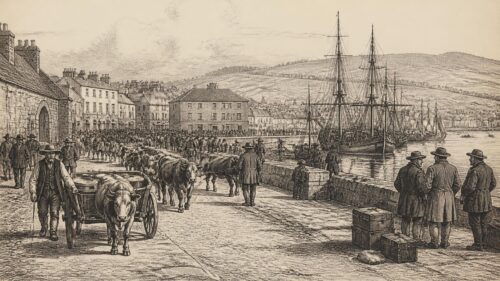
Control measures also reveal the distinction between a border on a map and a biosecurity boundary. Ireland’s geography gives it advantages as an island, yet it is not biologically isolated. Animals, animal products, feed, machinery, visitors, wildlife and pathogens move through many channels. The land frontier on the island adds another practical layer. Effective protection has consequently depended on cooperation, shared information and compatible disease-control practices as well as formal controls at ports and airports.
These historical episodes should discourage romantic ideas of self-sufficiency. Isolation can reduce some risks, but no agricultural system is sealed. Modern farming relies upon commerce, breeding, veterinary medicines, imported inputs, processors and transport. The challenge is not to end movement, which would itself damage rural livelihoods, but to make necessary movement traceable, assessed and as safe as possible.
Living Systems
Biosecurity must also account for wildlife, weather and ecological change. Bovine tuberculosis is a prominent example because control cannot be reduced to cattle alone. Research and policy have increasingly addressed interaction between cattle and wildlife, while farm-level measures seek to limit opportunities for transmission. This does not make wildlife a convenient villain. It means that disease ecology is more complicated than a single infected animal entering a herd.
Avian influenza presents another variation on the same theme. Wild birds can carry viruses across great distances, while commercial and backyard poultry holdings may be vulnerable to contamination brought in on footwear, equipment, vehicles, feed, litter or contact with wild birds. Housing orders and stringent hygiene measures can appear burdensome, especially to smaller keepers. Yet their purpose is to interrupt the connection between a wild reservoir and a concentrated domestic flock.
Plant disease, livestock infection and bird flu differ in biology, but their management shares recurring practices: observation, early reporting, separation, controlled movement, cleaning, disposal, records and collective discipline. The history of Irish farming shows that these practices acquire meaning through circumstance. A farmer may remember them as a bureaucratic burden during calm years and as a necessary protection during an outbreak. Both perceptions can be understandable.
Climate and changing production systems add further uncertainty. Mild, wet conditions are favourable to potato blight; intensified animal movements can complicate tracing; changing wildlife patterns can alter contacts between species. It would be unwise to claim that every new outbreak has one simple environmental cause. What can safely be said is that farming takes place in dynamic biological systems, and policies designed for one pattern of risk require regular revision when those systems alter.
Historical Lessons
The clearest lesson from Irish farming crises is that prevention cannot be separated from justice and capacity. During the Famine, advice on preserving potatoes did little for people whose food system had already failed and whose material choices were brutally restricted. In livestock disease control, testing and slaughter only work sustainably when farmers can trust diagnosis, receive intelligible information and obtain fair treatment for losses. A disease policy imposed without credibility may encourage evasion; a policy designed with no regard for farm realities may be impossible to practise.
A second lesson is that science is indispensable but never instantaneous. In 1845, investigators confronted an unfamiliar plant disease with limited tools. Later veterinary programmes could use tests, laboratories and statutory powers, yet bovine tuberculosis still resisted complete eradication. BSE required a reconception of risk across the food chain. The proper historical conclusion is neither contempt for earlier practitioners nor blind faith in modern systems. Knowledge grows through investigation, but every generation works with uncertainty.
A third lesson concerns memory. Folklore and family recollection are important parts of rural history, especially where disease left fear, bereavement or loss. They may preserve the felt experience of a blackened crop, an emptied byre or a blocked road better than an official report can. But they should not be confused with documentary proof about cause, scale or chronology. Archival returns, legislation, laboratory evidence and veterinary records establish one kind of historical evidence; remembered stories establish another. Good history makes room for both while being clear about their difference.
Finally, Irish biosecurity history is a history of interdependence. Farmers, labourers, veterinarians, scientists, civil servants, traders, processors and consumers occupy different places in the system, but none is outside it. The potato blight showed how crop disease could become a national calamity when vulnerability was widespread. Tuberculosis, BSE and foot and mouth showed how animal disease could affect food, trade, law and public confidence. The practical routines now associated with biosecurity—cleaning boots, isolating animals, reporting suspicion, controlling feed and recording movements—are modest acts with a long historical shadow. They are the everyday expression of a lesson learned repeatedly and often painfully: in agriculture, the safety of one holding is bound to the health of many others.
Guarded Harvests demonstrates that biosecurity has repeatedly relied on more than detecting disease: it has required trust, compensation and practical resources for people expected to follow restrictions. The contrast between potato blight, where vulnerable households could not always use recommended safeguards, and later livestock programmes suggests that technically sound measures may falter without social support. This remains relevant when diseases move through trade, wildlife and shared boundaries, making responsibility difficult to assign. How should Ireland balance surveillance, movement controls and compensation today so that biosecurity protects health and agricultural livelihoods while retaining farmers’ confidence and recognising unequal capacity to comply?