Clonard’s Half-Burned Grain751 CE
In 751, Irish annals recorded regional political and ecclesiastical change rather than a national event. Half the stored grain at Clonard, a major Meath monastery, was destroyed in uncertain circumstances, exposing the dependence of religious communities upon agricultural production, estates and redistribution. Flann of Uí Fhailgi and Fergus of southern Brega died, creating potential succession openings without recorded conflict. Numerous abbots, bishops, rulers and learned figures also died across Ireland, illustrating the reach of connected churches and monastic networks. The evidence does not establish famine, epidemic, warfare or Viking activity. Instead, 751 reveals fragmented kingship, clerical influence and material vulnerability.
Dateline
In 751 CE, Ireland’s annalists recorded no single island-wide battle, royal assembly or diplomatic settlement. Instead, the year survives through a striking combination of local loss: two regional kings died, a substantial quantity of grain was destroyed at Clonard, and a series of clerics and ecclesiastical leaders passed from the record. This is not an empty year. It reveals how power, food security and religion were interwoven across early medieval Ireland. The principal contemporary annalistic traditions agree on several core notices, although their terse language and later copying mean that the scale and precise circumstances of some events cannot be recovered.
A Fire at Clonard
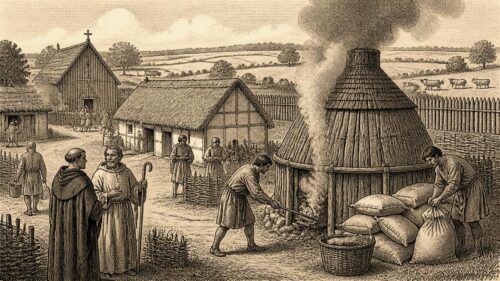
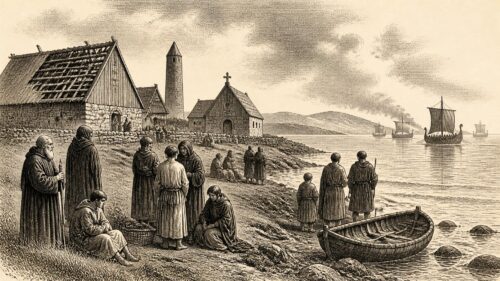
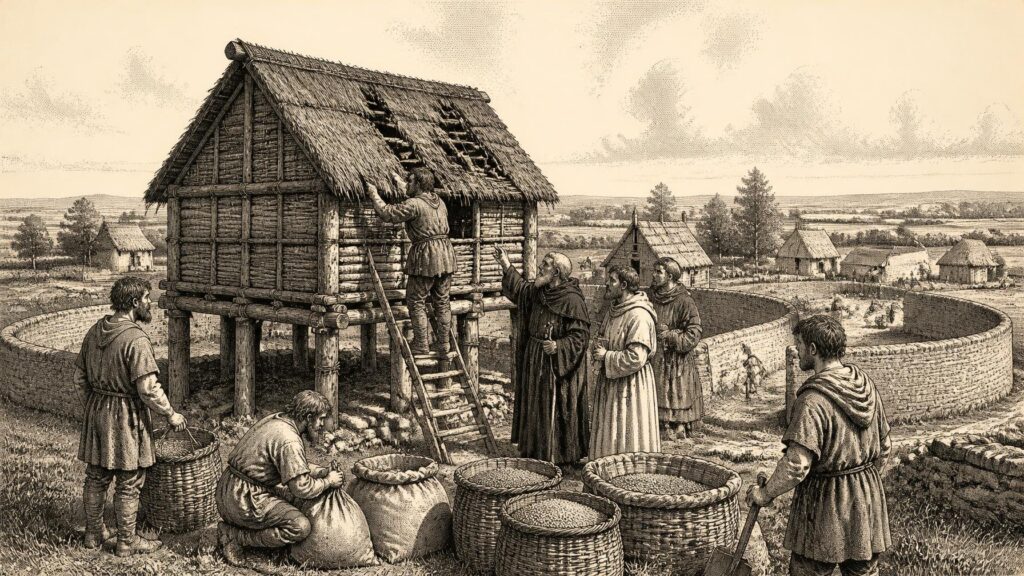
The most tangible incident is the burning of “half the stored grain” at Cluain Iraird, Clonard in modern County Meath. The Annals of Ulster adds the difficult word translated by its editors as “in a kiln(?)”; the Annals of Tigernach preserves a different and equally problematic reading. Neither source tells us whether this was an accident, a cooking or drying mishap, or deliberate destruction. It therefore cannot responsibly be called a raid or an arson attack. What can be said is that an exceptionally important food reserve was lost at a major church settlement.
Grain was not a minor supplement to an otherwise pastoral economy. Cattle, dairying and animal products were central to wealth and food, but cereals were essential for bread, porridge and ale. Stored grain also represented labour already invested: ploughing, sowing, harvesting, threshing, transport and protection from damp, vermin and fire. A store large enough for an annalist to note its partial destruction was likely connected with a community extending well beyond a handful of religious specialists. It could have supplied clergy, dependants, guests, tenants, labourers and travellers, as well as providing seed for a following season.
Clonard’s standing explains why the loss mattered. Founded in the early Christian period and prominent for centuries, it was among the great ecclesiastical centres of the Irish midlands. Archaeological survey has shown that the surviving landscape around St Finian’s church contains traces consistent with a far more extensive settlement, including enclosures, drainage features and possible buildings. In 751 its built fabric was mostly perishable: timber churches, houses, workshops, fences and stores, rather than the stone ruins visitors might expect today. The phrase about stored grain consequently offers an unusually direct glimpse of the working infrastructure beneath Clonard’s reputation for sanctity and learning.
The fire also underlines a broader vulnerability. A monastic settlement was a religious institution, but it was also a landed household and a hub for production and redistribution. Its reputation rested on prayer, teaching, hospitality and commemoration; all depended upon food. Losing half a reserve need not mean famine in 751, and the annals do not report one. Yet it would have imposed a practical burden: alternative supplies had to be found, consumption adjusted, or obligations called in from the community’s wider network. That mundane emergency is the year’s clearest documented economic development.
Deaths and Regional Power
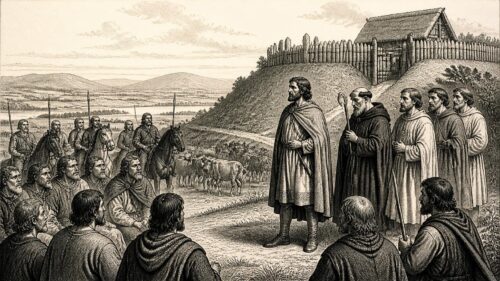
The annals also place political change in the foreground. Flann grandson of Congal, king of Uí Fhailgi, died. Uí Fhailgi was a major people and kingdom of the central midlands, broadly associated with much of later County Offaly. His death did not automatically produce a succession crisis; Irish kingship normally belonged to a ruling kindred rather than passing by simple primogeniture. Nevertheless, the death of a king created a moment at which competing eligible relatives and allied groups could renegotiate authority, land, clientship and military followings.
Fergus, or Fergal, son of Fogartach, king of southern Brega, also died. Southern Brega lay in the politically dense country north of the Liffey and around the lower Boyne, where branches of the Uí Néill and their rivals competed for regional supremacy. Its churches, royal sites and river routes gave the area weight beyond its size. The paired notices for Flann and Fergus show that 751 brought change to two neighbouring but distinct political worlds: one in the midlands west of Brega, the other in Brega itself. The record names no successor and no fighting. It is better to recognise the openings created by their deaths than to invent contests that the sources do not describe.
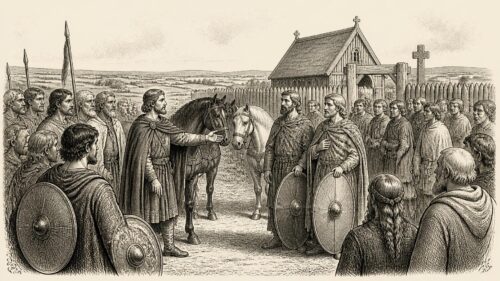
Ireland was not a unified kingdom ruled through a permanent national administration. Kings exercised authority through kinship, tribute, hosting, fosterage, alliances and the control of strategic places. An overking could claim wide precedence, but local kings remained consequential. Domnall mac Murchada, usually known as Domnall Midi, was the leading Clann Cholmáin ruler of the period and is later styled king of Tara in the annals. That wider political setting helps explain why events in Uí Fhailgi, Brega and Meath mattered. But 751 itself supplies no evidence that Domnall personally directed either succession, and the year should not be made into a demonstration of a centralised Irish state.
A Network of Churches
The clustering of ecclesiastical deaths is remarkable. Echaid of Cell Tóma died; the Annals of Tigernach identifies the place as Kiltoom. Céile Do-Laisse of Daiminis, Devenish in Lower Lough Erne, also died. Colmán “of the Britons”, son of Faelán and abbot of Slane, died, as did Nuadu son of Dub Sléibe, abbot of Cluain Eóis or Clones. Fursa, abbot of Lecan in Mide, and Máel Imarchuir, bishop of Echdruim, were likewise recorded. Tigernach adds Cuangus, abbot of Liath Mór; Loscaigde, described as a wise man; Muirgius son of Fergus, king of the Déisi; Mac Luiged of Lismore; and Fland Fortri, king of Corcu Loígde.
These notices should not be read as proof of a single disaster sweeping Ireland. The annals do not name disease, famine or warfare as a common cause. Their concentration instead reflects the kind of people and institutions that an annalistic network considered worth preserving in memory: kings, abbots, bishops, learned men and figures tied to well-connected churches. The geographic spread is significant. Devenish lay on an island in Lough Erne; Clones stood near the Ulster borderlands; Slane was closely linked to the royal landscape of north Brega; Lismore belonged to Munster; Clonard and Lecan were in the midlands. Religious connections crossed provincial boundaries even where political power remained fragmented.
Slane’s abbot is especially revealing. The designation “of the Britons” may preserve an origin, affiliation or nickname, but the annals do not explain it and no elaborate biography can be built from it. Still, his recorded office demonstrates the standing of Slane’s church. The hill and monastery overlooked the Boyne valley and stood near the power-base of the kings of north Brega. Its association with Patrick was already embedded in ecclesiastical tradition by the late seventh century. An abbot there was therefore a religious superior, a manager of resources and a participant in a landscape where royal and church interests met.
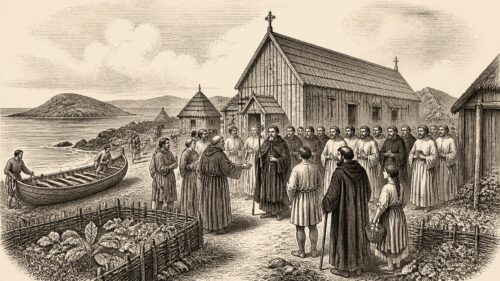
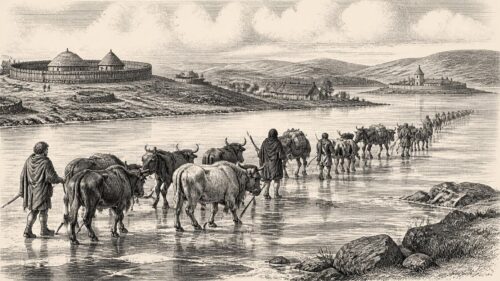
At Devenish, the death of Céile Do-Laisse shows the continued importance of island churches in the lake networks of the north-west. Such foundations were not isolated merely because they stood on water. Lakes and rivers were routes as well as barriers, enabling movement of people, livestock, goods, messages and religious influence. Archaeological and landscape research stresses that early Irish monasteries had outer enclosures and economic zones beyond their ritual cores. The communities remembered in the annals were sustained by surrounding estates and lay populations, not by prayer alone.
Learning, Memory and Limits
The death of Loscaigde “the wise man” is a small but valuable cultural notice. Wisdom in an early Irish annal could encompass learned status, legal knowledge, scriptural expertise, poetry, genealogy or teaching; the word is not precise enough to assign him one profession. Yet it confirms that intellectual standing was publicly recognisable. Monasteries were principal settings for literacy, Latin learning, the copying of books and the preservation of genealogies and history. Their scholars worked within an Irish-speaking society whose political and religious institutions required trained people to compose, remember, judge and record.
That learning should not be romanticised into a picture of serene cloisters detached from ordinary life. The same institutions that supported scholars required grain stores, labour, cattle, patronage and protection. Abbots could be politically important, while kings endowed, defended or exploited churches. The linked notices of 751—food lost at Clonard and religious leaders dying from Erne to Munster—make this interdependence visible.
There are also firm limits to the year’s evidence. No securely dated entry for 751 in the main annals reports Viking activity in Ireland; the Scandinavian raids familiar from later decades had not yet begun. Nor do the records provide a basis for describing a particular harvest, weather event, trade voyage or artistic commission in this calendar year. The later Annals of the Four Masters places several dramatic episodes under its own heading for 751, but its chronology differs from the earlier annalistic sequence. Those notices should not be transferred uncritically into 751 CE. The responsible picture is narrower but more revealing: a year of regional succession, clerical transition and a serious loss of grain at one of Ireland’s great monastic settlements.
Primary Sources
- The Annals of Ulster, Year U751
- The Annals of Ulster: TEI Header and Editorial Information
- The Annals of Tigernach
- The Annals of Tigernach: TEI Header and Editorial Information
- Annals of the Four Masters, Annal M751
- Annals of the Four Masters: Editorial Information
- Chronicon Scotorum: CELT Project Documentation
- Collation of the Irish Regnal Canon
- Geophysical Investigation of the Site of the Former Monastic Settlement, Clonard, County Meath, Ireland
- County Meath Urban Archaeological Survey: Slane
- Devenish Ecclesiastical Site
- Early Christian Irish Monasteries Survey
- Module 1: Transformation from Pre-Norman Monasticism to the Introduction of Religious Orders in Ireland
- The Archaeology of Lake Settlement in Ireland, Volume 1
- The Archaeology of Lake Settlement in Ireland, Volume 2
- Early Medieval Ireland: Archaeological Excavations, 1930–2009
- Early Christian Monasteries
- Churches and Ecclesiastical Enclosures
- Early Irish Monasticism
- Early Monastic Churches
- Christian Ireland, Fifth to Eighth Centuries
- Clonmacnoise Visitor Guide
- Residence, Ritual and Rulership: A State-of-the-Art for Royal Places in Early Medieval Ireland
- Patrician and Early Christian Architecture