

Cannocks Limerick
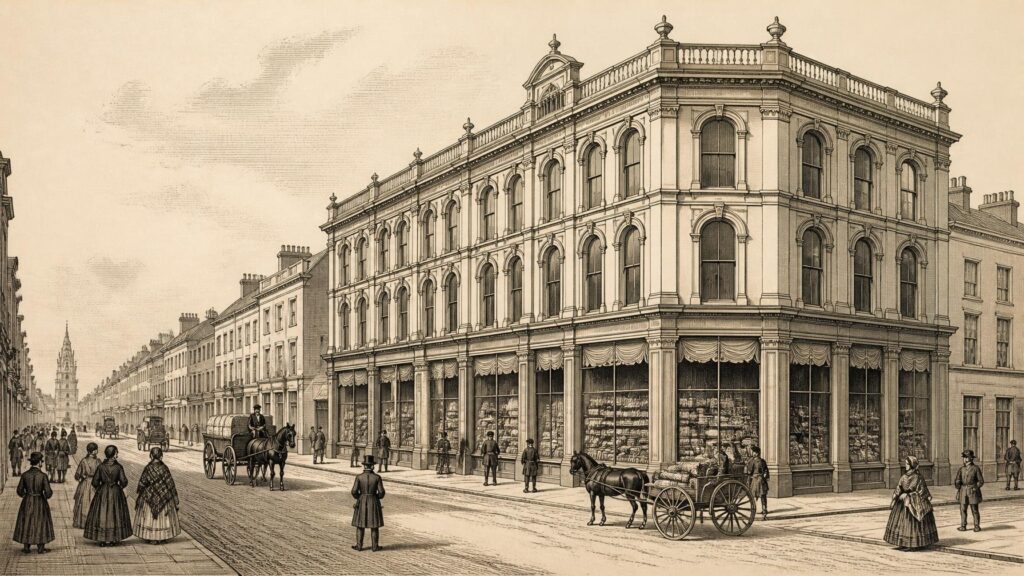
AI generated historical illustration, not a contemporary photograph.
At a Glance
For more than a century, Cannock’s was not merely a shop in Limerick: it was a conspicuous commercial institution, a workplace, a supplier to the surrounding region and, in the recollections of many inhabitants, a marker of the city centre itself. Its changing ownership, premises and fortunes reveal much about the making of modern Limerick. The evidence is especially valuable because it survives not only in retrospective memory but in company minutes, accounts, shareholder material, salary books, order books and civic records. Together these sources allow the business to be placed within a history of migration, manufacturing, retail, municipal ambition, political rupture and urban remodelling.
Commercial Origins
The story commonly associated with Cannock’s begins in 1850, when George Cannock and John Arnott purchased a drapery concern at 134 George Street, the thoroughfare later renamed O’Connell Street. The business had been operated by Cumine and Mitchell, a partnership associated with Scottish commercial enterprise. Its site stood in Newtown Pery, the planned Georgian expansion of Limerick whose broad streets and regular building plots made it the city’s principal setting for nineteenth-century mercantile display.
That date should not be mistaken for the beginning of trade on the site. Later accounts indicate that drapery activity had existed there for decades, while local historical material places earlier commercial occupation in the late eighteenth and early nineteenth centuries. What changed in 1850 was the ownership and the scale of the ambition attached to the premises. Cannock and Arnott were not inexperienced local newcomers. They already operated in Dublin, where their Henry Street concern would ultimately be associated with the Arnott name. Their purchase in Limerick therefore joined the city to a wider network of British and Irish urban retailing.
The firm’s history also cautions against treating a department store as a fixed institution with a single unchanging identity. During its long existence it was styled in several ways, reflecting partnerships, limited-liability arrangements and changes of control. Later memory generally reduced the story to the familiar possessive name, Cannock’s. That enduring name was commercially powerful, but it obscured a succession of people who financed, managed, rebuilt and reshaped the enterprise.
In the middle decades of the nineteenth century, drapery was a particularly important branch of retail. Cloth, clothing, haberdashery and household textiles were essential commodities, yet they also carried social meanings. A city draper served ordinary practical needs while selling the materials through which households marked respectability, mourning, celebration and aspiration. A successful premises could consequently draw custom from urban residents, rural traders and visitors alike. Cannock’s later expansion beyond a narrow drapery trade was rooted in that central position of cloth within domestic and public life.
Scottish Networks
The early history of the business demonstrates the importance of Scottish migration and commercial connections in nineteenth-century Limerick. George Cannock, John Arnott and the later partner Peter Tait were Scots or Scottish-born figures whose careers unfolded in Ireland. Such connections should not be presented as an external force simply imposed upon Limerick. Their firms depended upon local customers, local workers, Irish suppliers and the economic life of the city and its hinterland. Nevertheless, the biographies of these proprietors show how capital, expertise and commercial practices circulated across the Irish Sea.
Peter Tait’s role was especially consequential. Born in Scotland in 1828, he came to Limerick as a child. The archival description of the Cannock collection records that Arnott sold his interest in the Limerick business to Tait in 1858. From then, Tait drove expansion into Honan’s Quay and helped broaden the range of activity to include glove making, furniture, cabinet making, polishing and upholstery. This was more than a larger shop floor. It represented an attempt to combine retailing with skilled production and finishing work.
Tait’s wider career connected the store with Limerick’s industrial development. He founded a clothing factory at Boherbuoy, which archival accounts state employed 1,300 people. That figure indicates the scale of his manufacturing interests, although it belongs to the factory rather than to the department store alone and should not be casually transferred to Cannock’s staff. The distinction matters. The Limerick enterprise formed part of a wider business world in which a proprietor could hold interests in factory production, retail premises, property and transport.
He was also an important civic figure, serving three terms as mayor of Limerick between 1865 and 1868. The clock tower erected in his memory at Baker Street indicates the prominence he achieved in the city. Yet civic eminence did not make a commercial empire secure. The conjunction of Tait’s manufacturing, municipal and mercantile activities is historically revealing precisely because it shows both the opportunities and hazards created by rapid expansion in a nineteenth-century provincial city.
Store Rebuilding
The physical growth of the premises was one of the clearest expressions of the partnership’s ambitions. In 1858, the same year in which Tait acquired Arnott’s interest, major rebuilding took place. The Irish Historic Towns Atlas notes that Cannock and Tait rebuilt in that year and extended towards Sarsfield Street in 1862. Archive-based accounts similarly describe expansion into adjoining premises and an enlarged range of departments. The store was therefore not a self-contained Georgian shop preserved intact from an earlier age; it was a commercial complex repeatedly adapted to the needs of trade.
Its redevelopment belongs to a larger Victorian transformation of retail architecture. A growing business required more display space, storage, workrooms and circulation between departments. Furniture, garments and domestic goods all demanded different forms of handling and presentation. Large windows advertised stock to passers-by; layered interiors encouraged customers to spend time inside; and a prominent frontage asserted permanence in the street. Cannock’s was an example of this tendency in Limerick, even if the surviving documentary evidence does not justify treating it as an isolated architectural phenomenon.
Later writers and former customers remembered the old façade and clock with particular affection. Such testimony is significant as evidence of twentieth-century civic memory, but it needs careful handling. Nostalgia often sees an earlier streetscape as more coherent and elegant than it may have appeared to contemporaries. What can be stated securely is that the old frontage became a familiar landmark and that its later removal was regretted by many. The store’s visibility gave it a place in the mental map of the city, where it functioned as a meeting point as well as a retailer.
George Street itself supplied the appropriate setting for such commercial confidence. Developed as part of Newtown Pery, it was a broad urban route rather than a narrow medieval lane. Its later renaming as O’Connell Street gave the location a still greater civic resonance. Cannock’s thus benefited from an address at the heart of the expanding city, where shopping, transport, public institutions and sociability converged.
Business Collapse
The expansion under Cannock and Tait was followed by a sharp reversal. The archival description of the company papers records that the partners were involved in the River Plate Steamship Company. When that company collapsed in 1869, both Tait and Cannock became liable for losses and had to liquidate their assets. Property forming part of Cannock, Tait and Company was sold to Michael J. Clery and James Moriarty Tidmarsh. The cause recorded in the archive is important: the business failure was tied to liabilities arising beyond the counter and showroom, not simply to a lack of local demand for drapery.
This episode illustrates the interdependence of nineteenth-century enterprises. A prominent retailer might be exposed to distant ventures, personal partnerships and liabilities extending well beyond one city. The collapse also complicates any simple account of entrepreneurial progress. Commercial expansion could create a greater public profile and more employment, but it could also bind a firm’s fate to speculative or capital-intensive activities elsewhere.
George Cannock did not wholly disappear from the concern after the liquidation. According to the archival account, he continued in a management capacity, though he was no longer a legal partner. In the same year, the business took limited liability. This transition was a practical attempt to establish a more durable corporate footing after the crisis. It also shows why the name Cannock’s continued to adhere to the institution even though ownership and legal structure had altered.
The post-1869 firm prospered under Clery’s business leadership. The archive attributes part of this success to a policy of paying cash for stock, obtaining the highest available discounts and selling competitively. It is tempting to describe this as a timeless formula for retail success, but it should instead be understood in its historical setting. Ready cash, reliable purchasing and disciplined pricing were advantages in a period when credit, transport costs and irregular demand could make commercial life precarious.
Clery Management
Michael J. Clery is remembered chiefly because of his association with the better-known Dublin department store, but his Limerick role deserves attention in its own right. With James Moriarty Tidmarsh, he acquired the assets of the earlier business at a moment of vulnerability. The archival record credits Clery’s efficiency and commercial acumen with helping the firm to prosper during the following decade. Additional premises in Bedford Row were acquired, extending the concern’s urban reach.
This was a period when the department store model was becoming more recognisable. Its defining feature was not simply size. It was the gathering together of different departments under an increasingly integrated management, offering a broad range of merchandise to customers who might once have visited several specialist shops. Cannock’s range included clothing-related goods but extended into furniture and household provision. The business thereby helped make shopping a more comprehensive urban activity.
A surviving company brochure from 1900, preserved within the Cannock papers, described Irish goods sold by individual departments. Its existence is important even where the full contents are not quoted. It confirms that the company consciously represented itself through departmental organisation and through an association with Irish merchandise. That should not be turned into an anachronistic claim that the store was a straightforward nationalist enterprise. The firm’s origins, ownership and supply networks were complex. Yet it clearly traded in a city and country where the provenance of goods could carry economic and cultural weight.
The company archive provides a corrective to histories based only on advertisements and remembered display windows. It contains a minute book dating from 1877 to 1927, shareholder records, financial statements and accounts from 1869 to 1980, profit and loss accounts, a general ledger, mortgage and debenture registers, salary books and an outfitting department order book. These are unusually rich traces for a local commercial firm. They make it possible, at least in principle, to study corporate governance, finance, occupational structure, credit and departmental practice over a long period.
Working Lives
The company papers make clear that Cannock’s was an employer as well as a place of purchase. Salary books from 1885 to 1965 list employees’ names and positions, while the outfitting department order book covers 1918 to 1923. These records have considerable potential for social history. They could reveal how jobs were classified, how long employees remained with the company, which departments expanded or contracted, and how the organisation related to changing patterns of gender, age and skill in urban employment.
It would be unsafe, without systematic analysis of those books, to make sweeping claims about wages, working conditions or the precise gender balance of the workforce. Department stores often employed women in customer-facing roles, but the local record must be examined rather than assumed to follow every wider pattern. Similarly, the presence of furniture, cabinet making, polishing and upholstery points to varied skills, but it does not by itself establish the daily experience of every worker.
What can be said is that the institution brought together different kinds of labour: buying, accounting, window dressing, sales work, delivery, maintenance, office administration, furnishing and potentially workshop activity. The later recollections of people associated with the store evoke a hierarchical workplace, with managers, senior counter staff, junior workers and specialist employees. Such memories cannot replace employment records, but they help explain why former staff and customers continued to describe the firm as a distinctive social world.
The relationship between store and city was reinforced by its role in serving wholesale rural businesses as well as retail customers. Limerick was a regional market centre, and Cannock’s did not depend solely on pedestrian trade from its immediate neighbourhood. The company archive expressly identifies its importance to rural wholesale customers. The business therefore linked the county’s commercial life to the urban display and distribution systems of O’Connell Street.
Urban Consumption
Retail institutions are sometimes treated as superficial subjects beside politics or industry. Cannock’s demonstrates why that division is misleading. Shopping structures access to clothes, furnishings and household goods; it shapes public streets; and it supplies settings in which class, gender, family life and aspiration become visible. A large city store offered goods, but it also provided an environment in which customers encountered changing styles and standards of domestic comfort.
The store’s later advertising and recollections suggest a wide inventory: furniture, carpets, bedding, tailoring, children’s wear, electrical goods, hosiery, hardware and haberdashery. This range helps explain its endurance. A customer could enter in search of cloth or clothing and encounter the broader material culture of home-making. The department store model tied these purchases together, encouraging a conception of the household as something furnished, adorned and periodically renewed through the market.
Christmas holds a conspicuous place in the surviving recollections. Former shoppers remembered plate-glass windows filled with toys, books, fashions, furniture and seasonal decorations. Such accounts are not simply sentimental embellishments. They show the store’s role in creating a public ritual of looking, especially for children and families who may not have been able to purchase every item displayed. Window-shopping was a form of urban participation: people could share in spectacle, anticipate gifts and measure changing fashions without crossing the threshold as customers.
Still, memory should be distinguished from proof. Claims that every Limerick family shopped at Cannock’s, or that it alone defined the city centre, are rhetorical expressions of affection rather than propositions capable of demonstration. The evidence supports a more measured conclusion: for many decades, the firm was a major and highly visible part of Limerick’s retail life, and its displays entered the remembered seasonal culture of the city.
Civil War
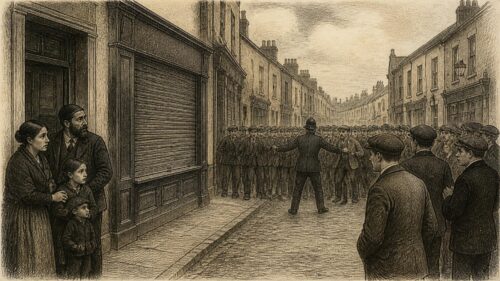
Cannock’s history intersected with one of the most disruptive events in the early Irish state. The Limerick City Archives description states that business was completely suspended during the Irish Civil War and that the store was commandeered by Irish Free State troops. This is a concise but powerful indication that a commercial premises in the city centre could become implicated in military occupation and the interruption of ordinary economic life.
The wider context is essential. Fighting in Limerick City intensified during July 1922, after the national conflict between pro- and anti-Treaty forces developed into open civil war. The city’s strategic location across the Shannon and within Munster made it important to both sides. Contemporary and later documentary accounts describe barricades, sniper fire, disrupted movement and the practical stoppage of civilian activity. In those circumstances, shops, offices and streets could not be separated from the conflict around them.
The archival assertion that Cannock’s was commandeered should be preferred to unverified stories about exact rooms, military uses or supposed dramatic incidents within the building. The present evidence establishes occupation and suspension of business; it does not support a detailed reconstruction of daily events inside the premises. Yet even this limited fact is historically telling. It reveals the vulnerability of commerce during political violence and reminds us that institutions remembered for their windows and goods also endured moments when normal trade was impossible.
After the Civil War, the company continued. The survival of financial and administrative records across later decades indicates a resumed and enduring corporate existence. That resilience should not be romanticised. Survival depended on management, capital, customers and adaptation, not on an automatic return to an imagined pre-war normality. But the firm did remain an established presence in the altered Ireland of the twentieth century.
Modern Changes
By the mid twentieth century Cannock’s had accumulated the authority of longevity. It had outlasted founding partners, bankruptcy, political revolution and a civil war. It had also become embedded in the visual culture of O’Connell Street. Yet the qualities that made it familiar did not guarantee that it would flourish amid changing retail conditions.
In 1961 the company began a major rebuilding project, completed in the early 1960s. This remodelling changed the streetscape and removed the older façade and landmark clock that later commentators mourned. The reaction recorded in retrospective local writing was strongly critical, often contrasting the old building’s perceived elegance with the newer premises. Those judgements are themselves part of the history of architectural taste. Mid-century redevelopment frequently valued modern layouts, enlarged interiors and new materials, while later observers regretted the loss of ornament and urban character.
It is not necessary to accept either view without qualification. The rebuilding may have answered real operational needs, including display, circulation, lighting and the demands of a changing retail market. At the same time, the removal of a familiar façade altered the public face of the street. The controversy demonstrates that commercial architecture has a civic importance beyond the intentions of owners. A shopfront can become part of collective memory, and its loss can be felt as a loss to the city.
The new premises did not restore the store’s earlier position. Retrospective accounts associate the later period with divided management, cheaper stock and an erosion of the old image. These are interpretations, not conclusions that can be established without a comprehensive study of accounts, competitors and consumer behaviour. However, the broader pattern is plausible: established department stores faced pressure from changing retail formats, altered consumer expectations and the difficulty of balancing prestige with price.
Final Closure
In 1980 the O’Connell Street premises were sold to Penneys, and Cannock’s moved to William Street. The move did not secure its future. The University of Limerick’s archival authority record dates the company’s existence from 1850 to 1984, when it went into liquidation. The Irish Archives Resource likewise records the final liquidation in 1984. The distinction between the 1980 departure from the famous premises and the 1984 corporate end is important: the institution did not vanish in a single instant, although its move marked the end of its historic central location.
The closure was more than a commercial event. For employees it meant the loss of a workplace; for customers, the disappearance of a familiar provider; and for the city, the final break between a long-established name and its most recognisable setting. It is understandable that memories concentrate on the former O’Connell Street building, the clock and Christmas windows. These were the visible signs through which a complicated business history was condensed into personal recollection.
That process of remembrance can be generous but selective. It foregrounds spectacle and nostalgia while potentially leaving the less glamorous realities of credit, stock management, management disputes, labour and financial risk in the background. The surviving archive makes a more complete history possible. Its minute books and ledgers offer another kind of memorial: not the emotional image of a window display, but the accumulated paperwork through which generations of people organised and sustained a large commercial undertaking.
Historical Meaning
Cannock’s matters to Irish history because it brings several themes together in one documented case. It demonstrates the role of Scottish and Irish commercial networks in nineteenth-century Limerick; the connection between retailing and local manufacture; the influence of leading businessmen in civic life; the risks attached to Victorian partnership and investment; and the resilience and eventual fragility of a long-lived urban firm.
It also complicates the notion that national history happens only in parliaments, barracks and battlefields. Cannock’s was affected by the Civil War, but its ordinary importance lay elsewhere: in the purchase of cloth, clothing and household goods; in wages paid to staff; in orders entered in books; in the shape of a major street; and in the routines of people visiting the city centre. These are not marginal details. They are the substance of social and economic life.
Folklore and recollection have their place. The stories of festive windows, a celebrated clock and the store as a meeting place explain why the business remains meaningful in Limerick’s local imagination. Yet the documentary record offers a firmer foundation. It identifies the changing partnerships, traces corporate records over more than a century and confirms moments of disruption such as the Civil War occupation. Where memory and evidence meet, the result is a history richer than either alone.
The lasting lesson is not that Cannock’s was uniquely grand or that a lost façade represented a vanished golden age. Rather, it is that a department store could become an engine of urban connection. It linked city and countryside, production and consumption, Scottish migration and Irish commercial life, private enterprise and civic identity. Its records, still preserved for research, ensure that the business can be understood not only as a cherished name but as a substantial part of Limerick’s historical fabric.
Cannock’s history raises a compelling question about how commercial institutions become embedded in civic identity. The article carefully distinguishes archival evidence from affectionate recollection, particularly regarding the clock, Christmas windows and the store’s centrality to Limerick life. Its records also suggest a richer, less nostalgic story: a business shaped by Scottish-Irish networks, manufacturing, rural wholesale, war and changing corporate structures. This tension matters because urban memory may preserve emotional significance while obscuring workers, ownership changes and financial vulnerability. How might systematic study of Cannock’s salary books, accounts and customer networks deepen, complicate or revise Limerick’s image of the department store?