Clonmacnoise and Limerick Raiders953 CE
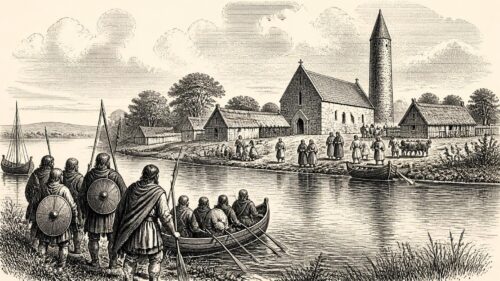
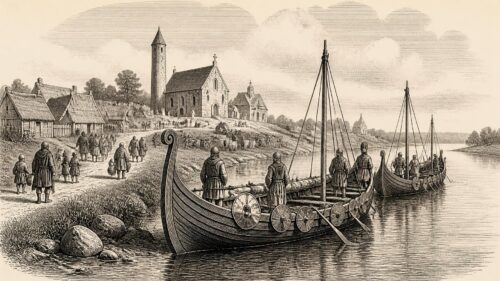
In 953, Clonmacnoise, a wealthy ecclesiastical settlement and strategic Shannon crossroads, was plundered by Munstermen accompanied by foreigners from Limerick. Although annals differ in dating and identify no commander, the raid demonstrates cooperation between Gaelic rulers and Norse-Gaelic urban forces, rather than a simple Irish-Viking division. It exposed the vulnerability of churches whose wealth, communications and prestige made them political targets. Congalach mac Máel Mithig’s high kingship provided precedence but limited practical control, while local conflict continued elsewhere. Annals also note dynastic and ecclesiastical deaths, including Congalach’s wife Eithne, illustrating interconnected political, religious and regional networks in tenth-century Ireland then.
Dateline
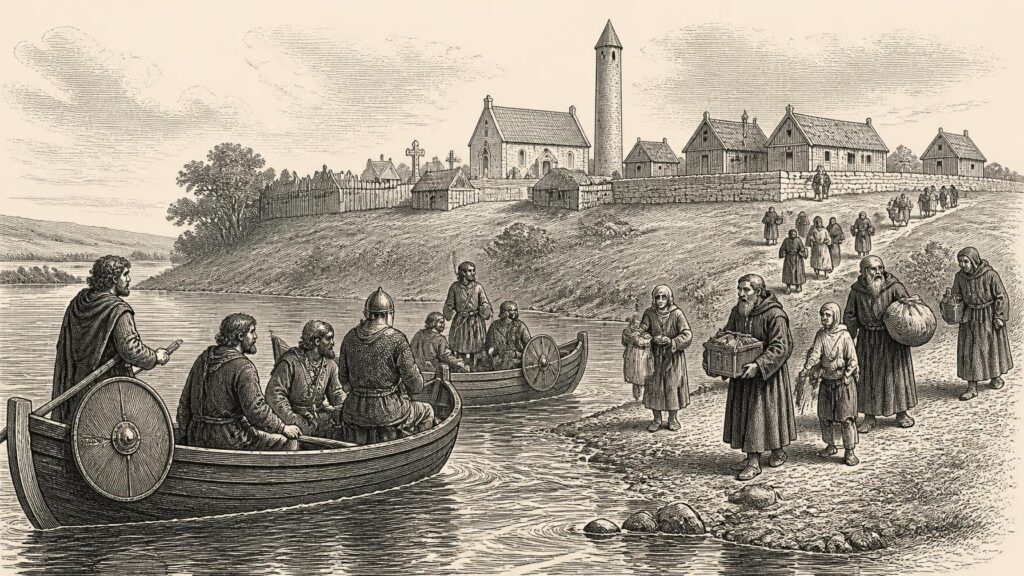
The clearest Irish event that can be placed in 953 is a raid on Clonmacnoise, the great ecclesiastical settlement beside the Shannon. The Annals of Ulster, under an entry calibrated as AD 952/953, says that Cluain Moccu Nóis was plundered by the men of Munster “accompanied by foreigners”. Chronicon Scotorum, whose chronological framework differs, specifies that these foreigners were from Limerick. The agreement on the raid is more important than the disagreement in annal headings: modern chronological work conventionally places the episode in 953, though no surviving source supplies a day, season or narrative of the attack.
A Raid at Ireland’s Crossroads
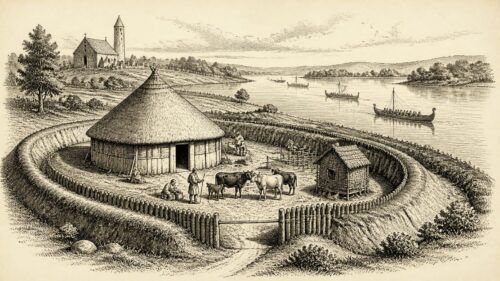
Clonmacnoise was an exceptionally consequential target. Founded beside the River Shannon in the sixth century, it stood where a north–south waterway met east–west routes along the esker country. By the tenth century it was not simply a community of clerics at prayer. It was a large, populous religious settlement, supported by land, labour, patronage, craft production and traffic on the river. Its churches, burial grounds, workshops, storehouses and timber domestic buildings served monks, clergy, tenants, dependants, pilgrims, visitors and powerful lay families. A raid there therefore struck a centre of wealth, communication and political prestige as well as a sacred place.
The word “plundered” should not be inflated into an account of wholesale destruction. The annals do not say that Clonmacnoise was burned in 953, nor do they enumerate deaths, captives or objects taken. Yet plunder could be deeply disruptive. Portable metalwork, food supplies, livestock, clothing, weapons, books, valuables offered at shrines and payments held by the community all had value. Raiders might also seize people or impose terms on surrounding districts, although neither result is recorded here. The absence of detail is a reason for restraint, not for treating the attack as slight. Annalists selected terse notices precisely because a major ecclesiastical community had been violated.
Its setting made Clonmacnoise vulnerable as well as prosperous. The Shannon connected the midlands to Lough Ree and the western interior, while tributaries and overland routes carried people and goods beyond the river. Fleets from the Norse-Gaelic towns could penetrate inland waterways; Irish rulers likewise moved men and supplies by boat. The raiders of 953 were not described as an isolated band arriving from overseas. They were Munstermen operating with the foreigners of Limerick: an alliance that shows how thoroughly people of Scandinavian background had become participants in Irish political conflict.
Munster, Limerick and Political Advantage
The identity of the Munster leader is less secure than the fact of the raid. The Annals of Inisfallen, compiled in Munster and using a different sequence of dates, records a foray by Cellachán and Donnchad against both Clonfert and Clonmacnoise under 951. It does not mention Limerick’s foreigners in that notice. The overlap may preserve the same campaign in another chronological tradition, but it cannot be demonstrated beyond doubt. Cellachán was king of Cashel, and his reign belongs to the political background of the early 950s; it is prudent, however, not to assert that he personally commanded the force at Clonmacnoise in 953.
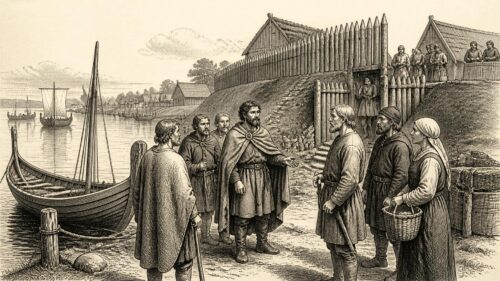
The wider meaning is nevertheless clear. Munster’s kings were capable of projecting force far beyond their southern heartlands. To raid Clonmacnoise was to enter the contested middle zone between Munster, Mide, Connacht and the kingdoms around the Shannon. Such expeditions sought movable wealth, but they also advertised power and tested rivals’ capacity to protect churches, clients and routes. The collaboration with Limerick indicates negotiation, shared interests or temporary dependence between Gaelic rulers and the town’s foreign population. It is misleading to imagine a simple opposition between “Irish” and “Viking” sides: alliances could cross language, religion and ancestry when political advantage required it.
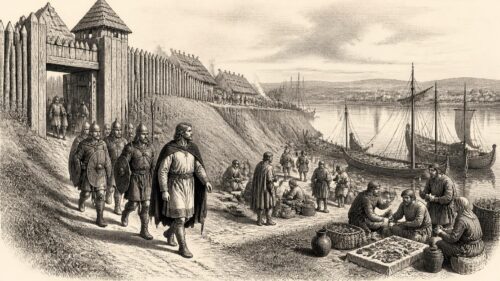
Limerick itself was a riverside port and power centre, not merely a raiders’ camp. Its inhabitants had access to ships, maritime expertise, commercial connections and armed manpower. Their involvement in an inland Munster expedition demonstrates the military usefulness of those resources. At the same time, the episode belongs before the later struggles in which Dál Cais rulers challenged Limerick’s position. In 953 the balance of power in Munster was still unsettled. The death of Lachtna, son of Cennétig and member of the rising Dál Cais kindred, is entered by the Annals of Inisfallen under this year. The record is an obituary, not a full account of succession, but it marks the losses and adjustments within a family that would soon become central to Munster politics.
Congalach’s Ireland
At the island-wide level, Congalach mac Máel Mithig was recognised in important annalistic traditions as king of Ireland. The later Annals of the Four Masters calls 953 the eleventh year of his rule. This title did not mean that he administered a unified state from a capital. Kingship in tenth-century Ireland rested on personal lordship, military followings, hostages, tribute, alliances and the ability to intervene beyond one’s own core territory. A raid by Munstermen and Limerick foreigners on a leading midland church illustrates the limits of any high king’s practical control.
Chronicon Scotorum also records the death of Eithne, Congalach’s wife and daughter of Fergal, described there as an overking of Ireland. The notice is brief, but it is a reminder that royal marriages joined ruling networks and that queens belonged to the political history recorded by annalists. Because the annal’s chronology does not always align neatly with that of the Annals of Ulster, the death should be treated as securely associated with this narrow period rather than assigned an invented date within the year. Its inclusion beside the Clonmacnoise raid reflects the annals’ concern with both public violence and dynastic continuity.
Elsewhere, the Annals of Ulster records that Gailenga was plundered by the Uí Chremthainn and that a clash involving Domnall and Muirchertach left “many heads” behind. The compressed phrase records lethal fighting but does not identify the participants sufficiently to reconstruct a campaign. It does, however, reveal the political texture of 953: warfare was often local or regional, fought among neighbouring peoples and dynasties rather than only between the most famous kings. Communities in central and northern Ireland lived with the possibility of sudden raiding, the loss of cattle and stores, and the dangers imposed by competing lords.
Churches as Communities and Assets
The same Ulster entry records the death of Máel Cothaid, successor of Comgall and Mo-Cholmóc, followed by a cluster of ecclesiastical obituaries. These include Máel Pátraic, lector of Armagh; Cenn Faelad, superior of Saiger; Diarmait of Lismore; Dub Inse, bishop of Bangor; and other churchmen. The list should not be mistaken for evidence of a single epidemic, since the annalist gives no cause linking these deaths. What it does show is the wide institutional map of Irish Christianity: Armagh in the north, Bangor on Belfast Lough, Saiger in Osraige, Lismore in Munster and Clonmacnoise in the midlands were connected by ecclesiastical rank, learning, travel, patronage and political rivalry.
Monasteries were therefore neither detached from society nor simply victims of it. They owned resources, preserved books, trained clerics and craftsmen, attracted burial patronage and carried the prestige of saints. Their leaders could be drawn from powerful families, while kings used gifts and protection of churches to reinforce authority. The danger was reciprocal: ecclesiastical wealth and strategic locations made major churches tempting targets, including for Irish Christian rulers. The men of Munster who reached Clonmacnoise in 953 were not outsiders to the island’s religious culture. Their raid exposes the uncomfortable fact that political and economic competition could override reverence for a renowned holy site.
For ordinary residents, the year’s consequences were likely experienced through insecurity rather than through the lofty vocabulary of kingship. A river traveller might hear of armed boats moving on the Shannon; a farmer could be required to provide food, transport or labour to a lord’s force; clerics and artisans at Clonmacnoise faced the immediate loss of goods accumulated through work and patronage. Recovery depended on surviving stores, local support, the ability to rebuild timber structures and the continuing attraction of the saint’s cult. Clonmacnoise did recover. Its later monuments and manuscripts should not obscure the fragility that lay behind such endurance.
What 953 Reveals
953 was not a year of a single decisive battle or a permanent remaking of Ireland. Its surviving record is instead unusually revealing of the tenth-century order. At Clonmacnoise, a monastery functioned as a wealthy settlement at a strategic transport junction. Munstermen and Limerick’s foreigners could cooperate in an expedition far from the lower Shannon. Congalach’s high kingship supplied a framework of precedence, but not a monopoly of force. Local warfare continued in Gailenga, while church offices and dynastic marriages tied distant regions into a shared political world.
The most responsible account of the year must preserve its uncertainties. The sources disagree over annal numbering and offer little narrative detail; they do not permit a day-by-day reconstruction, a casualty total or certainty about the raid’s commander. But they firmly preserve a striking event: in 953, Clonmacnoise was plundered by a Munster force joined by the foreigners of Limerick. That attack, on one of Ireland’s greatest ecclesiastical centres, captures a world in which waterways linked regions, urban Norse-Gaelic communities shaped inland politics, and even the most prestigious churches stood within the reach of armed power.
Primary Sources
- The Annals of Ulster: Year U953
- The Annals of Ulster: Year U952
- The Annals of Ulster: Year U954
- The Annals of Ulster
- Chronicon Scotorum: Annal CS953
- Chronicon Scotorum: Annal CS955
- Chronicon Scotorum
- Chronicon Scotorum (Latin): Annal CS953
- Annals of Inisfallen: Annals AI950–AI953
- Annals of Inisfallen
- Annals of Inisfallen (Latin): Annals I948–I953
- Annals of the Four Masters: Annal M953
- Annals of the Four Masters
- The Annals of Tigernach
- Clonmacnoise
- Clonmacnoise Monastic Site
- High Crosses
- Early Irish Monasticism
- Irish School of Illumination, c. 650–1100
- The Clonmacnoise Group 912–1100 and Its Relationship with the ‘Chronicle of Ireland’
- Vikings in Early Medieval Ireland: Church-Raiding, Politics and Kingship
- The Cambridge History of Irish Literature: Chronology
- Chronicon Scotorum: Bibliographical and Editorial Information