

Island Ledger
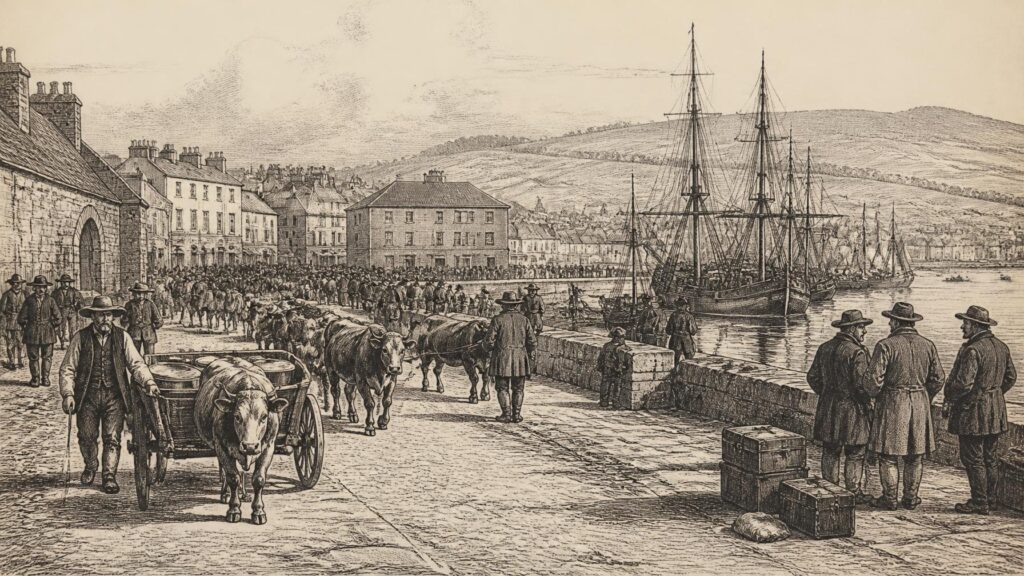
AI generated historical illustration, not a contemporary photograph.
At a Glance
The history of the Irish economy is not a simple ascent from poverty to prosperity, nor a morality tale in which independence, free trade or foreign investment alone supplies the explanation. It is the record of a small island economy repeatedly shaped by land, migration, its proximity to Britain, political sovereignty, European integration and the changing terms on which it entered wider markets. Its gains have been real, but so have its recurrent vulnerabilities.
Colonial Foundations
For much of the modern period, Ireland’s economy was formed within the political and commercial framework of the United Kingdom. That fact did not make Ireland economically uniform. The north-east, especially Belfast and its hinterland, developed important linen, engineering, shipbuilding and manufacturing interests. Much of the rest of the island was overwhelmingly rural, with livelihoods tied to tillage, livestock, seasonal work, domestic production and remittances from relatives abroad. Dublin was a port, administrative capital and market centre, but it did not command an industrial revolution comparable in scale to those of Manchester, Glasgow or Belfast.
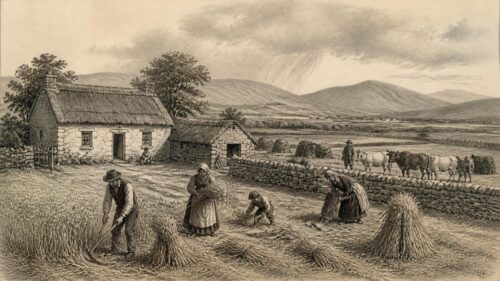
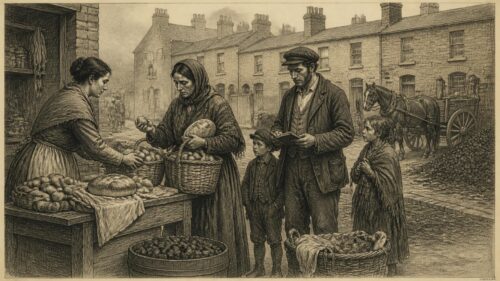
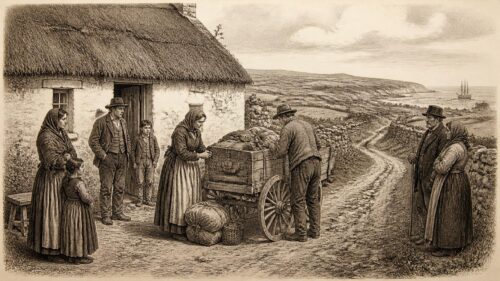
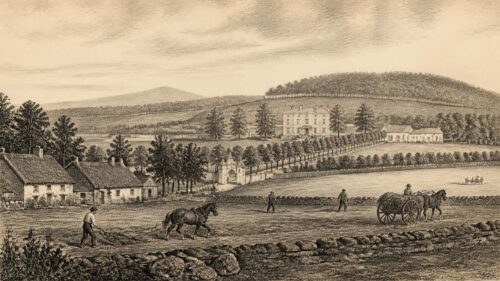
Land lay at the centre of this economy. The ownership of estates, the position of landlords and agents, the security or insecurity of tenants, subdivision of holdings and the availability of conacre all affected how families survived. Agricultural output was not simply food: it was rent, export income, wages, credit and social power. Cattle, butter and other provisions linked Irish producers to British urban markets, while the potato became crucial to the diet of a rapidly expanding rural population. Such dependence could sustain large numbers in ordinary years, but it created grave exposure when harvests failed or work disappeared.
Official records preserved by the National Archives show that hardship and food scarcity pre-dated the Great Famine. The post-Napoleonic slump after 1815 brought falling agricultural prices and unemployment, while population continued to rise sharply. Government papers record local food crises, petitions for meal and seed, and public-work schemes during the 1820s. This evidence matters because it corrects a misleading picture of pre-Famine rural life as either wholly contented or wholly inert. Communities possessed skills, local markets and resilient family networks, but many were also living near subsistence and were highly vulnerable to disruption.
Land Regimes
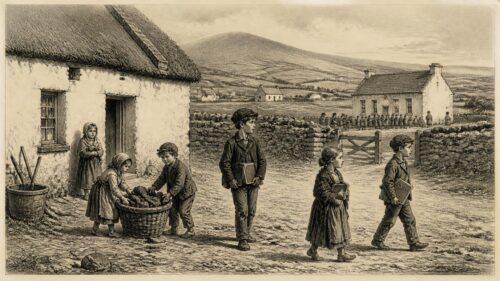
The land system did not operate in a single manner across Ireland. Farm size, soil, access to markets and landlord policy varied greatly by region. Yet the broad pattern was clear enough: a large proportion of the rural population depended upon holdings too small to provide security without supplementary labour or a dependable potato crop. Families might combine a patch of land with seasonal migration to Britain, spinning, fishing, labouring or service. The apparent density of rural settlement was therefore supported by a web of fragile expedients rather than by a broad distribution of wealth.
It is tempting to treat the potato as the sole cause of rural poverty. That is too narrow. The potato was extraordinarily productive per acre and could nourish households on very small plots; its importance was an adaptation to the underlying structure of landholding, labour and poverty. The crop’s centrality made survival possible, but it also meant that a disease affecting it could become a general social catastrophe. Historical interpretation should therefore distinguish between immediate biological cause and the economic arrangements that magnified its consequences.
Market Dependence
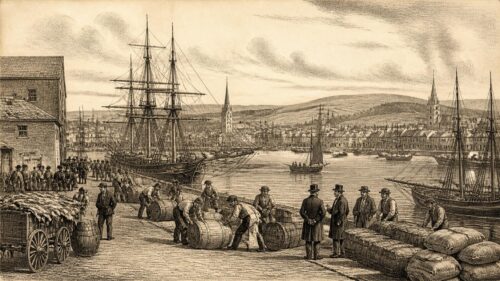
Irish agriculture was integrated into external markets long before political independence. This integration brought earnings and outlets for livestock and provisions, but it also meant that changes in British demand, tariffs, shipping and prices were felt directly in Irish districts. The same pattern appeared in labour. Migration was not merely an escape from crisis; for many households it was a regular element of economic life. Earnings sent home from Britain, North America and elsewhere became part of family budgets and, later, part of the social imagination of Ireland itself.
That outward orientation is a constant in Irish economic history. The forms changed—from cattle exports and migrant labour to manufactured exports, financial services and multinational production—but the fundamental question endured: how could an economy with a small domestic market earn income abroad without becoming excessively dependent upon conditions it could not control?
Famine Rupture
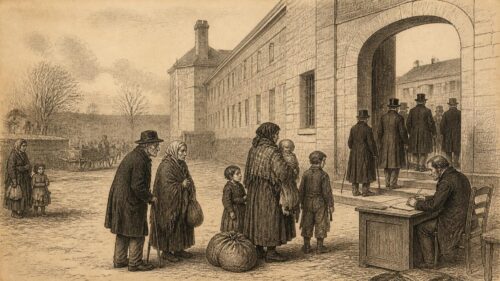
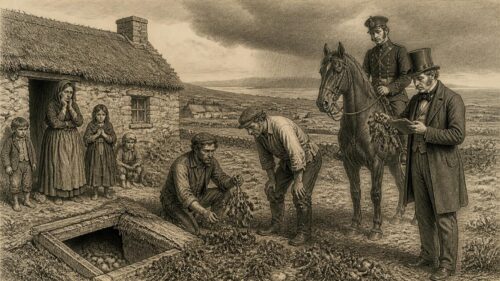
The Great Famine of 1845–1852 was the decisive rupture in nineteenth-century Irish economic and demographic history. Potato blight destroyed or gravely damaged the crop on which millions depended. The National Archives’ Distress Papers and Relief Commission records preserve reports, letters and petitions from affected localities, providing direct testimony to hunger, disease, relief efforts and administrative strain. They reveal the human scale behind aggregate figures: local committees seeking food, officials recording destitution, and communities attempting to secure assistance amid an unprecedented emergency.
The Famine cannot responsibly be described as a natural disaster alone. Potato blight was the precipitating biological event, but mortality and displacement were shaped by poverty, land tenure, access to relief, public policy, market relationships and the limited resources available to those already living close to the margin. It is also inaccurate to suppose that all food vanished from Ireland. Grain and livestock continued to move through commercial channels, a fact that has long carried moral and political force. Yet the historical significance lies in the inability of a market-centred system and official relief arrangements to protect a population whose purchasing power and secure access to food had collapsed.
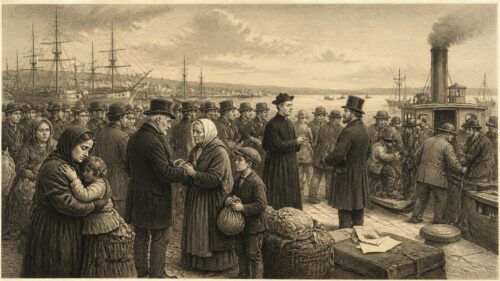
The consequences were enduring. Death, emigration, evictions, consolidation of farms and a profound collapse in the population altered Ireland’s social geography. The post-Famine countryside contained fewer people, fewer very small holdings and a stronger orientation towards pasture and cattle. Emigration became embedded as a structural response to limited employment. It was not an episode that ended when the blight receded; it became a recurrent feature of family strategy, community memory and national politics.
Demographic Aftermath
Census material and later historical studies make plain that Ireland’s population did not return to its pre-Famine level. A country that had experienced rapid growth before 1845 entered a long era of demographic decline. Young adults, especially those unable to inherit viable farms or secure stable work, departed in striking numbers. The National Archives’ census exhibition notes that hundreds of thousands emigrated even in the decade from 1891 to 1901, demonstrating that emigration was sustained by more than the immediate trauma of famine.
There was a paradox in this transformation. Smaller populations and larger farms could improve security for some remaining households, particularly where land purchase and agricultural reorganisation proceeded. But the aggregate improvement did not erase regional deprivation, seasonal underemployment or the dependence of many communities on absent children’s remittances. The family farm became an important symbol of rural independence, yet ownership did not guarantee prosperity. In poorer western districts, small holdings, poor soils and restricted non-farm opportunities remained serious constraints.
Memory Legends
Folklore and family memory are indispensable evidence of how economic trauma was understood, but they are not identical to statistical or archival proof. Stories of ships leaving forever, abandoned cottages and meals reduced to a single staple convey emotional truths about loss. They should not be used to produce invented local totals, precise dates or universal claims about every parish. Equally, the later nationalist legend of an entirely self-sufficient pre-Famine Ireland obscures the extent of commercial exchange, inequality and dependence that existed before 1845.
The documented record supports a more difficult conclusion: Ireland was neither economically isolated nor economically secure. It was integrated into markets in ways that distributed benefits unevenly and left a vast share of the population dangerously exposed. That pattern would inform later arguments about land reform, self-government and economic sovereignty.
National Possession
From the late nineteenth century, land reform altered the material as well as political landscape. A succession of Land Acts enabled many tenants to purchase holdings, gradually reducing the dominance of landlord ownership. The result was a countryside increasingly organised around owner-occupier family farms. This was a profound redistribution of property and an achievement of immense importance to nationalist political culture.
Yet land purchase did not solve every economic problem. It did not create an industrial base across the island, abolish marginal land or provide work for all those born into farming families. Nor did it end emigration. In this respect, the economic legacy inherited by the Irish Free State was mixed. There was a more secure pattern of rural proprietorship than before, but a narrow production base, a small home market and continuing reliance on Britain as the chief destination for many exports.
Partition Effects
Partition added a major economic complication after 1921. The new Free State did not include the north-east’s concentrated industrial economy, while its own territory remained predominantly agricultural. Revenue’s institutional history notes that, of nearly 300,000 industrial workers on the island in 1912, only about 80,000 were in the territory that became the Free State. The point should not be overstated into an argument that the new state possessed no industry; it had brewing, food processing, clothing, milling, transport and other enterprises. But its industrial inheritance was limited relative to the challenge of providing employment for its population.
State-building therefore required fiscal as well as political improvisation. The Revenue Commissioners were established in 1923, and customs duties, excise, income tax, stamp duties and estate duties supplied essential income to the new Exchequer. The administration inherited systems and personnel shaped by the former United Kingdom framework, but now had to serve an independent state facing post-revolutionary disruption, tax arrears and difficult arrangements with Britain.
Fiscal Foundations
Taxation was politically sensitive. Income tax, introduced in Ireland in 1853 after the Famine, had long been associated by many nationalists with unequal treatment and imperial fiscal authority. In the Free State it became an unavoidable instrument of government rather than an abstract symbol of external rule. This transition illustrates a central feature of independence: political sovereignty expanded the capacity to choose policy, but it also imposed responsibility for raising revenue, financing services and protecting public credit.
Customs and excise were particularly important because they could be collected at identifiable points and because imported goods supplied a broad tax base. But reliance on such taxes also demonstrated the small state’s vulnerability. A weak economy could not easily carry large social or capital programmes, while high tariffs or duties might raise prices for households. Economic policy after independence was consequently a balance between national aspiration, limited administrative means and dependence on trade.
Protected Ambitions
The 1930s brought a more assertive policy of economic nationalism. Fianna Fáil’s government sought to develop domestic industry, reduce dependence on imports and challenge obligations associated with the Anglo-Irish settlement. Tariffs and import controls were central instruments. The objective was not merely to protect particular firms; supporters hoped that domestic production would create employment, retain money within the state and give practical meaning to sovereignty.
The policy was accompanied by the Anglo-Irish Economic War, triggered by the dispute over land annuities. Britain imposed tariffs on Irish agricultural exports, notably cattle, and the Free State retaliated. Oireachtas historical material records that the conflict lasted five years and concluded with the Anglo-Irish Trade Agreement of 25 April 1938. The agreement abolished the tariffs and settled the annuities dispute through a once-off Irish payment. It also returned the Treaty Ports to Ireland.
For farmers dependent upon British markets, the dispute imposed serious costs. Revenue’s history records British duties of 40 per cent on Irish cattle and 30 per cent on other agricultural produce during the period. Smuggling increased and border enforcement expanded. These are documented administrative consequences, not simply retrospective political rhetoric. The wider lesson was stark: economic sovereignty could involve painful confrontation where trade patterns remained heavily concentrated on one neighbouring market.
Industrial Shelter
Protectionism did foster parts of domestic manufacturing. New firms and established producers enjoyed a sheltered home market, and industrial employment grew in some lines. A historical Oireachtas report later observed that policy from the 1930s into the 1950s rested substantially on high tariff barriers intended to preserve a home market for Irish manufacturers. That judgement should be read carefully. It does not mean protection achieved nothing; rather, it indicates that the industrial structure it supported often remained small-scale, technologically limited and poorly prepared for wider competition.
Interpretations of this era tend to divide too neatly between celebration and dismissal. It is fair to recognise that protection answered genuine fears of unemployment, import dependence and national fragility. It is also fair to note that it could preserve inefficient production and restrict consumer choice. The historical evidence suggests that it was most intelligible as a response to the circumstances of a young, poor state, but increasingly ill-suited to an economy that needed export markets, investment and technological change.
Neutral Scarcity
The Second World War, known in Ireland as the Emergency, exposed another weakness: dependence on shipping, imported fuel, fertiliser and machinery. Neutrality spared the state direct involvement in the conflict but did not prevent shortages, rationing and interruption to trade. Revenue records note that food rationing continued until December 1951. Rural self-sufficiency was often romanticised in later recollection, yet the period demonstrated how difficult it was to maintain modern living standards and productive capacity without dependable access to external supplies.
By the 1950s, low growth, weak investment and continuing emigration made the limitations of the earlier model impossible to ignore. The economic question was no longer whether Ireland should trade with the outside world—it always had—but on what terms it could do so while broadening opportunity at home.
Opening Doors
The late 1950s marked a major policy turning point. T. K. Whitaker’s Economic Development, followed by the First Programme for Economic Expansion, challenged the adequacy of inward-looking policy. The ESRI’s historical account describes the programme as a response to slow growth, recession, high emigration, low productivity and inadequate productive investment. It placed greater emphasis on exports, public capital investment, private enterprise and the attraction of foreign enterprise.
This was not a sudden abandonment of the state. Government remained central through infrastructure, education, development grants and planning. The change lay in the intended relationship between public action and private activity. Instead of attempting principally to reserve the domestic market for Irish producers, policy increasingly sought to make Ireland an attractive platform for production serving external markets. The Industrial Development Authority became an important institution in this new approach.
Whitaker Moment
The phrase “Whitaker revolution” is useful if treated as shorthand rather than magic. Whitaker’s analysis and the programme gave coherence and confidence to a shift already encouraged by economic pressures. Their significance lay in establishing an alternative diagnosis: emigration and stagnation were not inevitable national conditions but problems connected to investment, productivity, trade and institutional choices. The programme’s targets were modest, but growth during its first years exceeded expectations.
The social effects unfolded slowly. Emigration did not disappear at once, and agriculture remained under pressure. Nevertheless, the 1960s saw expanding education, growing industrial employment and greater engagement with European economic possibilities. The change was institutional and cultural as much as numerical. It invited Irish policymakers to see markets beyond Britain not simply as threats but as necessary fields of opportunity.
European Entry
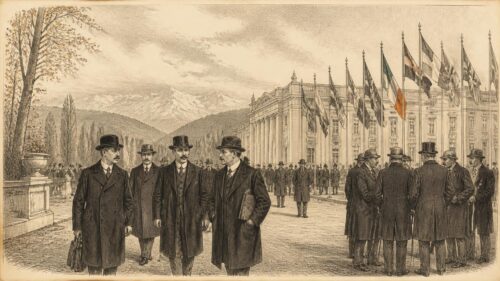
Membership of the European Economic Community in 1973 transformed this opening. Ireland entered at the same time as the United Kingdom and Denmark. For a state still highly dependent on trade with Britain, joining alongside its principal market reduced the risk that new European barriers would isolate Irish exports. The Common Agricultural Policy was especially consequential, providing price supports and a larger framework for farm production during a period when farming remained socially and economically important.
European membership also broadened the setting of Irish policy. Trade rules, competition, regional development and later monetary integration connected Ireland more closely to continental institutions. The benefits were not automatic, and entry did not erase domestic disparities. But European markets, funds and investment links helped to reduce the degree to which Ireland’s external economic life was organised around one neighbouring state.
European Transformation
The 1970s and 1980s were not uninterrupted years of success. Oil shocks, inflation, unemployment and heavy public borrowing created difficulties. Fiscal pressures became severe, and emigration again intensified in the 1980s. Still, the underlying structure of the economy was changing. Agriculture’s share of output and employment fell, while manufacturing and services gained importance. The Central Statistics Office’s retrospective account records that by 1998 agriculture represented only 5 per cent of output, a striking contrast with the state’s earlier rural character.
The change was not merely a movement from farms to factories. Services, education, technology, pharmaceuticals, financial activity and internationally traded business functions acquired increasing weight. Foreign direct investment was attracted by access to European markets, a young English-speaking workforce, industrial policy and a corporate tax regime that became internationally prominent. Domestic firms, too, adapted in sectors such as food, construction, software and professional services.
Investment Strategy
The investment-led model has sometimes been described as a simple tax bargain: low corporation tax in exchange for multinational jobs. That formulation is incomplete. Tax was important, but so were European membership, improvements in education, infrastructure, institutional credibility, industrial promotion and the worldwide restructuring of production. Nor should foreign investment be treated as entirely external to Irish society. It generated employment, supplier relationships, skills and tax receipts, while also creating dependence upon decisions made in corporate headquarters abroad.
Such dependence is not a reason to deny the model’s achievements. It is a reason to measure them accurately. Gross domestic product can be influenced strongly by profits and intellectual property associated with multinational firms. For questions about household income, domestic demand and public resources, other measures—including gross national income and employment—can sometimes give a more revealing picture. The CSO itself explains that national accounts describe the economy as a whole; no single aggregate can capture every distributional or social reality.
Tiger Years
The rapid expansion of the 1990s and early 2000s became known as the Celtic Tiger. Employment rose, unemployment fell sharply, immigration increased and public confidence changed dramatically. The boom drew on real strengths: export growth, investment, improved educational attainment, demographic change and European integration. It also altered everyday life through rising incomes, consumption, home ownership and a sense that the old economy of chronic departure had been decisively overcome.
Yet the label “Celtic Tiger” can conceal differences between phases of growth. The earlier expansion was strongly associated with export-oriented activity and productivity. Later growth became increasingly entwined with construction, land values, credit and tax revenues linked to property transactions. A historical article must resist treating the boom as either pure illusion or unqualified triumph. Its first phase created genuine productive capacity; its latter phase accumulated risks that were visible in the dependence of banks, builders, households and public finances upon continuing property inflation.
Credit Collapse
The crisis that broke in 2008 was among the most severe reversals in the history of the Irish state. The Central Bank’s assessments identify a credit-fuelled property boom, excessive and imprudent lending to the property sector, and heavy reliance by banks on unstable wholesale funding from abroad. When property prices fell and international funding conditions deteriorated, a banking crisis interacted with recession, collapsing tax revenue and a rapidly worsening fiscal position.
This was not simply an imported global shock. International financial turmoil intensified the crisis, especially after the collapse of Lehman Brothers, but domestic choices had made Ireland unusually exposed. Construction had become too large a share of activity; banks had lent heavily against rising property values; and public revenues had become reliant on boom-related sources. The Central Bank later acknowledged that regulatory measures taken before the crash were insufficient. These are documented institutional conclusions, not just political accusation.
Banking Failure
The state’s September 2008 guarantee of bank liabilities was adopted under exceptional pressure. Its later consequences were profound because banking losses became intertwined with sovereign risk. The Central Bank’s comparative study records that Ireland sought external assistance in November 2010 amid heightened European sovereign debt tensions. The EU–IMF programme, agreed in December 2010, combined banking restructuring, fiscal consolidation and structural measures.
Historical judgement on the guarantee remains contested. Some stress the immediate danger of systemic collapse and the restricted options open to a small euro-area member. Others argue that the breadth of the guarantee transferred excessive risks to the public balance sheet. Both positions concern interpretation. The underlying evidence is less disputable: the crisis brought unemployment, emigration, mortgage distress, business failure, public-service retrenchment and a deep loss of confidence, while bank support and recession transformed the condition of the state’s finances.
Uneven Recovery
Recovery restored employment and output, but it did not distribute relief evenly. The social aftermath included debt burdens, housing pressures, regional imbalance and renewed debate about the relationship between multinational-led growth and domestic living standards. The crisis also renewed an older Irish lesson: an open economy can prosper through external links, but cannot safely assume that rising asset prices, ready credit or foreign capital will continue indefinitely.
There is a continuity here with earlier eras, though not an identity. The potato economy, cattle trade, protectionist industry, European farm supports, export manufacturing and property finance belong to very different worlds. Each, however, involved a limited domestic market seeking livelihood through wider connections. The recurring challenge has been to spread the gains from openness while building institutions capable of withstanding shocks.
Enduring Questions
The Irish economy’s history should therefore be understood as a history of transformation rather than destiny. It moved from a predominantly rural society marked by insecure subsistence and mass emigration to a highly globalised economy with sophisticated export sectors and far higher average incomes. Political independence, land reform, public administration, education, European membership and investment policy all mattered. None operated alone.
It would be equally wrong to suggest that historical hardship automatically produced later success. Famine and emigration were not beneficial national disciplines; they were human losses. Protectionism was not a foolish aberration detached from its time; it was an attempt to solve real problems with tools that later proved inadequate. Foreign investment was not an external rescue untouched by Irish policy; it was enabled by deliberate institutional choices. The boom was not wholly fictitious; neither was its collapse unforeseeable in every respect.
Historical Balance
Documented evidence permits several firm conclusions. Agricultural dependence and unequal land relations made nineteenth-century Ireland vulnerable. The Famine permanently altered population and economic structure. The Free State inherited a narrow productive base and difficult fiscal constraints. The policy turn of the late 1950s and European entry widened the economy’s possibilities. The banking and property crisis exposed the dangers of unbalanced growth and weakly controlled credit.
Beyond those conclusions lies interpretation. Historians and economists will continue to debate the relative importance of policy, culture, demography, Britain, Europe and global capital. That debate is valuable when it is grounded in records rather than myth. Ireland’s economic past offers no simple formula for the future, but it does show that prosperity is most durable when productive investment, public capacity and social security are not sacrificed to short-lived gains.
The article’s most compelling thread is its insistence that openness was never simply beneficial or harmful: cattle exports, migrant remittances, European membership and multinational investment enlarged opportunities, yet each heightened exposure to forces beyond Ireland’s control. This perspective also complicates familiar contrasts between protectionism and liberalisation, since domestic choices over taxation, infrastructure, relief and regulation shaped who bore economic disruption. The recurring pattern raises a question about policy design in a small economy. Looking across the Famine, the Economic War, the Whitaker reforms and boom-bust cycles, how might Ireland combine international integration with safeguards that distribute external shocks more fairly?