Conall Grant’s Two Months718 CE
Dateline
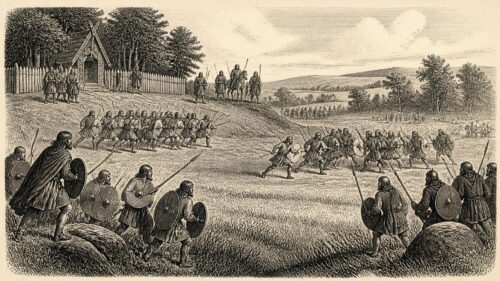
In 718 CE, a battle at Cenannas – the place later known as Kells in County Meath – brought a violent turn in the long struggle for Brega. Conall Grant, grandson of Cernach, emerged as victor over a group of rival leaders, but his success was startlingly brief: the annals state that Fergal son of Máel Dúin killed him two months later. The year also brought deaths at major religious communities, a recorded change in Iona’s monastic observance, reports of remarkable portents, and a lunar eclipse. Together, these sparse notices reveal an Ireland in which dynastic politics, ecclesiastical authority and the interpretation of unusual sights in the sky were closely intertwined.
A Battle at Cenannas
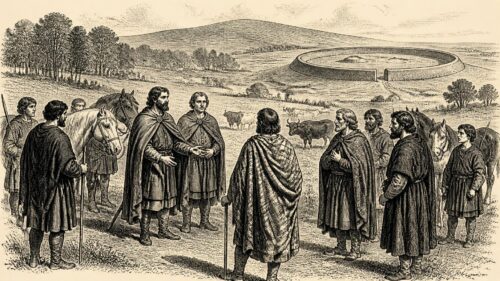
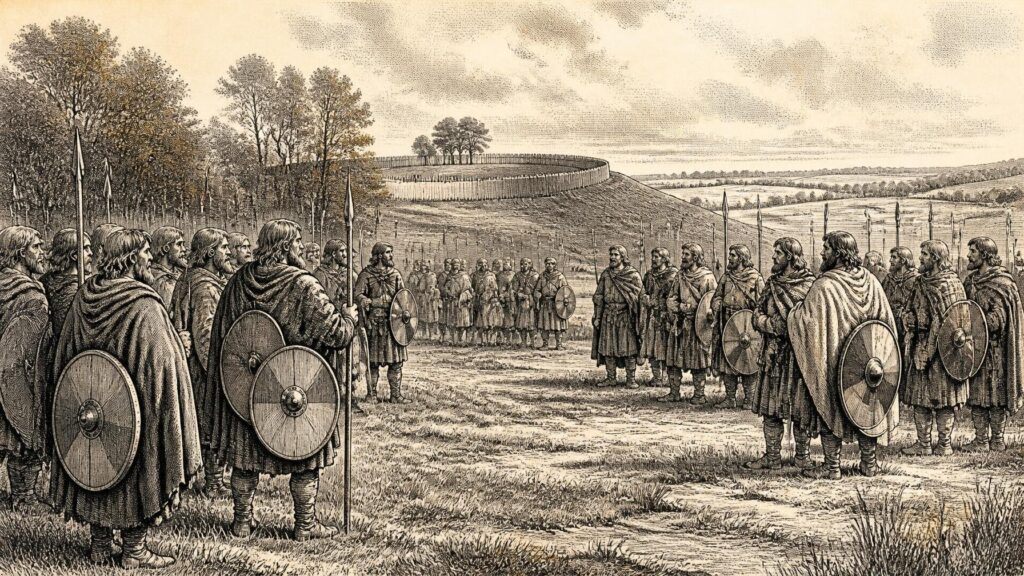
The clearest firmly dated political event is the battle of Cenannas. The Annals of Ulster name Tuathal grandson of Fáelchú, Cellach Diathraibh, Gormgal son of Áed son of Dlúthach, Amalgaid grandson of Conaing, and Amalgaid’s brother Fergal among those who fell. Conall Grant was the victor. The closely related annal traditions in the Annals of Tigernach and Chronicon Scotorum preserve much the same account, though not every manuscript gives precisely the same casualty list. Such variations are a reminder that the annals are compressed records transmitted and copied over centuries, not battlefield reports written by a participant.
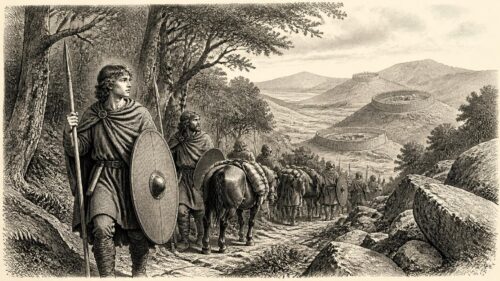
Cenannas stood in the heart of Mide, within the politically charged landscape between the Boyne and the central midlands. Its early Irish name is securely attested in the 718 annal entry; it should not, however, be confused with the much later famous monastery of Kells or its ninth-century gospel book. In 718 it was a place important enough to give its name to a battle, but the surviving notice does not tell us whether fighting took place beside a settlement, at an assembly site, on a routeway, or in open country.
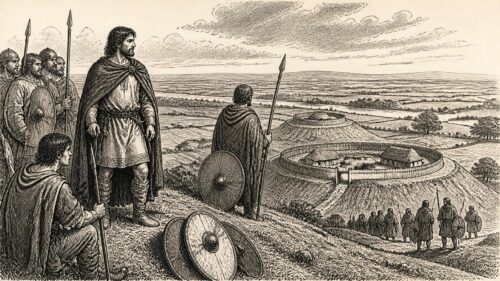
The names nevertheless permit a careful outline of the conflict. Brega, the fertile territory north of the Liffey and east of the Blackwater, was divided among competing branches of the Síl nÁedo Sláine, itself part of the wider Uí Néill political world. Conall belonged to the Uí Chernaig of southern Brega, associated with Lagore; Amalgaid belonged to the Uí Chonaing, associated with Cnogba, the royal complex at Knowth. Gormgal’s presence points to the involvement of another Brega kindred, Síl nDlúthaig. The battle was therefore not a simple encounter between two neatly bounded kingdoms. It was a collision among related ruling families, their allies and their dependent fighting followings.
Tuathal grandson of Fáelchú is especially revealing. His appearance among the dead shows that the struggle could draw in people beyond the immediate rival branches of Brega. Yet the sources do not provide enough evidence to identify each man’s motives, troop numbers or tactical role. It would be unsafe to imagine a set-piece national war. What can be said is that the deaths of Amalgaid, his brother and other prominent men would have altered claims to land, clientship, tribute and precedence across the region. In an intensely ranked society, the killing of a lord affected not only a family but also the households, church connections and clients attached to it.
Victory Without Security
Conall Grant did not live to consolidate his victory. The annals state that he was killed by Fergal son of Máel Dúin two months after the battle. They do not explain the setting or method of the killing, nor do they say whether Fergal acted personally, through followers, or under a formal judgement. The brevity is significant in itself. Annalists were concerned to record the fatal result and the identities of consequential men, not to satisfy later readers’ desire for narrative detail.
Fergal was the leading ruler of Cenél nEógain in the north and exercised a far-reaching overkingship during these years. His association with Conall’s death indicates that the Cenannas conflict had consequences beyond Brega. It also shows the limits of local military achievement. Conall could defeat rivals in Meath and still remain vulnerable to a superior political power. The struggle was not resolved by a single victory; rather, it was one episode in the shifting negotiation of authority among Uí Néill dynasties and neighbouring peoples.
Another death recorded in 718 was that of Béc of Bairche. The annals give no title in the obituary, so it would be wrong to assign him an office that the entry does not claim. His name had appeared in earlier notices of conflict in the north-east, however, and his death belongs to the same world of regional lordship in which personal reputation, kin networks and armed support mattered greatly. The individual notices of 718 do not amount to a complete political map of Ireland, but they show how many centres of power existed beyond any one ruler’s reach.
Monasteries and Learned Communities
The year’s ecclesiastical obituaries are unusually wide-ranging. Crónán grandson of Eóán, abbot of Lismore, died in Munster. Fiannamail grandson of Bógaine, head of Inis Maige Sam – generally identified with Inishmacsaint in Lough Erne – also died. So did Dub Dúin grandson of Fáelán, described as both bishop and abbot of Clonard. The Annals of Tigernach introduce the latter two as wise men, a revealing honour: leadership in an Irish church community involved learning as well as religious office and control of resources.
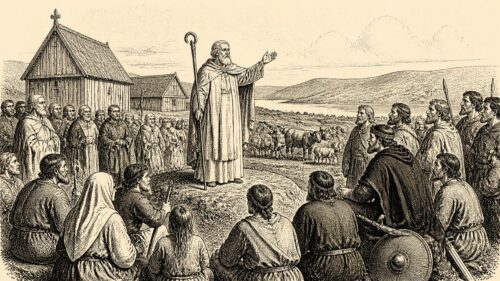
Lismore, Clonard and Inishmacsaint lay far apart. Their appearance together in one annal year illustrates the island-wide horizon of ecclesiastical record keeping. Monasteries were not secluded institutions detached from society. They possessed land and livestock, received food-renders and gifts, trained clerics, maintained books, offered hospitality and were connected to powerful families. An abbot’s death could therefore matter to a locality as much as the death of a secular ruler. The sources do not describe succession at these houses in 718, and no successor should be supplied by guesswork, but the loss of three senior churchmen must have required new settlements of authority.
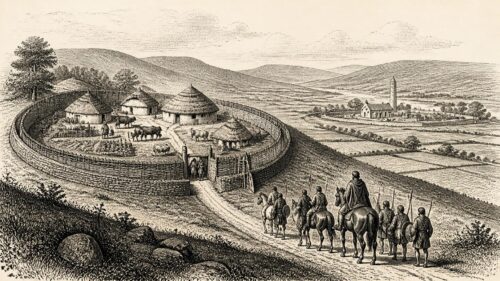
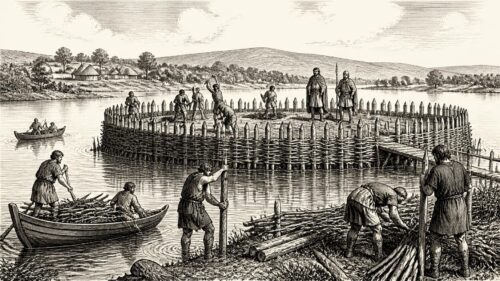
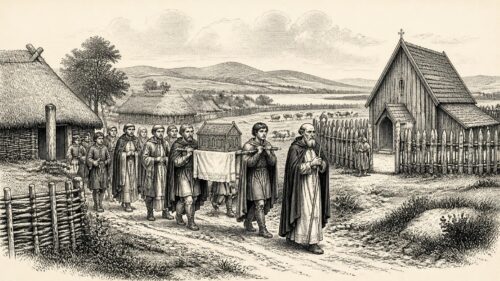
For ordinary people, life continued through work that the annals rarely describe: tending cattle, dairying, growing cereals, maintaining fences and houses, making tools and textiles, and travelling between farms, churches and assembly places. Legal material of the seventh and eighth centuries shows the centrality of cattle, milk products and food-renders to economic relationships. Archaeology complements this picture: ringforts were common enclosed farmsteads, while some crannogs and larger enclosed sites projected elite status. These are broader conditions of early medieval Ireland, not events that can be assigned specifically to 718.
Iona’s Crown Tonsure
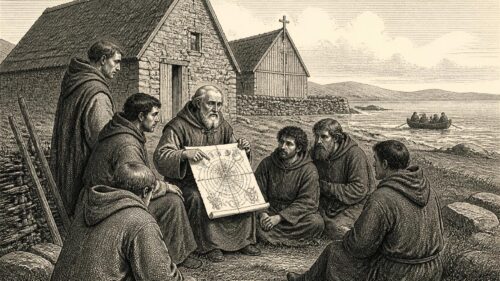
A short entry in the Irish annals says that the community, or familia, of Iona received the crown-shaped tonsure in 718. This matters directly to Irish history. Iona had been founded from the Columban Irish monastic tradition and exercised influence across Ireland, Dál Riata and northern Britain. The change concerned the outward shaving pattern worn by clerics and monks. It accompanied a wider movement towards the Roman method of calculating Easter, an issue that had become a marker of ecclesiastical unity, authority and international connection.
The dating needs care. Bede, writing in Northumbria, presents the Iona community’s acceptance of both Easter observance and the Roman tonsure as the outcome of Ecgberht’s mission in 716. The Irish annals distinguish the stages differently: they record Iona’s Easter change in 716 and the crown tonsure in 718. The difference may result from compressed chronology or from a real interval between decisions. Either way, 718 is responsibly connected with the visible adoption of the new tonsure, not with a sudden abandonment of Columban identity. Iona remained a Columban house; its practices were being aligned with a wider western Christian norm.
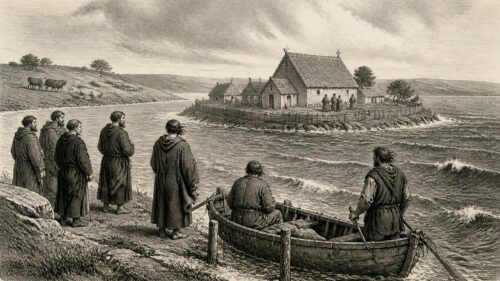
This was also a reminder that the sea linked rather than separated Irish religious communities from Britain. Clerics, books, computistical learning and arguments about correct observance crossed the North Channel. The surviving sources give no evidence for commercial traffic in 718, nor should such traffic be invented. But the Iona notice firmly demonstrates that Irish church affairs were part of a maritime world of communication and debate.
Honey, Blood and the Darkened Moon
The annals end the year with phenomena that require a different kind of reading. They report a shower of honey at Othan Becc, a shower of silver at Othan Mór in one version, and a shower of blood upon the foss of Laigin. The account connects these wonders with the birth of Niall Frosach, son of Fergal. Such notices cannot be treated as straightforward weather observations. Medieval writers often understood startling or symbolically charged events as signs, and the wording may preserve interpretation, literary convention or later elaboration as much as physical occurrence. The locations themselves are not securely identifiable from the entries.
By contrast, the final notice – an eclipse of the moon at full moon – concerns an event that can be independently tested. Astronomical analysis identifies a lunar eclipse on 12 November 718. The annal’s record is therefore valuable evidence of close observation and of the importance attached to the heavens. For communities that organised liturgical time through calculation and watched the seasonal cycle closely, a darkened full moon was both a memorable natural event and a potential subject for religious reflection.
There is no annalistic report of general famine, epidemic, foreign attack or island-wide treaty for 718. Its surviving record instead centres on a concentrated conflict in Brega, the fragility of a victor’s position, changes and losses within ecclesiastical networks, and signs read in sky and landscape. That combination is instructive. Ireland in 718 was neither politically uniform nor culturally isolated: power was contested in local places such as Cenannas, while monasteries and ideas connected communities across the Irish Sea.
Primary Sources
- The Annals of Ulster, Year U718
- The Annals of Ulster, Year U718: Latin Text
- The Annals of Tigernach
- Chronicon Scotorum, Annal CS718
- Chronicon Scotorum, Introduction and Chronological Notes
- Annals of the Four Masters, Annal M718
- Annals of the Four Masters, Annal M718: Irish Text
- Cath Almaine: Background Information
- Ecclesiastical History of the English People, Book V, Chapter 22
- The Venerable Bede: Bede’s Ecclesiastical History of England
- The Calculation of Columba’s Arrival in Britain in Bede’s Ecclesiastical History and the Pictish King Lists
- Kells, Irish Historic Towns Atlas
- Exploring the Irish Annals
- The Social and Ideological Role of Crannogs in Early Medieval Ireland
- The Social and Ideological Role of Crannogs in Early Medieval Ireland, Volume 1
- Managing Ancient Monuments in Grassland
- National Monuments Service: Monument Class and Scope Notes
- The Land of Milk and Honey
- Trees and Medicine, Part 1
- Hill of Tara: Highlights
- National Monuments Service: Archaeological Survey
- Five Millennium Canon of Lunar Eclipses: -1999 to +3000
- An Evaluation of Astronomical Observations in the Irish Annals
- Annals of Inisfallen to Go on Public Display in University College Cork