

Rotating Influence
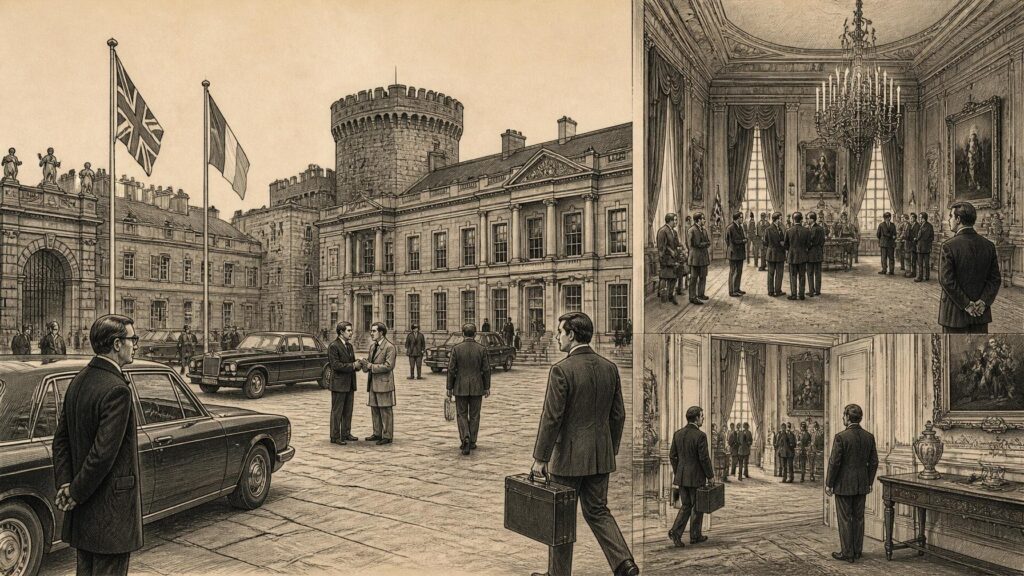
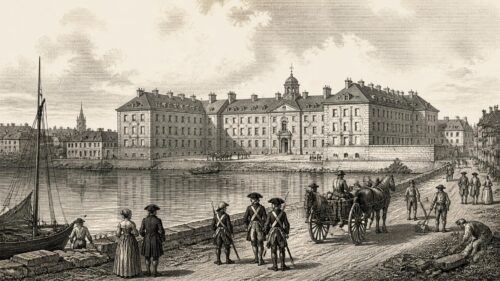
AI generated historical illustration, not a contemporary photograph.
At a Glance
Ireland’s eighth Presidency of the Council of the European Union, held from 1 July to 31 December 2026, is not simply a six-month sequence of ministerial meetings. It is the latest chapter in a long Irish engagement with European institutions: an engagement that has altered the State’s economic circumstances, diplomatic habits, constitutional debates and sense of place in Europe. The Presidency offers a particularly useful historical lens because it makes visible a recurring Irish task: to chair a collective enterprise without mistaking the chair for a throne.
European Return
On 1 July 2026 Ireland assumed the rotating Presidency of the Council of the European Union for the eighth time. The dates matter. This is a completed historical event in progress, rather than a distant plan: the term runs until 31 December 2026, after which Lithuania is due to take the chair for the first half of 2027. Ireland’s official Presidency material identifies the central themes as competitiveness, values and security, under the motto “Strength with unity”. Those phrases belong to the political language of the present, but the office itself has a longer pedigree. Ireland first held the Presidency in 1975, only two years after entering the European Economic Community.
The modern European Union can seem remote when described through regulations, councils and institutional acronyms. Yet the Irish Presidency is a concrete exercise of government. Irish ministers chair Council formations in their relevant policy fields; officials guide committees and working parties; negotiators seek agreement with the European Parliament and the European Commission; and the State hosts formal and informal gatherings. The Council is not the European Council, which brings together heads of state or government, nor is it the European Commission, which proposes legislation. The Council represents member-state governments and, with the Parliament, acts as a legislator.
That distinction explains both the opportunity and the limitation inherent in the Presidency. A member state does not receive a six-month licence to impose its national wishes on Europe. It receives responsibility for keeping business moving among twenty-seven governments with diverging economies, political coalitions, legal traditions and strategic interests. The official description of the role is deliberately restrained: planning, coordinating and chairing meetings; representing the Council; negotiating with other institutions; communicating; and serving as an honest broker. A successful Presidency is therefore commonly measured less by display than by whether difficult work has been brought to a conclusion without breaking the working relationships on which the Union depends.
This makes the subject proper Irish history. It concerns the Irish State’s development after entry into the European Communities on 1 January 1973, alongside Denmark and the United Kingdom. It also concerns the transformation of Ireland from a comparatively peripheral and poorer Community member into an established participant in European decision-making. That transformation should not be reduced to a simple tale of European benevolence or Irish ingenuity. It involved domestic choices, international conditions, controversy and uneven outcomes. Nevertheless, the sequence of Irish presidencies offers unusually clear documentary milestones in the relationship.
Institutional Machinery
The rotating Presidency predates the European Union in its present form. It arose in the earlier Communities, when the number of member states was smaller and the Council’s rhythms were more closely tied to national capitals. Every member state now holds the office for six months. With twenty-seven members, an individual country returns to the role only about every thirteen and a half years. Ireland’s eight presidencies are therefore not annual ceremonies but spaced moments in which changing national administrations meet changing European circumstances.
Presidencies are organised in groups of three, known as trios. The system was introduced under the Lisbon Treaty in 2009 to give continuity beyond any single half-year. Ireland’s 2026 term begins a trio with Lithuania and Greece, extending from July 2026 until December 2027. The trio prepares an eighteen-month framework, while each state sets out a more specific programme for its own six months. This structure is evidence of an institutional lesson learned over decades: the Union’s legislative and diplomatic work rarely fits neatly inside one national calendar.
The Presidency chairs most Council meetings and preparatory bodies, but not the Foreign Affairs Council in its ordinary form, which is chaired by the High Representative of the Union for Foreign Affairs and Security Policy. That qualification is significant. It guards against a misleading picture in which the presiding country becomes the sole voice of Europe abroad. The role is powerful chiefly through agenda management, procedure, preparation and mediation. A chair can identify practical points of convergence, draft compromises, sequence discussions and ensure that a proposal does not simply disappear into delay. It cannot responsibly act as the advocate of one national faction.
The expression “honest broker” is therefore more than ceremonial etiquette. It captures a constitutional expectation. A Presidency that visibly promotes its own narrow interests risks losing the confidence needed to obtain agreement from others. Ireland’s size has sometimes been presented as a natural advantage in such work, on the assumption that a smaller state appears less threatening than a large one. That is an interpretation, not a rule of institutional life. Smaller states can be trusted, ignored, influential or constrained, depending on the issue and the political climate. Ireland’s historical record is better understood as evidence of repeated preparation and coalition-building rather than proof that size alone produces diplomatic virtue.
The 2026 programme also illustrates the scale of the task. Official material anticipated twenty-two informal ministerial meetings, an informal meeting of heads of state or government in November, and more than 250 additional meetings and conferences. Such numbers do not demonstrate success by themselves. They do, however, show that a Presidency is not a single summit staged for cameras. It is a dense administrative undertaking involving departments, permanent representation staff, local authorities, cultural bodies, security arrangements, interpreters, civil servants and the European institutions themselves.
Membership Beginnings
Ireland’s European story cannot be understood without the decision to join the European Economic Community. Entry was approved by referendum in 1972 and took effect on 1 January 1973. Membership connected Ireland more closely to continental markets and institutions at a time when its economic relationship with the United Kingdom remained exceptionally important. The Communities were not an escape from geography, but they supplied a wider setting in which Ireland could diversify economic and diplomatic connections.
The importance of the Community to Ireland was material as well as symbolic. Regional development, agricultural policy, trade access and later structural funding all shaped public discussion. Yet the historical relationship was never merely a ledger of receipts and payments. Membership required Irish governments and voters to take positions on sovereignty, monetary integration, treaty change, social policy, neutrality, enlargement and the legal reach of European law. Referendums on major treaties made European questions part of domestic constitutional life in a particularly direct way.
The first Irish Presidency arrived before many of the later landmarks that now appear inseparable from the Union: the single currency, direct European Parliament elections, the formal European Council structure, successive enlargements to the east, and the trio system. In 1975, the Communities were still learning how to operate after the accession of Ireland, Denmark and the United Kingdom. Ireland’s early turn in the chair gave a new member a prominent role in a Community that was itself negotiating its identity amid economic turbulence.
It is tempting to tell this early period as a smooth national ascent from margin to influence. The documents do not justify such simplicity. Ireland remained exposed to global inflation, energy shocks and its close economic links with Britain. The European project also faced persistent disputes about agricultural spending, national budget contributions and institutional authority. What can be said with confidence is that Ireland was no longer a passive observer of continental developments. Through membership and the Presidency, it entered the routine processes by which common policies were argued over and made.
First Chairmanship
Ireland’s first Presidency, from January to June 1975, holds a special place in the institutional history of Europe. During that term Dublin Castle hosted the first formal meeting of the European Council, on 10 and 11 March. The European Commission’s representation in Ireland identifies this meeting as an important beginning for the regular gatherings of heads of state or government that would become central to European political direction. The event was not the creation of European cooperation from nothing; it was, rather, a decisive formalisation of leaders meeting at the highest political level.
The first term also coincided with the Equal Pay Directive and the establishment of the European Regional Development Fund. Both subjects had clear relevance to Ireland, though it would be an overstatement to depict them as Irish achievements alone. European directives and funds were products of collective institutional work, contested negotiation and longer policy histories. Ireland’s Presidency helped provide the setting in which this work advanced. The distinction matters. National commemorative accounts naturally emphasise the presiding country’s contribution, whereas historical explanation must retain the agency of the Commission, other governments, officials, legislators and organised interests.
The 1975 experience established a pattern that would recur. Dublin was used as a European meeting place, while Irish officials acquired experience in the procedural labour behind political statements. The Presidency did not abolish the difference between large and small states, but it gave Ireland a recognised responsibility at the centre of the Community’s calendar. That mattered for a country whose foreign policy had long been shaped by the need to maintain room for independent action beside its nearest neighbour and former imperial ruler.
There is no need for folklore to heighten this story. Irish historical writing can sometimes turn diplomatic hosting into a national legend of genial mediation, in which atmosphere and hospitality supposedly settle disputes that policy cannot. Hospitality may assist diplomacy, but the documentary record points to meetings, agendas, drafts, legal texts and negotiations. The more durable achievement was professional capacity: learning how to convene, brief, coordinate and compromise within a multilateral system.
Monetary Turns
Ireland’s second Presidency, from July to December 1979, came after the first direct elections to the European Parliament. This created an altered institutional environment. The Parliament now possessed a new democratic legitimacy, and the relationship between it and the Council needed to be worked out in practice. Irish official historical accounts place this problem alongside monetary and budgetary disputes, reminders that European integration has always combined ideals of cooperation with hard arguments about money and authority.
The European Monetary System had been launched earlier in 1979. Ireland’s participation involved a consequential break in the old one-for-one link between the Irish pound and sterling. That decision belongs to the broader history of Irish economic independence, even though it must be placed within the instability of the international monetary order. The Irish Presidency did not create the European Monetary System, but it helped steer Council business during its early phase, when practical confidence in the arrangement remained uncertain.
The Dublin European Council of December 1979 was dominated by negotiations over the United Kingdom’s budget contribution. The dispute demonstrated that Community solidarity had fiscal limits and that national leaders could use summitry to press forceful claims. For Ireland, the episode was also a lesson in the Presidency’s difficult position. The chair must guide a discussion in which its closest neighbour and major economic partner may be one of the principal antagonists. Such moments test procedure, patience and political judgement more severely than the celebratory language attached to European occasions.
The 1996 Presidency returned Ireland to monetary questions on the threshold of the euro. At the Dublin European Council that December, the visual designs for euro banknotes were unveiled. The term also dealt with the Stability and Growth Pact and with treaty reform. The Irish Presidency’s “Dublin II” draft formed an important staging point toward the Treaty of Amsterdam, subsequently signed in 1997. These matters reveal how treaty and currency histories overlap: monetary union required rules, institutions, political confidence and legal arrangements, not merely new notes and coins.
Ireland adopted the euro in 2002, joining eleven other states in the initial euro area. In retrospect, the path from the 1979 monetary break with sterling to the introduction of euro cash may seem inevitable. It was not. It passed through domestic debate, treaty referendums, convergence requirements and changing European bargains. Historical interpretation should resist the illusion that later outcomes were preordained. Ireland’s presidencies are valuable precisely because they show policy being negotiated before its results had become familiar.
Enlargement Politics
The Presidency of July to December 1984 unfolded against wider pressures: difficult budget negotiations, impending enlargement and the humanitarian emergency of famine in Ethiopia and the Sahel. Irish accounts record agreements on financial and food aid, including substantial grain commitments from member states. They also emphasise the settlement of outstanding issues relating to Spain and Portugal’s accession, including matters of wine, fisheries and social policy. Those technical subjects might appear unglamorous, but enlargement has always depended on such detail. New members do not enter an abstract Europe; they enter legal regimes that govern livelihoods, trade and public policy.
The same term produced the Ad Hoc Committee on Institutional Affairs, chaired by the former Irish foreign minister Jim Dooge. The committee’s recommendations became an important antecedent to the Single European Act of 1987. Here again, causation should be expressed carefully. The Dooge Committee did not single-handedly produce the Act, and reform emerged from broader pressures within the Community. But its work gave organised form to a debate about how a larger Community could make decisions and complete the internal market. Ireland’s association with the committee marks a significant contribution to institutional reform.
Ireland’s 1990 Presidency took place after the fall of the Berlin Wall, when European politics was being transformed by German reunification and the prospect of a changed eastern Europe. Meetings in Dublin addressed a common European approach to German reunification and relations with central and eastern European neighbours. Agreement was reached to convene intergovernmental conferences on Economic and Monetary Union and Political Union, negotiations that led towards the Maastricht Treaty. The historical importance of this episode lies not in claiming that Dublin directed the continent’s future, but in recognising that Ireland chaired vital collective discussions at an exceptional moment.
In 2004, enlargement moved from prospect to ceremony. Ireland’s January to June Presidency coincided with the accession of ten new member states on 1 May, the largest single enlargement in the Union’s history. A “Day of Welcomes” at Áras an Uachtaráin brought leaders of the enlarged Union together, with a commissioned poem by Seamus Heaney read as part of the occasion. The cultural symbolism was powerful, but it rested on many years of negotiations by applicant states, existing members and EU institutions. Ireland hosted a moment of arrival; it did not own the process.
The 2004 term also helped secure agreement on the draft Treaty establishing a Constitution for Europe. That constitutional treaty did not enter into force after referendums in France and the Netherlands rejected it in 2005. Elements of its institutional settlement later appeared, in altered form, in the Lisbon Treaty. This is a useful warning against treating every agreement reached under a Presidency as a final destination. European history often advances by revision, failure, reworking and renewed consent.
Recovery Years
Ireland’s seventh Presidency, in the first half of 2013, occurred after the financial crash and amid the eurozone crisis. The contrast with the buoyant ceremonies of 2004 could hardly have been sharper. Ireland had experienced a severe banking and fiscal crisis, and its European role was now bound to difficult questions of economic recovery, regulation and confidence. The official record describes the term as addressing a eurozone in crisis, while listing progress on Common Agricultural Policy reform, the Youth Guarantee, the Multiannual Financial Framework for 2014–2020 and the Single Supervisory Mechanism.
The Single Supervisory Mechanism was part of the emerging banking union designed to strengthen oversight and reduce the risks exposed by the crisis. The Youth Guarantee sought to respond to high youth unemployment by committing member states to provide younger people with a quality offer of employment, continued education, apprenticeship or traineeship within a defined period after becoming unemployed or leaving formal education. These were European responses to a crisis that had national variations. Their advancement during an Irish Presidency should not conceal the human cost of recession in Ireland or elsewhere, but it shows how a state recently subject to intense economic adjustment could contribute to policy discussions about the Union’s recovery.
The 2013 term also reveals the changing practical character of a Presidency. Official accounts record 185 events in Ireland and eleven informal Council meetings. By then, Brussels-based negotiation, digital communication and permanent institutional machinery were more developed than in 1975, but national hosting still mattered. A Presidency creates occasions in which domestic audiences encounter European politics at close range, while visiting officials see the presiding state beyond the corridors of Brussels.
Irish became an official and working language of the European Union in 2007, though temporary derogations limited its use in some institutional processes. Those exemptions ended in 2022, granting Irish full equality with the Union’s other official and working languages. This is not a decorative footnote. Language status concerns access, cultural recognition and the practical ability of citizens to encounter European law and institutions in their national language. It connects the constitutional Irish State’s linguistic commitments to the multilingual reality of the Union.
Present Mandate
The 2026 Presidency’s stated priorities—competitiveness, values and security—are broad enough to encompass some of the most difficult questions confronting the Union. Competitiveness can involve industrial policy, research, the single market, regulation, energy, skills and trade. Values may refer to democracy, the rule of law, fundamental rights and social cohesion. Security extends across economic resilience, cyber concerns, defence questions, borders and the wider geopolitical environment. The breadth is not an evasion; it reflects the fact that modern European policy problems overlap.
Still, a published programme is evidence of intention, not proof of accomplishment. Historical accounts written before a Presidency concludes should not convert ambitions into achievements. Whether a legislative file is concluded, whether a compromise survives, and whether member states accept a common position can only be assessed against the official record at the end of the term. As of 1 November 2026, Ireland remains in office, with two months still to run. Any final judgement must therefore be provisional.
The role is also constrained by events outside Dublin’s control. International crises, disagreements between governments, Commission proposals, parliamentary timetables, court decisions, elections and economic developments can all redirect the Council’s agenda. A Presidency must maintain continuity while responding to interruption. That balance is why the office is better understood as stewardship than command.
Ireland’s own political context matters as well. The country brings to the chair experience of EU membership, a small open economy, a border shaped by the United Kingdom’s departure from the Union, a tradition of military neutrality, and a history of peace and reconciliation on the island. None of these characteristics automatically determines a common European policy. They do, however, inform the perspectives Irish ministers and officials bring to negotiation. The official Presidency narrative presents Ireland as an outward-looking state on Europe’s western edge with transatlantic and global connections. This is a self-description, but it corresponds to a recognisable feature of the State’s modern diplomatic position.
Historical Measure
The historical significance of Ireland’s 2026 Presidency will not rest solely on a closing communiqué or a count of meetings held. It will depend on the quality of agreements reached, the files advanced, the relationships maintained and the institutional record left behind. It will also be judged differently by officials, politicians, business groups, workers, campaigners and citizens. Some will regard a quiet Presidency as effective because it preserved consensus; others will see caution where they wanted political ambition. Such disagreement is not a failure of history but part of the subject itself.
Across eight presidencies, certain continuities stand out. Ireland has repeatedly chaired the Council at moments of European transition: the first formal European Council meeting in 1975; monetary reorganisation in 1979 and 1996; institutional reform and southern enlargement in 1984; the reshaping of Europe after the Cold War in 1990; eastern enlargement in 2004; recovery and banking reform in 2013; and a contemporary agenda framed by competitiveness, values and security in 2026. The sequence does not prove that Ireland caused these changes. It shows that Irish governments were entrusted, at consequential intervals, with helping the Union manage them.
That is the most defensible interpretation of rotating influence. The Presidency amplifies a country’s capacity to organise, mediate and represent, but it does not suspend the collective nature of European government. Ireland’s strength in the role has lain not in commanding Europe but in working within the discipline of shared rules, patient preparation and negotiated compromise. For a State that entered the Community in 1973, the eighth turn in the chair is evidence of durable participation in a political order that Ireland has helped to shape and has, in turn, helped to shape Ireland.
The article presents Ireland’s 2026 Council Presidency as influence exercised through restraint: shaping agendas, building compromise and sustaining administrative momentum rather than directing Europe. Comparing earlier Irish terms, from Dublin Castle in 1975 to monetary change, enlargement and treaty negotiations, it suggests that smaller states may gain leverage through preparation, trust and continuity. Yet competitiveness, values and security could create competing demands among member governments, while results remain uncertain. This raises an question about how success should be interpreted when visible national victories are not the purpose. How should historians assess whether Ireland’s honest-broker role produced progress during 2026 Presidency?