

Guarded Childhoods
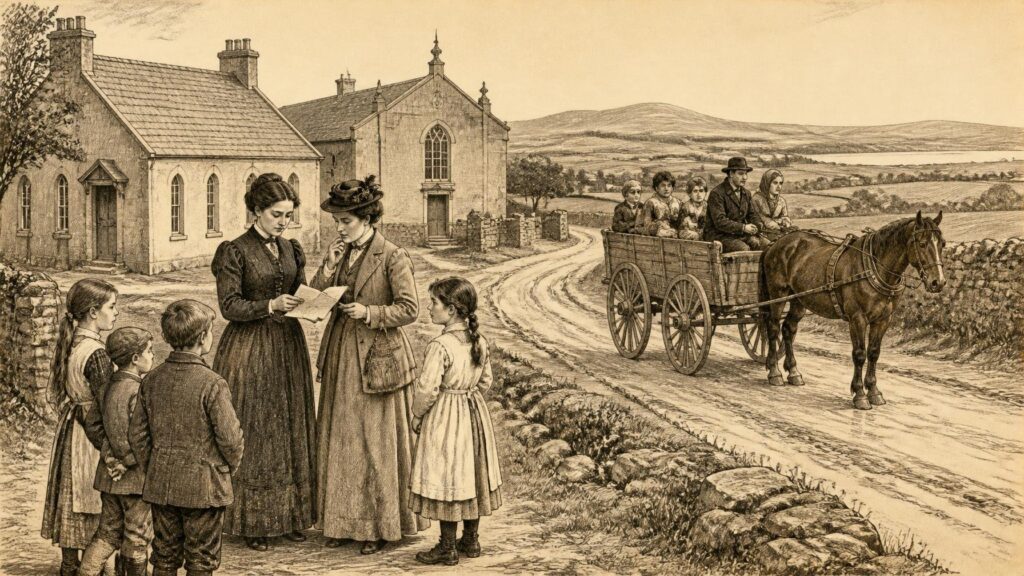
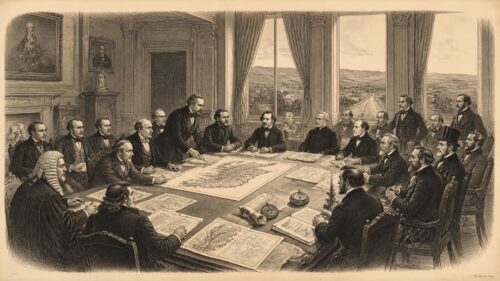
AI generated historical illustration, not a contemporary photograph.
At a Glance
The history of safeguarding children in Ireland is not a simple story of enlightened reform replacing a darker past. North and South, protective law and charitable care often existed beside institutional systems that exposed children to neglect, violence, separation and silencing. Modern safeguarding emerged through painful scrutiny of those contradictions: survivor testimony, public inquiries, changing professional practice, new statutory duties and an insistence that children’s welfare must be more than an aspiration.
Divided Island
“North and South” is an important phrase in this subject because the island contains two legal jurisdictions, two administrative traditions and, since partition, two related but distinct histories of child welfare. Northern Ireland remained within the United Kingdom after 1921; the twenty-six counties became the Irish Free State in 1922 and later the Republic of Ireland. Yet the border did not create wholly separate social worlds. Families crossed it, churches and religious congregations operated on both sides, and children could be placed, moved or lost within networks extending beyond either jurisdiction.
At the beginning of the twentieth century, the principal statutory inheritance for child care across Ireland was the Children Act 1908. Its provisions addressed matters including juvenile justice, neglect, cruelty and the care of children away from their parents. Such law represented an important recognition that children could require public protection. It did not, however, establish the child-centred system now associated with safeguarding. Its outlook was entangled with poverty control, moral regulation, institutional discipline and the management of families regarded as troubled or inadequate.
This distinction matters. Protective intervention is not automatically safeguarding in the modern sense. A state may remove a child from a dangerous home and still place that child in an unsafe institution. A voluntary body may offer food, schooling and shelter while denying privacy, family contact, affection or redress. Historical assessment must therefore ask not merely whether authorities acted, but what they understood protection to mean, whose voices carried authority, and how institutions were inspected, challenged and held accountable.
For much of the twentieth century, care arrangements in both jurisdictions rested heavily upon large residential settings and organisations outside the ordinary family home. These included children’s homes, approved schools, orphanages, industrial schools, training schools and institutions connected with religious bodies. The precise legal arrangements differed North and South, but the wider pattern was comparable: vulnerable children were frequently dealt with through systems that were distant from their families and subject to uneven external oversight.
It would be misleading to treat every residential setting as identical or to assume abuse in every case. The evidence does not support so broad a claim. But later investigations in each jurisdiction established that institutional arrangements could conceal grave failures and that official supervision did not reliably protect children. The central historical lesson is not that care itself was inherently harmful; it is that care without effective scrutiny, independent reporting routes and meaningful regard for the child’s experience is dangerously vulnerable to abuse.
Institutional Shadows
In the Republic, the twentieth-century history of industrial and reformatory schools became inseparable from debates about the State’s duties towards children. These institutions were part of a wider system shaped by legislation, religious management and State finance or regulation. Children entered for many reasons, including poverty, family crisis, bereavement, perceived neglect, offences, disability and social stigma. Admission was not a neutral administrative event: it could separate a child from parents, siblings, locality and identity for years.
The Commission to Inquire into Child Abuse, commonly known after its chair as the Ryan Commission, reported in 2009. Its report examined institutions and systems responsible for children during the period under review and made twenty recommendations. The Government’s subsequent implementation plan contained ninety-nine actions intended both to address the consequences of past abuse and to strengthen national child-care policy. The report’s importance lay not only in the detail it assembled but in its public acknowledgement that systemic settings could fail children over a prolonged period.
The story of mother and baby homes and county homes adds another essential dimension. These institutions were not identical to industrial schools, but their histories overlap in the treatment of mothers, infants and children whom society marked as shameful, dependent or inconvenient. The Commission of Investigation into Mother and Baby Homes and Certain Related Matters was established in 2015 to investigate what happened to women and children in named institutions and a representative county sample between 1922 and 1998. Its remit encompassed care, welfare, entry arrangements and routes out of institutions.
Public debate about those homes has sometimes encouraged sweeping assertions, especially around individual experiences, burial practices and adoption. A responsible historical account must distinguish the Commission’s documented findings from unresolved personal cases, archival gaps and claims requiring further corroboration. Uncertainty is not a reason for dismissal. It is itself evidence of the harm caused when records were incomplete, inaccessible or controlled by institutions rather than by the people whose lives they recorded.
The State’s response to the final report included an apology that recognised failures of Church, State and society. Such statements are historical evidence of official recognition, not substitutes for the testimony of survivors or for critical scholarship. Apologies cannot restore lost childhoods, repair fractured identities or settle every factual question. They can, however, mark a significant change from older cultures in which institutional authority was routinely presumed and children’s accounts were too readily doubted.
Northern Ireland’s historical record contains comparable warnings. The Historical Institutional Abuse Inquiry investigated abuse of children under eighteen who lived in institutions in Northern Ireland between 1922 and 1995. Its report, published on 20 January 2017, found systemic failings to varying degrees in many of the institutions it examined, alongside evidence of sexual, physical and emotional abuse, neglect and unacceptable practices. The inquiry’s remit also included child migration from Northern Ireland institutions.
The Hart Inquiry did not claim that every institution or every person working in one had behaved abusively. Its significance was more exacting: it showed that serious failures could be systemic, that organisational reputation could not be treated as proof of safety, and that the State had obligations even where care was delivered by religious or voluntary bodies. Its recommendations included redress, survivor support, a public apology, a memorial and a commissioner. These measures placed recognition and remedy alongside the question of prevention.
Legal Turning
The later twentieth century brought a conceptual change. Older arrangements often treated child welfare through the lenses of rescue, discipline and family deficiency. The emerging model gave greater weight to children’s welfare, family support, professional assessment, rights and the prevention of significant harm. The transformation was uneven and incomplete, but it altered the language in which authorities were expected to justify intervention.
In the Republic, the Child Care Act 1991 was a decisive legal landmark. It provided for the care and protection of children and required health boards, in promoting the welfare of children not receiving adequate care and protection, to regard the child’s welfare as the first and paramount consideration. It also directed them, where practicable and appropriate to age and understanding, to consider the child’s wishes, while retaining the principle that children generally benefit from being brought up in their own families.
That wording expressed a balance which remains central to safeguarding. The family is normally the best setting in which a child should grow and develop; poverty, disability, domestic conflict or parental difficulty do not erase family bonds. At the same time, family privacy cannot be used to ignore serious risk. The challenge for services is to support families early, assess danger accurately and intervene proportionately. No statute can remove the need for judgement, resources and skilled relationships.
The 1991 Act did not create a perfect service, nor did legislation alone erase inherited attitudes. Its practical implementation was phased over several years, and services continued to face pressures in staffing, accommodation and coordination. Still, its statutory emphasis on welfare, assessment and support represented a departure from systems in which institutional placement could become the default response to family difficulty.
In Northern Ireland, the Children (Northern Ireland) Order 1995 became the principal framework for child-care law. It provides that a child’s welfare is the paramount consideration in relevant proceedings, includes duties concerning children in need and family support, and establishes care, supervision, emergency-protection and investigative powers. The Order’s architecture placed family support, court oversight and protective intervention within a more integrated framework than earlier legislation.
There were similarities between the two jurisdictions, especially in the centrality of welfare and the effort to avoid unnecessary removal from families. There were also structural differences. Northern Ireland operated within the United Kingdom’s devolved health and social-care arrangements; the Republic developed its own statutory and administrative structures. Comparisons must therefore avoid the lazy assumption that one system simply copied the other. They shared influences, but they were neither legally identical nor historically interchangeable.
Northern Framework
In Northern Ireland, the word “safeguarding” came to denote a broad responsibility shared across public, voluntary, community, independent and faith sectors. It encompasses protection from abuse and neglect, but it also points towards prevention, coordinated planning, safe recruitment, proper information handling and organisational culture. This wider language reflects the recognition that social workers and police cannot carry responsibility alone.
The Safeguarding Board Act (Northern Ireland) 2011 supplied a legislative basis for the Safeguarding Board for Northern Ireland. The Act created a regional board, set out its objective and functions, imposed duties of cooperation and addressed arrangements to safeguard and promote children’s welfare. Explanatory material records that earlier Area Child Protection Committees had been formed in the early 1990s and that later reforms sought stronger regional interagency cooperation.
This was an institutional response to a recurring historical problem: fragmented responsibility. When education, health, police, housing, youth justice and voluntary agencies each hold only part of a child’s story, grave risk can be missed. Multi-agency arrangements promise a remedy, but their success depends on more than meetings and written protocols. Staff require time, clear authority, sound records and confidence that raising concern will bring action rather than retaliation or delay.
The Northern Ireland Department of Health’s Co-operating to Safeguard Children and Young People provides the overarching policy framework for safeguarding across statutory, private, independent, community, voluntary and faith sectors. First issued in 2016 and published in its current framework in 2017, it replaced 2003 guidance and has subsequently been updated. Its breadth illustrates how safeguarding has expanded beyond the residential institution or social-work office to include every organisation with regular responsibilities towards children.
Such development should not be read as proof that risk has disappeared. Modern systems face forms of harm that earlier law described poorly or not at all, including online exploitation, coercive control, trafficking, criminal exploitation and harm occurring between children. Historical continuity lies in the need to hear children, test institutional assurances and respond before concerns harden into catastrophe. What changes are the settings, technologies and professional vocabulary through which that duty is exercised.
Southern Framework
In the Republic, the creation of the Child and Family Agency, widely known as Tusla, marked another important administrative change. The Child and Family Agency Act 2013 established the Agency, transferring relevant functions and assigning it roles in supporting and promoting children’s development, welfare and protection, supporting families, and maintaining services. The Agency formally came into being on 1 January 2014.
The 2013 Act also required the Agency to have regard to children’s best interests and, where children can form and express views, to ascertain and give due weight to those views in accordance with age and maturity. This was more than a rhetorical refinement. It reflected a long international and domestic shift away from treating children solely as objects of adult protection and towards recognising them as people whose knowledge, wishes and fears may be vital to sound decisions.
Children First, first published as national guidance in 1999 and comprehensively revised in 2017, became the Republic’s central framework for identifying, reporting and responding to concerns about abuse and neglect. It addresses the responsibilities of professionals, organisations, employees, volunteers and members of the public. Its guidance language is significant historically: child protection is not confined to a specialist service but requires people in ordinary institutions to recognise danger and know how to act.
The Children First Act 2015 placed important elements of this approach on a statutory footing. It created duties for mandated persons who know, believe or reasonably suspect that a child has been harmed, is being harmed or is at risk of harm to report that concern to the Agency as soon as practicable, subject to statutory qualifications. It also requires providers of relevant services to prepare child-safeguarding statements and assess risk.
Mandatory reporting is sometimes imagined as a complete answer to safeguarding. History cautions against that belief. A report is only the opening of a process. Effective protection depends upon the quality of assessment, the availability of services, accurate information sharing, respectful engagement with families, supervision of staff and the willingness of institutions to act upon uncomfortable evidence. A reporting duty without capacity can merely produce queues of concern; capacity without accountability can create unchallengeable discretion. Both are required.
The Republic’s system also moved towards stronger regulation of early-years and school-age services. The State identifies Tusla’s Early Years Inspectorate as the independent statutory regulator for early learning and care and school-age childcare, operating under the Child Care Act 1991 as amended and subsequent regulations. Regulation does not guarantee safety, but it changes the expectation that providers must meet published minimum requirements and submit to inspection.
Survivor Testimony
The greatest corrective to institutional history has been survivor testimony. Official files often record decisions made about children rather than children’s own accounts of what was done to them. Administrative language can reduce a life to categories such as “committed”, “transferred”, “discharged” or “boarded out”. Survivors restore the human meaning obscured by those terms: fear, hunger, punishment, separation, loneliness, resilience and the enduring difficulty of being believed.
Testimony must be treated with seriousness and care. It is not folklore merely because it is oral, personal or recalled after many years. Nor should historians treat every recollection as immune from contextual examination. The proper approach is neither credulity nor reflexive suspicion. Accounts should be listened to on their own terms, compared where possible with records and other testimony, and understood in light of the power imbalance that once prevented children from reporting harm safely.
Public inquiries have been crucial because they create a forum in which individual testimony can alter the national record. The Ryan and Hart inquiries did not emerge solely from official initiative. They followed sustained campaigning by survivors, advocates, journalists, researchers and community organisations. That fact complicates any comforting account of reform as benevolently granted from above. Often, institutions changed only after people formerly denied authority compelled the public to confront what authority had concealed.
Memory also has a role in commemoration. Memorials, records-access schemes, redress arrangements and official apologies may be meaningful, but they should not impose a single approved narrative upon all survivors. Experiences differed by institution, period, gender, disability, family circumstances and the particular adults involved. Respectful remembrance preserves that complexity. It recognises patterns of systemic failure while allowing each person the right to describe a childhood in his or her own words.
Border Practice
The border introduces practical risks that are easy to overlook in a map-based history. A vulnerable child may move with a family from Donegal to Derry, from Newry to Louth, or between rural communities whose economic and kinship connections pre-date partition. A child may be subject to care arrangements, an assessment, a protection plan or a missing-person response in one jurisdiction while physically present in the other. In such circumstances, delayed communication can have serious consequences.
North–South cooperation developed gradually through professional networks, departmental contact and formal agreements. The Protocol Between Northern Ireland and Ireland for Handling Inter-Jurisdictional Child Cases has existed in some form since 2011. Its updated version provides a framework for social-work authorities in both jurisdictions dealing with vulnerable children and families who have moved across the border, children requiring placements in the other jurisdiction, and cases involving assessment, protection or missing children.
The protocol is historically significant because it accepts a practical truth: sovereignty divides legal competence, but it does not divide children’s lives into neat compartments. It aims to help authorities fulfil their respective responsibilities while acting in the child’s best interests. This is not an argument for erasing distinct legal systems. It is an acknowledgement that safeguarding fails if agencies regard a border crossing as somebody else’s problem.
Cross-border work also reveals the limits of legislation. Protocols must operate through named professionals, reliable contact points, secure information sharing and mutual understanding of different thresholds and procedures. The language used in one jurisdiction may not map perfectly onto that used in the other; a register, plan, order or placement can carry different technical meanings. Good cooperation therefore requires training and relationships as well as formal text.
In May 2025, the North South Ministerial Council approved a child-protection work programme to 2028. It included knowledge exchange, early identification and information sharing concerning emerging complex child-protection issues, and continuing cooperation on child welfare and protection. The programme demonstrates that cross-border safeguarding is not merely a historical legacy but an ongoing practical necessity.
Persistent Duties
There is a temptation to divide the past from the present too sharply: institutional abuse belongs to history, while safeguarding belongs to a more vigilant age. That division is unsafe. The forms of care, law and public language have changed substantially, but the underlying dangers of deference, secrecy, weak inspection, poor record keeping and defensive institutions remain recognisable. A safeguarding culture must be tested by what happens when a child’s account is inconvenient, not only by the quality of its published policy.
Historical evidence supports several enduring principles. Children require adults who will listen and act. Organisations require independent oversight and transparent routes for complaint. Family support must be real rather than rhetorical, since neglect and crisis are often connected to poverty, insecure housing, ill health, addiction, violence and exclusion. Professional cooperation must have a clear purpose: not the exchange of data for its own sake, but the timely protection and flourishing of an individual child.
There must also be restraint. The history of Irish child welfare shows that intervention can itself be harmful when it is coercive, careless or rooted in stigma. Safeguarding is not a licence to treat poor families, unmarried mothers, disabled people or marginalised communities as presumptively unfit. The best modern frameworks therefore combine child-centred protection with proportionality, respect for family life, support before crisis where possible, and review of decisions affecting children.
The history of safeguarding North and South is consequently a history of both state-building and state failure. It records the growth of statutory duties, professional social work, regulatory inspection and children’s rights. It also records how readily institutions can confuse their own preservation with the welfare of those entrusted to them. The proper inheritance of that history is vigilance: a willingness to believe that harm can occur within respected settings, and an equal willingness to build services capable of preventing it.
Historical Balance
Irish history provides no basis for a sentimental tale in which a naturally caring society occasionally lost its way. Nor does the evidence support the opposite caricature, in which all former care was cruel or all present practice is ineffective. What it reveals is a more demanding reality. Safeguarding improved because assumptions were challenged: that religious, charitable or state authority was self-validating; that children could be safely spoken for without being heard; and that the border excused failures of cooperation.
The transition from the institutional world inherited from the Children Act 1908 to contemporary safeguarding structures has been profound. The Republic’s Child Care Act 1991, Tusla and the Children First framework; Northern Ireland’s 1995 Order, Safeguarding Board and regional guidance; and cross-border protocols all represent attempts to make welfare, accountability and cooperation operational rather than ceremonial. Yet laws and boards are instruments, not guarantees.
The most reliable historical conclusion is therefore modest but urgent. Children are safer when their rights, welfare and voices are placed at the centre of decision-making; when adults and institutions can be questioned without fear; when survivors are heard; and when agencies North and South recognise that safeguarding is a continuing public duty. The past cannot be repaired by language alone. It can, however, instruct the island to ensure that protection is measured by children’s lived safety, not by institutional confidence.



Guarded Childhoods demonstrates that legal reform alone cannot guarantee safety: both jurisdictions moved from institutional models towards welfare, participation and interagency safeguarding, yet survivor testimony revealed how oversight could fail despite formal protective duties. The article’s cross-border dimension is especially significant, since families, religious organisations and children’s placements have long extended beyond separate legal systems. Contemporary cooperation must therefore address differing procedures while avoiding gaps in information, accountability or support. How might Northern Ireland and the Republic develop cross-border safeguarding practices that provide consistent protection, respect family relationships, and genuinely incorporate children’s voices in individual decisions across both legal systems?