Dirath, Faelchar and Leinster692 CE
In 692, annals record the deaths of Dirath, bishop of Ferns, and Bran, grandson of Faelán and king of Leinster. A battle between the Osraige and Laigin killed Faelchar, grandson of Máel Odor, though its cause, location and outcome are unknown. Other fragmentary notices cannot be securely interpreted. Parallel annals also associate Leinster with blood-coloured rain, perhaps an observation, portent or later elaboration. These events occurred in a rural society sustained by farming, cattle and ecclesiastical communities. The sparse records reveal political and religious change, but leave many details unrecoverable.
Dateline
In 692 CE, Ireland’s surviving annalistic record centres on Leinster and its western neighbour Osraige. The firmest items are terse but consequential: Dirath, bishop of Ferns, died; Bran, grandson of Faelán and king of Leinster, also died; and a battle between the Osraige and the Laigin cost the life of Faelchar, grandson of Máel Odor. These entries occur under the following annal heading in the Annals of Ulster, whose calendrical apparatus explicitly equates that heading with AD 692. The precision is important. Irish annals preserve a sequence of notices copied and reshaped over centuries, and their year numbers do not always correspond neatly with modern calendar years. For this article, the events are included because the source itself connects them to AD 692; no day, battlefield or fuller narrative has survived.
A King Dies in Leinster
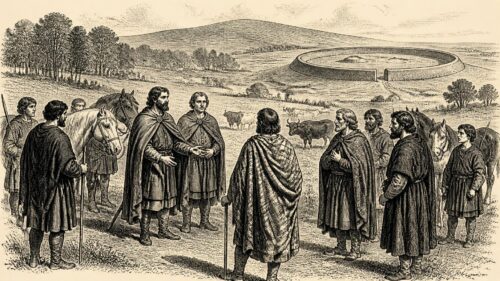
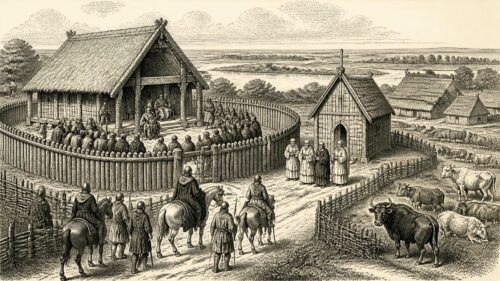
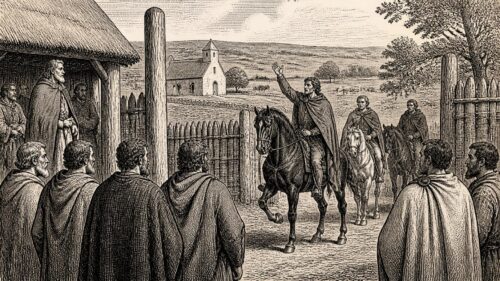
The death of Bran was more than a private dynastic loss. The annals style him rí Laigin, king of Leinster: a title that signals acknowledged pre-eminence among the several kindreds and territories of the province, rather than rule over a centralised kingdom. His grandfather Faelán had been a major Leinster ruler earlier in the century, so Bran’s death removed a man whose standing rested upon both descent and political connection. The record does not name a successor, describe a funeral, or say whether the transition was disputed. Silence on those points must not be mistaken for peace. In a political world of competing royal lineages, the death of a provincial king opened questions of clientship, tribute, military followings and control of church lands.
Leinster’s position made such questions especially sensitive. Its rulers had to negotiate with powerful neighbours in Brega and the midlands, while its eastern and southern districts contained rich pasture, arable land and important ecclesiastical sites. The later tradition surrounding the Bórama, the contentious cattle tribute said to have been demanded from Leinster by kings of the Uí Néill, shows how deeply later writers associated Leinster’s politics with obligations imposed from outside. That tradition should not be used as proof of a particular payment or confrontation in 692. It does, however, help explain why the succession of a Leinster king mattered beyond the province. Fínnechta Fledach remained the leading Uí Néill ruler in the wider annalistic sequence at this time, but authority described as the kingship of Ireland rested on alliances and submissions, not on a permanent state administration.
War on the Osraige Frontier
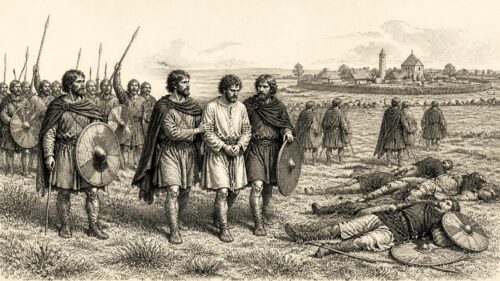
The battle between the Osraige and the Laigin is the year’s clearest notice of armed conflict. Osraige lay on Leinster’s western edge, broadly in the region of modern County Kilkenny and adjoining districts. It could be treated in different periods as politically distinct, as a neighbour of Munster, or as subject to Leinster’s pressure. The annal gives no cause for this encounter: there is no named place, no reported victor, no tally of casualties and no statement that territory changed hands. Its one certainty is death: Faelchar, grandson of Máel Odor, fell.
That spare formulation still tells us something about the character of warfare. Annalists normally singled out people whose death mattered to their communities: a ruler, a claimant, a leader of a fighting force, or a figure of a powerful kindred. Faelchar’s fall therefore made the battle worth entering into a national chronological record, even though his precise office is not supplied. It would be unsafe to call him king, general or hostage. Equally, it would be wrong to imagine an anonymous clash of peasants. Early medieval campaigning was usually organised through royal households, dependent groups and allied kin; cattle, food renders, honour and control of people could all be at stake. Most inhabitants would have experienced its effects not in a formal battlefield account but through demands for provisions, the movement of armed retinues, insecurity on roads and the risk of livestock seizure.
The same annal heading preserves two still more opaque notices: the killing of Ainfthech, Nia Néill and “the sons of Boendo”, followed by “a battle against Penda”. Neither identifies a place or explains the relationships involved. Penda may be a personal name, but the entry does not permit a secure reconstruction of opponent, kingdom or outcome. Such fragments are a useful warning against turning the year into a smooth story of provincial war. They show instead how much historical information has been lost between event, original memorandum, later compilation and surviving manuscript.
Ferns Without Its Bishop
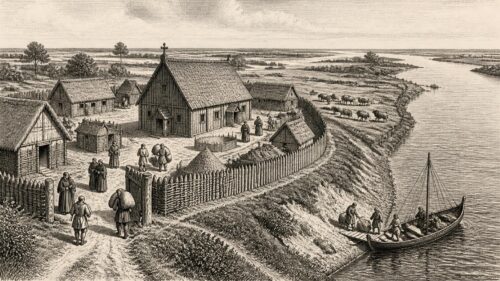
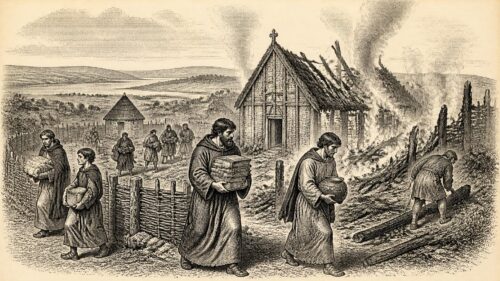
The death of Dirath, bishop of Ferns, brings the ecclesiastical landscape into view. Ferns, in present-day County Wexford, was an important Leinster church. Calling Dirath a bishop does not mean that he occupied a modern territorial diocese with fixed boundaries and a bureaucracy familiar from later centuries. In seventh-century Ireland, churches were embedded in networks of founders’ families, learned clerics, patrons, tenants and neighbouring rulers. Bishops performed sacramental and pastoral functions, while abbots and heads of religious communities could wield extensive institutional influence. The death of a bishop therefore involved a religious office, but also potentially affected a community’s lands, political protections, scholarly connections and claims to status.
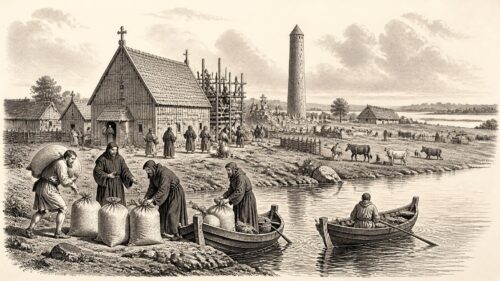
Nothing in the 692 entry identifies Dirath’s successor or describes Ferns itself. Yet it is reasonable to place his death within an Ireland in which churches were increasingly central to the ordering of society. Monasteries and other ecclesiastical settlements were places of worship, hospitality, craft activity, food production and literacy. They were also repositories of memory. The annals’ ability to preserve the names of a bishop, a king and a fallen aristocrat reflects clerical habits of record-keeping, although the texts now available are much later witnesses to earlier compilations. Their notices are evidence, not transcripts from the year itself.
Learning travelled through these institutions and across the Irish Sea. Adomnán, abbot of Iona, was active in this same generation and composed works that reveal a highly literate Columban milieu, linked to Ireland, western Britain and Northumbria. His recorded journey to Ireland is placed under the preceding annal number, not the one explicitly aligned to AD 692; astronomical and chronological study cautions against simply moving it into this calendar year. It belongs as immediate context, not as a securely dated event of 692. The distinction matters, particularly because Adomnán’s later return to Ireland in 697 and the promulgation of the Cáin Adomnáin, or Law of Innocents, are securely separate developments and should not be projected backwards onto Dirath’s year.
Blood-Coloured Rain
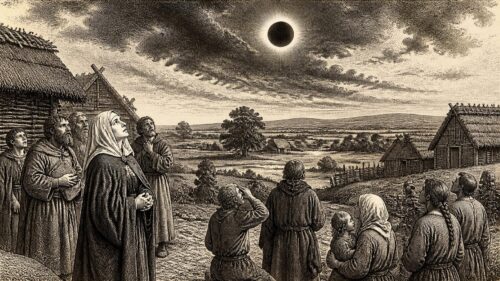
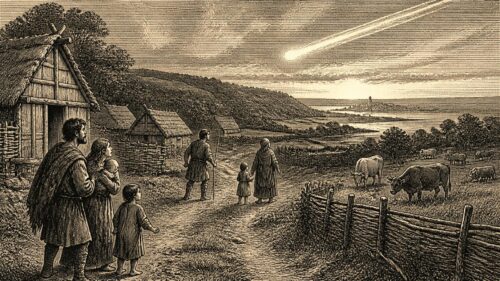
One striking detail appears in the parallel annal tradition. Chronicon Scotorum records that bloody rain fell in Leinster, while the Annals of Tigernach expands the image: it was like streams for three days and three nights. The Annals of Ulster does not include the notice in its corresponding entry. The responsible conclusion is not that a supernatural event, massacre or environmental catastrophe has been independently demonstrated. Rather, a learned annalistic tradition associated an extraordinary red or blood-like rainfall with Leinster in the same chronological context as Bran’s death and the Osraige conflict. It may preserve an observation, a literary portent, or a later elaboration; the evidence cannot decide between them.
For contemporaries, however, signs in the heavens and landscape could carry moral and political meaning. The annals commonly noticed eclipses, unusual weather, disease and celestial phenomena beside killings and royal deaths. Such juxtaposition did not necessarily claim a modern-style physical cause. It expressed a Christian historical imagination in which disorder in the natural world, warfare and the fate of rulers could be recorded within one providential chronology. The value of the “bloody rain” entry lies partly in revealing that mental world, and partly in demonstrating the need to compare versions rather than rely upon a single annal.
Life Beyond the Notices
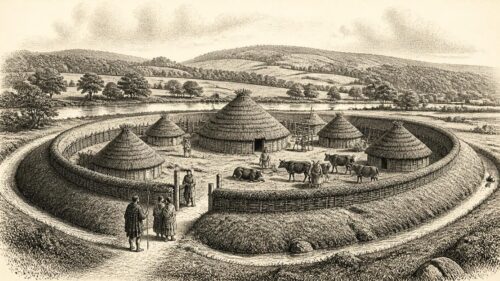
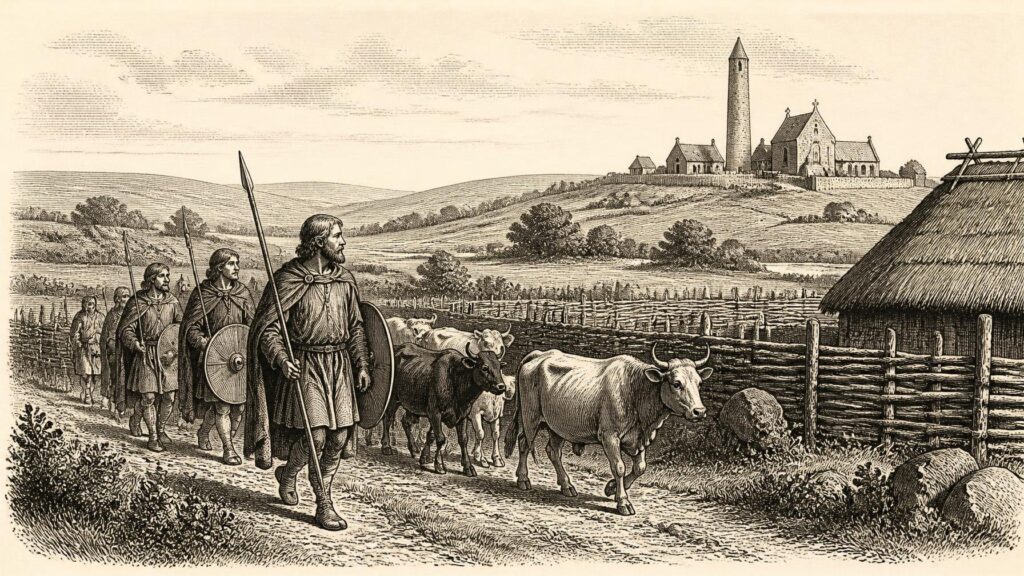
The deaths and battle recorded for 692 touched a society that remained overwhelmingly rural. Most people lived at dispersed farmsteads and enclosed settlements, working a mixed agricultural economy. Cattle were the chief measure of wealth and an important source of dairy produce, status and tribute, but they were not the whole economy. Archaeobotanical evidence shows the cultivation of barley and oats, with wheat, flax, peas and beans also present at some sites. Herding, sowing, harvesting, milling, food preservation, spinning and repair work structured ordinary life far more consistently than the dramatic episodes selected by the annals.
That everyday labour underpinned politics. A king’s ability to reward followers, sustain a hosting or protect a church depended on access to cattle, grain, labour and routes across the countryside. A battle on the Osraige–Leinster frontier and the deaths of Bran and Dirath were therefore not isolated elite occurrences. They were interruptions and rearrangements within systems of landholding, obligation and protection that involved religious communities and farming households alike. Yet the sources do not tell us that famine, plague, harvest failure or mass displacement occurred in Ireland in 692. The proper picture is narrower: a year marked in the record by a Leinster succession, a frontier conflict, a bishop’s death and a memorable, uncertain report of red rain—events whose significance is real even where their details remain beyond recovery.
Primary Sources
- The Annals of Ulster
- Chronicon Scotorum
- Part 69 of Chronicon Scotorum
- Annals of Tigernach
- Part 11 of The Annals of Tigernach
- Annals of the Four Masters, Part 52
- Fragmentary Annals of Ireland
- Chronological Synchronisation of the Irish Annals
- Exploring the Irish Annals
- The Life of Columba, written by Adamnan
- Adamnan's De Locis Sanctis
- Bede's Ecclesiastical History of England, Book V, Chapter 15
- Adomnán, Plague and the Easter Controversy
- Early Mechanisms of Abbatial Succession: The Case of Iona (563–704)
- Agriculture, Settlement and Society in Early Medieval Ireland
- Early Medieval Farming and Food Production: A Review of the Archaeobotanical Evidence from Archaeological Excavations in Ireland
- The Economy of Early Medieval Ireland
- Early Medieval Ireland: Archaeological Excavations, 1930–2009
- Early Medieval Dwellings and Settlements in Ireland, AD 400–1100, Volume 1
- Early Medieval Ireland, AD 400–1100: The Evidence from Archaeological Excavations
- Cáin Adomnáin and the Beginnings of International Humanitarian Law
- Early Human Rights Protections in Ireland