Clonmacnoise After Crón Bec693 CE
In 693, Irish annals recorded the death of Crón Bec, abbot of Clonmacnoise, alongside ecclesiastical deaths at Movilla and Balla, the killing of Cerball son of Máel Odar, and the siege of Dún Foither. These brief notices reveal the importance of monasteries as religious, economic and political centres within a fragmented society. Clonmacnoise, strategically located on the Shannon, depended on rural resources and river communications. The siege may have occurred in northern Britain, reflecting Irish Sea connections. Disputed annalistic dates prevent certainty over wider struggles for Tara, but the year shows institutional succession, local violence and interconnected ecclesiastical networks.
Dateline
In 693 CE, Ireland’s surviving annalistic record is unusually compact but revealing. The Annals of Ulster, whose annal headed 694 is synchronised to AD 693, record the death of Crón Bec, abbot of Clonmacnoise; the deaths of ecclesiastics at Movilla and Balla; the killing of a layman named Cerball son of Máel Odar; and a siege at Dún Foither. No contemporary narrative explains how these events were connected. Yet together they show an island in which monastic communities, local lordship and fortified places formed the essential framework of public life. The year was not one of a single, island-wide turning point. It was a year in which mortality, violence and institutional succession were important enough to enter records maintained by churches.
A Sparse but Careful Record
The dating requires some care. Early Irish annals were compiled and recopied over centuries, and their numbered headings do not always align neatly with modern calendar years. The relevant Annals of Ulster section is labelled U694 but explicitly assigns its material to AD 693. It is therefore reasonable to place its notices in 693 CE, while avoiding claims about month, season or sequence which the text does not supply. The notices are terse: a person dies, another is killed, a fortress is besieged. Their brevity is not evidence that such events were minor to those affected. Rather, it reflects the annals’ purpose: to preserve memorable facts in a form that could be fitted into a chronological framework.
Nor should the entries be read as a complete account of Ireland. They favour people and places connected with literate ecclesiastical networks. Ordinary households, women outside named religious communities, cultivators, herders, craftspeople and enslaved people appear only indirectly. Nevertheless, the material offers a valuable cross-section. It ranges from Clonmacnoise on the Shannon, one of the most important churches in the midlands, to Mag Bili or Movilla in the north-east; it also records a political disturbance at a dún, a defended stronghold. Ireland in 693 was divided among many competing dynasties and client populations, not governed by a central state. Churches and monasteries were consequently not detached retreats but corporate landholders, centres of learning, employers, hosts and political stakeholders.
An Abbot Dies at Clonmacnoise
The most prominent Irish notice is the death of Crón Bec, abbot of Cluain Moccu Nóis, now Clonmacnoise. His epithet, Bec, means ‘small’ or ‘little’, but no secure contemporary account survives of his appearance, career or family. What is certain is his office. To lead Clonmacnoise was to head a major religious community at a strategic crossing region of the River Shannon. Founded in the sixth century and associated with Ciarán, the settlement stood beside a principal north–south water route and close to overland routes across the central plain. Its influence rested on religious prestige, landed resources, the movement of people and goods, and relationships with neighbouring rulers.
Crón Bec’s death therefore mattered beyond the internal routine of one monastery. An abbot supervised a community whose members and dependants may have included clergy, scribes, students, tenants, labourers, artisans and travellers. He had responsibilities for worship and discipline, but also for property, hospitality and the protection of a saint’s cult. The sources do not name his successor in 693, nor do they describe any dispute. It would be unsafe to invent one. Even an uneventful succession, however, required the reorganisation of authority in a settlement where spiritual standing and material resources were inseparable.
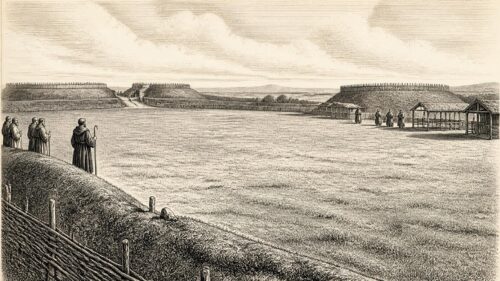
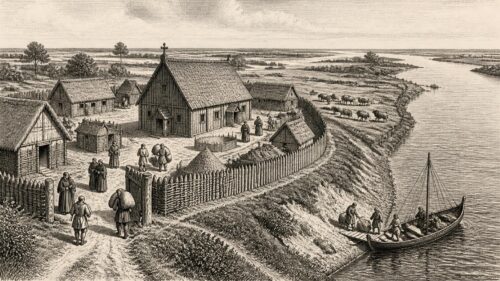
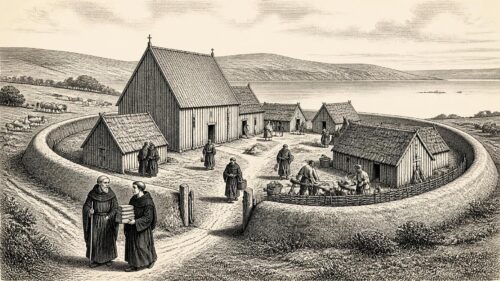
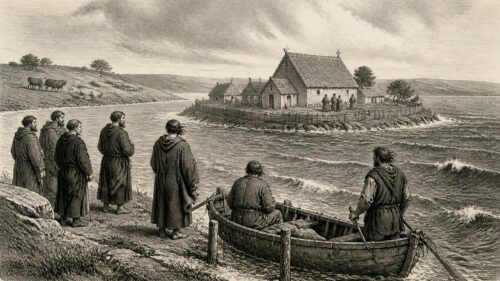
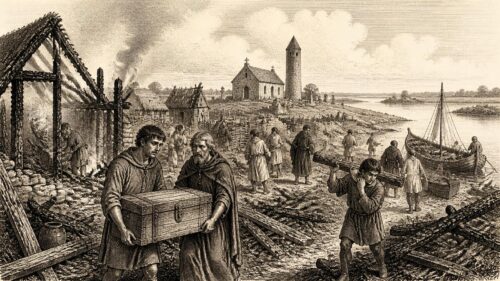
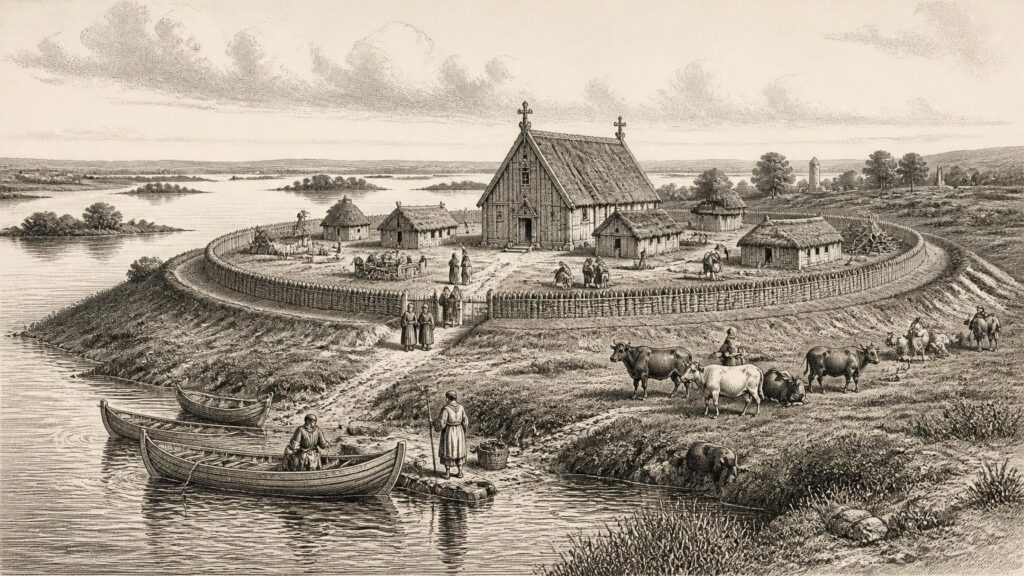
Clonmacnoise in 693 should not be pictured chiefly through its later stone churches, high crosses and round tower. Much of the community’s built environment was then likely to have been timber: churches, dwellings, workshops, storehouses and boundary structures within or near an earthen enclosure. The archaeological and historical evidence points to a populous monastic settlement with a substantial lay presence. River traffic supplied an obvious means of communication. Boats could bring visitors, food renders, animals, raw materials and manuscripts, while the Shannon connected the monastery to political and ecclesiastical worlds far beyond its immediate hinterland.
Churches Across the Island
Two further ecclesiastical deaths widen the year’s horizon. Bishop Bec Fhóla is recorded as having ‘rested’, the conventional Christian language of the annals. Uidréne of Mag Bili likewise died. Mag Bili is identified with Movilla, near modern Newtownards in County Down, a significant early church whose Irish name means the plain of the sacred tree. The annal does not specify Uidréne’s rank, but recording the death at all suggests standing within its ecclesiastical milieu. The death of Crónán of Balla, in what is now County Mayo, supplies a western counterpart. Balla was also a recognised religious foundation.
These notices demonstrate the geographical reach of Irish Christian institutions without implying a centrally directed Irish church. Communities possessed their own saints, local patrons, kin connections and landed interests. Bishops could work within monastic settings, while abbots often exercised authority more comparable to that of major secular rulers than to that of later diocesan clergy. Latin learning, the copying of texts and the calculation of the Christian calendar bound such centres into wider networks. But their daily existence depended upon local fields, pasture, food supplies, labour and negotiated relations with lay powers.
Dún Foither and the Limits of Certainty
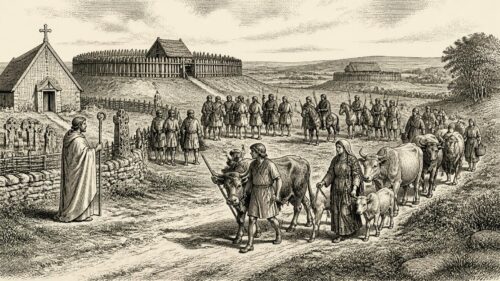
The annals also record the siege of Dún Foither. A siege means that armed pressure was applied to a defended place, whether by surrounding it, cutting access, assaulting it or forcing submission through threat. The entry gives neither the attackers nor the defenders, no outcome and no certain location. Its name has often been associated by modern scholars with Dunottar in north-east Britain, rather than with a site in Ireland. If that identification is correct, the notice illustrates the Irish chronicles’ interest in the interconnected Irish Sea and northern British world. It should not be converted into evidence for an Irish campaign without further proof.
Its inclusion is still historically useful. Irish ecclesiastical record-keeping did not stop at the coastline: Iona, Dál Riata, Pictland, Alt Clut and Ireland were linked by sea travel, kinship, church connections and conflict. The same annal records the death of Domnall son of Hoan, king of Ail Cluaithe, the British kingdom centred on Dumbarton Rock on the Clyde. This was not an Irish political event, but it was directly relevant to the maritime neighbourhood in which Irish churches and rulers operated. Sea lanes carried pilgrims, clerics, livestock, prestige goods and military parties as readily as they carried news.
Violence, Kingship and Dating Problems
The killing of Cerball son of Máel Odar is another reminder that violence was routine enough to be recorded even when the annalist gave no setting or motive. The formula does not permit us to decide whether Cerball died in feud, raid, judicial execution or battle. Ferchar son of Connaed Cerr also died, again without explanation. Such small notices resist modern storytelling, but they reveal a political culture in which lineage was vital: a person’s father and ancestral group located him within obligations of protection, compensation and rivalry.
Later annalistic traditions complicate the wider political picture around this year. The seventeenth-century Annals of the Four Masters place the killing of Fínsnechta Fledach, ruler of Tara, at Grellach Dollaig in 693, followed by Loingsech son of Óengus in the next annal. The Annals of Ulster, however, place Fínsnechta’s death under their following heading, AD 694. Other texts also distribute events involving Osraige and Leinster differently. The disagreement is important: the struggle for Tara was real and consequential, but its exact placement in the modern calendar cannot responsibly be asserted as a firm event of 693. In an article confined to this year, the proper conclusion is that 693 lay immediately beside a contested succession crisis, not that its decisive battle can certainly be dated within it.
Living in the Monastic Landscape
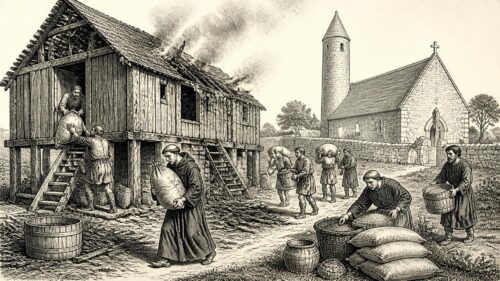
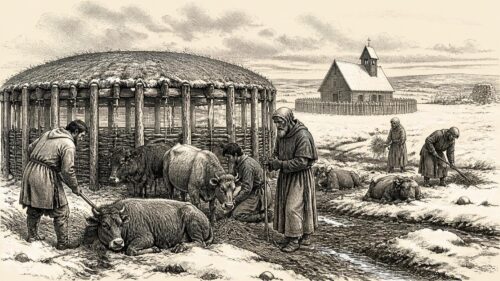
For most people, the rhythms of 693 were agricultural. Families lived chiefly in dispersed rural settlements, commonly within or beside enclosed farmsteads now termed ringforts or raths. Cattle were stores of wealth as well as sources of dairy produce, traction and social standing; cereals were grown, processed and stored; woodland, bog, rivers and coasts supplied fuel, fodder, fish and other resources. Food renders and labour services supported kings, local lords and churches. Monasteries such as Clonmacnoise were embedded in this rural economy rather than standing apart from it: their communities needed grain, cattle, timber, metalwork, cloth and boats.
Learning, too, was practical as well as devotional. Clerics needed books, scribes, teachers and knowledge of Latin; they also required the skills to maintain property, receive guests and communicate across regions. The annals themselves are among the products of this learned culture. Their apparently bare notices embody sustained habits of writing, copying and calendrical calculation. The death of Crón Bec in 693 was preserved because Clonmacnoise mattered to that world; the survival of the record allows a glimpse of the institution whose people remembered him.
Thus 693 CE is best understood not as a blank interval before a better-documented political drama, but as a year of institutional change. Clonmacnoise lost its abbot; Movilla and Balla lost remembered churchmen; a man was killed; and a defended place was under siege somewhere in the northern Irish Sea world. The evidence is limited, but it portrays the essential realities of seventh-century Ireland: local power, Christian communities, communication by river and sea, and a society whose significant losses and conflicts were fixed in writing.
Primary Sources
- The Annals of Ulster: Year U694 (AD 693)
- The Annals of Ulster
- Annals of the Four Masters: Annals M689–M696
- Fragmentary Annals of Ireland: Annals FA 109–120
- Annals of Inisfallen: Annals AI687–AI696
- Annals of Inisfallen
- Chronological Synchronisation of the Irish Annals, 488–722
- The Irish Chronicles and the British to Anglo-Saxon Transition in Seventh-Century Northumbria
- The Life of Columba, Written by Adamnan
- Clonmacnoise Monastic Site
- Clonmacnoise Visitor Guide
- Early Christian Monasteries
- Early Monastic Churches
- Patrician and Early Christian Architecture
- Landscape and Settlement in Late Iron Age Ireland: Some Emerging Trends
- Western Stone Forts Project
- Archaeological Survey
- Movilla Cemetery
- The History and Provenance of Two Early Medieval Crosiers Ascribed to Clonmacnoise
- Christian Ireland, Fifth to Eighth Centuries