Mayo Records
At a Glance
Textual Grounding
The CELT listing shows that Irish historical texts are gathered under several named categories, including annalistic, historical, and historicist texts. Within that listing appear the Annals of Ulster, the Annals of Tigernach, the Annals of Inisfallen, the Annals of Connacht, and the Annals of the Kingdom of Ireland by the Four Masters. For a study centred on Mayo, this matters because the repository offers a structured entry point into the kinds of writing that preserve dated notices and sequence.
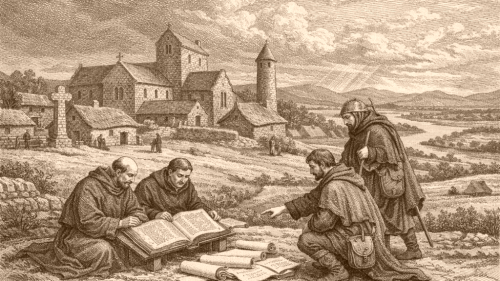
The Annals of Tigernach page gives more precise manuscript information than the general list. It identifies two manuscript witnesses of the Irish original, one from Rawlinson B 502 and one from Rawlinson B 488, and dates them broadly to the eleventh and fourteenth centuries respectively. The page also identifies the contents of Rawlinson B 488 as fragments covering specific year-ranges. These details show that the textual basis is not abstract but tied to physical manuscripts and editorial description.
Institutional Frame
The logainm.ie pages describe a placenames programme whose purpose is to provide authoritative Irish-language versions of place names for official and public use. The site says those forms gain legal status through placenames orders made by the Minister of State for Gaeltacht Affairs, and it notes that fourteen placenames orders had been made since the Official Languages Act 2003. The evidence here concerns institutional process, not a Mayo place-name itself, but it establishes the framework in which such names are researched and formalised.
The same site explains that research material is not limited to one kind of document. It refers to historical works, index cards, scanned images of cards, books, articles, maps, manuscripts, and other publications, and it says the collection has been edited over time. That means a local historical inquiry would have to distinguish between authoritative name forms, archival records, and later editorial organisation. The repository itself also cautions that explanatory notes and citations have separate conditions of use.
Source Range
A comparison of the repositories shows different scales of organisation. CELT lists specific editions and editorial histories for annalistic works, while logainm.ie states that its database contains approximately 7,000 sources. That is a large placename archive, but the site also makes clear that its source base was gathered over a long period and that its systems of abbreviation changed over time. The contrast is between a catalogue of textual editions and a database of many localised name records.
The logainm.ie glossary adds a useful comparison point because it presents common placename elements and flags limitations in its own indexing. It says the glossary is based on automated text searches, that editorial checks are still under way, and that not all placenames have yet been indexed, including some in Northern Ireland and some minor names. The list of frequent elements includes words such as baile, cill, cnoc, loch, and gleann. These observations describe the current shape of the tool rather than any single county.
Administrative Lens
The open-data notice shows how the placenames material is governed. It states that Logainm data is copyright Government of Ireland, available under CC BY 4.0, and that the website should not be scraped. It also gives a recommended attribution and says users should obtain updates through the API and apply them monthly. For historical work, these statements matter because they define how the dataset may be used, updated, and cited in a scholarly environment.
The sources pages reinforce that the repository is a curated tool rather than a passive dump of records. They mention that some material is supplied by the Placenames Branch and other bodies, that additional material is welcome, and that the site includes publications, manuscripts, historical maps, and featured themes. The evidence does not show a Mayo case file here, but it does show the administrative scaffolding through which county-level research would usually be assembled.
Chronological Limits
The chronological evidence in these excerpts is uneven but clear. The Tigernach page names manuscript witnesses dated roughly to the eleventh and fourteenth centuries, while the Four Masters page presents entries with explicit year headings such as 903, 904, and 905. These are different kinds of temporal markers: manuscript date, editorial arrangement, and annalistic year. A careful reading must keep them distinct, because one describes the surviving copy and another the historical sequence in the text.
That distinction also limits what can be said about Mayo from these passages. None of the retrieved excerpts names Mayo directly, and none offers a county-specific narrative to test against annalistic or placename data. What they do provide is a model of evidence: editions, manuscripts, orders, databases, and glossaries. Any future reading focused on Mayo would need a matching body of county-level entries before stronger claims could be made from this material.
Historical Reading
Taken together, the excerpts show two complementary forms of historical infrastructure. One preserves medieval and early modern narrative in annalistic editions; the other regulates and indexes Irish placenames for public use. The evidence is strongest on the form of these resources, not on Mayo itself. The historical reader can therefore say that the repositories exist, that they are carefully described, and that they are designed for continued research rather than final closure.
For a research question about Mayo, the most responsible conclusion is provisional. The cited materials allow one to identify the kinds of sources that would be relevant and the rules under which placename data is maintained, but they do not yet provide a Mayo-specific chain of evidence. The record here therefore supports a methodological answer: before interpretation of local history, the historian must first establish which annals, maps, and placename forms actually mention the district in question.