
Boyne Battle
At a Glance
Battle Setting
The battle is dated to 1 July 1690 in one museum account and to 12 July 1690 in another, the latter noting the difference between modern and old style dating. Both accounts place the fighting at the Boyne River near Drogheda, about 50 kilometres north of Dublin, or at Oldbridge in County Meath. One source also says that the armies met on Irish soil in the largest engagement there. This wording identifies the same event through closely related place descriptions. [1] [2] [5]
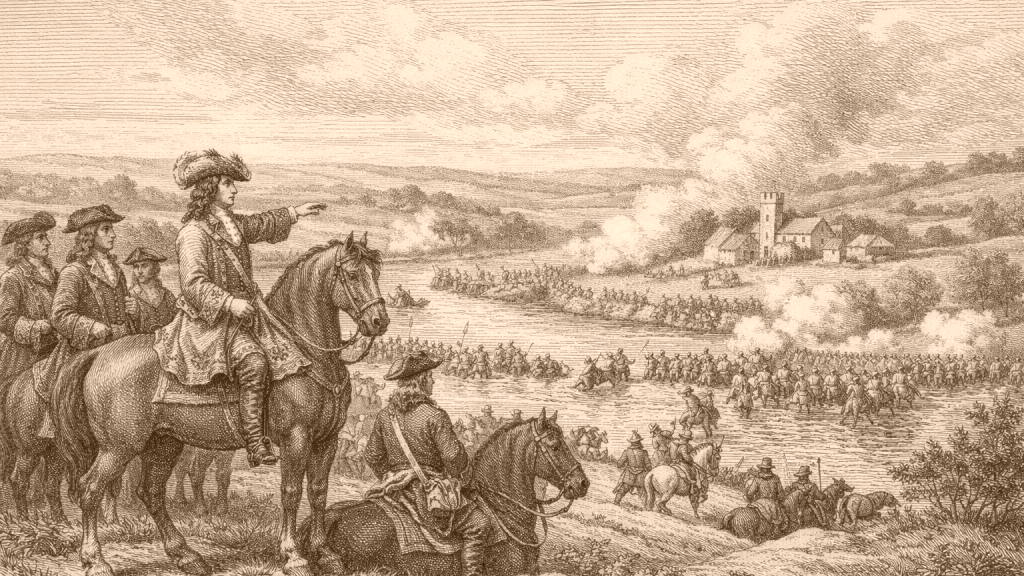
The same museum descriptions identify the opposing rulers as King James II and King William III. One account says the engagement was between James and his successor; another says William clashed with his father-in-law. A painting record adds that William and officers are shown in the foreground while troops force the river passage in the middle distance. These records combine narrative description with a visual reconstruction of command and movement. [1] [2]
Command Forces
The museum accounts describe the armies as large and mixed. One gives 36,000 men for the Williamite side and 25,000 for the Jacobite side, while another says William’s army numbered about 37,000 and included Dutch, Danish, Huguenot, German, English, Scottish, and Irish troops. The same source also says James’s side had strong backing in Ireland. Taken together, these passages show scale and composition, though the exact figures are not identical. [2] [5]
One account explicitly states that both kings commanded their armies in person. Another says William arrived with veteran Continental troops and marched south after landing near Belfast, joining Schomberg and marshalling loyalist Protestant forces. The sources do not give a full tactical order of battle, but they do connect each monarch directly with the army in the field and with the campaign's movement toward the Boyne. [2] [5]
River Fighting
The diary of Bonnivert gives a close view of the action near Drogheda. It says the army came within sight of the town, formed horse in three lines, and moved in order of battle on a long hill with the river between the two sides. Dragoons lined the river bank and exchanged fire with the enemy. The account is immediate and local, recording what the writer saw rather than later reflection. [3] [4]
The same diary says the king passed by the first troop of Guards, that the enemy fired two small guns at him, and that one bullet grazed his coat. It also notes shot falling among men and horses, the wounding of a guard, and the killing and wounding of some Dutch troops. These details show the closeness of the fighting without extending beyond the diarist's report. The description remains focused on motion, fire, and immediate injury. [3] [4]
Battle Progress
Bonnivert's diary continues by saying that James reviewed his army during the day, while the writer's side lacked artillery until the afternoon. The passage records that the troops retired confusedly behind the hill, that they might have managed matters better, and that artillery only later came up and began to play upon the enemy. This is a sequential battlefield narrative, with timing, hesitation, and gunfire all set out in order. [3] [4]
The museum summary offers a broader ending to the same action. It says William's forces eventually broke through the Jacobite centre and right, causing a general retreat, while Jacobite casualties were comparatively light and much of James's army escaped. Another account calls the battle militarily indecisive, even while describing it as the largest engagement ever to take place on Irish soil. The sources therefore preserve both operational movement and a more measured appraisal. [1] [2]
Aftermath Memory
The National Army Museum account says the battle remains a key event for Protestants in Northern Ireland, especially the Orange Order, and that anniversary marches have been seen by Republicans and Nationalists as provocative. It also says such marches were often marred by violent confrontations during the Troubles. These claims describe later memory and commemoration rather than the battle itself, but they are tied directly to the Boyne in the museum text. [1]
A separate National Army Museum page gives a more concise commemorative frame: the battle is said to have affected the history of continental Europe, Britain, and Ireland, where it continues to arouse strong feelings. That wording does not explain those feelings in detail, but it does show that the event is still treated as significant beyond the battlefield. The retrieved passages thus move from 1690 combat to modern remembrance without offering a full history of reception. [2]
Source Nature
The retrieved material includes both modern institutional summaries and a seventeenth-century diary. The museum pages provide condensed narratives, battlefield location, troop totals, and visual interpretation, while Bonnivert's diary records movement, distance, artillery delay, and the writer's reactions. Because these texts are different in genre and purpose, they do not always match in detail, especially on chronology and emphasis. Their overlap is strongest on place, commanders, and the fact of combat at the Boyne. [1] [2] [3] [4]
One omitted feature of these excerpts is a detailed map of the whole campaign, since the passages here do not lay out every march, flank movement, or subordinate command. Another omission is any long explanation of why the battle mattered, apart from brief statements about later significance. What can be stated securely is narrower: the date, the place, the leaders, the size of the forces, and a sequence of fighting recorded by an eyewitness. [1] [2] [4] [5]
Source References
Hover over a number to see the source. Select it to open the source.



How do these retrieved texts describe the battle of the Boyne in terms of date, commanders, troop strength, and immediate battlefield movements?