Annal Year621 CE
The surviving evidence for AD 621 is sharply limited but still identifiable. The Annals of Ulster preserve a year heading equated with AD 621 and a compact sequence of notices about battles, deaths, one drowning, and one qualified statement of uncertainty. Other annal material in the retrieved evidence helps compare chronology and manuscript description, but it does not add a securely dated 621 event. The result is a narrow historical profile: a dated annal block, not a reconstructed narrative. This article distinguishes the year’s directly attested notices from broader contextual material and from what the record leaves unstated.
Dateline
Dating Evidence
The clearest secure evidence for AD 621 is the Annals of Ulster year block headed with that date. In the surviving entry, the notices follow one another without day-level dating and name Cenn Deilgthen, Conaing son of Aedán, several deaths, Lindas, Caemgein of Glenn dá Locha according to some, Cennbag, Ailill son of Cellach, and Colgu son of Cellach. The record is terse, but the year itself is explicit. [1]
That same block also shows the limits of what can be said with confidence. The passage offers a sequence of notices, yet it does not explain how they relate to one another, and only one item is marked as uncertain by the phrase according to some. The safest reading is to keep the secure notices separate from that qualified notice and to avoid turning the list into a fuller narrative than the wording allows. [1]
Ulster Record
The Annals of Ulster preserve the year heading in a form that explicitly equates the annal year with AD 621. That makes the entry useful as a dated witness rather than a loose chronological label. The same passage then moves directly into the event list, so the heading and the notices belong to a single surviving record for this year. Nothing in the excerpt suggests any separate explanation for the date. [1]
The structure of the entry is compact and annalistic. Battles and deaths are named in sequence, but there is no extended description of causes, movements, or outcomes beyond the brief formulations preserved in the text. The evidence therefore supports the presence of recorded notices in 621, not a reconstructed campaign history. Any broader storyline would go beyond the surviving wording and should be left unstated. [1]
Named Figures
Several named individuals appear in the Ulster year block for AD 621. Conaing son of Aedán is recorded as drowned, while Mael Mracho son of Rímid son of Colmán son of Cobthach and Ailill son of Cellach are listed as dead. The same entry also notes the death of Colgu son of Cellach. These are the securely named persons attached to the year in the surviving text. [1]
The same block also links Conall son of Suibne to victory at Cenn Deilgthen. Apart from that role, the excerpt gives no office, territory, or biography for the named people, only brief notices of death, drowning, or success in battle. The evidence therefore supports a list of named figures in one year, but not any fuller social or political profile for them. [1]
Battle Sequence
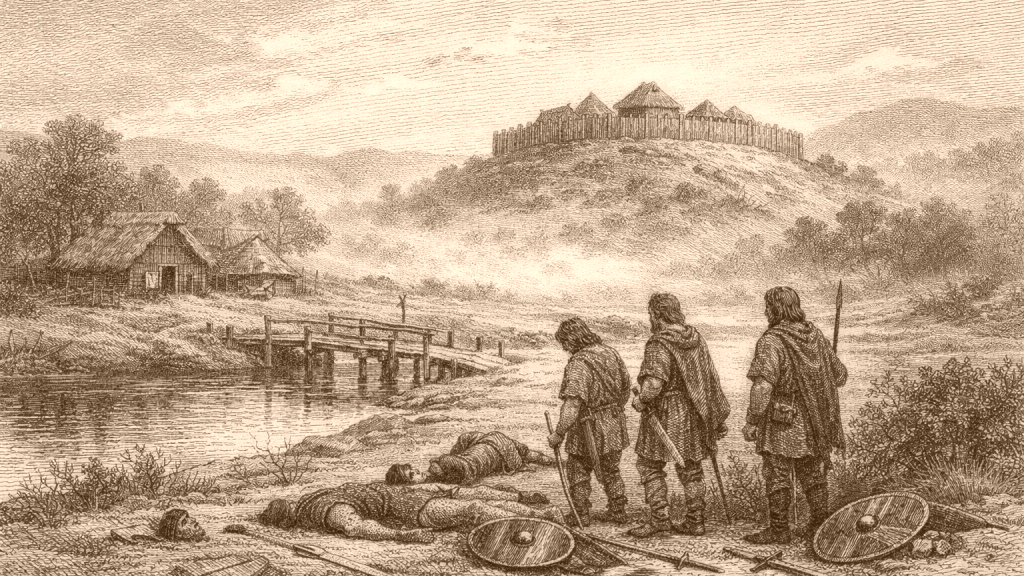
The year 621 contains at least three battle notices in the Ulster entry: Cenn Deilgthen, Lindas, and Cennbag. Only the first is associated with a named victor in the excerpt, Conall son of Suibne. The battle of Cennbag is linked to the fall of Colmán son of Cobthach, showing that the annal records outcomes through named persons as well as place-names. [1]
The order of these notices is itself all that can be observed. The text places the battle names in sequence, but it does not say whether they were near one another, part of a single struggle, or separated in time. For that reason, the secure conclusion is simply that the year contains multiple remembered conflicts, while the relationships among them remain unstated in the surviving entry. [1]
Textual Limits
The safest historical account of 621 must respect what the source does not say. The Ulster entry gives no motives, no alliances, and no explanation of why the named battles or deaths occurred. It also does not identify every person by office or territory, and one notice remains qualified by the phrase according to some. Those limits make the year informative but fragmentary. [1]
Those same limits also rule out importing details from outside the year block. The surviving excerpt for AD 621 stands on its own as a dated cluster of notices, and nothing in it authorizes moving later or earlier notices into the year. The record therefore defines 621 by its own heading and entries, not by surrounding material or by assumptions about what may have stood nearby. [1]
Comparative Context
A wider annalistic comparison is possible, but only in a restrained way. The Annals of Inisfallen excerpt supplied here shows later entries with explicit cross-references to other annal traditions and dates, including notes that are marked with bracketed year equivalents. That demonstrates a comparative chronological practice in the retrieved material, yet it does not alter the specific evidence for AD 621 in the Ulster entry. [3]
The Annals of Tigernach are useful here mainly as a descriptive witness to another annal compilation in the evidence set. The edition notice identifies manuscript fragments and an editorial tradition, which helps place the text as a distinct annal source. But the excerpted material used here does not provide a Tigernach notice for AD 621 itself, so it cannot be pressed into service for that year. [2]
Secure Summary
For AD 621, the evidence securely preserves a year heading and a compact group of notices. Those notices include the battle of Cenn Deilgthen, the drowning of Conaing son of Aedán, the deaths of Mael Mracho son of Rímid, Ailill son of Cellach, and Colgu son of Cellach, the battle of Lindas, a qualified notice about Caemgein of Glenn dá Locha, and the battle of Cennbag with the fall of Colmán son of Cobthach. Each belongs to the same dated block. [1]
Nothing in the cited evidence justifies adding a fuller political narrative or a longer sequence of events. The year 621 is therefore best presented as a securely dated annal entry with several named notices and one explicit caveat, while the rest remains unknown from the excerpted record. That is the limit of what can be stated without inventing events to fill an annal gap, and it is the proper limit for this year. [1]
Manuscript Details
The Tigernach edition notice supplies manuscript and editorial context rather than year-specific events. It identifies two manuscript witnesses of the Irish original, one from Bodleian Rawlinson B 502 and one from Rawlinson B 488, and it notes that the text survives in fragments. This is useful only as background for comparison, because the excerpt does not present a separate notice for AD 621 in Tigernach itself. [2]
The Inisfallen excerpt, by contrast, preserves a compact sequence of entries in which some notices are explicitly keyed to other annal years in brackets. That visible feature makes it a helpful comparison for chronology, but it remains separate from the Ulster wording for AD 621. The safest approach is to keep each annal and its own dating system distinct, rather than merging them by similarity of content. [3]
Historical Boundaries
The evidence for 621 is strong on one point and weak on many others. It securely identifies a year block and attaches to it a cluster of brief notices, but it leaves their order beyond sequence, their relationships beyond naming, and their wider consequences unstated. The notice about Caemgein of Glenn dá Locha according to some is especially important because it shows that even within the year there is an explicit boundary between certainty and qualification. [1]
For that reason, the historical value of the year lies in precision rather than fullness. We can say that the surviving text preserves battles, deaths, and one drowning under the heading AD 621, and we can compare that format with other annal material in the evidence set. We cannot safely turn the entry into a narrative of causes or outcomes, because the record itself stops at brief notice. [1] [3]
Source References
Hover over a number to see the source. Select it to open the source.