Recorded Year620 CE
The surviving notices for 620 CE are brief and mostly funerary. In the Annals of the Four Masters, the year is marked by a cluster of deaths, including an abbot of Clonfert, several other named men, Mongan son of Fiachra Lurgan, and Cathal son of Aedh, king of Munster. The Tigernach material available here does not preserve a 620 notice, but it provides nearby years for comparison. Read narrowly, the evidence supports a careful record of named deaths and one killing, not a full narrative of events.
Dateline
Year Record
The strongest evidence for 620 CE comes from the annalistic entry that explicitly labels the year and then lists several deaths. It gives the tenth year of Suibhne and records Seanach Garbh, abbot of Cluain Fearta Breanainn Clonfert; Colman son of Coimgellan; Aedh son of Cumascach; Ronan son of Tuathal, lord of the Airtheara; and Cormac Caemh with Illann son of Fiachra. On this wording alone, 620 survives as a compact year of named deaths. [3]
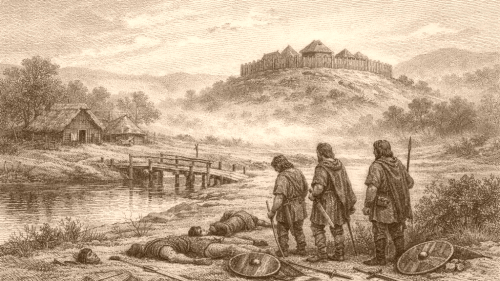
The same entry continues with two more notices securely tied to the year by the surrounding annal rubric. One says that Mongan son of Fiachra Lurgan was killed by Arthur son of Bicar, described as one of the Britons; the other notes the death of Cathal son of Aedh, king of Munster. The passage provides no connected story, only separate notices attached to the year 620 itself. [3]
Death Forms
The 620 entry is dominated by death notices, but the wording is not uniform. Seanach Garbh is identified by office, while other men are simply named, and Mongan’s notice alone specifies a killer. Cathal son of Aedh appears with a royal title, and Ronan son of Tuathal with a territorial lordship. The structure is therefore a list of individuals and statuses, not a narrative account of a single event or crisis. [3]
The presence of one explicit killing should not be expanded into wider speculation. The passage states that Arthur son of Bicar killed Mongan, and it also states that Cathal died, but it does not explain motive, battlefield context, or succession. What can be said securely is narrower: within the 620 entry, one death is described as violent, while the others are reported as plain deaths, all within the same dated notice. [3]
Monastic Notice
Ecclesiastical figures are prominent in the 620 notices, beginning with Seanach Garbh, abbot of Clonfert. The same annal year also includes Cormac Caemh and Illann son of Fiachra, though their offices are not given in the excerpt. The text therefore preserves a mixture of clerical and nonclerical identification, but only where the wording itself supplies such detail. Nothing further about rank or function can be safely added. [3]
Nearby years in the same annalistic sequence show that this kind of ecclesiastical notice was not isolated. In 618, the same source records the death of Sillan, bishop and abbot of Movilla, and Liber, abbot of Aghaboe. In 622, it again names a bishop and abbot, Mac Laisre of Armagh. Those comparisons are strictly formal, showing the same kind of brief clerical obituary in adjacent years. [3] [1]
Royal Notice
Cathal son of Aedh, king of Munster, is the clearest royal figure in the 620 entry. His notice is brief and unelaborated, but the title itself is important because it places a regional kingship beside clerical and other elite deaths in the same year. The entry does not say how or where he died, only that his death belonged in the sequence assigned to 620. [3]
Ronan son of Tuathal, lord of the Airtheara, appears in the same list, showing that the year contains more than one high-status lay notice. Yet the passage gives no reason to connect Ronan’s death with Cathal’s, and no line indicates that either man died in the same episode as Mongan. The evidence remains a set of discrete entries, not a continuous political narrative. [3]
Nearby Years
The surrounding entries help define the form of 620 without changing its content. In 619, the annal records the slaying of Doir son of Aedh Allainn and the later revenge killing of Failbhe Flann Fidhbhadh. In 622, it moves to deaths of saints and bishops as well as two battles. These neighboring years show the range of material in the same annalistic sequence, but they do not alter the wording of 620 itself. [3]
The same source also shows a closely related pattern in 618, when it records deaths of clerics and a Munster kingship change. That does not make 620 into the same kind of notice, but it does confirm that the annal can cluster office-holders, kings, and unnamed circumstances within short yearly entries. The comparison is only structural; it should not be stretched into an inferred event for 620. [3] [1]
Tigernach Context
The Tigernach material is useful as a control on what the record can and cannot say, because the excerpted fragment here runs through 618 and then stops. It includes deaths of abbots, bishops, and kings, a battle, and a notice that Sillan of Moville and Fingein son of Fiachra rested in 618. But no 620 entry appears in the retrieved Tigernach excerpt, so it cannot be used to support a 620 event. [1] [2]
The bibliographic description of Tigernach identifies manuscript witnesses with different ranges, including one fragment covering AD 489 to 766 and another spanning later years. That information helps explain the bounds of the excerpted witness available here, not any historical development in 620. It is therefore a contextual aid only, while the dated substance for 620 remains in the separate Four Masters entry. [2]
Year Limits
For 620 CE, the evidence supports a narrow summary. The year contains a list of deaths, including an abbot of Clonfert, a lord of the Airtheara, and a king of Munster, together with the killing of Mongan son of Fiachra Lurgan by Arthur son of Bicar. No battle, famine, conversion, or assembly is attached to the year in the wording available here. The secure claim is simply that 620 is recorded as a year of deaths and one killing. [3]
That narrowness is itself historically important, because the surviving entry does not invite a larger reconstruction. It leaves the causes of death unstated, does not connect the notices into one episode, and gives no account of consequences. A disciplined reading of the year therefore stops where the wording stops: at the level of named persons, titles where given, and the dated record of loss within 620. [3]
Careful Reading
Read together, the available passages show how thin and precise the evidence for 620 CE is. One annal preserves the year with a cluster of named deaths, one of them explicitly violent, and another with a royal title from Munster. Other years in the same sequence provide surrounding context by showing similar obituary notices and occasional battles, but they do not fill the gap in 620. The year remains a dated list rather than a reconstructed story. [3]
A sound historical account of Ireland in 620 must therefore distinguish certainty from context. Certainty lies in the year label, the named individuals, the titles attached to some of them, and the single killing reported in the notice. Context lies in nearby years, which show that similar entries could record clerics, kings, battles, and deaths in the same terse style. Beyond that, the evidence does not support further invention. [3] [1]
Source References
Hover over a number to see the source. Select it to open the source.