Saint Colman of Cloyne
Colmán of Cloyne, also known as Colmán mac Léníne, was a sixth-century monk and the founder of the monastic settlement of Cluain Uama, which is the modern town of Cloyne in County Cork. While historical records from the early medieval period are often sparse, Colmán is recognised as an important figure in the early Irish church and is the patron saint of the Diocese of Cloyne. His life and work bridge the transition from the secular courts of Munster to the establishment of enduring ecclesiastical centres in East Cork.
Dateline
Colmán of Cloyne, also known as Colmán mac Léníne, was a sixth-century monk and the founder of the monastic settlement of Cluain Uama, which is the modern town of Cloyne in County Cork. While historical records from the early medieval period are often sparse, Colmán is recognised as an important figure in the early Irish church and is the patron saint of the Diocese of Cloyne. His life and work bridge the transition from the secular courts of Munster to the establishment of enduring ecclesiastical centres in East Cork.
Early Life
The dates of Colmán’s life vary across different sources, with traditional accounts and modern summaries suggesting he lived roughly between the mid-sixth and early seventh centuries. Some traditions place his birth in 522 and his death in 604, while other records suggest a timeframe between 530 and 606. He is generally identified as the son of Lénín. Genealogical records indicate he was descended from the Rothrige, a people who were subject to the Déisi of Munster. However, later genealogical traditions sought to link his ancestry to the Éoganachta, the dominant ruling dynasty of Munster, possibly to enhance the prestige of his foundation at Cloyne.
Courtly Background
Before dedicating himself to the monastic life, tradition holds that Colmán served as a poet and bard at the court of Caomh, the King of Munster at Cashel. This background in the vernacular arts is significant, as he is credited as one of the earliest known Irish poets to write in the vernacular. This literary skill likely informed his later religious work and his status within the social hierarchies of early Munster. His transition from a royal court poet to a man of faith is often attributed to the influence of Saint Brendan of Clonfert, who is traditionally said to have induced him to embrace Christianity.
Monastic Foundation
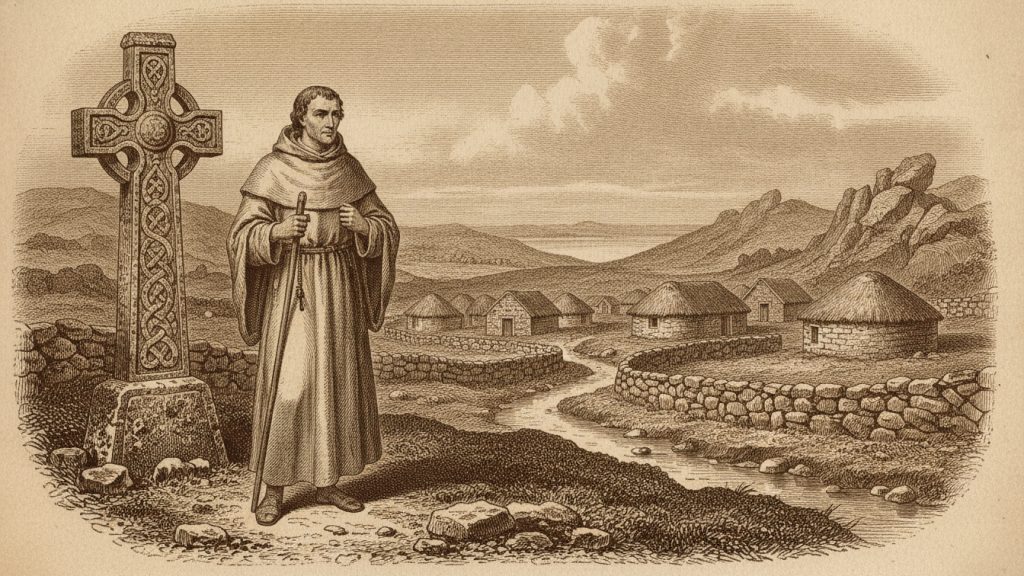
Following his conversion and subsequent studies at the monastery of Saint Jarleth in Tuam, Colmán moved to East Cork to preach. Around 560, he established his own monastic settlement at Cluain Uama. This site evolved into the ecclesiastical centre of Cloyne. Unlike many other saints of the period, no formal hagiographical “Vita” or “Life” is known to have been written for Colmán. Instead, his historical presence is attested through Irish annals, martyrologies, and genealogical tracts. Scholars note that the absence of a formal “Life” has led to him being somewhat neglected in modern scholarship compared to contemporaries like Saint Finbarr of Cork.
Historical Legacy
The historical authenticity of Colmán is supported by a core of credible textual records, despite the presence of later legendary elements. His influence is still visible today through the Diocese of Cloyne, which traces its origins back to his foundation. His feast day is celebrated annually on 24 November. The site of Cluain Uama continues to be a centre of worship, marked by a pre-reformation cathedral and a round tower, reflecting the enduring nature of the monastic settlement he established in the sixth century. His legacy remains tied to the regional identity of East Cork and the early integration of Gaelic poetic tradition with Christian monasticism.
Source References
Hover over a number to see the source. Select it to open the source.