
Cathedral Sites
At a Glance
Churches Sites
The evidence available here frames cathedral history through churches, sees, and texts rather than through a single architectural definition. One historical summary of Irish church history lists annals, saints' lives, and other chronicles among its sources, and a modern university page identifies CELT as a major digital resource for Irish studies. Together, these passages show that work on cathedral sites relies on a broad textual base, even though they do not name any one building as a cathedral. [1] [3]
A separate scholarly note says research on three churches, including Temple Kelly and Temple Ciarán, is based primarily on documentary sources rather than architectural or archaeological evidence. It also says the notes are mainly annalistic and intended to complement earlier work. That makes the method itself part of the subject: some ecclesiastical sites can be approached through texts alone, even when the physical remains are not the main basis for description. [2]
Synod Ordering
The clearest episcopal framework appears in Geoffrey Keating's account of Raith Breasail. The synod is placed in the year 1100, the pope's legate is said to preside, and the narrative says the council regulated the bishops of Ireland. It then distributes bishops across Leath Mogha, Leath Cuinn, and Meath. As a record, the passage is explicit about ordering, but it presents that order only within its own narrative voice. [6]
Within the same account, named sees are listed for Ulster, Meath, Connaught, Munster, and Leinster. Among them are Ard Macha, Daimhliag, Cill Dara, and Cashel. The passage also states that Ath Cliath is not counted because it was not customary for its bishop to receive consecration except from the archbishop of Canterbury in England. That is the Dublin exception as written here, and it is the only explanation offered in the passage. [6]
Architectural Change
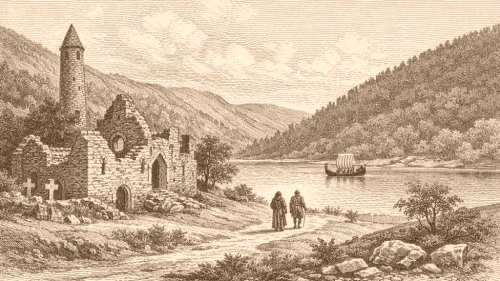
Architectural scholarship on Irish churches between about 950 and 1150 describes a period of change and survival. One chapter summary says it is an overview of ecclesiastical architecture at major and minor establishments, and it notes that the first definite cloister is Mellifont, founded in 1142. It also says churches were being founded in the Hiberno-Scandinavian ports from about 1000, and that Dublin in particular had a substantial number of churches by about 1100, though very few traces survive. [7]
Another architectural study says surviving churches and documents do not support the widely held view that congregations stood outside. Instead, it argues that the relatively small size of many churches reflects communities smaller and more diverse than later high-medieval successors. It also says altars in large episcopal or monastic churches tend to lie further west than those in smaller pastoral churches. These are comparisons within the study, not a full map of cathedral design. [4]
Ritual Space
The same architectural study places externally defined chancels in the late eleventh century and links their appearance to a stronger emphasis on the real presence in the Eucharist. It further says that such features occur at a handful of important sites whose clerics and patrons were in direct contact with Lanfranc of Canterbury, described there as a key exponent of the doctrine. The passage therefore links form, liturgy, and a small cluster of important sites without extending the claim beyond them. [4]
A museum exhibition on medieval Ireland supplies a broader frame for that change. It says the Irish church changed fundamentally in the twelfth century, though many older traditions survived. It also notes that the exhibition's Prayer gallery focuses on major changes in the church's organisational structure and the introduction of new monastic orders, while retaining older devotional forms through shrines and reliquaries. The passage is general, but it fits the pattern of change and survival seen elsewhere. [8]
Textual Limits
The boundaries of the evidence are clear. Keating's account gives a formal list of sees and boundaries, but it appears as part of his historical narrative rather than as a standalone ecclesiastical register. Another overview says current scholarship is being summarised rather than advanced, and that some churches survive only faintly in the archaeological record. Together, these passages encourage caution when a named church is treated as though its cathedral status were directly attested here. [5] [7] [6]
The passages also leave a notable omission. They do not provide a direct definition of cathedral, and they do not identify a single surviving building as the cathedral for any particular see. What they do show is a convergence of types of evidence: annals naming sees, architectural studies distinguishing larger episcopal churches from smaller pastoral ones, and site histories built mainly from documents. The picture is structured and comparative, not singular or complete. [2] [4] [6] [7]
Historical Reading
Read together, the passages sketch an ecclesiastical landscape in which episcopal organisation, church architecture, and historical memory intersect. The Raith Breasail narrative assigns sees to named places; the architectural studies describe differences in scale, altar placement, and chancels; and the museum summary places twelfth-century reform beside older survivals. None of these passages alone supplies a full history of cathedral foundations, but each contributes a directly observed element to that larger pattern. [4] [6] [7] [8]
The most secure conclusion is modest. Between the late eleventh and twelfth centuries, Irish ecclesiastical space appears to have been ordered in ways visible both in texts and in buildings: diocesan arrangement, westward altars in larger churches, and the appearance of chancels at important sites. The evidence does not allow a single model for all cathedrals, nor does it identify every site by name. It does, however, show a more differentiated sacred landscape. [4] [6] [7]
Source References
Hover over a number to see the source. Select it to open the source.

- [1] The History of Ireland
- [2] The “cathedral”, Temple Kelly and Temple Ciarán: notes from the annals
- [3] Research in History | University College Cork
- [4] The architectural setting of the mass in early-medieval Ireland - Discover Research at University College Cork
- [5] Life and Work of Geoffrey Keating (Seathrún Céitinn)
- [6] Part 90 of The History of Ireland
- [7] Buildings of worship in Ireland, c.950-1150 - Discover Research at University College Cork
- [8] Medieval Ireland 1150-1550 | Archaeology | National Museum of Ireland

How do annalistic notices, architectural summaries, and historical surveys together describe cathedral-related ecclesiastical space in medieval Ireland?