
Neutrality Lock
At a Glance
Constitutional Frame
The constitutional text sets out several principles relevant to Ireland's external relations. It affirms devotion to peace and friendly co-operation, adherence to pacific settlement by arbitration or judicial determination, and acceptance of generally recognised principles of international law. It also states that executive power in external relations is exercised by or on the authority of the Government. These provisions do not mention neutrality, but they do establish a legal frame for peaceful conduct abroad. [3]
The same constitutional article also records later European commitments. It says the State may become a member of European Atomic Energy arrangements, affirms commitment to the European Union, and permits ratification of the Treaty of Lisbon. It further says certain decisions and acts connected with European cooperation require prior approval of both Houses of the Oireachtas. In these excerpts, the constitution links external policy to both international and parliamentary procedures. [3]
Neutrality Claims
A later academic discussion describes Irish claims of neutrality as something that can be tested against defined variables. It says that, in this century, Ireland has claimed neutrality at critical moments and has also claimed a policy of traditional neutrality. The same discussion notes that nonalignment was claimed on occasion in the last generation. The excerpted material presents neutrality as a claim to be assessed, not as a settled label. [1]
That discussion then lists criteria such as due diligence regarding neutral rights and duties, recognition by others, disavowal of help, and freedom of decision and action. It also says Ireland failed to meet the criteria associated with either of neutrality, while its record on lack of isolationism, willingness to ameliorate world problems, and impartiality is mixed. The passage therefore contrasts several standards rather than reducing them to one simple test. [1]
Triple Lock
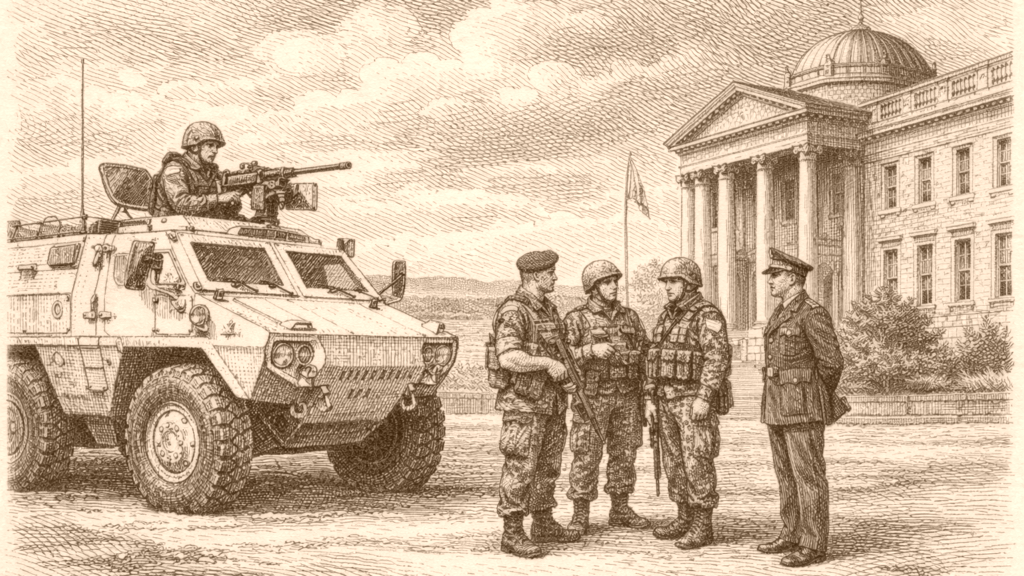
Reporting on the Triple Lock describes it as the rule governing Irish peacekeeping deployments abroad. One account says that, for decades, participation has depended on United Nations approval and that the Government has proposed removing that requirement. Another account explains that the term does not appear in legislation but describes the legal process used for overseas missions since the Defence Act 1960. The mechanism is presented as involving UN approval, Government decision, and a Dáil vote. [2] [5]
The same reporting states that the Defence Act 1960 first put in place the requirements now called the Triple Lock. It adds that later changes in 1993 extended possible missions to peace enforcement, while a 2006 amendment updated language on UN authorisation and clarified the need for a Government decision. The evidence here shows a changing statutory framework rather than a single unaltered rule. [5] [6]
Legislative Change
The constitutional and statutory record shows repeated adjustment to Ireland's external powers. The amended constitutional text recorded approval for joining European Communities and later the European Union, while the Defence legislation was amended in 2006. The Revised Acts record that the 2006 Defence Amendment Act authorised dispatch of contingents or members of the Permanent Defence Force for service outside the State and included an annual report to Dáil Éireann. These excerpts show formal legal revision, not only political discussion. [3] [4] [6]
A more recent report says the Government proposed new legislation to change how Ireland decides to send soldiers abroad, including removing the Triple Lock when Defence Forces serve as part of an international force. Another report says the Government wanted to remove UN approval and increase the number of situations in which troops could be deployed. In these passages, the issue is the scope of the authorisation rules, not the existence of overseas service itself. [2] [5]
Public Debate
The reporting also records the arguments made around the Triple Lock. One account says supporters believe it protects Irish neutrality and ensures troops are deployed only on legitimate peacekeeping operations. It then notes the criticism that UN Security Council vetoes can block authorisation, preventing Irish participation even when Ireland wants to take part. The discussion is about the effect of the UN requirement, not about a single agreed definition of neutrality. [2] [5]
The same material gives an example from 2003, when China vetoed the resolution approving a mission and Ireland could not participate. It also says there had been no new UN missions that Ireland was able to join for nearly a decade after the last Security Council approval mentioned there, which was in 2014. These are specific observations about the operation of the rule in the material, not a complete history of every deployment. [2] [5]
Distinct Position
The academic thesis concludes that Ireland is in a distinctive position. It says Ireland has not been committed to co-belligerency, while also stating that it is neither non-aligned, neutral, nor an alliance member. The same passage describes Ireland as 'sui generis', particularly but not only within the European Community. This is an interpretive conclusion in one study, not a constitutional definition or a universal verdict. [1]
Taken together, the excerpted constitutional text, legislative record, and contemporary reporting show two linked but different subjects. One is Ireland's declared commitment to peace, international law, and European cooperation. The other is the Triple Lock as a legal mechanism for authorising overseas deployments. The documents do not collapse these into a single rule, and they leave open how far neutrality and the Triple Lock should be treated as equivalent concepts. [2] [3] [5] [6]
Source References
Hover over a number to see the source. Select it to open the source.


How have constitutional provisions, legislation, and public debate defined the relationship between Irish neutrality and the Triple Lock?