James FitzMaurice
James FitzMaurice FitzGerald was an Irish rebel leader in the sixteenth century whose career became closely tied to the Desmond rebellions and to efforts to secure foreign support against Elizabeth I’s authority in Ireland. Following a failed rebellion in 1565, he submitted to Elizabeth I’s authority and was pardoned. He also lost all his holdings to the English and was removed from the stewardship of the Earl of Desmond’s territories. After that submission, he did not disappear from the political scene. The record states that he lost his holdings and was deprived of his role in the Desmond territories, but later events show that he remained active in the struggle against English power in Munster.
Dateline
James FitzMaurice FitzGerald was an Irish rebel leader in the sixteenth century whose career became closely tied to the Desmond rebellions and to efforts to secure foreign support against Elizabeth I’s authority in Ireland. Following a failed rebellion in 1565, he submitted to Elizabeth I’s authority and was pardoned. He also lost all his holdings to the English and was removed from the stewardship of the Earl of Desmond’s territories.
Submission Years
After that submission, he did not disappear from the political scene. The record states that he lost his holdings and was deprived of his role in the Desmond territories, but later events show that he remained active in the struggle against English power in Munster. His position had been altered by the defeat and pardon, yet he later emerged again as a rebel leader.
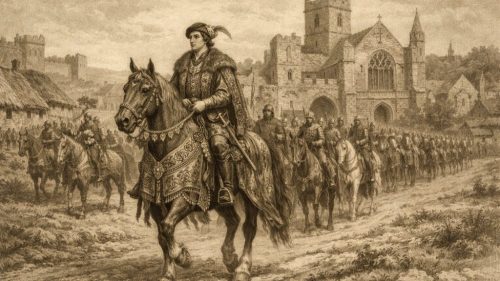
In 1575, he sailed to the French port of St. Malo with his wife and children. From there he sought an audience at the French court with the intention of winning support for an invasion of Ireland. That request was declined, but Catherine de Medici granted him a pension of 5,000 crowns. He then travelled to Spain and approached King Phillip II for help. These movements show him pursuing aid in more than one continental court rather than relying on a single patron.
Continental Courtship
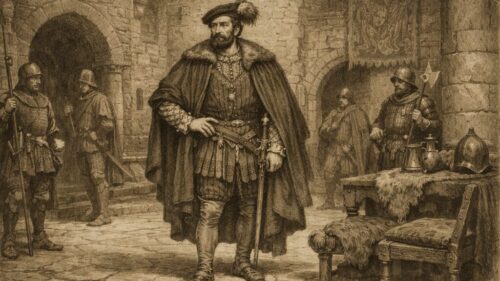
His search for assistance continued in Rome, where he fell in with an English Catholic adventurer named Thomas Stukeley. Together they entered into a plan to invade Ireland. Pope Gregory XIII gave the plan his blessing and supplied them with a force of 1,000 Italian swordsmen. The same account says that they were also given money and ships. FitzMaurice and Stukeley then sailed with their force to Portugal, where King Sebastian commandeered them to fight the Moors in Morocco.
Events did not proceed as planned. Stukeley died at the Battle of Alcácer Quibir in August 1578. FitzMaurice was unaware of that death, and he was able to reassemble some 800 of his army. In June 1579 they set sail for Ireland accompanied by the Papal Nuncio, Nicholas Sanders. The expedition thus continued despite the loss of the man with whom he had made the original papal-backed scheme.
Return Landing
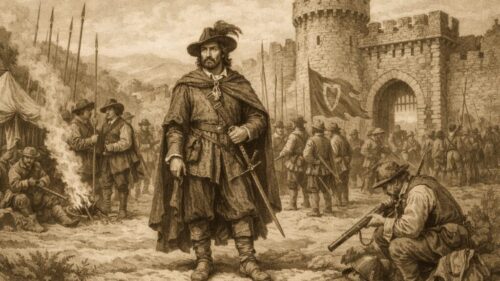
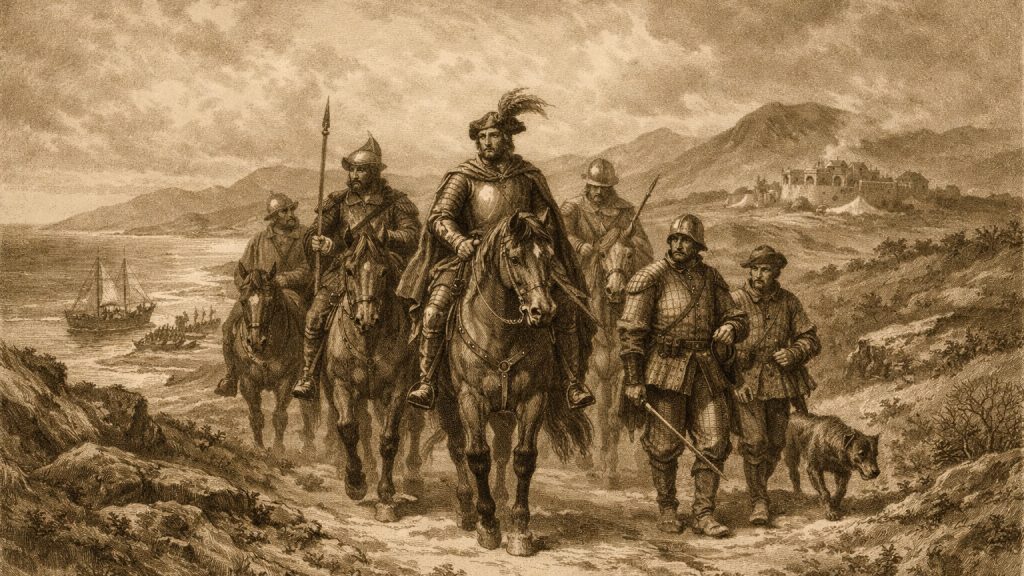
A small force arrived at Smerwick Harbour on 18 July and quartered nearby at Dún an Óir in County Kerry. FitzMaurice immediately sent out a plea to the surrounding clans and Catholic Anglo-Irish families requesting that they rebel against the English heretics. Although the Earl of Desmond did not join his force, other FitzGeralds did, and he was also reinforced by the MacCarthy Mór. With those allies he was strong enough to capture and hold the town of Tralee.
Other clansmen, together with gallowglass and warriors from across Munster, began to flock to the force. The account presents his return as the opening of a renewed rebellion and as the centre of a wider appeal to Catholic and Gaelic support in the province. It places his activity in the context of organised resistance rather than isolated action.
Final Raid
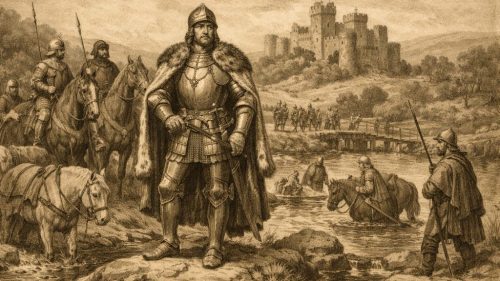
His death came during a horse raid into the lands of Castleconnell near Barrington Bridge in County Limerick. There he came up against Theobald Bourke. The Bourkes had fought alongside the FitzGeralds in the first of the Desmond rebellions against Elizabeth Tudor, but they had submitted and retained their lands. Theobald was by blood a cousin to James FitzMaurice, yet he came against him in the encounter.
There was a fracas in which Theobald Bourke and his brother Richard, also called Ulick, were killed and wounded by a musket ball. FitzMaurice’s wound was so severe that he died a few hours later. The Bourkes then decapitated his body and displayed his head on the walls of Castleconnell. His body was sent to the Lord President, who had it hung on the gates of Killmallock. The record also notes that William, the father of Theobald and Richard Bourke, was rewarded by Elizabeth I by being created Lord Baron Bourke of Castleconnell and by receiving an annuity of 200 marks.
James FitzMaurice FitzGerald’s career, as represented in these accounts, moves from pardon and dispossession to exile, foreign solicitation, papal-backed planning, and a fatal return to Ireland. The surviving facts trace a life shaped by rebellion, courtly negotiation, and military action in Munster.
Source References
Hover over a number to see the source. Select it to open the source.