Patrick Sarsfield
Patrick Sarsfield was born at Lucan about the middle of the seventeenth century. He bore a commission in the English Life Guards, fought under Monmouth on the Continent, and was severely wounded at Sedgemoor. After that he retired with James II to France, then accompanied him to Ireland in March 1689, where he ranked as a brigadier-general. After the death of his elder brother William, he succeeded to the family estates. He also married Honora Burke, daughter of the 7th Earl of Clanricard. He sat in James II’s Irish Parliament for the County of Dublin.
Dateline
Patrick Sarsfield was born at Lucan about the middle of the seventeenth century. He bore a commission in the English Life Guards, fought under Monmouth on the Continent, and was severely wounded at Sedgemoor. After that he retired with James II to France, then accompanied him to Ireland in March 1689, where he ranked as a brigadier-general.
Irish Service
After the death of his elder brother William, he succeeded to the family estates. He also married Honora Burke, daughter of the 7th Earl of Clanricard. He sat in James II’s Irish Parliament for the County of Dublin. After Mountcashel’s defeat before Enniskillen, he marched to Sligo for the defence of Connaught, occupied Athlone after the relief of Londonderry, and later secured Galway for James.
Limerick Defence
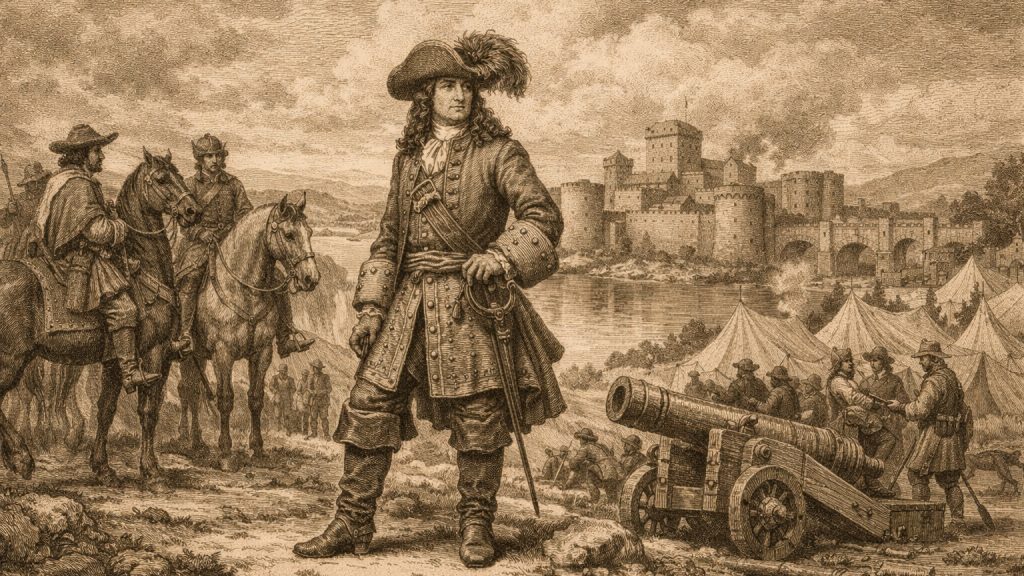
Sarsfield held a command at the battle of the Boyne on 1 July 1690, then became second in command under Major-General Boiseleau at Limerick. On 10 August he left the city with 500 picked men and surprised William’s siege convoy at Ballyneety, where the guards were sabred or taken prisoner and eight heavy battering cannons, five mortars, eighteen tin pontoons, and 200 waggons were destroyed or captured. He returned safely to Limerick with 500 captured horses.
Later Command
In February 1691 James II created him Earl of Lucan, Viscount of Tully, and Baron of Rosberry, and also made him Colonel of the Life Guards and Commander-in-chief in Ireland. He took part in the defence of Athlone, acted as second in command at Aughrim, and attended to the defence of Limerick’s fortifications, provisions, forage, and ammunition. He signed the Treaty of Limerick on 3 October 1691, and on 8 December 1691 issued a release to lieutenant-general Ginkel.
Source References
Hover over a number to see the source. Select it to open the source.