Cushendall
Cushendall is securely identifiable as a historical settlement in County Antrim. Modern Irish-language authority records it as the townland Bun Abhann Dalla / Cushendall in county Aontroim/Antrim, within the civil parish of Layd/Layd and the barony of Glenarm Lower, confirming both the place and its historical county assignment 1. A nineteenth-century historical gazetteer likewise places Cushendall (also called Newtown-Glens) in the parish of Layde, barony of Lower Glenarm, county of Antrim 2.
Dateline
Settlement and names
Cushendall is securely identifiable as a historical settlement in County Antrim. Modern Irish-language authority records it as the townland Bun Abhann Dalla / Cushendall in county Aontroim/Antrim, within the civil parish of Layd/Layd and the barony of Glenarm Lower, confirming both the place and its historical county assignment 1. A nineteenth-century historical gazetteer likewise places Cushendall (also called Newtown-Glens) in the parish of Layde, barony of Lower Glenarm, county of Antrim 2.
The name is historically explained from Irish as “the foot of the river Dall” or similar, and the same interpretation appears in a local historical account from the Glens of Antrim Historical Society, which explicitly notes that the village name meant the foot of the river Dall and that it had been changed to Newton-Glens before resuming its older form 3. The Irish form therefore aligns with the settlement’s topography at the mouth or lower reach of the River Dall 13.
Historical development
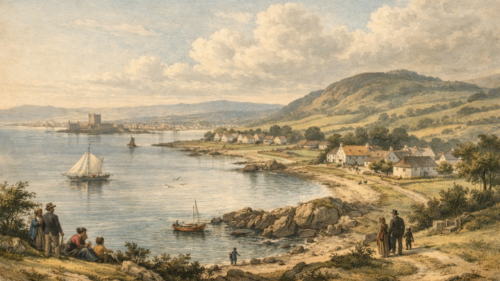
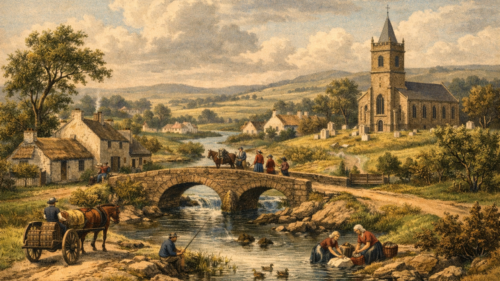
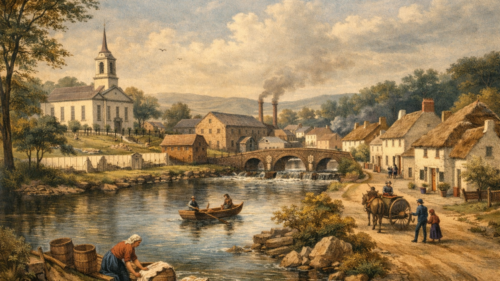
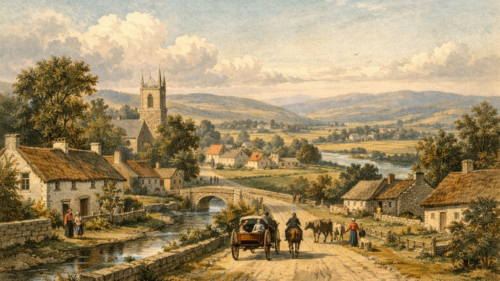
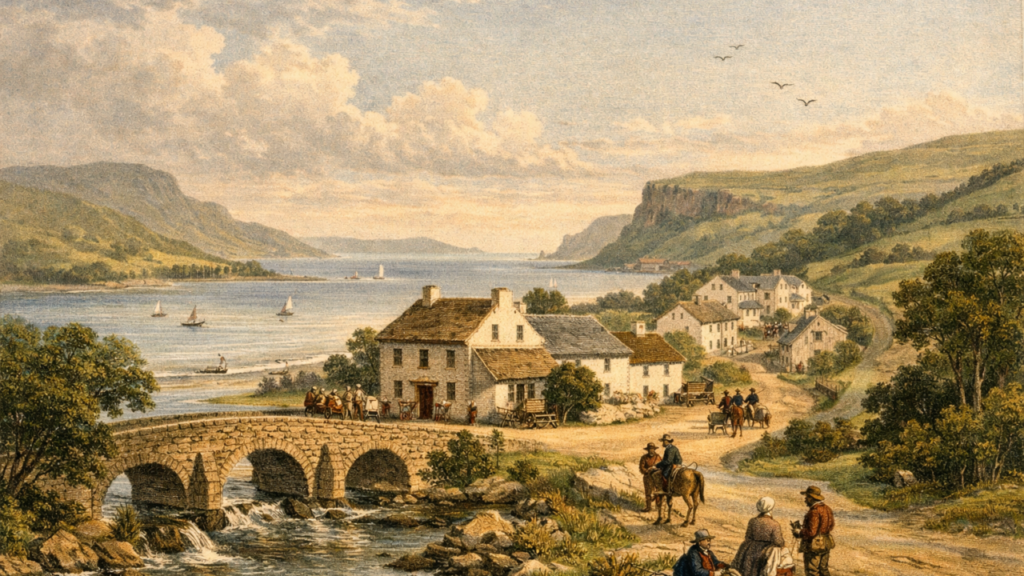
Lewis’s Topographical Dictionary describes Cushendall in the 1830s as a post-town situated near the sea, crossed by the river Dall, with a stone bridge, a neat built town, about 90 houses, and a hotel intended to serve visitors travelling the coast road toward the Giant’s Causeway 2. This shows that by the early nineteenth century it was already more than a hamlet: it functioned as a minor coastal service centre and stopping place on an important north Antrim route 2.
Local historical writing preserves an even more specific naming history. In the parish account of Layd and Ardclinis, Cushendall is said to have been renamed “Newton-Glens” by Surgeon Richardson, before the old name was restored under Mr Turnly 3. That testimony is valuable because it records an actual historical renaming, not merely a later folk explanation. Taken together, these sources show a settlement with an old Irish-derived name, a brief English-imposed alternative, and a continued identity as Cushendall in the historical record 23.
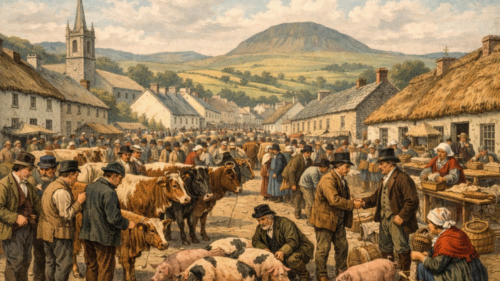
The same nineteenth-century sources also associate the town with bathing, accommodation, fairs, and a parish church at the western end of the town, indicating a settled community with civic and economic functions rather than a purely rural waypoint 23.
Historical county context
All consulted authoritative references place Cushendall in County Antrim, historically within the parish of Layd/Layd and barony of Lower Glenarm 12. The name record from Logainm explicitly gives the county as Aontroim/Antrim, and the Lewis entry repeats the county designation in the standard nineteenth-century administrative form 12.