Dunseverick
Dunseverick is securely identifiable as the population centre recorded in the Irish place-name authority as Dún Sobhairce / Dunseverick, in County Antrim, in the civil parish of Billy and the townland Feigh alias Dunseverick. That modern catalogue form confirms both the settlement identity and the county assignment, while also preserving the Irish-language form used by the authority 1. The historical spelling record is varied. A Queen’s University Belfast archaeological and heritage publication on north Antrim calls the place Dún Soirbhice and gives the Anglicised form “Dunserverick”, showing that the name has circulated in more than one rendered spelling in scholarship and local history writing 2.
Dateline
Settlement and name
Dunseverick is securely identifiable as the population centre recorded in the Irish place-name authority as Dún Sobhairce / Dunseverick, in County Antrim, in the civil parish of Billy and the townland Feigh alias Dunseverick. That modern catalogue form confirms both the settlement identity and the county assignment, while also preserving the Irish-language form used by the authority 1.
The historical spelling record is varied. A Queen’s University Belfast archaeological and heritage publication on north Antrim calls the place Dún Soirbhice and gives the Anglicised form “Dunserverick”, showing that the name has circulated in more than one rendered spelling in scholarship and local history writing 2. A nineteenth-century topographical dictionary likewise lists the parish as “DUNSEVERICK, or DOONSERE”, placing it in County Antrim and showing another historical English form, “Doonsere”, beside the better-known modern spelling 3.
Early and medieval history
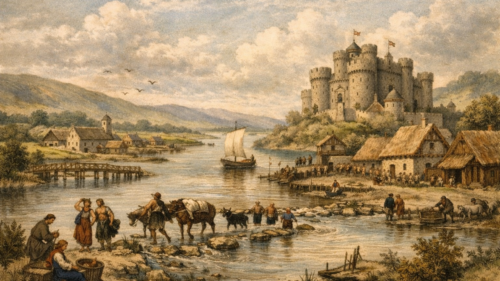
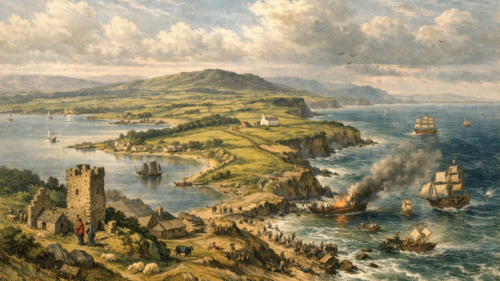
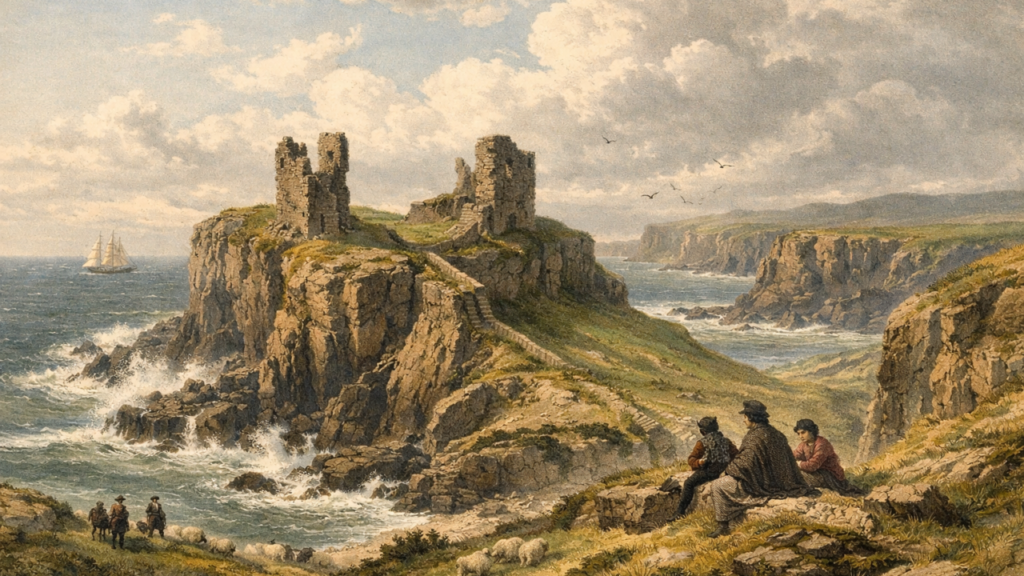
The historical importance of Dunseverick is much older than the surviving ruins. The Queen’s University study describes it as an important place “for millennia”, noting its appearance in early Irish myth and in the Tripartite Life of St Patrick; it identifies the site as the reputed capital of Dál Riata in north Antrim 2. That same source summarises the medieval sequence: the site was attacked by Vikings, became an Anglo-Norman manor, and was later occupied by the MacDomhnaill lordship, which probably built the small stone tower still associated with the promontory 2.
The name is therefore not merely a castle label but a long-lived place-name attached to a strategically important north-coast promontory. The scholarship makes clear that Dunseverick’s history is bound up with both early medieval political memory and later lordship, rather than with a single-period castle site 2.
Nineteenth-century historical description
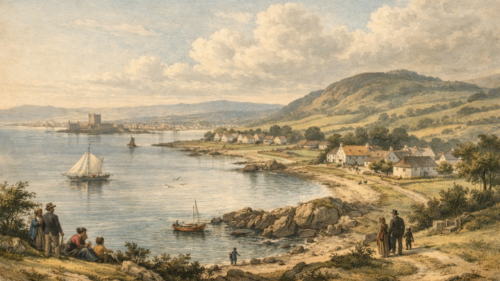
By the nineteenth century, Dunseverick was already being described in antiquarian and topographical literature as part of County Antrim’s northern coastal landscape. Lewis’s topographical dictionary places the parish “in the county of Antrim” and notes the prominence of the coast, the church site, and the “venerable remains of Duuseverick castle” 3. This is useful historical evidence because it shows that the name was still recognised in local administrative and descriptive usage, and that the ruins were already an established historical landmark by the 1830s 3.
Read together, these sources establish a continuous historical identity: an ancient and medieval stronghold-place, later a parish and locality within County Antrim, and a site whose Irish and English forms were preserved in both scholarly and administrative records 123.