Contracts Shortened
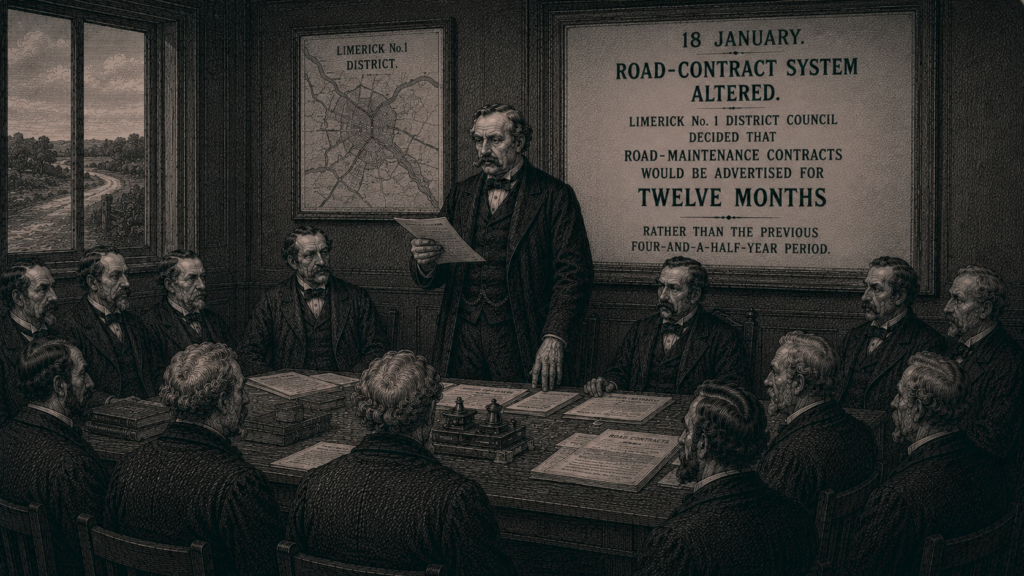
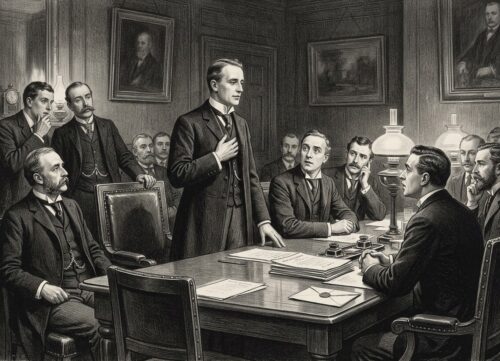
Limerick No. 1 District Council altered the system governing maintenance and repair contracts for public roads when members decided that future agreements would run for twelve months rather than the four-and-a-half-year term previously used. The decision followed an adjourned quarterly meeting held under the chairmanship of William Noonan and reported on 18 January 1900. Road tenders rejected at an earlier sitting had been referred to Limerick County Council, which declined to consider them and returned the entire question to the District Council. Members were therefore required to reconsider both the tenders and the basis upon which future road work would be awarded.
John Ryan moved that contracts should be advertised for one year from 31 March 1900. The shortened term represented a substantial departure from established practice and gave the Council greater opportunity to review costs, workmanship and the conduct of contractors before renewing agreements. Long contracts offered continuity but could bind a local authority to unsatisfactory arrangements for several years. Annual contracts provided more frequent competition and allowed councillors to respond to changing wages, road conditions and maintenance needs. Ryan’s motion reflected the uncertainty surrounding road administration during the first year of the new elected local-government system in County Limerick.
The resolution also required successful contractors to obtain security through a guarantee society. Mr Doyle, a solicitor representing intending contractors, argued that this condition could not be fulfilled. He stated that Mr Shee, MP, who had suggested the arrangement, had consulted guarantee societies whose managers indicated that they would refuse to act as sureties for road contractors. Chairman Noonan believed the resolution should be amended to meet this difficulty, but members did not accept his suggestion. The condition remained attached to the proposal, raising the possibility that otherwise suitable contractors might struggle to provide the form of financial security demanded by the Council.
The debate took place amid growing agitation for direct labour on County Limerick roads. Labourers and their supporters argued that councils should employ workers themselves rather than place public money in the hands of private contractors. The County Council had already received approval to put roads under the County Surveyor where no acceptable tenders were submitted. Shortening contracts to twelve months allowed the District Council to retain the contracting system while limiting the period for which it surrendered direct control. The decision therefore represented a compromise between long-established contracting arrangements and demands for more accountable public employment.
The motion was ultimately adopted unanimously. Its passage established a new annual rhythm for advertising, evaluating and awarding road-maintenance contracts within the Limerick No. 1 district. Councillors would have more frequent opportunities to compare contract prices with direct-labour costs and to judge whether contractors were keeping roads in satisfactory repair. For labourers, ratepayers and farmers, the consequences would be visible in employment opportunities, local taxation and the condition of routes used for markets, farms and everyday travel. The altered contract term became one element of a wider struggle over who should control public work under Ireland’s new democratic councils.
- Irish Times, “The Direct Labour Question,” 18 January 1900, p. 6.
- Limerick No. 1 Rural District Council minute books, January 1900, Limerick Archives; exact volume and folio for the meeting not confirmed.
- Local Government (Ireland) Act 1898, 61 & 62 Vict., c. 37.
- Local Government (Procedure of Councils) Order 1899, provisions governing meetings, contracts and financial administration by Irish local authorities.
- Limerick County Council minute books, 1899–1900, Limerick Archives, records concerning road tenders, direct labour and responsibility for county road maintenance.