Potato Findings
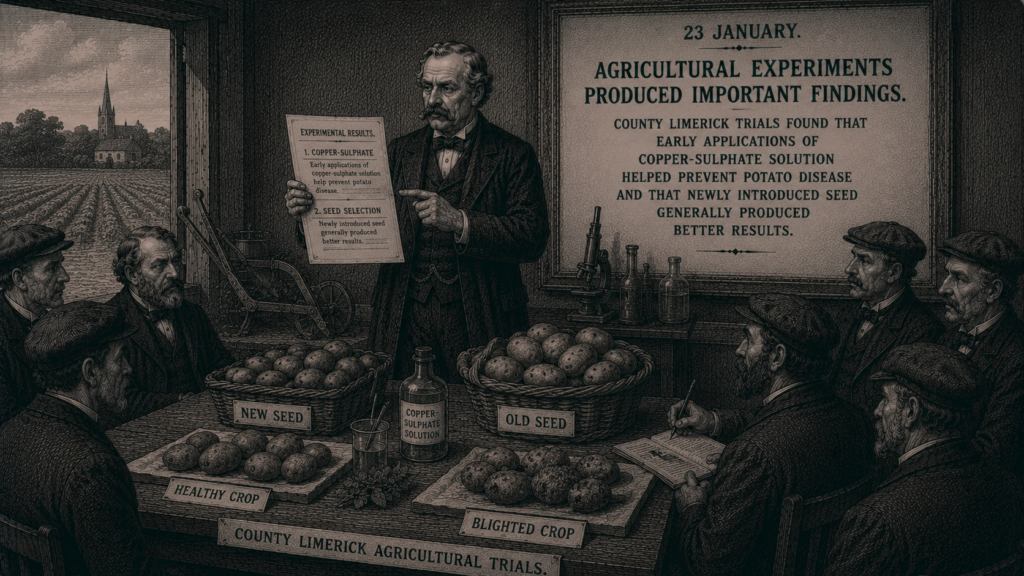
Important results from agricultural experiments conducted across County Limerick were reported on 23 January 1900. The trials examined whether a copper-sulphate solution could protect potato crops against disease and whether freshly introduced seed performed better than potatoes repeatedly grown on the same farms. The findings were encouraging. Even during a season when blight had been comparatively limited, treated plots produced sufficient improvement to repay the expense of spraying. For farmers whose income and household food supply depended heavily upon the potato harvest, the experiments offered practical evidence that preventive treatment could reduce risk rather than merely respond after disease had appeared.
Timing proved central to the success of the copper treatment. The Limerick trials indicated that two applications made relatively early in the growing season were more effective than one heavier dressing applied later. This supported the principle that the solution worked best as a preventive coating upon healthy foliage rather than as a cure after infection had become established. Farmers therefore needed to act before obvious damage appeared, preparing the mixture, maintaining spraying equipment and treating fields while the crop still looked sound. The method required additional labour and expenditure, but the reported improvement suggested that prevention could protect both yield and quality.
The experiments were conducted over a considerable area, giving the findings greater value than results obtained from a single isolated plot. Potato disease varied according to weather, drainage, soil and local growing conditions, making comparison across several farms particularly useful. The preceding crop had been one of Ireland’s soundest for some years, although wet lands in Connacht had suffered more severely. The relative absence of widespread destruction did not weaken the Limerick evidence. Instead, the results suggested that spraying remained economically worthwhile even when disease pressure was moderate, allowing farmers to protect against sudden deterioration during damp summer weather.
A second series of tests compared old farm-grown seed with potatoes newly introduced from elsewhere. In almost every instance, the fresh seed produced substantially better results than stock that had been cultivated repeatedly upon the same holding. The finding encouraged farmers to renew their seed rather than relying indefinitely upon potatoes selected from previous harvests. Better seed could improve vigour, yield and resistance, although the surviving report did not identify the varieties or every farm involved. Combined with early spraying, periodic seed renewal offered County Limerick growers a practical programme for strengthening a crop still central to rural food, wages and farm income.
The trials reflected a growing effort to apply organised agricultural science to the ordinary problems of Irish farming. Demonstration plots and comparative experiments translated chemical and botanical knowledge into recommendations that cultivators could judge by visible results. In County Limerick, where mixed farming and dairying existed alongside widespread potato cultivation, the value of a healthier crop extended beyond human consumption because potatoes could also support livestock feeding and household economy. The findings did not eliminate the continuing threat of blight, but they showed that careful timing, copper-sulphate treatment and renewed seed could materially reduce the vulnerability inherited from older cultivation practices.
- Irish Times, “Sulphate of Copper Solution and Potato Disease,” 23 January 1900, p. 6.
- Farmer’s Gazette, account of agricultural experiments conducted in County Limerick during the 1899 growing season concerning copper-sulphate treatment, potato disease and old versus newly introduced seed; exact issue and page not confirmed, cited in the Irish Times, 23 January 1900, p. 6.