Summit Disaster
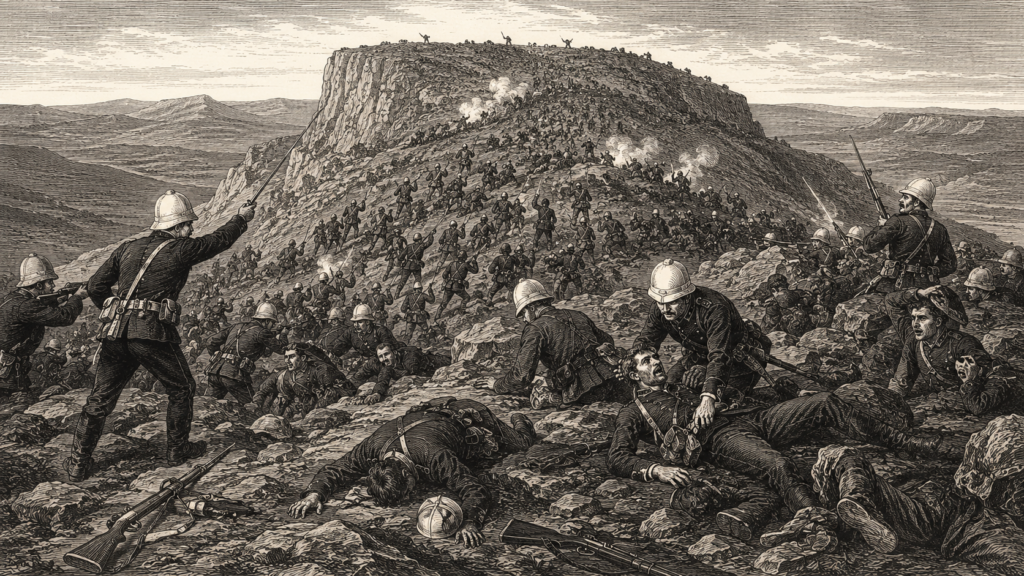
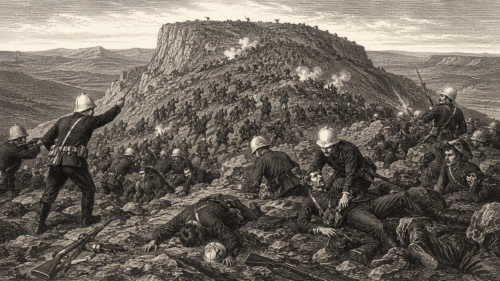
For Limerick, whose city and county belonged to the recruiting region of the Royal Munster Fusiliers, reports from Spion Kop carried immediate human significance even though that regiment did not fight upon the summit. During the night of 23–24 January 1900, British troops commanded by Major-General Edward Woodgate climbed the steep hill in Natal as part of Sir Redvers Buller’s renewed attempt to relieve besieged Ladysmith. The attackers surprised a Boer outpost and secured part of the summit before dawn, but mist and darkness concealed the true shape of the ground and the stronger positions lying beyond them.
British engineers began digging defensive trenches, but the rocky soil prevented them from creating adequate protection. When the mist lifted, the troops discovered that they occupied only a cramped portion of the plateau and remained exposed to Boer rifles and artillery firing from several directions. Louis Botha rallied the defenders while Boer commandos advanced towards the summit from neighbouring ridges. Woodgate was seriously wounded early in the fighting, leaving authority uncertain among officers who lacked reliable information about neighbouring units, reinforcements and the plans of their commanders below. The captured height rapidly became a confined and increasingly dangerous position.
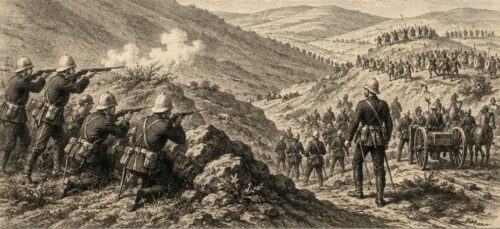
Reinforcements climbed the hill throughout 24 January, including men of the Middlesex, Dorset and Somerset regiments, the Imperial Light Infantry and other formations. Their arrival increased the number of rifles available but also crowded thousands of soldiers into ground offering little cover. Ammunition, water, medical assistance and clear orders moved slowly over the steep approaches. British artillery below could not effectively silence Boer guns concealed behind intervening ridges. Rifle fire, shells and rapid-firing weapons swept the summit for hours, while sections of trench changed hands and exhausted soldiers struggled to hold their positions amid wounded comrades and broken unit formations.
Lieutenant-Colonel Alexander Thorneycroft eventually assumed command on the summit, although the arrangements were poorly communicated and several senior officers remained uncertain about who held final authority. After nightfall, believing the shattered force could not endure another day without artillery, water and properly organised support, Thorneycroft ordered a withdrawal. Many Boer fighters had also become discouraged, but the British commanders did not know this. By dawn on 25 January, Boer forces had reoccupied the abandoned summit. The later official despatches criticised the failures of communication, organisation and command that allowed a position gained through a difficult night assault to be surrendered.
British losses at Spion Kop amounted to approximately 1,500 killed, wounded, missing or captured, while Boer casualties numbered several hundred. Warren’s force subsequently withdrew across the Tugela, and Ladysmith remained under siege until the end of February. For Limerick households following relatives and neighbours in South Africa, the defeat exposed the personal cost hidden behind imperial reports of advance and relief. It also entered an Irish political climate divided between military service within the British Empire and sympathy for the Boer republics. Spion Kop therefore reached Limerick not as a distant battlefield alone, but as news carrying anxiety, argument and possible bereavement.
- The London Gazette, issue 27183, 17 April 1900, pp. 2497–2503, War Office despatches concerning the Tugela operations and the capture and evacuation of Spion Kop.
- Winston S. Churchill, London to Ladysmith via Pretoria, London: Longmans, Green, and Co., 1900.
- Arthur Conan Doyle, The Great Boer War, London: Smith, Elder & Co., 1900, Chapter XV, “Spion Kop.”
- Frederick Maurice, ed., History of the War in South Africa, 1899–1902, vol. II, London: Hurst and Blackett, 1907.
- National Army Museum, “‘Spions Kop, Natal. Jan 26th 1900’, British Casualties, 1900,” collection accession 2006-09-2-2.