Commons Uproar
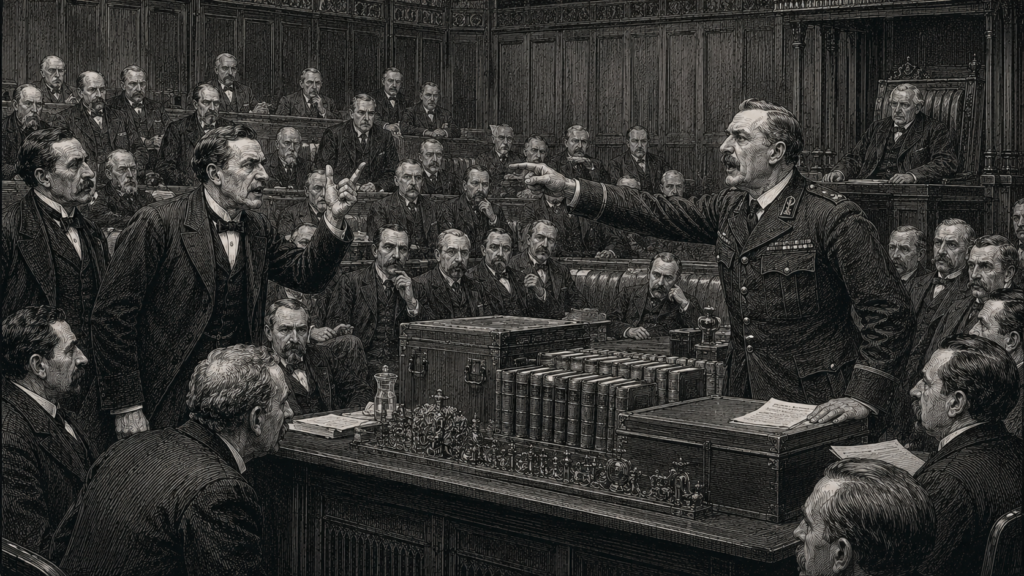
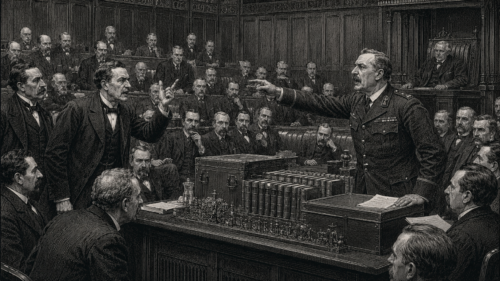
The House of Commons descended into uproar on 2 February 1900 after Colonel Edward Saunderson invoked remarks attributed to John Daly, the Mayor of Limerick, during a fierce attack upon Irish Nationalists. Speaking in a debate on the Government’s conduct of the South African War, the North Armagh Unionist argued that a ministry dependent upon Nationalist votes could not be trusted to prosecute the conflict. Limerick’s political voice therefore entered Westminster at a moment of imperial crisis, exposing the gulf between Irish opposition to the war and Unionist demands for victory and loyalty to the Crown.
Saunderson quoted Daly as declaring that British soldiers were falling before the Boers and that, once the Boers had taken the “stuffing” out of them, the men of Cork and the rest of Ireland would lend a hand. The words were presented in Parliament as evidence of Nationalist hostility towards Britain, although Hansard records them only through Saunderson’s attribution and does not establish the original occasion or full context. Daly, a veteran Fenian and serving mayor, represented a separatist tradition that regarded British reverses in South Africa as weakening imperial authority and creating opportunities for Ireland’s national cause.
The confrontation became disorderly when Saunderson added that British troops might be attacked from behind because Nationalists “never attacked in the front.” Timothy Healy demanded to know why Saunderson was not serving with the Cavan Militia, while John Dillon and William Redmond protested that the remark insulted Irish courage. Members shouted demands for withdrawal, Speaker William Gully repeatedly called for order, and John Redmond formally questioned whether the words exceeded parliamentary usage. Saunderson initially attempted to explain the observation through what he called Irish historical records, an explanation that Nationalist members considered more offensive than the original insult.
Arthur Balfour appealed for the dispute to end, and the Speaker eventually pressed Saunderson to withdraw the observation after Nationalist MPs made clear that they regarded it as a personal reflection. The argument later returned to military service when William Redmond asked why Saunderson did not go to South Africa himself. Saunderson replied that age prevented him from volunteering, describing “Anno Domini” as an incurable condition. He then challenged Redmond to join the Boers, prompting Redmond to answer that he could serve their cause and liberty more effectively within the House of Commons.
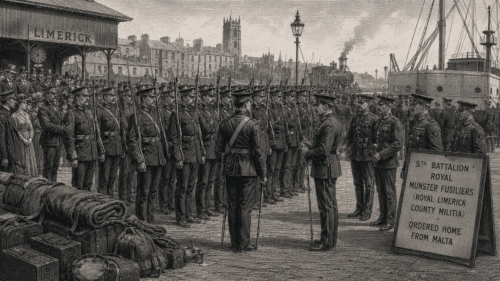
The episode captured the bitterness created by Irish participation in an imperial war many Irish Nationalists condemned. Irish soldiers were fighting and dying in British uniform while politicians such as Daly and Redmond expressed sympathy for the Boer republics. Saunderson used those sympathies to question Nationalist loyalty, while his opponents insisted that opposition to the war did not justify insulting Irish valour. Horace Plunkett privately recorded that Saunderson’s attack damaged relations between Nationalists and English members. For Limerick, the confrontation showed how its mayor’s reported words could become ammunition in a Westminster struggle over empire, patriotism and Ireland’s political future.
- House of Commons Debates, 2 February 1900, fourth series, vol. 78, cols. 451–548, especially cols. 531–542, “Fourth Day’s Debate.”
- House of Commons Debates, 15 February 1900, fourth series, vol. 79, “Irish Militia—Alleged Coercion to Volunteer,” concerning Irish militia service in South Africa.
- Sir Horace Curzon Plunkett, Diary, entry for 2 February 1900, National Library of Ireland digital edition.
- Lawrence William White, “Daly, John,” Dictionary of Irish Biography, Royal Irish Academy.
- Patrick Maume, “Saunderson, Edward James,” Dictionary of Irish Biography, Royal Irish Academy.