Archived: 16 November 2026
Abstract
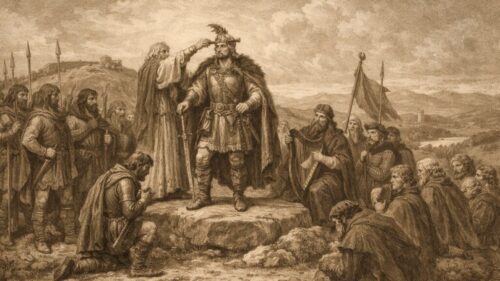
Turlough Luineach O'Neill was an Irish lord of Tyrone, styled Luineach because he had been fostered by O'Luinigh of Muintir Luinigh in Tyrone. He was the son of Niall Conallach O'Neill, and his mother was Rose, daughter of Manus O'Donnell. The same account places his birth about 1530. Family OriginsThe name by which he is known in historical writing reflects fosterage as well as birth. He was a grandson of Art Og O'Neill, and the source places him as a younger brother of Con mor O'Neill, who was the father of Con, first earl of Tyrone. The extract does not
Read Article
Archived: 16 November 2026
Abstract
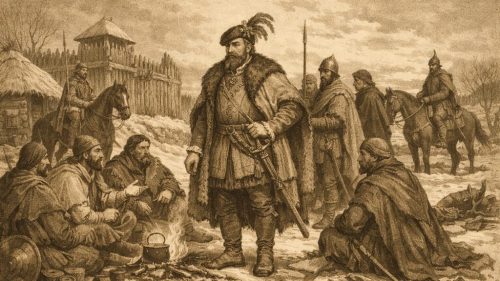
Hugh O'Neill, Earl of Tyrone, was born about 1540 in one account, while another gives about 1545. He was the second son of Matthew, Baron of Dungannon. Later biographical accounts describe him as having been brought over to court by Sidney, given a troop in the Queen's service, and employed in the English army in the Irish wars. Those same accounts place him at the Smerwick massacre in 1580.Early AllegianceIn the years before the great war in Ulster, O'Neill appears in the records as a man closely tied to English authority. An old biography says that he was supported by
Read Article
Archived: 16 November 2026
Abstract
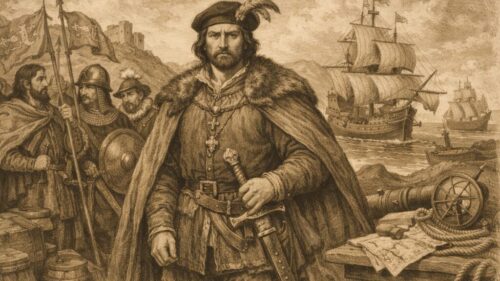
Red Hugh O'Donnell, also known in Irish as Aodh Ruadh Ó Domhnaill, was an Irish clan chief and a leader of the confederacy of Irish lords during the Nine Years' War. The surviving account identifies him as Hugh Roe O'Donnell II and gives his life dates as c. 20 October 1572 to 30 August 1602. He was born into the powerful O'Donnell clan of Tyrconnell, the Gaelic Irish noble dynasty based in the area now associated with County Donegal.Clan BirthO'Donnell was the eldest son of Hugh McManus O'Donnell and his second wife, Fiona “Iníon Dubh” MacDonald. His family belonged to
Read Article
Archived: 16 November 2026
Abstract
Dating FrameThe surviving annals do not mark 552 in the same way. Annals of Ulster supplies a printed AD heading for 552 and then places several notices under that heading, while the Four Masters does the same with its own year label. By contrast, Tigernach and Chronicon Scotorum present the material under year entries without explicit AD headings in the retrieved text, so the year must be read from those entries rather than from a converted identifier.Within that frame, the notices attached to 552 are not all the same kind. In Annals of Ulster, the year includes death notices and
Read Article
Archived: 16 November 2026
Abstract
Calendar NoticesFor the year identified in these annals as 553, the clearest chronological markers are the year headings themselves. In the Annals of Ulster, the relevant block is printed with the heading for 553 and begins with U554.0, “Kalends of January [...] AD 553.” The same cluster continues with U554.1, “Birth of Lugaid moccu Óchae,” and U554.2, “A pestilence i.e. leprosy called the samthrosc.” These are the notices explicitly attached to that year-heading sequence in the excerpt, and the source label should be read as the manuscript’s own identifier rather than as an instruction to convert dates.The Annals of the
Read Article
Archived: 16 November 2026
Abstract
Diarmait Mac Murchada was king of Laigin in the twelfth century. The surviving annalistic record places him in that role in 1166, when he was banished eastwards over sea after the foreigners of Áth Cliath and the Laigin had turned against him. The same record notes that Ruaidrí Ua Conchobuir then took the kingship of Ireland. A later historical reference work identifies Diarmait as king of Leinster and gives the form Diarmaid MacMurrough as an equivalent rendering of his name.Royal PositionThe annals describe Diarmait as son of Mac Murchada and as king of Laigin. In the surviving notice for 1166,
Read Article
Archived: 16 November 2026
Abstract
The annals connected with 557 preserve a small and uneven set of notices. In the Annals of Ulster, the year opens with a notice for the Kalends of January and records the death of Fergna or Fiacha, king of Ulaid, without an explicit printed AD heading on that notice. The Annals of Inisfallen also place Fergna’s death in 557 by cross-reference. Other compilations around the same chronological zone supply nearby notices for 557 and 558, but they do not all agree in wording, ordering, or year-labeling. This article keeps those notices separate and avoids forcing them into one reconstructed sequence.
Read Article
Archived: 16 November 2026
Abstract
Ruaidrí Ua Conchobair is named in the annals in connection with events of the twelfth century. The surviving notices identify him by name and place him among the rulers of Connacht. They record him in actions involving military movement, the taking of hostages, inauguration, tribute, and the reception of important figures into his house. The notices are brief and episodic, but they preserve a sequence of events in which Ruaidrí appears repeatedly in the political affairs of the western and southern Irish kingdoms.Royal LineageThe annals identify him as Ruaidhri Ua Conchobair and place him among the rulers of Connacht. In
Read Article
Archived: 16 November 2026
Abstract
Annal NoticesThe material placed under 588 is brief in the Annals of Ulster and consists of separate notices rather than a connected narrative. Under the printed AD heading 588, the source gives the repose of bishop Aed son of Brec, the death of Aed son of Brenainn, and the statement that in the same time there was a very hot and dry summer. The entries are listed one after another, and the source does not join them into a single explanation.The Annals of Tigernach present a different arrangement for the same year frame. Their notice labelled T588.0 introduces a cluster
Read Article
Archived: 16 November 2026
Abstract
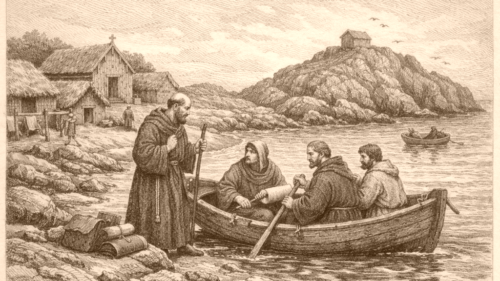
Year noticesThe notices relevant to 563 CE are distributed unevenly across the annals, and the printed headings are part of the record. In the Annals of Ulster, U563.0 reads with the heading AD 562, while U564.0 reads with the heading AD 563. In the Annals of Tigernach, T563 begins under Annal T563, and in the Annals of Inisfallen AI563.1 is placed under Annal AI563.These headings do not place all the relevant notices in one identical year, and the records themselves keep their own sequence. The Ulster text places the voyage of Colum Cille under U563.4 and prints AD 562 at
Read Article
