Archived: 16 November 2026
Abstract
Annal NoticesIn the Annals of Ulster, the sequence around U571 and U572 places the deaths and slayings beside one another in a tightly dated framework. U571.0 is printed as AD 570, and U571.2 adds the alternative notice, “Or this year the repose of Mo-Laise of Daiminis.” U572.0 is printed as AD 571. In U572.1 the annalist records the slaying of two descendants of Muiredach, namely Baetán son of Muirchertach and Echaid son of Domnall son of Muirchertach Mac Erca, and states that they were killed by Crónán son of Tigernach. U572.2 then notes that Maenu, bishop of Cluain Ferta Brénainn,
Read Article
Archived: 16 November 2026
Abstract
Royal BeginningsSitric Silkbeard appears in the historical record as a ruler of Dublin at the turn of the eleventh century. He belonged to the Uí Ímair dynasty, the Scandinavian-descended ruling family that had long been prominent in the Irish Sea world. Later discussion of his career has emphasised that he was part of a Christian, Hiberno-Norse royal milieu rather than a simple outsider figure. The same tradition also places him within a web of Irish dynastic relationships, with a Leinster connection through his mother and close links to Brian Boru’s family through marriage. Sitric Silkbeard ruled Dublin for over four
Read Article
Archived: 15 November 2026
Abstract
Calendar FrameThe Annals of Ulster mark the notice cluster under U565, preceded by the calendrical heading that states AD 564, and then list the slaying of Diarmait son of Cerball, the repose of Brénainn of Biror as some say, and the battle of Gabair Liphi with the death of Daimíne Daim Airgit. The same source then moves on to U566, where the next calendrical heading is AD 565. In this witness, the material for the year is compact and the heading sequence itself is part of the evidence.The Annals of Tigernach present a parallel sequence under Annal T565, headed K.
Read Article
Archived: 15 November 2026
Abstract
The annalistic material attached to 576 CE is uneven and requires separation of record from record. One set of notices places a battle at Teloch and associates it with deaths among the followers of Gabrán’s sons; another set records a plentiful crop of nuts or an abundance of nuts, together with illness. Other compilations attach deaths of Brénainn, Colman, and related ecclesiastical notices to the same calendar year. The surviving entries do not agree in placement or content, so the year must be read through the wording and headings of each annal independently rather than as a single harmonized narrative.
Read Article
Archived: 15 November 2026
Abstract
Year NoticesIn the Annals of Ulster, the passage marked U588 begins with the heading “Kalends of January ... AD 587.” It records the repose of Cairlén, bishop of Ard Macha; the repose of Senach, bishop of Cluain Iraird; the death of the grandsons of Giun(?); the conversion of Constantine to the Lord; a great snowfall; and the slaying of Áed Dub son of Suibne. The sequence is compact, but it joins ecclesiastical death-notices, an imperial conversion, weather, and violence in a single annal unit.The Annals of Tigernach preserve a nearby sequence under the internal label T587. In that sequence, T587.1
Read Article
Archived: 15 November 2026
Abstract
Year MarkersThe retrieved passages do not use a single shared year label. In the Annals of Ulster, the relevant notice stands under U583.0 with the printed heading AD 582. In the Annals of Tigernach, the same printed year appears as Annal T582. In the Four Masters, it appears as Annal M582 with the heading The Age of Christ, 582. These different labels are visible in the excerpts themselves and should be kept distinct.The Annals of Ulster excerpt for AD 582 begins with the heading and then gives a death notice for Feradach son of Daui, king of Osraige. The Tigernach
Read Article
Archived: 15 November 2026
Abstract
Year SettingThe notices relevant to 570 CE are not all placed under the same printed annal year. In the Annals of Ulster, the sequence around the target year includes the heading U570.0 with AD 569, followed by U571.0 with AD 570. In the Annals of Tigernach, the sequence includes T570.0 and T570.1, and in the Annals of the Four Masters the relevant material appears under M570.0, where the text itself gives the Age of Christ 570.The printed headings themselves must be kept distinct from modern year labels inferred from later systems. Ulster places the notice about one hundred years from
Read Article
Archived: 15 November 2026
Abstract
Dating FramesThe surviving notices around 566 are presented in different chronological frames. In the Annals of Ulster, U566.0 gives a Kalends of January notice and prints AD 565 before U566.1 and U566.2; in the Annals of Tigernach, T566.0 marks the corresponding entry with K. ui.; in the Annals of the Four Masters, M566.0 gives the Age of Christ, 566; and in the Annals of Inisfallen, AI566.1 appears under the heading Annal AI566.These headings do not all point to the same modern year in the same way. The Ulster sequence places the battle notice under U566 but prints AD 565, while
Read Article
Archived: 15 November 2026
Abstract
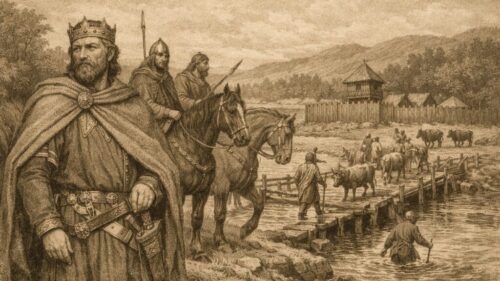
Máel Sechnaill mac Máele Ruanaid is named in the annalistic and king-list material preserved in the extracts. The material places him in the midland political world of Mide and in the dynastic setting of Clann Cholmáin. It records his name in notices connected with rule, movement, and conflict, and it also preserves a place for him in a formal list of rulers. Dynastic BackgroundThe king-list material gives Máel Sechnaill a place in the sequence of rulers associated with Clann Cholmáin. In the preserved verse list, the line “Mael Sechnaill meic Mael Ruanaid” is followed by “cethri bliadna déc ic dáil
Read Article
Archived: 15 November 2026
Abstract
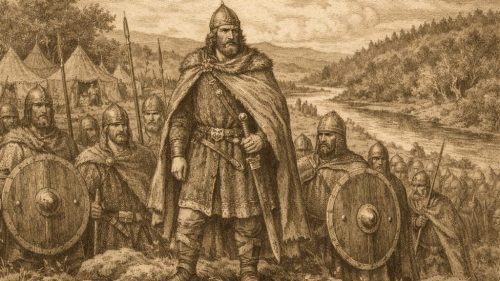
Máel Mórda mac Murchada was a king of Leinster in the late tenth and early eleventh centuries. He belonged to the Uí Dúnlainge dynasty, the royal line that supplied a number of Leinster kings, and he is chiefly remembered in Irish history for his part in the conflicts that surrounded Brian Boru’s rise to dominance in Ireland. The surviving narrative tradition places him at the centre of the political struggle between Leinster, Dublin, and Munster in the years before the Battle of Clontarf.Royal HeritageTradition identifies Máel Mórda as a son of Murchad and places him among the northern Leinster ruling
Read Article
