Archived: 15 November 2026
Abstract
The genealogical material identifies him with Eogan Taidlech and notes that he was called Mug because he had been fostered by Nuadu mac Darfine mac Bairr while he was engaged in making a bond or surety. The same tradition gives him a place among the rulers associated with Munster before the rise of his descendants.Lineage NameThe sources place Mug Nuadat within the royal genealogy of Éber, tracing the Munster dynasties back through Ailill Aulom, his son, and the later Éoganachta. One account says that Ailill Aulom was the son of Mug Nuadat and that Mug Nuadat fathered Ailill Aulom and
Read Article
Archived: 14 November 2026
Abstract
Year DatingThe surviving notices for this period must be read through each annal’s own dating scheme. In the Annals of Ulster, the group that includes the 577 material is headed U577.0 with Kalends of January, sixth feria, twenty-sixth of the moon, followed by AD 576 before the entries themselves. The same source later places a different cluster under U578.0 with AD 577. These headings show that the printed AD label and the annal identifier are not interchangeable.The Annals of Tigernach and the Annals of the Four Masters both place this material under Annal T577 and Annal M577, but they format
Read Article
Archived: 14 November 2026
Abstract
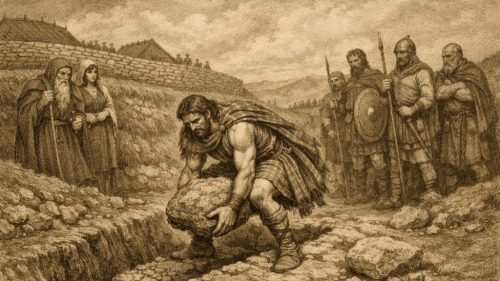
ail Mogh Nuadat .i. Eogan mac Mogha Nét. It says that there was then in Ireland a remarkable champion, Núaidha Sálfada mac Aengusa mic Fir Da Crích of Cúailnge, and that he was brought to Daire m-Barrach for the making of Dún Aillinne. The story then presents the event at the fort as the occasion on which the name Mog Nuadat was given, and it closes by saying that he was so named from that incident. Name TraditionHere the account names Eogan mac Mogha Nét in the episode of Dún Aillinne. Daire m-Barrach mac Cathair had the fortification made, and
Read Article
Archived: 14 November 2026
Abstract
Dating FrameThe excerpts place the year 578 beside differently numbered annal entries rather than by a single shared system. In the Annals of Ulster, the relevant heading is U579.0, which is printed as AD 578; the notices begin at U579.1. In the Annals of Tigernach, the nearby material appears as Annal T579 and Annal T580, while the Four Masters excerpts move from M577 to M579. The passages therefore offer parallel records, but they do not line up perfectly in their own numbering.Only the Ulster passage in these excerpts is explicitly headed AD 578, and its notices begin after that heading.
Read Article
Archived: 14 November 2026
Abstract
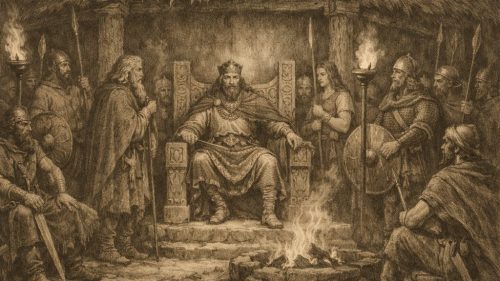
Conchobar mac Nessa belongs to the literary world of the Ulster Cycle, where he appears as the king whose court at Emain Macha gathers the chief warriors of Ulster. In the medieval tradition preserved in Irish manuscript culture, he stands at the centre of a group of stories concerned with heroic deeds, violent deaths, and the fortunes of the warriors attached to his household. The surviving material is not a single continuous life story written by a contemporary observer, but a body of saga literature in which his name recurs as part of the framework of the cycle. Courtly Setting
Read Article
Archived: 14 November 2026
Abstract
The surviving annal entries identify Máel Sechnaill as Mael Sechnaill son of Mael Ruanaid son of Donnchad son of Domnall son of Murchad of Mide son of Diarmait the Harsh son of Airmedach the One-eyed son of Conall of the Sweet Voice, son of Suibne son of Colmán the Great son of Diarmait the Red son of Fergus Wrymouth. The Annals of Ulster state that he was king of all Ireland and that he died on the third feria, the second of the Kalends of December, 30 November, in the sixteenth year of his reign. Chronicon Scotorum also records his
Read Article
Archived: 14 November 2026
Abstract
Ulster RecordIn the Annals of Ulster, the material placed under U603.0 begins with the printed heading AD 602 and then gives several notices for that annal year. U603.1 records the repose of Finntan moccu Echdach, U603.2 places the battle of Echros in Muiresc between Cenél Cairpri and Uí Fhiachrach Muirsce, and U603.4 notes the rest of Sinell, bishop of Mag Bili. U603.5 then gives the battle of Sliab Cua in Mumu.The same annal sequence also places U602.1 to U602.5 under the printed heading AD 601, showing that the Ulster text separates the battle of Slemain, the battle of Cúil Caíl,
Read Article
Archived: 14 November 2026
Abstract
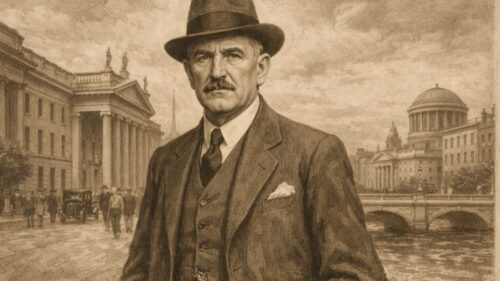
Domhnall Ua Buachalla, also recorded as Donal Buckley and born Daniel Richard Buckley, was born in Maynooth, County Kildare, on 2 February 1866 and died in Dublin on 30 October 1963. His life moved from the Irish language movement and republican activism to the constitutional office of Governor-General in the Irish Free State, a path that placed him at several turning points in modern Irish history.Early LifeHe was baptised on 6 February 1866 as Daniel Ricardus, and later began to use the Irish form of his name in 1901. The record of his baptism places his origins in Maynooth, and
Read Article
Archived: 14 November 2026
Abstract
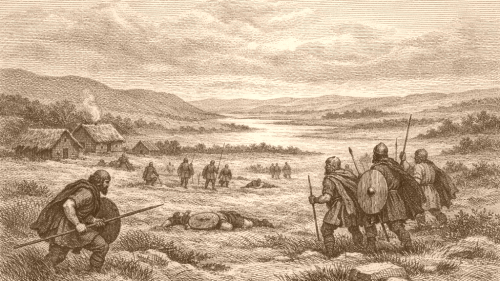
Annal FrameThe notices relevant to 579 appear in annal entries that preserve both a heading and a compact list of events. In the Annals of Ulster, the entry marked U580.0 carries the printed heading AD 579, and the same entry lists the battle of Druim Meic Erce, the expedition to Innsi Orc by Aedán son of Gabrán, and the death of Cennalath, king of the Picts.The same kind of compact listing appears in the Annals of Tigernach, where Annal T579 contains the battle of Mano, the death of Feargna son of Caiblene, and the death of Baedán son of Cairell,
Read Article
Archived: 14 November 2026
Abstract
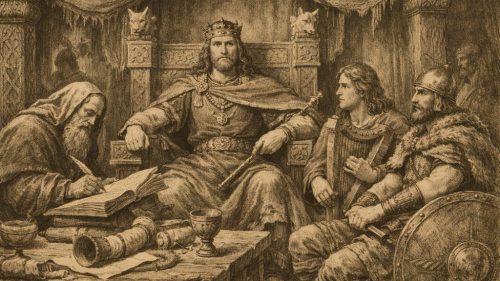
Cormac mac Airt is linked in the supplied sources to the wisdom text Teocosca Cormaic, the tale Scéla Éogain agus Cormaic, and Echtra Cormaic. The sources also cite Tomás Ó Cathasaigh’s 1977 book The heroic biography of Cormac mac Airt, published by the School of Celtic Studies, Dublin Institute for Advanced Studies, and note manuscript sources and printed editions for these texts.Royal PortraitThe tradition includes the Irish text Scéla Éogain agus Cormaic, and related material on Cormac mac Airt is preserved in editions such as Tecosca Cormaic (The instructions of King Cormac Mac Airt) and Vernam Hull’s edition of Echtra
Read Article
