-
Roads Conflict
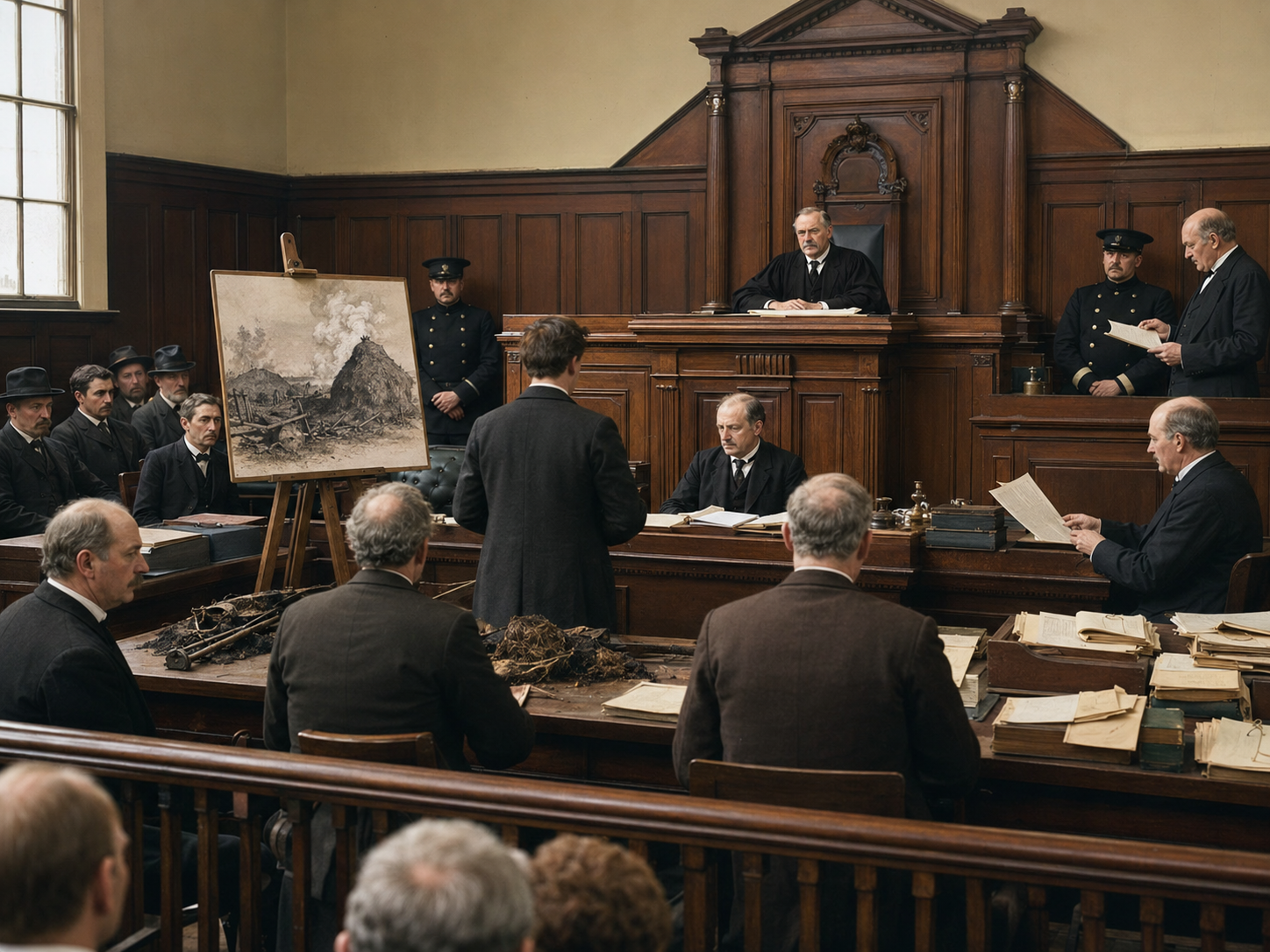
Read Article: Roads ConflictJudge Richard Adams awarded £105 compensation at Limerick County Crown Court for hay maliciously burned at Templebredin on the night of 6 December 1899. The claimant, T. M. English, had sought £116 for the destroyed property and argued that hostility arose from his position during a dispute over the maintenance of public roads. Evidence presented to the court connected the burning with an increasingly bitter campaign for the direct employment of labourers by the newly established local authorities. The case brought a rural employment controversy from council meetings into the formal machinery of criminal injury compensation.
English told the court that he had supported a limited experiment rather than the complete abandonment of road contractors. His proposal was that labourers should maintain half of the main roads for twelve months, allowing the council to compare the expense with the established contracting system. The remaining main roads and smaller roads would continue under contractors. At a district council meeting, however, labourers accompanied by a band and banners reportedly interrupted proceedings, groaned and hooted while English attempted to speak, and allowed one campaigner who was not a council member to address the gathering.
The claimant further alleged that two labourers later attempted to assault him while he was returning from Old Pallas Fair. The destruction of his hay followed soon afterwards, completing what the prosecution presented as an escalation from public obstruction to intimidation and malicious damage. Judge Adams accepted that the crime arose from the direct-labour agitation, though the surviving report does not identify the individuals responsible for setting the fire. His remarks were sharply hostile towards the conduct described in court, and he called for stronger protection of district councils when crowds attempted to disrupt their lawful proceedings.
Adams placed the compensation charge upon County Limerick at large rather than upon the immediate locality. He explained that he would have imposed the burden locally had evidence shown that neighbouring ratepayers supported or assisted the intimidation, but no such proof had been offered. The decision meant that the financial consequence of the burning would be shared through county taxation. It also distinguished ordinary ratepayers and elected councillors from the labourers whom the judge blamed for the agitation, although he criticised the local authorities for what he regarded as timidity in responding to organised pressure.
The case exposed the tensions created by the transfer of road administration to elected county and district councils under the Local Government Act of 1898. Direct labour offered rural workers the prospect of wages controlled through public bodies rather than private contractors, while farmers and ratepayers worried about costs, supervision and political pressure. A related County Council decision permitted roads lacking acceptable tenders to be placed under the county surveyor and worked directly by labourers. The Templebredin burning therefore arose during a wider struggle over employment, local democracy and control of public expenditure in the first years of the new system.
- Irish Times, “The Direct Labour Agitation: Strong Remarks by Judge Adams,” 5 January 1900, p. 2.
- Irish Times, “Limerick County Council and the Roads,” 5 January 1900, p. 3.
- Irish Times, “The Direct Labour Question,” 18 January 1900, p. 6.
- Local Government (Ireland) Act 1898, 61 & 62 Vict., c. 37.
- County Officers and Courts (Ireland) Act 1877, 40 & 41 Vict., c. 56.
-
Kincora Committees
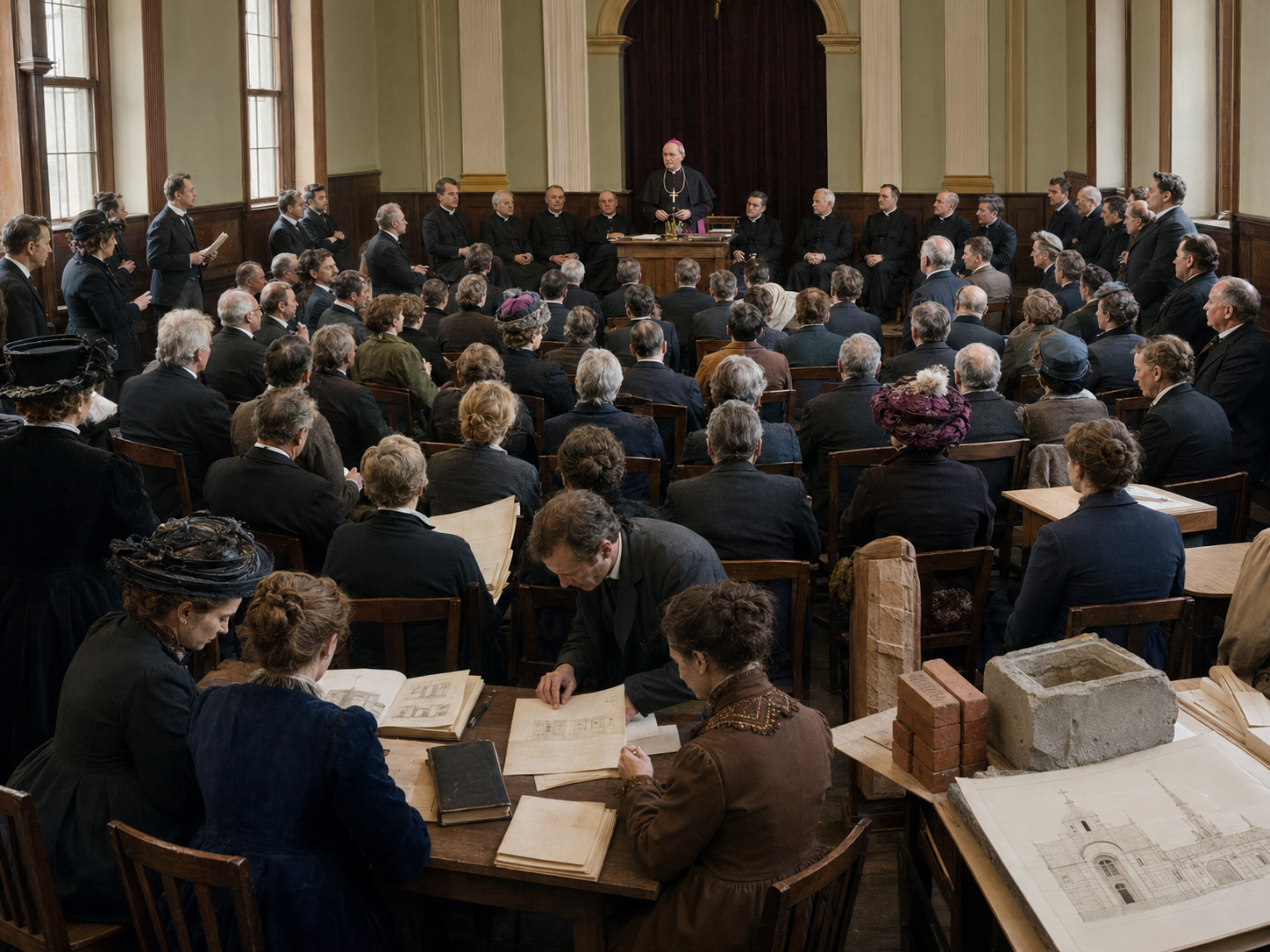
Read Article: Kincora CommitteesA large public meeting assembled in the Lecture Hall of Limerick’s Catholic Institute to organise a fête and fancy fair for the new church of St Joseph then rising within St Michael’s Parish. The gathering, reported on 4 January 1900, was promoted by the parish clergy and presided over by Bishop Edward Thomas O’Dwyer. Clergy, women and men attended in considerable numbers, demonstrating broad interest in completing the additional parochial church. The meeting agreed that the fundraising celebration would take place in June and established committees to undertake the detailed work required before the event could open.
The proposed church was intended to serve the extensive population of St Michael’s, which reached from central Limerick towards Ballinacurra. Bishop O’Dwyer and the parish clergy had decided in 1897 that an auxiliary church was necessary, and a site on Military Road was donated by Mr Byrnes. William Edward Corbett supplied the design, while John Ryan and Sons became the builders. Construction had advanced sufficiently for the organisers to confront the remaining financial burden. The fête was therefore conceived not as a minor parish entertainment but as a major city fundraising effort supporting an important addition to Limerick’s Catholic infrastructure.
The Reverend Father O’Donnell explained that the organisers had first ensured that their plans would not conflict with a proposed hospitals fête. Only after the hospital committees indicated that they would not stage such an event during the year did the parish proceed. June was selected partly to avoid competition with other public attractions and because the celebrated Limerick tenor Joseph O’Mara had offered to keep himself available to assist. Father O’Donnell also welcomed promised support from Protestant citizens, presenting the undertaking as an opportunity for cooperation extending beyond the congregation that would eventually worship in the new church.
Letters supporting the project were received from several people unable to attend, including Count Moore, who offered a prize. The meeting created a number of organising committees charged with preparing the entertainment, stalls, subscriptions, publicity and other arrangements. The celebration was named the Kincora Fête, drawing upon the royal residence traditionally associated with Brian Boru and giving the undertaking a recognisably Irish cultural character. The choice reflected the elaborate themes commonly adopted by large charitable fêtes, which relied upon spectacle, music, performances and carefully decorated attractions to encourage repeated attendance and generate substantial income.
The preparations culminated in the Kincora Fête at the Markets Field in June 1900. Cardinal Michael Logue formally opened the celebration, and a large choir performed under the direction of Vincent O’Riordan. Advertised attractions included the cinematograph, then still a striking novelty for many Irish audiences. The fête proved financially successful and strengthened the fund for St Joseph’s, although construction continued beyond that summer and the church was not formally opened until April 1904. The January meeting had nevertheless created the organisational structure that transformed a parish need into one of Limerick’s largest public fundraising enterprises of the year.
- Freeman’s Journal, “Proposed Fete in June,” 4 January 1900, p. 6.
- St Joseph’s Parish, St Joseph’s Parish: A History, pp. 13–14, account of the decision to build the church, its financing and the Kincora Fête of June 1900.
- Denis Condon, Early Irish Cinema, 1895–1921, Dublin: Irish Academic Press, 2008, pp. 22–23, identifying the cinematograph among the attractions advertised for Limerick’s Kincora Fête, 4–9 June 1900.
- St Joseph’s Parish, “Parish History,” account of the church’s construction as a chapel of ease for St Michael’s Parish, its architect William Edward Corbett and builders John Ryan and Sons.
- Patrick Comerford, “Saint Joseph’s, a Limerick Church that Features in Angela’s Ashes,” 13 January 2018, architectural and historical account of St Joseph’s Church.
-
Sessions Rejected
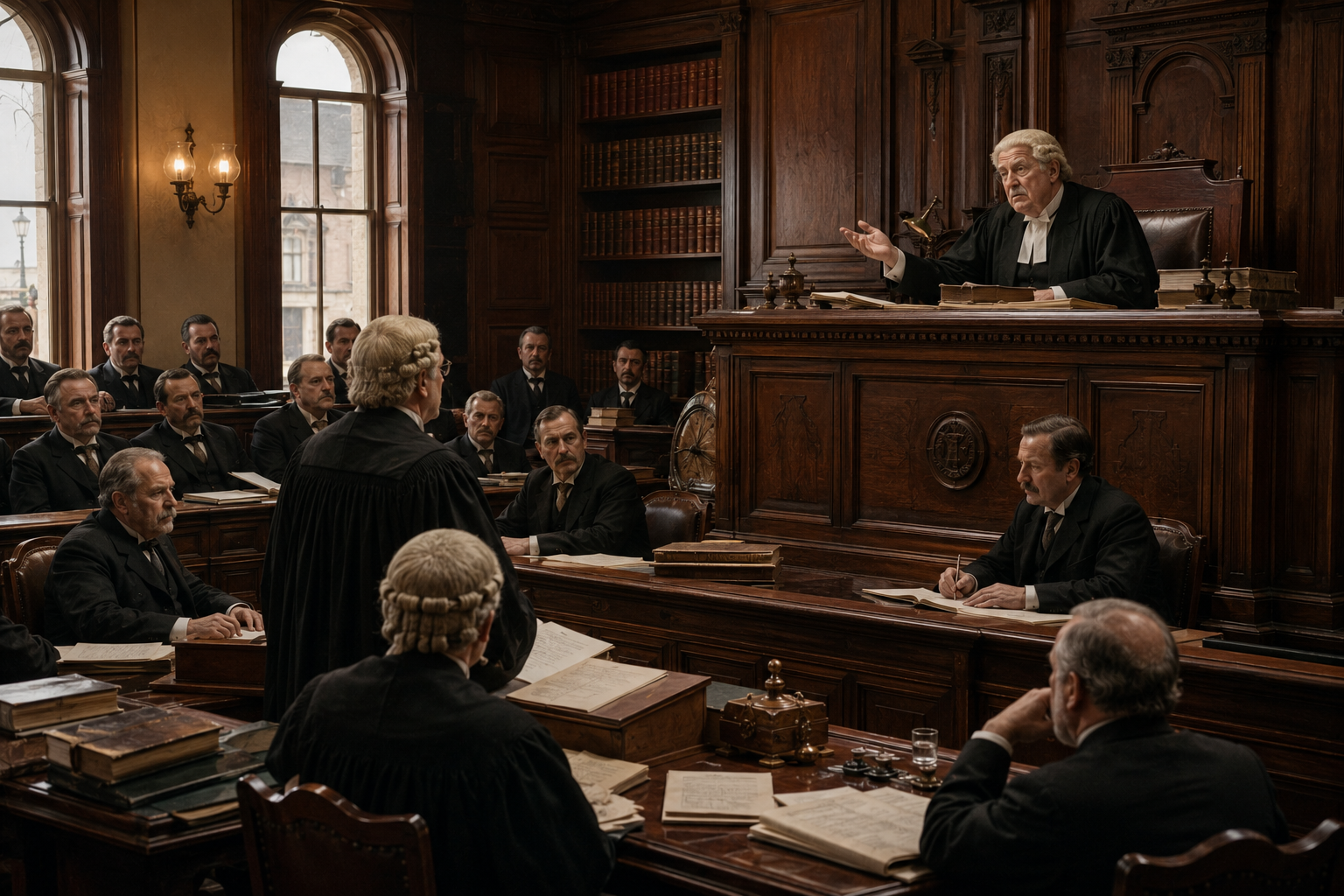
Read Article: Sessions RejectedJudge Richard Adams firmly resisted a proposal to double the number of annual Quarter Sessions held in Limerick from four to eight. At the opening of the Hilary sittings, reported on 3 January 1900, the County Court judge asked whether any members of the legal profession present supported the suggested increase. Receiving no affirmative response, he declared that the demand did not come from local barristers, solicitors or the wider public. Adams presented the proposal as the work of a small deputation seeking attention rather than as a reform arising from demonstrated pressure upon the court.
The Limerick County Court combined civil jurisdiction with the judge’s responsibilities as chairman of Quarter Sessions. These sittings dealt with civil bills and criminal business beyond the lesser matters heard at Petty Sessions, making their frequency important to litigants, witnesses, solicitors and court officials. Four annual sessions followed the traditional quarterly pattern. Supporters of additional sittings could argue that more frequent courts might reduce delays and distribute legal business more evenly, but Adams questioned whether Limerick possessed either the workload or the professional demand necessary to justify doubling the established schedule.
Adams referred sarcastically to efforts made before the Lord Chancellor and contrasted Limerick with Galway, where the Recorder had reportedly agreed to conduct eight sessions annually. His remarks displayed the independence and humour for which he became well known, but they also asserted a serious constitutional position. He maintained that he would not hold more than four sessions unless compelled by legislation. Even if Parliament attempted such a change, he suggested that opposition would be organised in both Houses. The judge therefore treated the proposed reform as an intrusion requiring statutory authority rather than an informal administrative adjustment.
The disagreement mattered directly to Limerick people whose property disputes, debts, compensation claims, tenancy matters and criminal cases entered the County Court system. Additional sessions might have offered earlier hearing dates, yet they would also have required more jurors, officials, legal attendance and public expenditure. The absence of support voiced by the professionals present strengthened Adams’s contention that the existing arrangement remained adequate. His response also exposed tension between local judicial experience and reform campaigns conducted through deputations to Dublin, where the Lord Chancellor exercised considerable influence over Irish court administration.
No immediate increase followed the confrontation, and the four-session arrangement remained the position defended by Adams. The episode offers a revealing picture of Limerick’s legal world at the beginning of the twentieth century: a powerful local judge, a courtroom attentive to public controversy and a central administration attempting to consider changes across different Irish towns. Adams’s refusal was characteristically outspoken, but it rested upon his claim that reform should answer a genuine public or professional need. Until Parliament directed otherwise, he intended to preserve the established rhythm of justice in Limerick.
- Munster News, “Limerick Quarter Sessions: ‘Soldiers of the Queen’—An Epidemic of Window Breaking,” 3 January 1900; page not confirmed.
- National Archives of Ireland, Court Records Pre-1922, Courts of Crown and Peace, finding aids and records relating to Quarter Sessions and County Courts.
- County Officers and Courts (Ireland) Act 1877, 40 & 41 Vict., c. 56, governing County Court judges, Quarter Sessions and Civil Bill Courts in Ireland.
- Cork Examiner, 6 April 1908, obituary and career appreciation of Limerick County Court Judge Richard Adams.
-
Garrison Announced
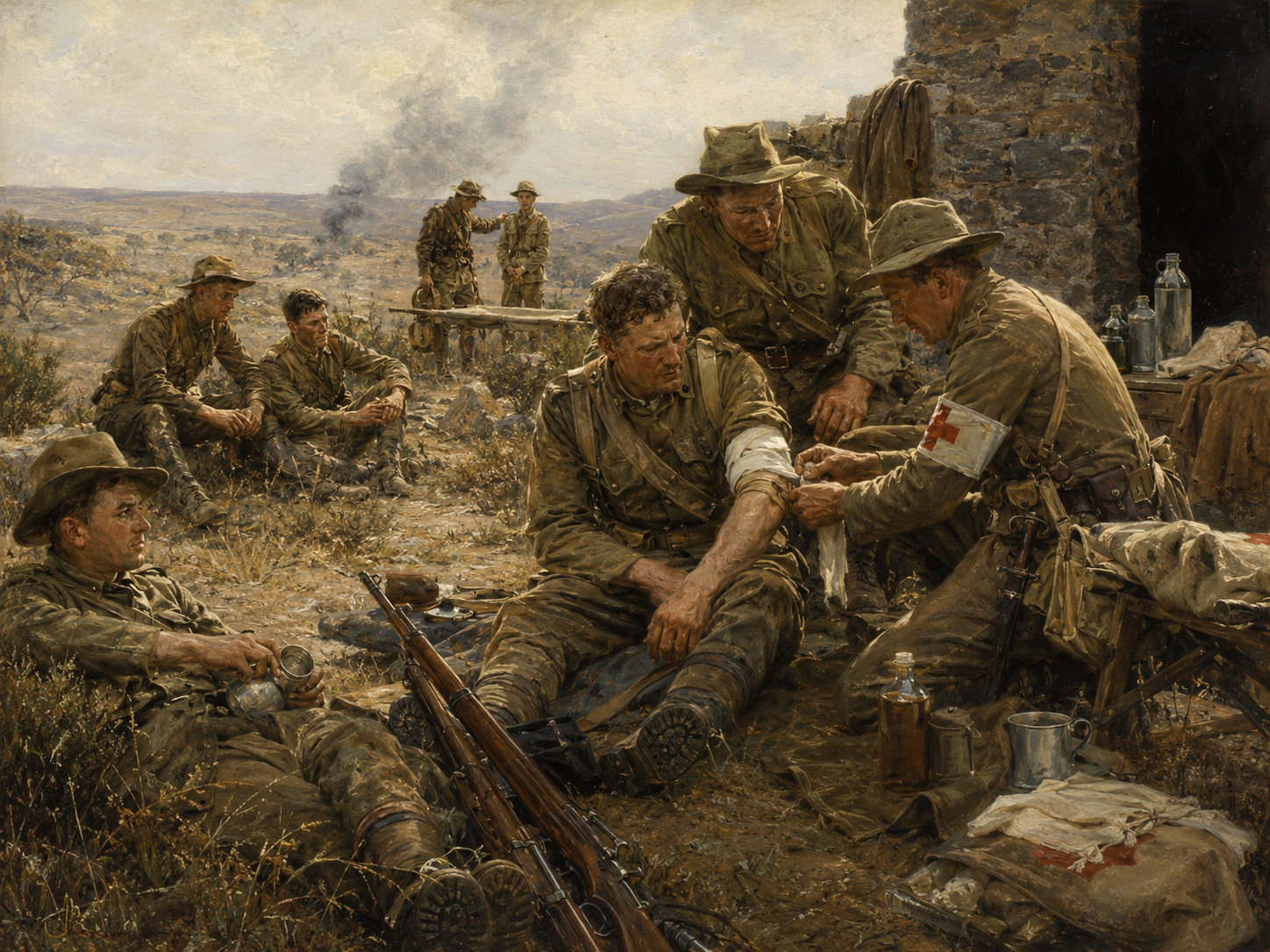
Read Article: Garrison AnnouncedA new military garrison was announced for Limerick on 2 January 1900, although the arrangement proved provisional. Contemporary reports stated that the 3rd Battalion, Oxfordshire Light Infantry, formerly the Royal Bucks Militia, would be embodied at High Wycombe and sent to Limerick for garrison duty during the South African War. The announcement also noted that the home details left behind by the regiment’s 1st Battalion, which had departed Aldershot for active service, had already reached the city. Within days, however, the proposed destination was altered, and the militia battalion was directed to Buttevant rather than Limerick.
The 3rd Battalion was not a regular-service formation but a militia unit attached to the Oxfordshire Light Infantry under the army reforms of 1881. Its older identity as the Royal Buckinghamshire Militia remained widely used, reflecting a history and recruiting base centred upon High Wycombe. Militia battalions were ordinarily raised for domestic defence, training and reinforcement rather than permanent overseas campaigning. The war in South Africa placed exceptional pressure upon the British Army, however, requiring auxiliary forces to assume duties at home and in Ireland while regular battalions were concentrated for service against the Boer republics.
For Limerick, the announcement demonstrated how a distant imperial war was reshaping the city’s military establishment. Barracks, railway facilities, supply arrangements and local services were required to accommodate troops passing through or replacing units dispatched overseas. The arrival of the Oxfordshire Light Infantry’s remaining details connected Limerick directly with a regiment preparing for active operations in South Africa. Soldiers stationed locally also affected civilian life through spending, transport requirements, discipline cases and relationships with employers and public institutions. Even an intended posting that was later changed required planning by military authorities and alerted the city to further wartime movements.
The revised order sent the Royal Bucks militiamen to Buttevant, County Cork, where they arrived after embodiment in January and joined a substantial concentration of auxiliary troops. They later trained at Kilworth before returning to Buttevant. During their service in Ireland, the battalion helped release regular soldiers for the war and supplied volunteers and reinforcement drafts to the 1st Oxfordshire Light Infantry in South Africa. The change of destination illustrates the speed with which War Office arrangements were revised during the early months of the conflict, when troop shortages and transport demands repeatedly altered previously announced plans.
Although the battalion itself did not take up the announced Limerick station, the episode remains significant within the city’s wartime history. It records Limerick’s place within the network of Irish garrisons used to sustain Britain’s overseas campaign and shows how regular and militia formations were redistributed to meet an emergency. The distinction between announcement and fulfilment is important: the Royal Bucks Militia was assigned publicly to Limerick, but the order was superseded before the battalion arrived. Limerick nevertheless received regimental personnel and remained affected by the broader movement of soldiers, reservists and military resources caused by the South African War.
- Irish Times, 2 January 1900, contemporary military report announcing the intended assignment of the 3rd Battalion, Oxfordshire Light Infantry, Royal Bucks Militia, to Limerick; page not confirmed.
- Daily Telegraph & Courier (London), 9 January 1900, report that the Royal Bucks Militia, previously intended for Limerick, would instead be stationed at Buttevant.
- Ian F. W. Beckett, Buckinghamshire: A Military History, Chapter Seven, “1899–1914,” Buckinghamshire Military Museum Trust, account of the battalion’s embodiment at High Wycombe on 17 January 1900 and subsequent service at Buttevant and Kilworth.
- The New Annual Army List, Militia List, and Yeomanry Cavalry List for 1900, entry for the Oxfordshire Light Infantry and its 3rd Battalion, Royal Bucks Militia.
- H. W. Base, The Regimental Records of the British Army, London: George Bell and Sons, 1901, entry for the Oxfordshire Light Infantry identifying the 3rd Battalion as the Royal Bucks Militia.
- War Office, Distribution of the British Army, May 1900, listing the 3rd Battalion, Oxfordshire Light Infantry, Royal Buckinghamshire Militia, as stationed in Ireland.
- House of Commons Debates, Army Supplementary Estimates, 1899–1900, 15 February 1900, vol. 79, discussion of militia mobilisation and the replacement of regular forces sent to South Africa.
-
Shannon Defence
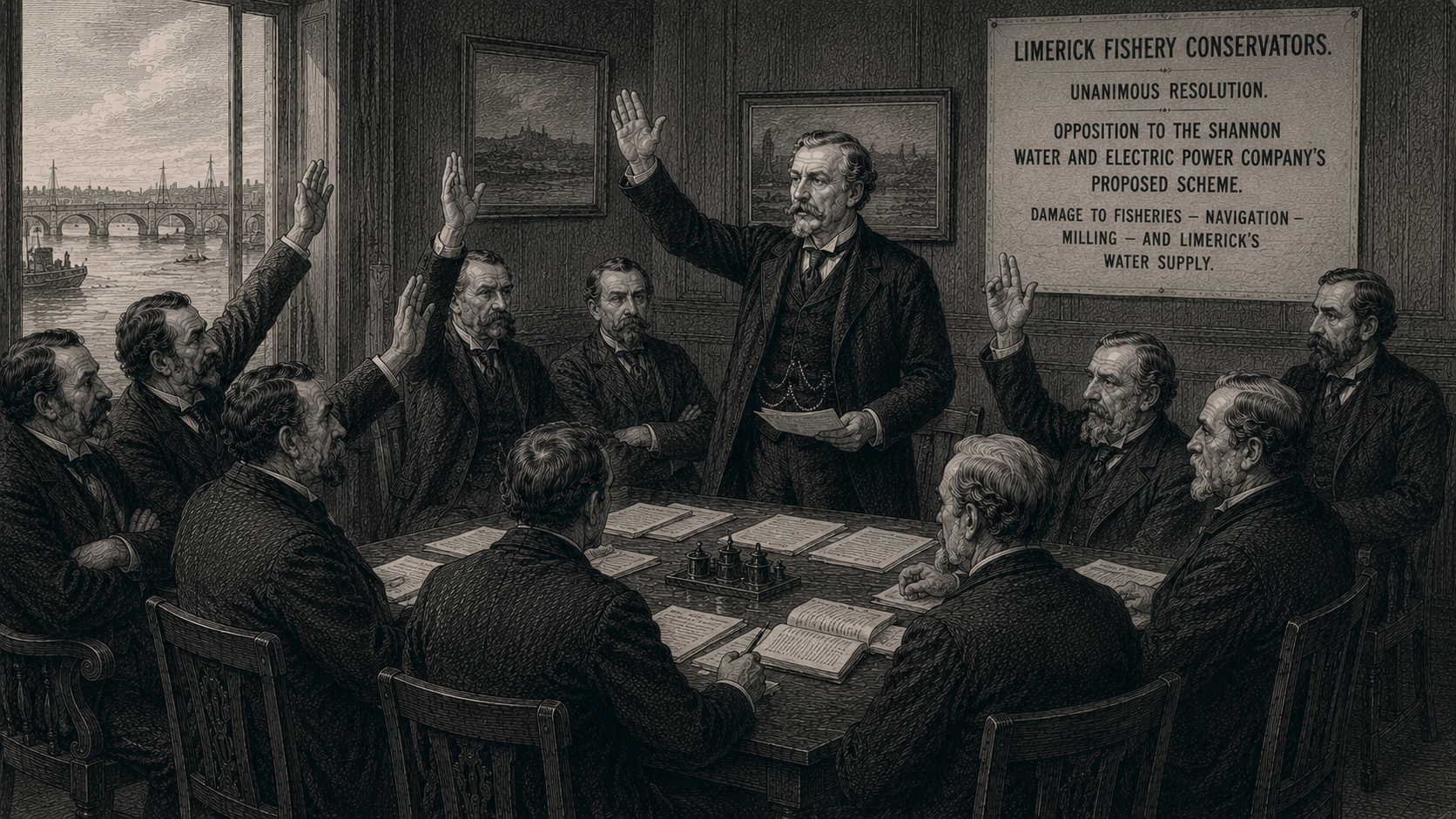
Read Article: Shannon DefenceOn 2 January 1900, the Limerick Fishery Conservators unanimously opposed the scheme promoted by the Shannon Water and Electric Power Company. Meeting under Lord Massy’s chairmanship, the members viewed the proposed parliamentary bill as a direct threat to interests dependent upon the river. Their objections extended beyond salmon fishing to navigation, milling and the public water supply of Limerick. The Conservators feared that private promoters seeking to harness the Shannon for electricity might secure broad powers before the consequences for existing river users had been fully investigated or adequately protected.
The company proposed to employ Shannon water for generating electrical power near Limerick, presenting the undertaking as a means of reducing industrial dependence upon costly imported coal. Parliamentary descriptions later placed the principal generating works at Clonlara and envisaged supplying electricity to factories, mills, tramways, public authorities and other consumers within a wide surrounding district. Supporters argued that unused water power could encourage manufacturing and employment. The Conservators did not reject electricity itself, but questioned whether the promised economic benefits justified altering water levels and flows upon which fisheries, transport, businesses and communities already relied.
Fishery representatives warned that changes to the river and Lough Derg could obstruct salmon moving towards tributaries and spawning grounds. Members also feared that a substantial lowering of water levels would damage quays, interfere with navigation and reduce the supply available to mills and factories below the lake. Limerick’s municipal water arrangements created a further concern, since any alteration affecting the river near the city’s intake could carry serious public consequences. The objections reflected the Shannon’s multiple roles as a fishery, navigable route, industrial resource and source of water rather than treating it merely as potential electrical power.
The Conservators resolved to bring their opposition before the Chief Secretary for Ireland and the Commissioners of Public Works, whose responsibilities included Shannon navigation and drainage. Copies were also to be sent to Limerick Corporation, parliamentary representatives and local authorities throughout counties connected with the river system. The Board of Works indicated that it would protect its statutory interests, while warning that other affected parties might need to act independently. This response reinforced the Conservators’ belief that fishery owners, millers, riparian proprietors, navigational users and municipal authorities required a coordinated campaign if their separate interests were to receive effective parliamentary protection.
The opposition did not immediately defeat the promoters. The bill proceeded through Parliament, where critics again warned of possible injury to fisheries and navigation, while supporters claimed that safeguards would preserve sufficient river flow. The Shannon Water and Electric Power Act received royal assent in July 1901, although the projected works were not completed and the private scheme was eventually abandoned. The Conservators’ unanimous stand nevertheless marked an important early Limerick dispute over hydroelectric development. It revealed the difficult balance between industrial ambition and the protection of a river already sustaining employment, food, transport, milling and public services.
- Irish Times, “Shannon Water and Electric Power Company,” 2 January 1900, p. 7.
- Irish Times, “Limerick Fishery Conservators: The Shannon Water and Electric Power Bill,” 5 January 1900, p. 3.
- Irish Times, editorial concerning the Shannon Water and Electric Power proposal, 6 January 1900, p. 4.
- Irish Times, “News from the Provinces: Shannon Water and Electric Power Syndicate,” 18 January 1900, p. 6.
- Limerick Fishery Board of Conservators Collection, IE LA P48, Limerick Archives.
- House of Lords Debates, “Shannon Water and Electric Power Bill,” 23 July 1900, vol. 86.
- Shannon Water and Electric Power Act 1901, 1 Edw. 7, c. cxxxvi, royal assent 26 July 1901.
- Commissioners of Public Works correspondence concerning the Shannon Water and Electric Power Bill, quoted at the Limerick Fishery Conservators’ meeting and reported in the Irish Times, 5 January 1900, p. 3.
-
Railway Resistance
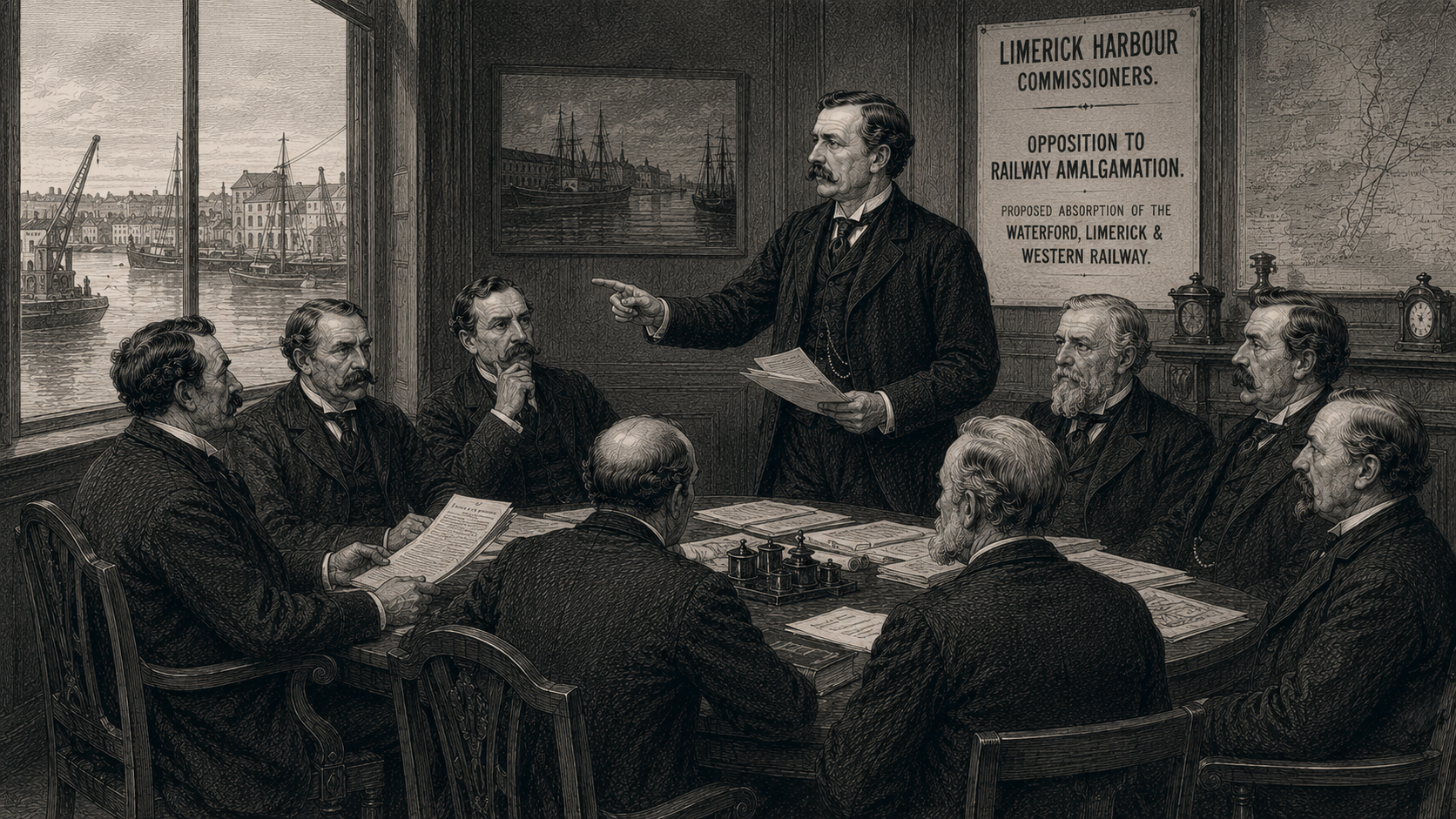
Read Article: Railway ResistanceOn 2 January 1900, the Freeman’s Journal reported that the Limerick Harbour Commissioners had again engaged Mr Fottrell, a Dublin solicitor, to organise opposition to the renewed railway amalgamation scheme. He was also instructed to retain senior counsel on the Commissioners’ behalf. The proposed arrangement would absorb the Waterford, Limerick and Western Railway into the larger Great Southern and Western Railway system. By appointing legal representatives before the parliamentary contest developed further, the Harbour Commissioners signalled that they regarded the scheme not as a private commercial transaction, but as a matter affecting the future prosperity of Limerick and its port.
The Waterford, Limerick and Western Railway provided a direct commercial artery between the Shannon and the south-east, while its branches connected Limerick with important agricultural and trading districts across the west. Opponents feared that amalgamation would remove one of the few substantial competitors to the Great Southern and Western Railway. Parliamentary debate had already highlighted the reductions in freight charges produced by competition on routes serving Limerick, Tuam, Thurles, Tralee and the Fergus district. Harbour interests consequently worried that a dominant railway company might increase rates, redirect traffic or favour routes and ports better suited to its wider corporate strategy.
The Commissioners’ intervention reflected the close relationship between rail transport and the working life of Limerick Harbour. Grain, livestock, provisions, coal and manufactured goods depended upon reliable connections between the docks, merchants, inland producers and distant markets. A railway monopoly could influence not only the price of carriage but the volume and direction of trade reaching the quays. Local merchants and public representatives therefore viewed railway competition as protection for employment, shipping and commercial independence. Their opposition was shared by other Limerick bodies, including the Corporation and County Council, although individual businessmen and commissioners differed over the merits of the proposed sale.
Retaining a Dublin solicitor and senior counsel transformed local resistance into an organised parliamentary campaign. The Commissioners required legal advice, statistical evidence and representation capable of challenging a private bill promoted at Westminster. Their expenditure later became controversial when the Irish Board of Works warned them against incurring further costs without authority. On 8 March 1900, Patrick O’Brien raised the matter in the House of Commons, arguing that the Harbour Commissioners should remain free to oppose legislation affecting Limerick. The Treasury acknowledged that their finances had recently been kept within revenue, while maintaining that the legality of the expenditure remained relevant.
The opposition ultimately failed to prevent amalgamation. Parliament passed the Great Southern and Western and Waterford, Limerick and Western Railways Amalgamation Act in August 1900, and the smaller company lost its independent existence at the beginning of 1901. The Harbour Commissioners’ decision nevertheless demonstrated how seriously Limerick regarded the danger of railway concentration. Their campaign joined commercial self-interest with a broader defence of competition across southern and western Ireland. By retaining legal specialists at the outset, the board ensured that the city’s concerns about freight charges, harbour traffic and economic dependence would be formally presented during the parliamentary struggle.
- Freeman’s Journal, “The Railway Amalgamation Proposals: Action of Limerick Harbour Commissioners,” 2 January 1900, p. 6.
- Limerick Harbour Commissioners Collection, IE LA P2, Board and Secretary records, including minute books P2/1/1–28, Limerick Archives.
- House of Commons Debates, “Irish Railway Amalgamation—Limerick Harbour Commissioners,” 8 March 1900, vol. 80.
- House of Commons Debates, “Great Southern and Western and Waterford, Limerick, and Western Railway Companies Amalgamation Bill,” 1 August 1900, vol. 87.
- Reports from the Joint Select Committee on the Great Southern and Western and Waterford, Limerick, and Western Railway Companies Amalgamation Bill, Parliamentary Papers, 1900, paper 196, vol. X, p. 19.
- Great Southern and Western and Waterford, Limerick and Western Railways Amalgamation Act 1900, 63 & 64 Vict., c. ccxlvii.
- Irish Times, “Limerick Corporation Railway Amalgamation Question,” 24 January 1900, p. 3.
- Irish Times, “Southern Railway Amalgamation Scheme,” 29 January 1900, p. 6; 30 January 1900, p. 7.
-
Branches Demand
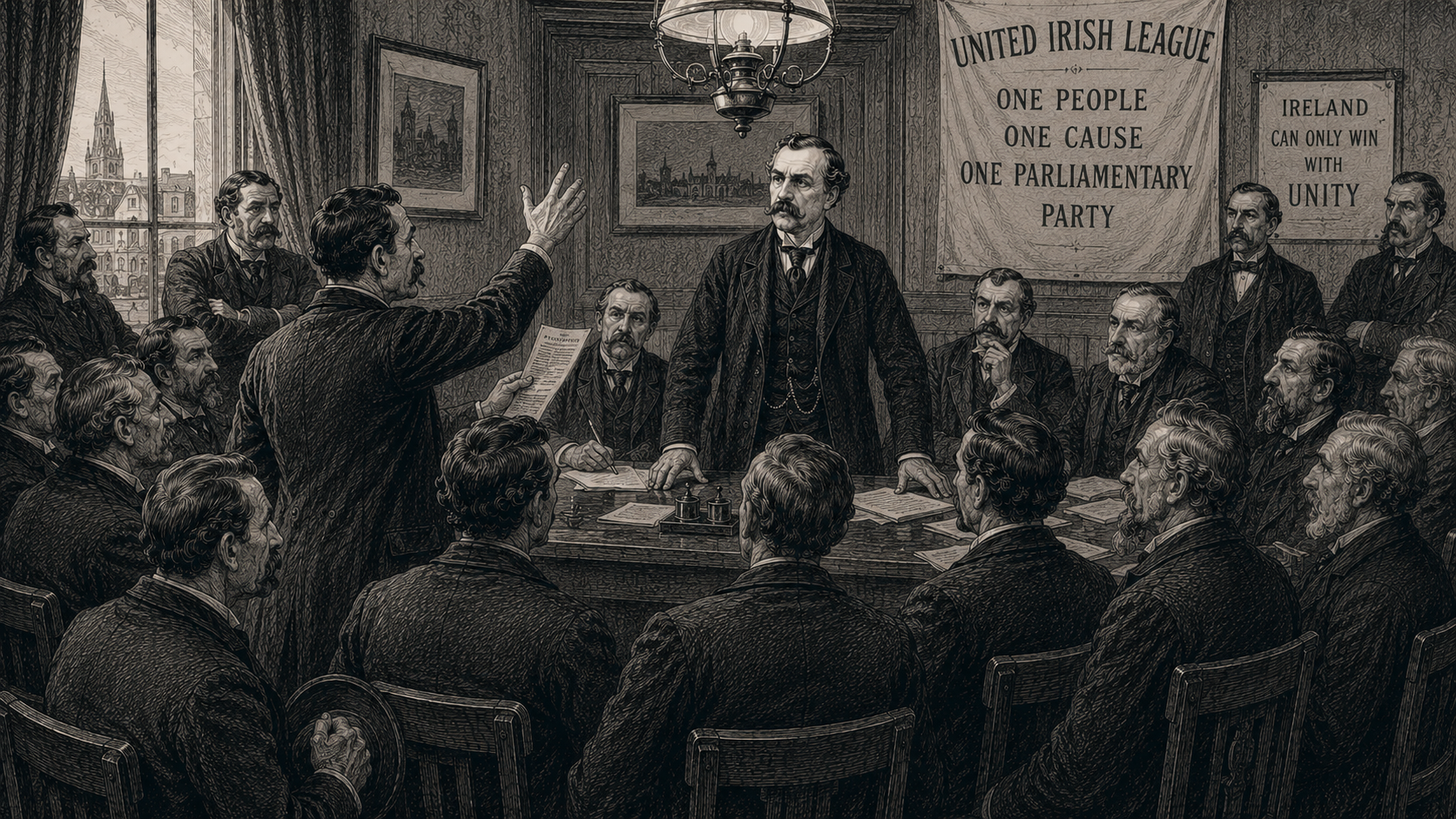
Read Article: Branches DemandUnited Irish League branches pressed nationalist MPs to place national unity above personal disagreement as the organisation expanded during 1899. Founded at Westport in January 1898, the League combined agrarian agitation with a campaign to reconstruct the divided parliamentary movement. Local meetings and resolutions allowed tenant farmers, organisers and constituency workers to express impatience with leaders whose rivalries had weakened Irish representation since the fall of Charles Stewart Parnell. Branches possessed no constitutional power to command MPs, but their subscriptions, electoral labour and influence over candidate selection gave their appeals a force that Westminster politicians could not safely dismiss.
The demand for reunion was directed towards several competing groups. John Redmond led the principal Parnellite body, John Dillon dominated much of the anti-Parnellite majority, and Timothy Healy retained an independent following shaped by localism and personal hostility towards former allies. William O’Brien used the United Irish League to argue that these distinctions had become less important than the need for an effective national organisation. Resolutions favouring unity placed moral and electoral pressure upon representatives to accept common discipline. They also warned that members who prolonged factional conflict might face opposition from candidates supported by the growing network of League branches.
The branch campaign joined political unity to the practical needs of rural Ireland. League supporters demanded enlarged holdings, restoration of evicted tenants and stronger action against the concentration of grazing land, but such objectives required coordinated parliamentary pressure. A divided group of Irish MPs could be ignored, outmanoeuvred or courted separately by British parties. Local resolutions therefore treated reunion not as an act of personal forgiveness, but as the necessary machinery through which land reform and Home Rule might be pursued. The movement’s strength rested upon its ability to turn dissatisfaction in villages and market towns into instructions addressed directly to elected representatives.
The argument had a defensible connection to Limerick, where political participation broadened significantly during the first local elections held under the Local Government (Ireland) Act of 1898. Limerick City’s municipal electorate rose from 709 to 5,521, while elected county and rural bodies replaced institutions previously dominated by property and appointment. The surviving evidence does not establish which Limerick League branches passed particular reunion resolutions during this campaign. Nevertheless, nationalist MPs representing the city and county operated within a political culture increasingly shaped by organised voters who expected land, housing, public works and Home Rule to receive disciplined parliamentary representation.
The accumulated pressure helped bring the rival parliamentary sections together in Committee Room 15 at Westminster on 30 January 1900. John Redmond became chairman of the reunited Irish Parliamentary Party, although the agreement did not remove the tensions among Redmond, Dillon, Healy and O’Brien. League branches had succeeded in making continued division politically dangerous, but reunion opened another dispute over whether authority belonged primarily to MPs or to the organisation sustaining them in the constituencies. The settlement restored outward unity and coordinated representation, while confirming that local branches and ordinary supporters had become active participants in determining the direction of constitutional nationalism.
- Freeman’s Journal, 18 April 1899.
- Freeman’s Journal, 6 May 1899.
- Freeman’s Journal, 20 May 1899.
- Freeman’s Journal, 22 May 1899.
- Freeman’s Journal, 3 August 1899.
- Mayo News, 15 April 1899.
- The Times, 12 April 1899.
- Michael Davitt to William O’Brien, 6 April 1899, National Library of Ireland, MS 913, ff. 621–623.
- McInerney to William O’Brien, 3 and 6 May 1899, William O’Brien Papers, University College Cork, AJB.9 and AJB.11.
- John Dillon to William O’Brien, 1 June 1899, National Library of Ireland, MS 8555/11.
- T. P. O’Connor to John Dillon, 18 September 1899, John Dillon Papers, Trinity College Dublin, MS 6740/56.
- Philip Bull, “The United Irish League and the Reunion of the Irish Parliamentary Party, 1898–1900,” Irish Historical Studies, vol. 26, no. 101, May 1988, pp. 51–78.
- Local Government (Ireland) Act 1898, 61 & 62 Vict., c. 37.
- Martin Walsh, Limerick Local Government 1899–1942: An Online Exhibition Commemorating the 125th Anniversary of the Local Elections, 1899, Limerick Museum and Limerick Library Service, 2024.
-
Unity Resolutions
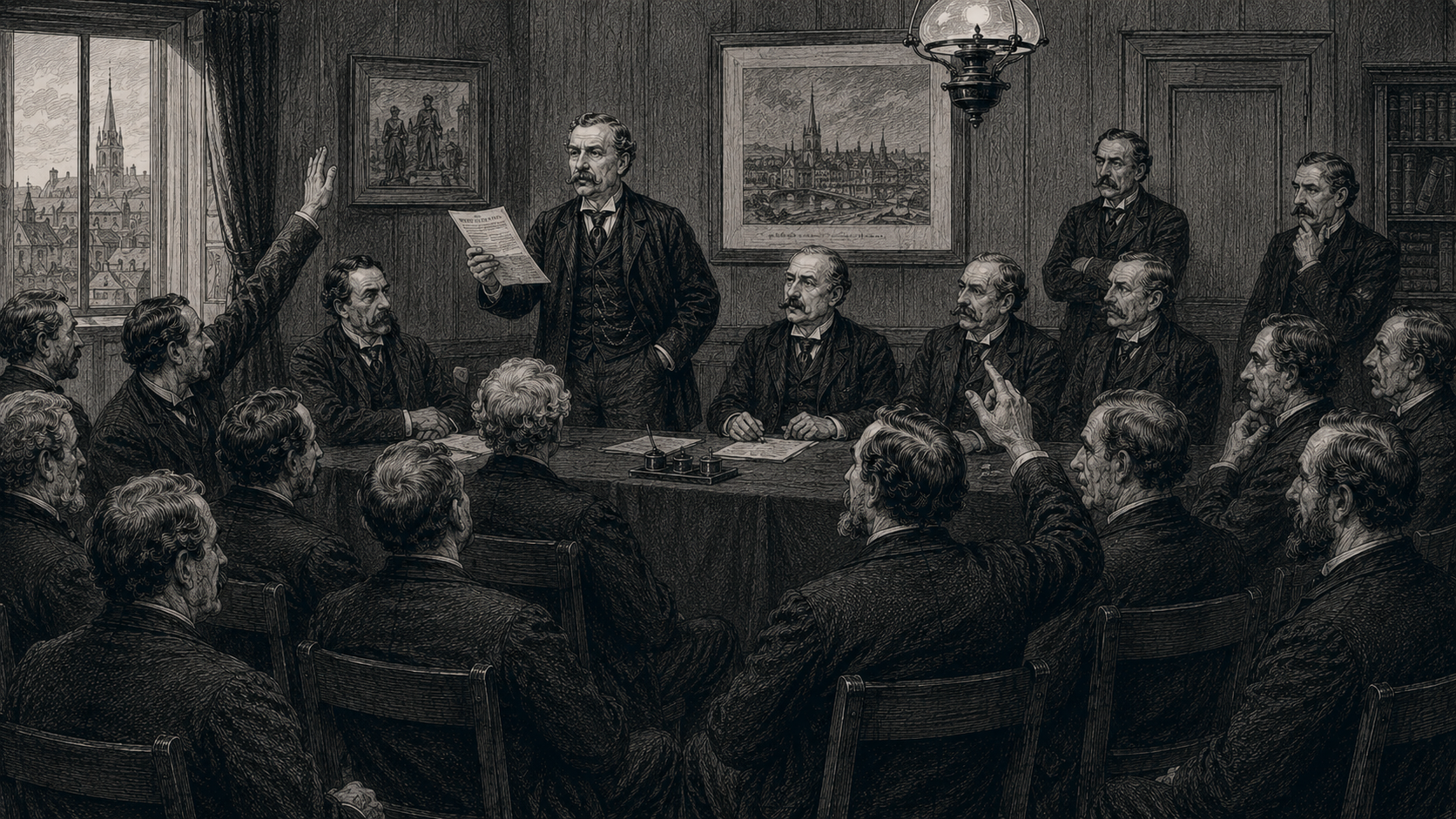
Read Article: Unity ResolutionsLocal political organisations passed resolutions supporting a united Irish parliamentary representation as dissatisfaction deepened with the factional divisions inherited from the fall of Charles Stewart Parnell. United Irish League branches, nationalist associations and constituency bodies increasingly treated reunion as a public obligation rather than a private matter for rival leaders. Their resolutions urged parliamentarians to restore cooperation, accept common discipline and present Ireland’s claims through one organised party at Westminster. Such declarations did not possess formal authority over every MP, but they demonstrated that continued separation risked alienating local supporters whose votes, subscriptions and organisational labour sustained constitutional nationalism.
The campaign gathered force during 1899 as William O’Brien’s United Irish League expanded beyond its western base. Its organisers connected agrarian demands with the reconstruction of national political representation, arguing that land reform and Home Rule required coordinated parliamentary pressure. Meetings gave local activists an opportunity to condemn factional quarrels and instruct representatives to place unity above personal allegiance. Contemporary newspapers recorded repeated public appeals for reconciliation, while correspondence among nationalist leaders reveals their awareness that organised opinion was becoming difficult to disregard. The resolutions helped convert reunion from an abstract hope into a practical test of whether MPs remained answerable to their constituencies.
Local declarations also carried an electoral warning. The approaching general election raised questions about candidates, campaign funds and the possibility that divided nationalist groups might oppose one another in constituencies otherwise secure from unionist competition. A resolution favouring united representation could therefore signal that electors expected one agreed candidate and disciplined voting at Westminster. Established MPs understood that the United Irish League might support challengers where sitting members resisted reunion. The language of harmony consequently concealed a struggle over political authority: local organisations demanded unity, but they also asserted their right to influence who represented the nationalist cause and upon what conditions.
The issue had clear relevance in Limerick, where the first elections under the Local Government (Ireland) Act of 1898 had widened participation in county, urban and rural administration. The surviving evidence does not justify attributing a particular reunion resolution to every Limerick organisation, yet local nationalists operated within the same expanding culture of meetings, resolutions and representative politics. The city and county returned nationalist MPs whose effectiveness depended upon cooperation with colleagues from elsewhere in Ireland. Land purchase, labourers’ housing, public works, local finance and Home Rule all strengthened the practical argument that Limerick interests required a coordinated parliamentary body rather than competing factions.
The accumulating pressure contributed to the formal reunion of the parliamentary sections in January 1900. John Redmond became chairman of the restored Irish Parliamentary Party, while John Dillon, Timothy Healy, William O’Brien and their followers entered a common organisation without abandoning every disagreement. Local resolutions had not settled questions of leadership, finance or control of the United Irish League, but they had helped establish the political cost of continued division. Reunion consequently reflected more than negotiation among prominent men. It also represented the influence of branches, constituency workers and local electors who insisted that Ireland’s representation at Westminster should act collectively if it expected to retain national confidence.
- Freeman’s Journal, 18 April 1899.
- Freeman’s Journal, 6 May 1899.
- Freeman’s Journal, 20 May 1899.
- Freeman’s Journal, 22 May 1899.
- Freeman’s Journal, 3 August 1899.
- Freeman’s Journal, 8 August 1899.
- Mayo News, 21 January 1899.
- Mayo News, 15 April 1899.
- Mayo News, 27 January 1900.
- The Times, 17 January 1900.
- The Times, 31 January 1900.
- Philip Bull, “The United Irish League and the Reunion of the Irish Parliamentary Party, 1898–1900,” Irish Historical Studies, vol. 26, no. 101, May 1988, pp. 51–78.
- F. S. L. Lyons, The Irish Parliamentary Party, 1890–1910, London: Faber and Faber, 1951, pp. 75–89.
- Local Government (Ireland) Act 1898, 61 & 62 Vict., c. 37.
-
Editorial Pressure
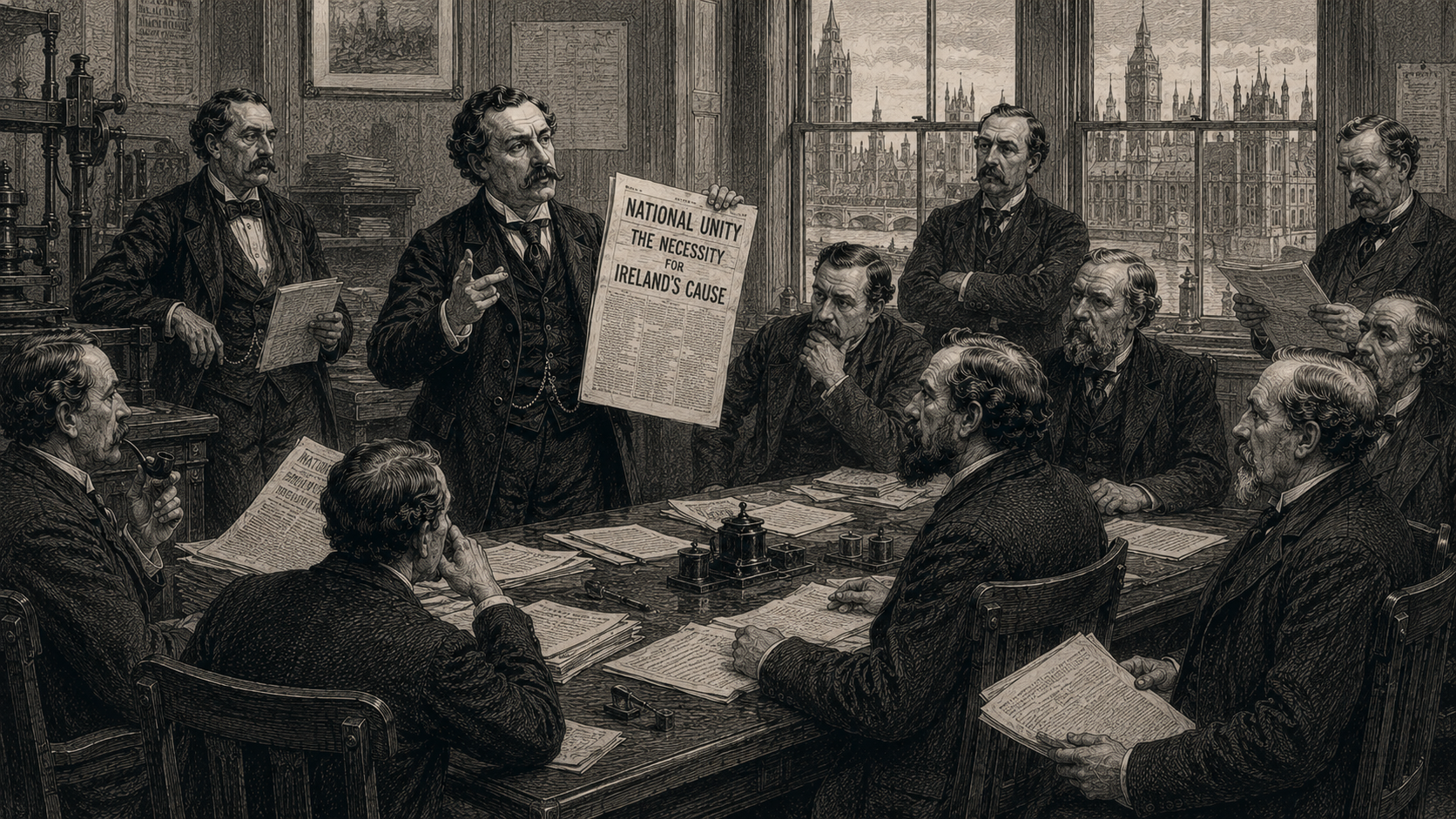
Read Article: Editorial PressureNationalist newspapers increasingly presented reunion as a political necessity if Ireland was to recover influence at Westminster. Nearly ten years of division had left the parliamentary movement broken into Parnellite, Dillonite and Healyite groupings, each claiming to represent the national cause while weakening the collective strength of Irish MPs. Editorial argument did not always conceal sympathy for particular leaders, but a common warning became difficult to ignore: a divided party could neither discipline its members nor exploit opportunities created by close divisions in the House of Commons. Unity was therefore described less as reconciliation between personalities than as an instrument of national effectiveness.
The Freeman’s Journal occupied an especially important position because it had long been associated with constitutional nationalism and had become aligned with the anti-Parnellite majority after the split. Its treatment of reunion was complicated by Thomas Sexton’s influence and the continuing rivalry between John Dillon and Timothy Healy, yet the newspaper remained a major forum in which the movement’s weakness was examined. Other nationalist titles, including William O’Brien’s Irish People and the Mayo News, reflected the growing strength of the United Irish League. Their coverage helped turn parliamentary reunion from a private negotiation among MPs into a public test of political responsibility.
The argument rested upon Westminster arithmetic. Irish nationalist MPs could exert pressure only when they acted together, voted under discipline and negotiated as a recognisable parliamentary force. Continued factional rivalry allowed British governments and opposition leaders to discount demands for Home Rule, land reform and administrative change. Newspaper readers were repeatedly reminded that public meetings and constituency organisation would have limited value if the men elected to Parliament remained divided. Reunion promised a single leadership, coordinated voting and greater bargaining power, though editors differed over whether the restored party should be controlled by its MPs, the United Irish League or organised nationalist opinion throughout Ireland.
For readers in Limerick, the question was directly connected to representation for the city and county at Westminster. Limerick City, East Limerick and West Limerick each returned nationalist members, but their effectiveness depended upon cooperation with colleagues from across Ireland. Land purchase, tenant security, labourers’ housing, local government and Home Rule could not be advanced by isolated representatives acting through competing factions. National newspapers carried these debates into local homes, reading rooms, railway stations and political branches. The surviving evidence does not justify attributing one uniform opinion to every Limerick reader, but the practical case for united parliamentary action was readily understood.
Press advocacy helped create the atmosphere in which the factions met in Committee Room 15 on 30 January 1900 and formally restored a united Irish Parliamentary Party. John Redmond’s election as chairman gave the movement a recognised public leader, while John Dillon, Timothy Healy, William O’Brien and their followers entered an organisation whose unity remained dependent upon compromise. Newspapers could celebrate the recovery of parliamentary strength, but they could not remove the mistrust accumulated since 1890. Reunion nevertheless allowed nationalist Ireland to approach the coming general election with coordinated candidates and a stronger claim to speak at Westminster through one disciplined parliamentary body.
- Freeman’s Journal, 6 May 1899.
- Freeman’s Journal, 20 May 1899.
- Freeman’s Journal, 3 August 1899.
- Freeman’s Journal, 8 August 1899.
- Mayo News, 27 January 1900.
- The Times, 31 January 1900.
- Mayo News, 3 February 1900.
- W. H. Brayden to William O’Brien, 5 February 1900, William O’Brien Papers, University College Cork, AKA.74.
- Philip Bull, “The United Irish League and the Reunion of the Irish Parliamentary Party, 1898–1900,” Irish Historical Studies, vol. 26, no. 101, May 1988, pp. 51–78.
- F. S. L. Lyons, The Irish Parliamentary Party, 1890–1910, London: Faber and Faber, 1951, pp. 79–89.
-
Factional Shadows
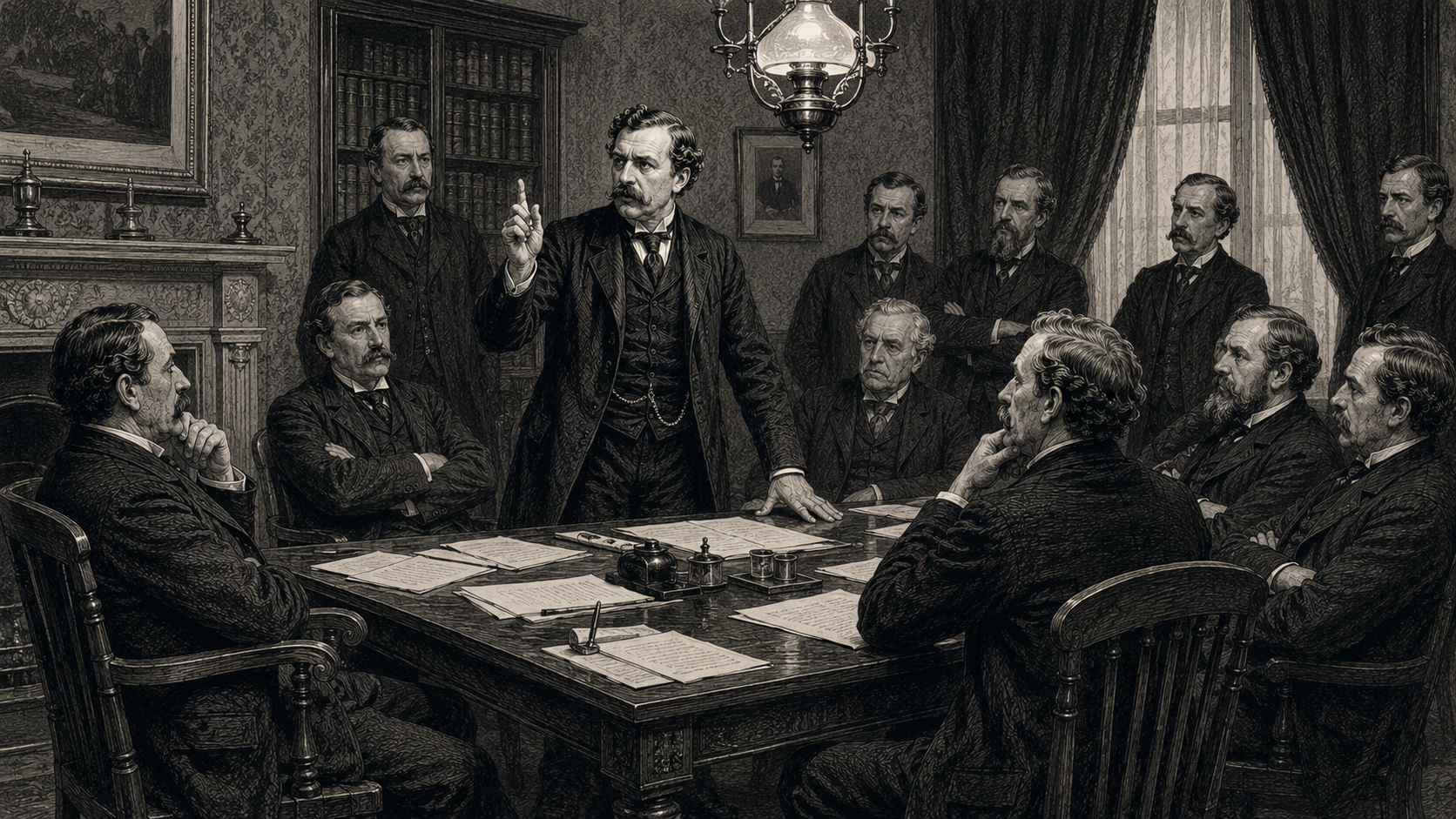
Read Article: Factional ShadowsThe legacy of the Parnell split continued to shape personal rivalries within Irish nationalism nearly a decade after the parliamentary rupture of December 1890. Charles Stewart Parnell’s refusal to surrender the party leadership during the crisis created by the O’Shea divorce case divided former colleagues into Parnellite and anti-Parnellite camps. Political disagreement quickly became entangled with questions of loyalty, honour and betrayal. Parnell’s death in October 1891 removed the central figure but did not settle the quarrel. Memories of who had defended him, abandoned him or challenged his authority remained powerful within parliamentary groups, newspapers, constituency organisations and personal relationships.
John Redmond inherited leadership of the Parnellite minority and presented himself as the guardian of Parnell’s political tradition. John Dillon became one of the strongest figures among the anti-Parnellites, while Timothy Healy, although an opponent of Parnell during the crisis, increasingly pursued an independent course and quarrelled bitterly with former allies. William O’Brien moved between these competing personalities while attempting to rebuild organisation through the United Irish League. Their disputes concerned Home Rule, land reform, party discipline, candidate selection and political strategy, but the language and emotional force of the arguments repeatedly returned to the unresolved wounds of the split.
The United Irish League, founded in 1898, placed new pressure upon leaders whose personal hostility had weakened nationalist representation at Westminster. O’Brien’s organisation mobilised tenant farmers, local activists and constituency branches around agrarian reform and political reunion. Sitting MPs were increasingly expected to place collective action above inherited factional loyalties. Yet reunion negotiations exposed the difficulty of separating policy from personality. Redmond feared domination by the anti-Parnellite majority, Dillon sought dependable parliamentary discipline, and Healy resisted arrangements that might diminish his independence. The League could bring rival leaders towards agreement, but it could not compel them to forget the accusations exchanged during the previous decade.
In Limerick, the consequences of national division were felt through elections, newspapers, political organisations and the work of parliamentary representatives. The surviving evidence does not justify describing one uniform local reaction, but voters in the city and county had practical reasons to resent factional weakness. Land reform, labourers’ housing, local administration and Home Rule required coordinated pressure upon the government. The widening of elected local government under the 1898 legislation also encouraged expectations of greater political accountability. Nationalist representatives who remained absorbed in personal quarrels risked appearing increasingly detached from Limerick electors whose immediate concerns depended upon effective organisation rather than loyalty to old parliamentary camps.
The formal reunion of the Irish Parliamentary Party in January 1900 placed Redmond at the head of a reconstructed organisation, but it did not recreate the personal authority once exercised by Parnell. Redmond had to balance Dillon’s influence, O’Brien’s popular organisation and Healy’s independent strength. Old suspicions continued to affect decisions concerning funds, constituencies, leadership and relations with the United Irish League. The settlement therefore restored outward parliamentary unity without removing the rivalries beneath it. Irish nationalism entered the new century with a recognised chairman and a common party structure, yet the emotional and political inheritance of the Parnell split remained embedded within its leadership.
- Frank Callanan, The Parnell Split, 1890–91, Cork: Cork University Press, 1992.
- F. S. L. Lyons, The Irish Parliamentary Party, 1890–1910, London: Faber and Faber, 1951.
- F. S. L. Lyons, John Dillon: A Biography, London: Routledge and Kegan Paul, 1968.
- T. M. Healy, Letters and Leaders of My Day, 2 vols, London: Thornton Butterworth, 1928.
- William O’Brien, An Olive Branch in Ireland and Its History, London: Macmillan, 1910.
- John Redmond Papers, National Library of Ireland, Collection List No. 118.
- John Dillon Papers, Trinity College Dublin Manuscripts, IE TCD MSS 6455–6909.
- Philip Bull, “The United Irish League and the Reunion of the Irish Parliamentary Party, 1898–1900,” Irish Historical Studies, vol. 26, no. 101, May 1988, pp. 51–78.