Jaunting Car On O’Connell Street

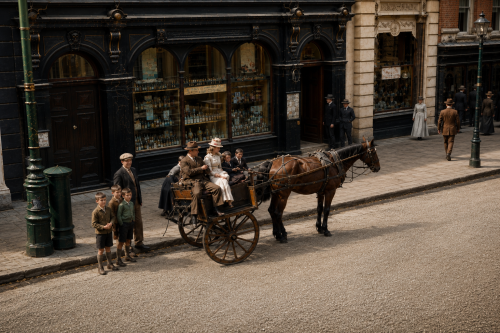
By 1937, O'Connell Street stood as Limerick's principal commercial thoroughfare, its Victorian and Georgian frontages housing chemists, drapers, and grocers that served the city's daily life. Ireland was still finding its footing after the Economic War with Britain, which had strained trade and agriculture through much of the decade, while the country prepared to adopt a new Constitution that same year. Horse-drawn jaunting cars remained a familiar sight on Limerick's streets even as motor vehicles grew more common, reflecting a city balancing older rhythms of trade and transport with the slow arrival of modern urban life in provincial Ireland.
Castle River View

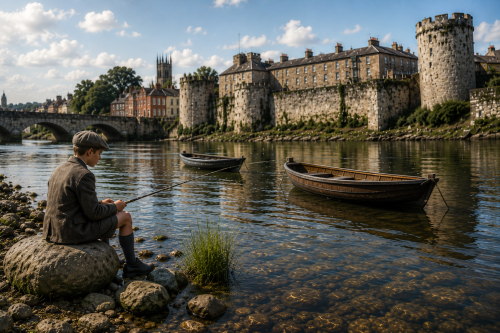
A reconstructed view of the River Shannon at Limerick City shows King John’s Castle, Thomond Bridge and the surrounding riverside buildings in a calm heritage scene. A young boy sits fishing from the rocky bank in the foreground, while small wooden boats rest quietly on the reflective water. The castle walls, bridge arches, church towers and old houses combine to suggest the layered history of the city. Although not an original period photograph, the image presents an atmospheric AI-assisted reconstruction of old Limerick, designed to evoke memory, place, childhood, river life and the enduring presence of the Shannon itself there.

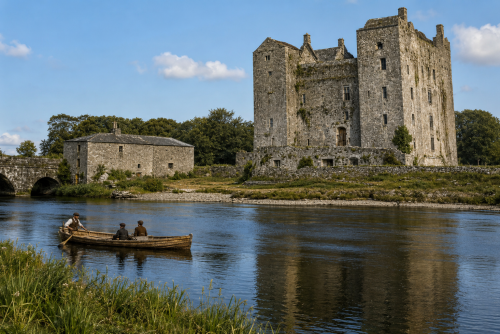
Bunratty Castle

Bunratty Castle in County Clare is one of Ireland’s finest surviving medieval tower houses. The present fortress was built around 1425 by the MacNamara clan on a site occupied by three earlier castles. It later passed to the O’Briens, Earls of Thomond, and endured siege during the Confederate Wars. After the family moved to Dromoland, Bunratty declined into ruin under later ownership. Lord Gort purchased the roofless structure in 1953 and directed its careful restoration, furnishing it with medieval tapestries, furniture and artworks. Opened to visitors in 1962, the castle and adjoining Folk Park remain major heritage attractions worldwide.

Wellesly Bridge, Limerick (c.1840s)

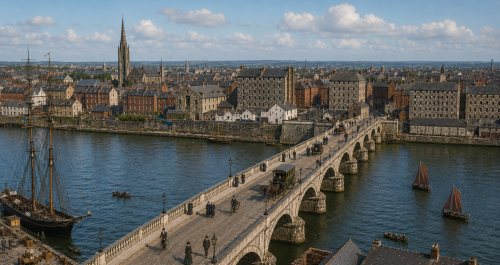
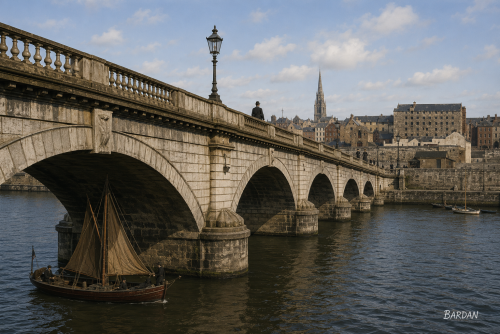
A sweeping view of Wellesley Bridge, now Sarsfield Bridge, crossing the River Shannon in Limerick City. The elegant 1835 structure rises with restrained neoclassical grace, its stone arches carrying traffic between the historic city centre and Thomondgate on the northern shore. Calm river water reflects the bridge’s pale masonry, while quays, rooftops, and distant activity suggest a city expanding beyond its old boundaries. Maritime details, mooring points, and riverside movement evoke Limerick’s trading past. The scene should feel dignified, atmospheric, and historically grounded, presenting the bridge as both active crossing and enduring architectural landmark.

Limerick Horse Brake, 1900

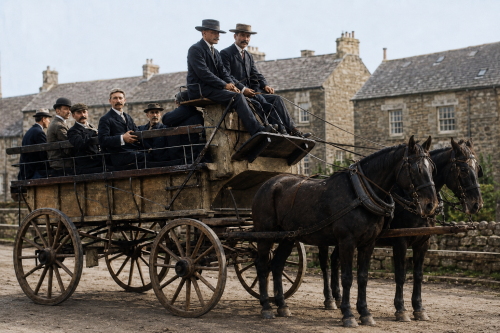
By 1900, Limerick’s great long-distance stagecoach era had largely disappeared, replaced by the expanding railway network. Horse-drawn vehicles nevertheless remained essential throughout the city and surrounding countryside. Large brakes and passenger wagons carried groups on local journeys, outings and transfers, while hackney cars, jaunting cars, drays and private carriages crowded the streets. Horses also transported goods from the docks, breweries, distilleries and railway station. This reconstructed scene captures a group of formally dressed men aboard a substantial horse-drawn vehicle, reflecting a transitional age when steam powered intercity travel, but horses still firmly supported Limerick’s everyday commercial, urban and social life.

Blossom Gate, Kilmallock

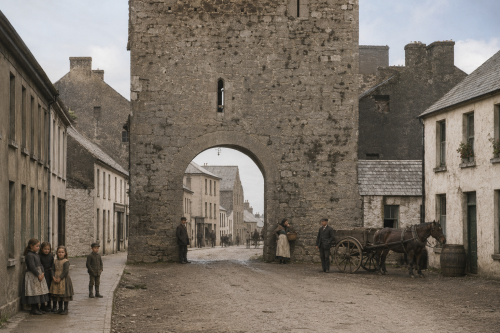
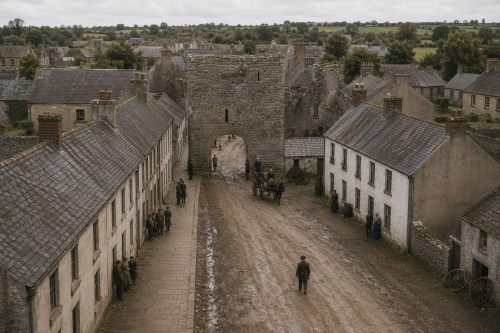
Blossom Gate is the last surviving medieval gateway of Kilmallock, County Limerick, once one of Ireland’s most strongly fortified towns. Originally one of five entrances through the defensive walls, it alone remains; St John’s, Water, Ivy and Friary gates have disappeared. Standing on Emmet Street, the three-storey stone tower spans the roadway above a pointed arched vault, marking where the town walls formerly joined it. The name may derive from “Blae Gate” or from the Irish word blá, meaning flower or blossom, combined with the French porte, meaning gate. Today, it is a prominent reminder of Kilmallock’s medieval importance and heritage.

Boers Defended

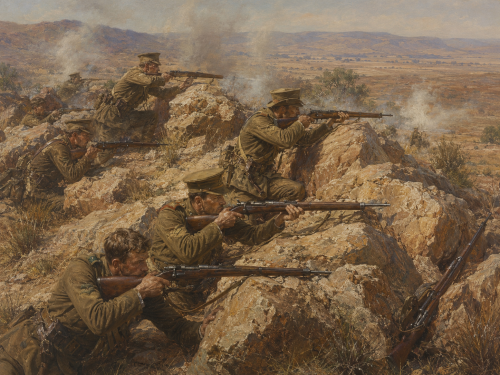
Nationalists throughout Limerick are following a forceful parliamentary protest against Britain’s continuing war in South Africa, where Irish representatives have declared their sympathy for the Boer republics. John Redmond told the House of Commons today that Ireland opposed the conflict and regarded the Transvaal and Orange Free State as small nations defending their independence against imperial power. The declaration carries particular weight in Limerick, where nationalist feeling exists beside the reality that local men serve in British uniform. Families may therefore condemn the Government’s policy while remaining deeply concerned for Irish soldiers facing death and injury overseas.

St. John’s Cathedral (Before Tower)

St. John’s Cathedral dominates Limerick’s skyline from John’s Square, crowned by Ireland’s tallest church spire. Designed by English architect Thomas Hardwick, the Gothic Revival cathedral opened for worship in 1859, replacing an earlier eighteenth-century chapel. Its celebrated limestone spire, completed in 1882 to designs by M. A. Hennessy, rises approximately 94 metres above the city. Inside, the cathedral contains a Carrara marble high altar, carved oak choir stalls, an episcopal throne and eight historic bells cast in Dublin. Major restoration projects in 1959 and 2003 preserved the building, which remains an enduring centre of Catholic worship and architectural heritage today.

Wellesly Bridge, Limerick (c.1840s)

A sweeping view of Wellesley Bridge, now Sarsfield Bridge, crossing the River Shannon in Limerick City. The elegant 1835 structure rises with restrained neoclassical grace, its stone arches carrying traffic between the historic city centre and Thomondgate on the northern shore. Calm river water reflects the bridge’s pale masonry, while quays, rooftops, and distant activity suggest a city expanding beyond its old boundaries. Maritime details, mooring points, and riverside movement evoke Limerick’s trading past. The scene should feel dignified, atmospheric, and historically grounded, presenting the bridge as both active crossing and enduring architectural landmark.

Blossom Gate, Kilmallock

Blossom Gate is the last surviving medieval gateway of Kilmallock, County Limerick, once one of Ireland’s most strongly fortified towns. Originally one of five entrances through the defensive walls, it alone remains; St John’s, Water, Ivy and Friary gates have disappeared. Standing on Emmet Street, the three-storey stone tower spans the roadway above a pointed arched vault, marking where the town walls formerly joined it. The name may derive from “Blae Gate” or from the Irish word blá, meaning flower or blossom, combined with the French porte, meaning gate. Today, it is a prominent reminder of Kilmallock’s medieval importance and heritage.

Now Sharing: Articles (166) Images (578) Total Items Archived (744)
Our Mission: 100,000 Items Total Percentage Achieved (0.74%)