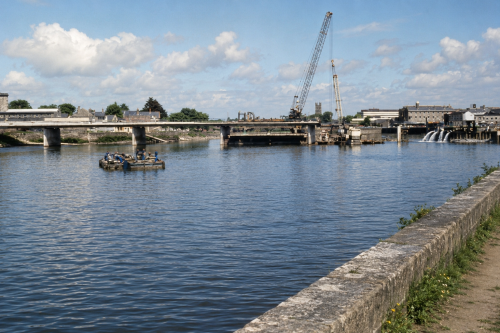
Shannon Bridge Under Construction (1987)

Shannon Bridge, opened on 30 May 1988, remains widely known in Limerick as the “New Bridge”, despite now being several decades old. This four-lane concrete girder crossing connects the Dock Road and Mallow Street area with the North Circular Road and Clancy Strand, providing an important inner-city relief route across the River Shannon. Soon after opening, it acquired another memorable nickname, the “Whistling Bridge”. Strong winds travelling up the Shannon Estuary passed through gaps in the original railings, producing a loud, eerie shrill sound. The problem was later reduced by fitting mesh grilles over the railings along the exposed crossing.

Blossom Gate, Kilmallock

Blossom Gate is the last surviving medieval gateway of Kilmallock, County Limerick, once one of Ireland’s most strongly fortified towns. Originally one of five entrances through the defensive walls, it alone remains; St John’s, Water, Ivy and Friary gates have disappeared. Standing on Emmet Street, the three-storey stone tower spans the roadway above a pointed arched vault, marking where the town walls formerly joined it. The name may derive from “Blae Gate” or from the Irish word blá, meaning flower or blossom, combined with the French porte, meaning gate. Today, it is a prominent reminder of Kilmallock’s medieval importance and heritage.

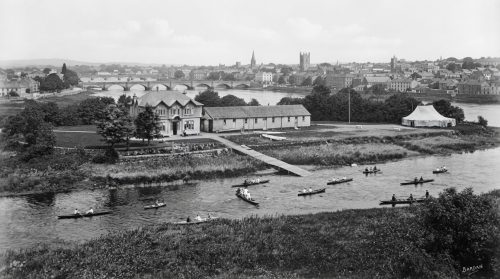
Athlunkard Boat Club

Athlunkard Boat Club was founded in 1898, taking its name from its home beside O’Dwyer Bridge at the end of Athlunkard Street. By the 1930s, the club was already firmly woven into Limerick’s rowing tradition, with a proud record on the water. Its greatest distinction came through the Senior Eight Championship, which Athlunkard won twice, in 1913 and 1923. That achievement made it the only Limerick club to secure the title on two occasions. Its riverside presence and competitive success gave Athlunkard Boat Club a lasting place in the sporting history of the city and the wider Shannon rowing community.

Shannon Rowing Club

Shannon Rowing Club is Limerick City’s oldest sporting institution. Founded in 1866 by entrepreneur and mayor Sir Peter Tait, the club has long been identified by its royal blue and white colours. Its historic headquarters on Wellesley Pier beside Sarsfield Bridge opened in 1905. Designed by William Clifford Smith, the listed Edwardian Arts and Crafts building remains one of the city’s most distinctive sporting landmarks. The clubhouse supports dry training through gym equipment, static bicycles and rowing machines, while also providing space for snooker and chess. It continues to represent Limerick’s rowing tradition and community spirit.

Grazing Dominance

Cattle grazing remains more profitable than tillage in many Irish districts, encouraging landowners and substantial occupiers to devote extensive farms to livestock rather than labour-intensive cultivation. The difference is keenly felt in County Limerick, where broad grasslands can support valuable cattle while requiring comparatively few permanent workers. Families dependent upon agricultural wages find fewer opportunities wherever ploughing, sowing, weeding and harvesting give way to grazing. Supporters of the existing system point to dependable livestock markets and lower operating costs, but critics argue that profitable land is failing to sustain the number of people it once employed.

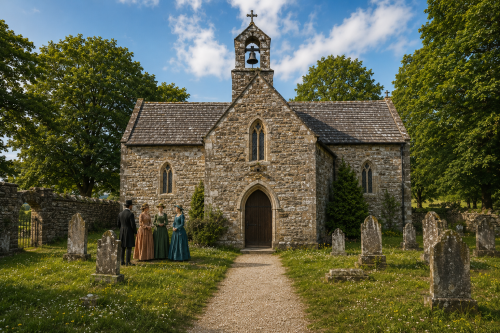
Teampall Nua in Ruins

The old church near Holycross, County Limerick, was recorded as a ruin by 1642. In 1679, Rachael Bourchier, Countess of Bath, restored the building, just one year before her death. Thereafter it became known as the New Church, or Teampall Nua in Irish, and served local Church of Ireland parishioners. A belfry was added during the restoration, giving the structure a distinctive profile. Although the church later fell out of use and returned to ruin, its surviving walls, arched openings and graveyard remain important reminders of seventeenth-century religious life and the long history of worship at this historic site today.

Is This Ireland’s Shortest Street?

Quinlan Street is one of the shortest principal streets in Limerick City, measuring approximately eighty-five feet at its centre. Located within the historic Georgian Quarter, it forms an important connection between the Crescent, at the southern end of O’Connell Street, and O’Connell Avenue. Developed between the 1820s and 1840s, the street is lined with distinctive multi-storey red-brick Georgian townhouses built over basements. Its unusual layout means that one side is longer than the other. The street was named after Thomas Quinlan, the builder responsible for the original houses at numbers 1 and 2, preserving his contribution to Limerick’s urban development.

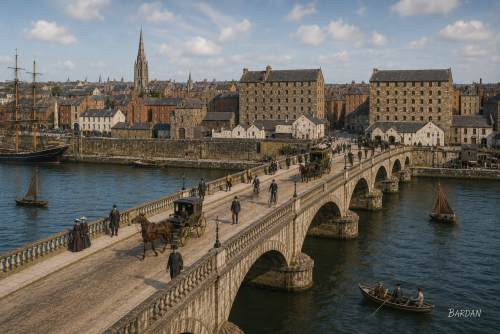
Wellesly Bridge, Limerick (c.1840s)

A sweeping view of Wellesley Bridge, now Sarsfield Bridge, crossing the River Shannon in Limerick City. The elegant 1835 structure rises with restrained neoclassical grace, its stone arches carrying traffic between the historic city centre and Thomondgate on the northern shore. Calm river water reflects the bridge’s pale masonry, while quays, rooftops, and distant activity suggest a city expanding beyond its old boundaries. Maritime details, mooring points, and riverside movement evoke Limerick’s trading past. The scene should feel dignified, atmospheric, and historically grounded, presenting the bridge as both active crossing and enduring architectural landmark.

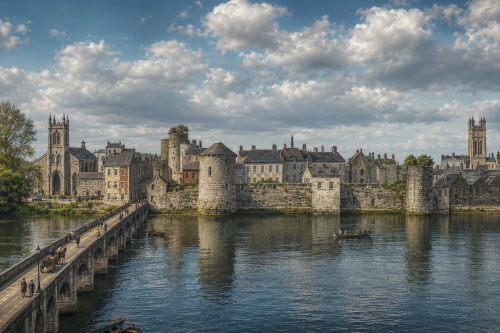
Limerick from the Shannon, c. 1850s

By the mid-nineteenth century, Limerick remained one of Ireland's most strategically significant river cities, its fortunes long tied to the Shannon as a route for trade, defence, and settlement. The medieval walls and towers still visible in this period recalled centuries of contested history, from Norman fortification to the sieges of the seventeenth century that shaped the city's identity. Alphonse Dousseau's romanticised depiction reflects a wider mid-Victorian fascination among European artists with Ireland's older townscapes, capturing Limerick at a moment when its historic core coexisted with the pressures of modernisation, emigration, and post-Famine recovery reshaping much of the country during this era.

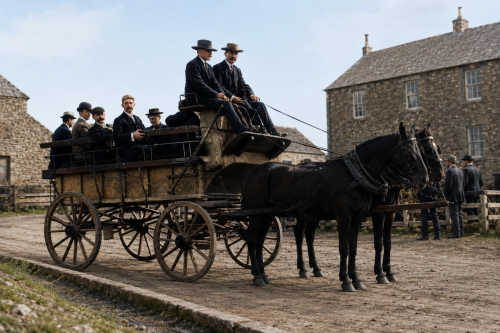
Limerick Horse Brake, 1900

By 1900, Limerick’s great long-distance stagecoach era had largely disappeared, replaced by the expanding railway network. Horse-drawn vehicles nevertheless remained essential throughout the city and surrounding countryside. Large brakes and passenger wagons carried groups on local journeys, outings and transfers, while hackney cars, jaunting cars, drays and private carriages crowded the streets. Horses also transported goods from the docks, breweries, distilleries and railway station. This reconstructed scene captures a group of formally dressed men aboard a substantial horse-drawn vehicle, reflecting a transitional age when steam powered intercity travel, but horses still firmly supported Limerick’s everyday commercial, urban and social life.

Now Sharing: Articles (166) Images (578) Total Items Archived (744)
Our Mission: 100,000 Items Total Percentage Achieved (0.74%)