Grazing Dominance(c.1900s)
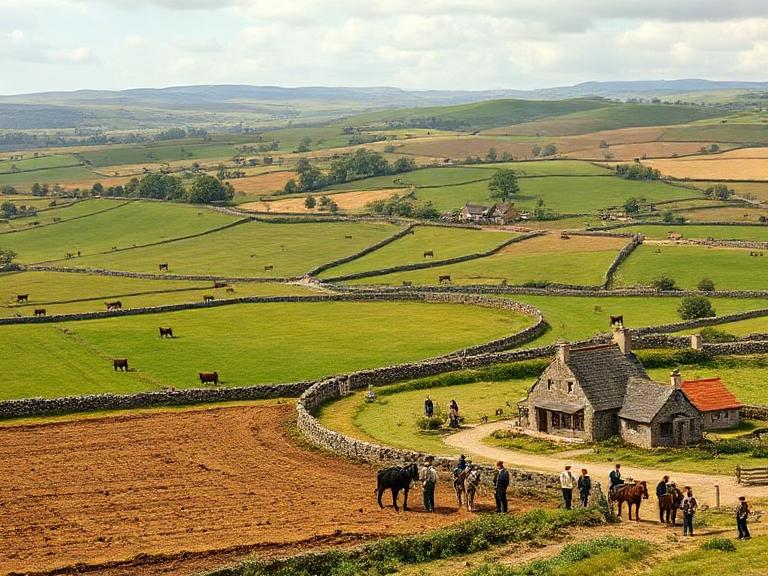
Cattle grazing remains more profitable than tillage in many Irish districts, encouraging landowners and substantial occupiers to devote extensive farms to livestock rather than labour-intensive cultivation. The difference is keenly felt in County Limerick, where broad grasslands can support valuable cattle while requiring comparatively few permanent workers. Families dependent upon agricultural wages find fewer opportunities wherever ploughing, sowing, weeding and harvesting give way to grazing. Supporters of the existing system point to dependable livestock markets and lower operating costs, but critics argue that profitable land is failing to sustain the number of people it once employed.
Tillage requires labour throughout much of the agricultural year. Fields must be prepared, planted, maintained and harvested, creating work for ploughmen, labourers, carters, women and seasonal hands. Grazing demands fewer workers once fences, water and pasture are properly maintained. A large cattle farm may therefore produce a satisfactory return for its occupier while providing little employment to neighbouring households. The contrast has strengthened complaints that agricultural profitability is being measured without sufficient attention to the number of families supported by the land or the condition of labourers left dependent upon irregular hiring.
The expansion of grazing is also connected with changes in markets and farming practice. Irish cattle can be raised upon grass and sold for finishing or slaughter in Britain, offering producers access to a large commercial market. Tillage farmers face uncertain weather, fluctuating grain prices and competition from imported produce. Many occupiers consequently regard livestock as the safer investment. Yet land campaigners maintain that private calculations have created a wider public injury, particularly where extensive grass farms stand near cramped holdings whose occupants require additional acreage to achieve even modest security.
Rural unemployment contributes directly to migration and population decline. Labourers unable to obtain sufficient work may travel to other counties or cross the Irish Sea for seasonal employment. Younger men and women frequently conclude that permanent emigration offers greater security than remaining in districts where agricultural work continues to contract. Their departure weakens local trade, reduces school attendance and leaves ageing relatives responsible for farms and households. County Limerick’s market towns may still benefit from cattle fairs and livestock commerce, but prosperity measured through sales does not necessarily reach cottages in which employment has disappeared.
The conflict between grazing and tillage has therefore become part of the broader Irish land question. Campaigners seek the division of large grass farms and the enlargement of smallholdings, arguing that land should support families as well as cattle. Graziers answer that they are using their farms according to market conditions and cannot be expected to maintain uneconomic cultivation merely to provide employment. The dispute places commercial freedom against social necessity. In Limerick, its consequences are visible wherever fertile pasture produces valuable livestock while labouring families confront unemployment, seasonal absence and the continuing loss of population from the countryside.
- Department of Agriculture and Technical Instruction for Ireland, Agricultural Statistics of Ireland with Detailed Report for the Year 1900, Dublin: His Majesty’s Stationery Office, 1901. Consult the county tables concerning tillage acreage, pasture, livestock and agricultural production. Exact table and page should be confirmed before formal citation.
- Census of Ireland, 1901, County of Limerick Tables, Dublin: His Majesty’s Stationery Office. Consult the returns concerning population change, agricultural occupations and rural districts. Exact volume, table and page should be confirmed before formal citation.
- Irish Agricultural Organisation Society, Annual Report for 1900, Dublin: Irish Agricultural Organisation Society. Consult the reports concerning livestock farming, rural employment, agricultural organisation and population loss. Exact page and section should be confirmed before formal citation.
- House of Commons Debates, 1900, debates concerning Irish agriculture, grazing farms, congested districts and rural depopulation. The precise debate, date, volume, column and speaker must be identified before formal citation.
- Limerick Chronicle, 1900, reports concerning cattle fairs, grazing farms, agricultural employment, tillage and rural conditions in County Limerick. Exact issue, page and column should be confirmed before formal citation.