Now Sharing: Articles: 202 Images: 652 Total Items Archived: 854

Military Review

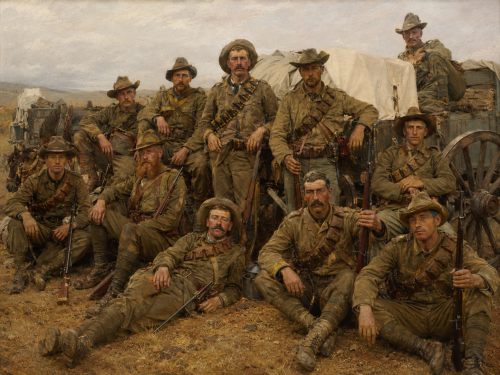
Queen Victoria has reviewed troops drawn from the Dublin garrison and the Curragh Camp during her final visit to Ireland, placing the British Army prominently within the royal programme. The review was held in Phoenix Park, where infantry, cavalry and artillery units assembled before large crowds. Soldiers marched past the Queen in formal order while officers, mounted escorts and military bands completed the spectacle. Reports reaching Limerick describe an event intended to honour the armed forces and demonstrate their discipline. The ceremony also connected Ireland directly with the continuing war in South Africa, where Irish regiments were serving throughout the British campaign.
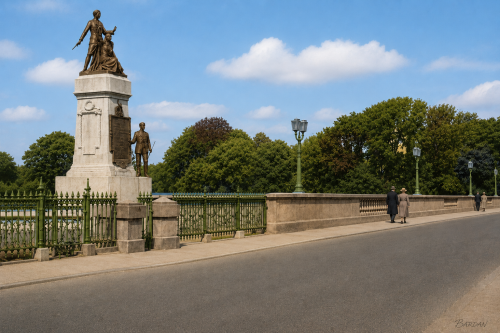
1916 Memorial, c.1940s

On Sarsfield Bridge in 1940s Limerick, the 1916 Memorial rises proudly beside the roadway, enclosed by green iron railings and watched over by elegant lamps. Its pale stone pedestal supports bronze figures commemorating the Rising, their solemn poses lending dignity to the riverside setting. Trees line the background, softening the urban scene and framing the monument against a bright open sky. Pedestrians in period dress walk along the bridge, suggesting ordinary city life continuing around a place of remembrance. The image captures civic pride, republican memory, and the enduring presence of national history within Limerick’s daily landscape and local identity.

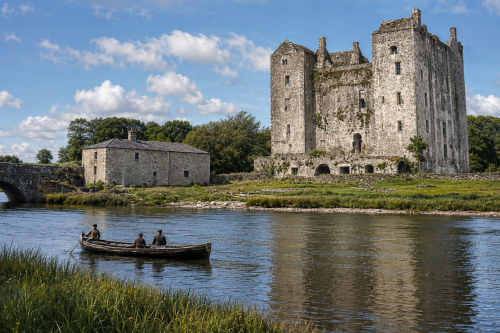
Bunratty Castle

Bunratty Castle in County Clare is one of Ireland’s finest surviving medieval tower houses. The present fortress was built around 1425 by the MacNamara clan on a site occupied by three earlier castles. It later passed to the O’Briens, Earls of Thomond, and endured siege during the Confederate Wars. After the family moved to Dromoland, Bunratty declined into ruin under later ownership. Lord Gort purchased the roofless structure in 1953 and directed its careful restoration, furnishing it with medieval tapestries, furniture and artworks. Opened to visitors in 1962, the castle and adjoining Folk Park remain major heritage attractions worldwide.

Is This Ireland’s Shortest Street?

Quinlan Street is one of the shortest principal streets in Limerick City, measuring approximately eighty-five feet at its centre. Located within the historic Georgian Quarter, it forms an important connection between the Crescent, at the southern end of O’Connell Street, and O’Connell Avenue. Developed between the 1820s and 1840s, the street is lined with distinctive multi-storey red-brick Georgian townhouses built over basements. Its unusual layout means that one side is longer than the other. The street was named after Thomas Quinlan, the builder responsible for the original houses at numbers 1 and 2, preserving his contribution to Limerick’s urban development.

St. John’s Cathedral (Before Tower)

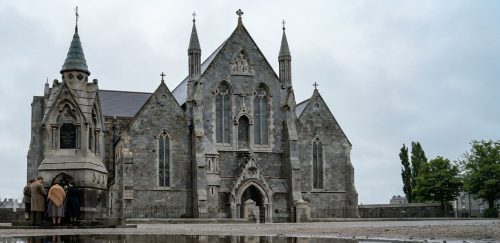
St. John’s Cathedral dominates Limerick’s skyline from John’s Square, crowned by Ireland’s tallest church spire. Designed by English architect Thomas Hardwick, the Gothic Revival cathedral opened for worship in 1859, replacing an earlier eighteenth-century chapel. Its celebrated limestone spire, completed in 1882 to designs by M. A. Hennessy, rises approximately 94 metres above the city. Inside, the cathedral contains a Carrara marble high altar, carved oak choir stalls, an episcopal throne and eight historic bells cast in Dublin. Major restoration projects in 1959 and 2003 preserved the building, which remains an enduring centre of Catholic worship and architectural heritage today.

Grange House And Georgian Estate Life

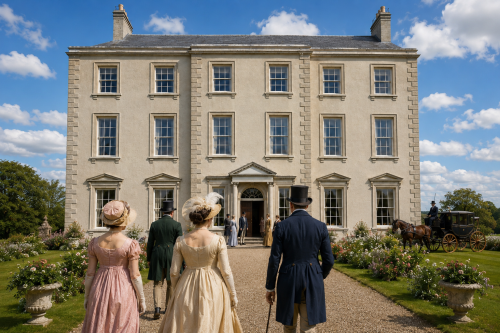
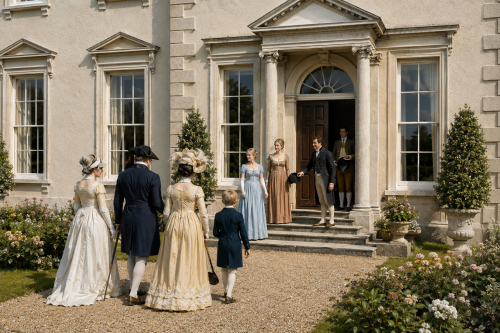
This reconstructed scene evokes the life of a prosperous Georgian country estate around the turn of the nineteenth century. The imposing house, formal gardens and gravel approach reflect the architectural taste and social order of the period. Elegantly dressed visitors, household servants, gardeners and horse-drawn carriages suggest activity surrounding such residences, where family life, hospitality and estate management met. Although idealised, the image offers a vivid historical impression of how the property may once have appeared when newly built, occupied and maintained, before decline altered its character and left only fragments of its former grandeur for future generations to study.

Grange House And Georgian Estate Life

This reconstructed scene evokes the life of a prosperous Georgian country estate around the turn of the nineteenth century. The imposing house, formal gardens and gravel approach reflect the architectural taste and social order of the period. Elegantly dressed visitors, household servants, gardeners and horse-drawn carriages suggest activity surrounding such residences, where family life, hospitality and estate management met. Although idealised, the image offers a vivid historical impression of how the property may once have appeared when newly built, occupied and maintained, before decline altered its character and left only fragments of its former grandeur for future generations to study.

Pery Square

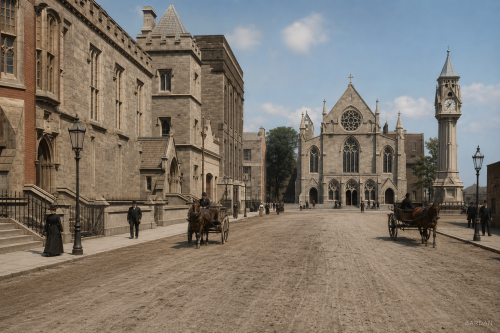
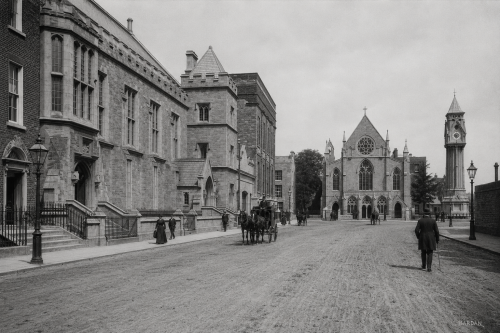
Around 1900, Pery Square presented one of Limerick’s most elegant urban settings, facing the newly opened People’s Park and framed by distinctive Georgian terraces. The celebrated Tontine Buildings, built between 1835 and 1838 as a speculative venture, gave the square a story as unusual as its architecture. Their shares, tied to named lives in the so-called Life and Death Lottery, were still gaining value as horse-drawn traffic, pedestrians, gas lamps, and civic buildings animated the street. The tontine was finally won in 1913 by Sophia Vanderkiste, closing a remarkable chapter in Limerick’s local social and architectural history.

Limerick Lace Garden Gown

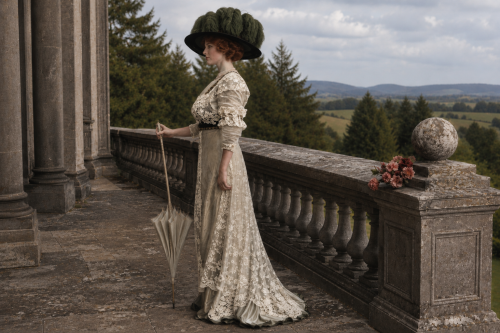
Published in the Ladies’ Field Supplement in May 1909, this elegant garden-party ensemble combines pale green crêpe météore with a flowing tunic of delicate Limerick lace. The softly draped fabric creates a graceful Edwardian silhouette, while the intricate lacework adds texture, refinement and distinctly Irish craftsmanship. A fitted waist, long skirt and trimmed bodice reflect the fashionable ideal of the period, balancing formality with lightness suitable for outdoor social occasions. Completed by an elaborate feathered hat and parasol, the gown captures the elegance, confidence and decorative luxury associated with upper-class women’s fashion in the years before the First World War.

Pery Square

Around 1900, Pery Square presented one of Limerick’s most elegant urban settings, facing the newly opened People’s Park and framed by distinctive Georgian terraces. The celebrated Tontine Buildings, built between 1835 and 1838 as a speculative venture, gave the square a story as unusual as its architecture. Their shares, tied to named lives in the so-called Life and Death Lottery, were still gaining value as horse-drawn traffic, pedestrians, gas lamps, and civic buildings animated the street. The tontine was finally won in 1913 by Sophia Vanderkiste, closing a remarkable chapter in Limerick’s local social and architectural history.