Now Sharing: Articles: 202 Images: 652 Total Items Archived: 854

The Carnegie Library

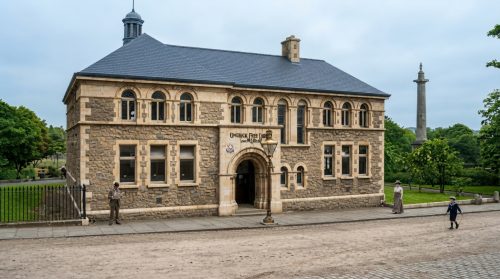
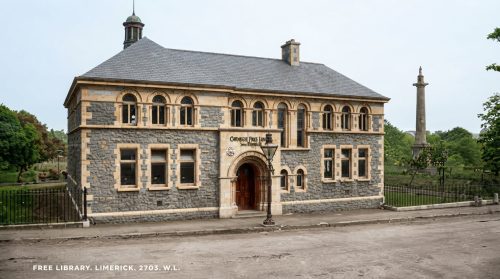
The Carnegie Library on Pery Square is one of Limerick’s most distinctive civic buildings. Funded by a £7,000 donation from Scottish-American philanthropist Andrew Carnegie, its foundation stone was laid by Carnegie himself in October 1903. Designed by Dublin architect George Patrick Sheridan, the limestone building opened in 1908 as a combined free library and museum. It later housed Limerick Museum and the growing Limerick City Collection of Art. After the library and museum relocated in 1985, the building became home to Limerick City Gallery of Art. Modern extensions have expanded its exhibition spaces while preserving its historic Neo-Hiberno-Romanesque character today.
The Carnegie Library

The Carnegie Library on Pery Square is one of Limerick’s most distinctive civic buildings. Funded by a £7,000 donation from Scottish-American philanthropist Andrew Carnegie, its foundation stone was laid by Carnegie himself in October 1903. Designed by Dublin architect George Patrick Sheridan, the limestone building opened in 1908 as a combined free library and museum. It later housed Limerick Museum and the growing Limerick City Collection of Art. After the library and museum relocated in 1985, the building became home to Limerick City Gallery of Art. Modern extensions have expanded its exhibition spaces while preserving its historic Neo-Hiberno-Romanesque character today.
Estates Reorganised

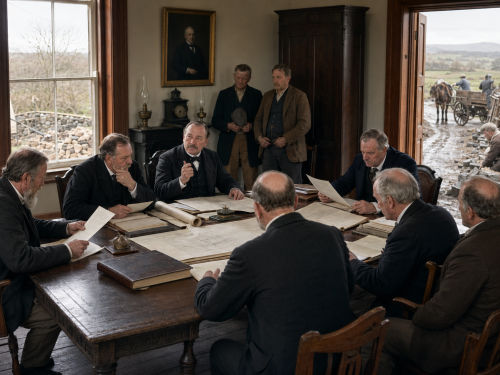
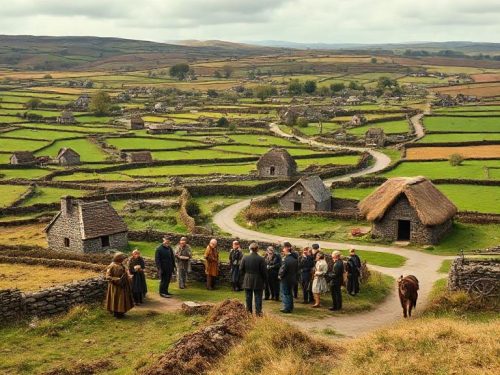
The Congested Districts Board is continuing its efforts to purchase and reorganise estates in the poorest districts of western Ireland. Created in 1891 to relieve chronic rural poverty, the Board has increasingly turned towards land purchase as a means of enlarging uneconomic farms, combining scattered plots and moving selected families from overcrowded districts onto more productive ground. Its work is concentrated principally in Connacht and the western counties, where generations of subdivision have left many households dependent upon holdings too small or infertile to provide a secure living.

The Monument Gathering

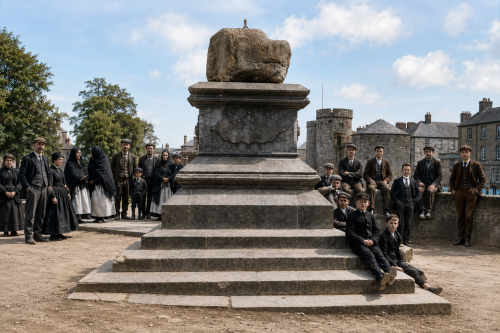
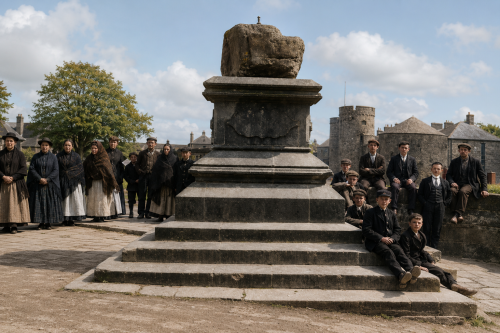
This reconstructed image depicts the Treaty Stone in Limerick as it may have appeared around 1880, standing on its substantial stepped pedestal as a powerful emblem of the city’s past. Groups of townspeople, including men, women and children in period clothing, gather around the monument in a lively public setting. In the background, traditional buildings, stone walls and the nearby tower reinforce the historic atmosphere of the riverside area. Long associated with the Treaty of Limerick of 1691, the stone remained an important civic landmark, meeting place and symbol of memory, identity and local heritage in nineteenth-century Limerick.

Government Amendment

On 2 February 1900, the introduction of a bill to amend the Local Government (Ireland) Act 1898 was formally announced in the British Parliament, an event that sparked immediate interest among Limerick’s councillors, administrators, and politically engaged citizens. The original Act had brought sweeping changes to local governance, replacing grand juries with elected county and district councils, and its provisions continued to shape civic life across Limerick city and county. News of the amendment bill was reported in local newspapers and discussed at council meetings, as officials anticipated further adjustments to the structure and operation of Irish local government.

Roberts Arrives

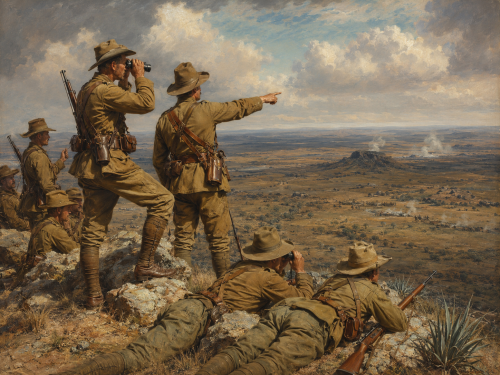
Field Marshal Lord Roberts arrived at Cape Town on 10 January 1900 and assumed supreme command of British forces in South Africa. He travelled aboard the Dunottar Castle with Lord Kitchener, who became his chief of staff. Their appointment followed the defeats of “Black Week,” when British reverses at Stormberg, Magersfontein and Colenso exposed serious weaknesses in command, intelligence and battlefield preparation. Roberts received a formal welcome at the harbour, but the ceremony could not conceal the gravity of his task. British garrisons remained besieged, casualties were rising and reinforcements arriving from across the Empire required organisation.

The Monument Gathering

This reconstructed image depicts the Treaty Stone in Limerick as it may have appeared around 1880, standing on its substantial stepped pedestal as a powerful emblem of the city’s past. Groups of townspeople, including men, women and children in period clothing, gather around the monument in a lively public setting. In the background, traditional buildings, stone walls and the nearby tower reinforce the historic atmosphere of the riverside area. Long associated with the Treaty of Limerick of 1691, the stone remained an important civic landmark, meeting place and symbol of memory, identity and local heritage in nineteenth-century Limerick.

Contracts Shortened

Limerick No. 1 District Council altered the system governing maintenance and repair contracts for public roads when members decided that future agreements would run for twelve months rather than the four-and-a-half-year term previously used. The decision followed an adjourned quarterly meeting held under the chairmanship of William Noonan and reported on 18 January 1900. Road tenders rejected at an earlier sitting had been referred to Limerick County Council, which declined to consider them and returned the entire question to the District Council. Members were therefore required to reconsider both the tenders and the basis upon which future road work would be awarded.

Trawling Criticism

On 8 February 1900, the practice of steam trawling in Wexford Bay was sharply criticised in Parliament, with local fishermen and their advocates voicing concern over its damaging effects on traditional livelihoods. The introduction of steam-powered trawlers had revolutionised fishing along the Irish coast, but many small-scale fishermen complained that these vessels indiscriminately swept up fish stocks, destroyed spawning grounds, and left little for those using more sustainable methods.

Monasteranenagh Abbey, 1148

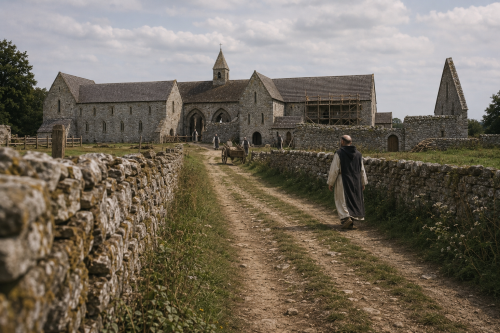
Founded in 1148 by Toirdelbhach mac Diarmaida Ua Briain, Monasteranenagh Abbey became one of County Limerick’s most important Cistercian foundations. This reconstruction imagines the monastery during its earliest years, with newly completed stone buildings, steep roofs, narrow lancet windows, timber doors, and monks moving quietly through the surrounding grounds. The austere architecture reflects the Cistercian ideals of simplicity, discipline, prayer, and communal labour. Supported by the O’Brien dynasty, the abbey later expanded under Domnall Mór Ua Briain. Though centuries of conflict and collapse reduced it to ruins, its surviving walls remain a powerful monument to medieval Irish faith and craftsmanship.