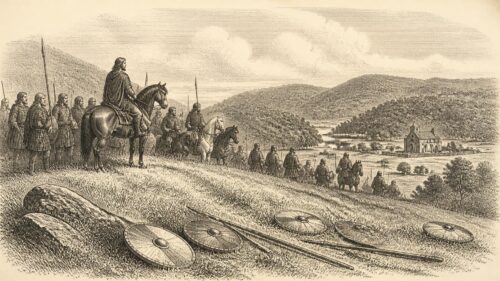
Athlone Castle Rises1213 CE
In 1213, King John’s submission of England and Ireland to Pope Innocent III altered the lordship’s international status, while Henry of London became archbishop of Dublin and justiciar. Royal and settler forces campaigned in Mide, defeating Cormac Ó Máel Sechlainn’s allies and building castles at Athlone, Birr, Durrow and Kinnitty to control crossings and routes. Cormac nevertheless recovered influence, illustrating frontier instability. Ulster saw Gaelic feuds, Anglo-Norman attacks, church plundering, Coleraine Castle’s construction and Áed Ó Néill’s raids. Clerical deaths highlighted enduring ecclesiastical centres. Ireland remained politically plural, as castles, warfare, alliances and royal administration reshaped contested regions across Ireland.
Dateline
In 1213 Ireland stood at the meeting point of several overlapping worlds. King John’s lordship claimed authority across the island, but its effective reach was uneven: strongest in the ports, boroughs and lordships of the east and south-east; contested along the midlands; and dependent on warfare, negotiation and local alliances elsewhere. Gaelic kings and lordships remained powerful political actors, while churches, monasteries and new castles were both places of worship or refuge and prizes in conflict. The year’s surviving record is especially vivid for frontier violence in Ulster and Mide, for the extension of fortifications, and for a change in royal government at Dublin.
A New Royal Governor
Two precisely dated events linked Ireland to the grave political crisis then enveloping King John. On 15 May 1213, at Dover, John formally surrendered England and Ireland to Pope Innocent III and received them back as papal fiefs. His charter explicitly named both realms. Ireland was therefore included in a settlement designed principally to end John’s destructive quarrel with the papacy and to avert the threat of French-backed intervention. The change did not transfer the daily conduct of Irish affairs to Rome, nor did it make the king’s claims effective in every Irish region. It did, however, give the lordship a newly emphatic place in John’s relationship with the papacy.
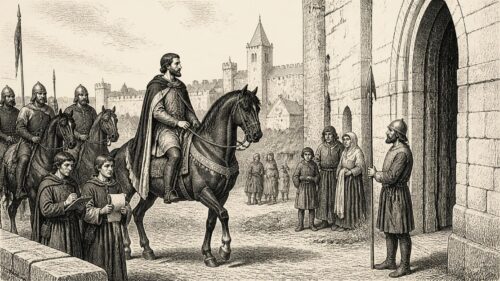
Henry of London, newly elected archbishop of Dublin, was among the witnesses to John’s submission. On 23 July he was appointed justiciar of Ireland, the king’s chief governor. He arrived to hold an unusual concentration of authority: archbishop of the principal English-founded ecclesiastical province in Ireland and royal administrator responsible for the peace and security of the lordship. John’s instructions expected the magnates of Ireland to assist Henry with their counsel and aid. That formula reveals a central fact of government: royal administration depended on the co-operation of powerful lay lords rather than on a large independent bureaucracy.
Henry succeeded John de Gray, bishop of Norwich, whose energetic administration had sought to consolidate royal authority after John’s Irish expedition of 1210. De Gray’s departure was tied to the king’s urgent needs in Britain and on the Channel coast. He brought forces from Ireland to England at a time when a French invasion appeared possible. Thus Irish knights, mounted men and resources were not peripheral to John’s wider political survival. In November, Henry of London took custody of Dublin Castle, the developing royal stronghold and administrative centre. The handover was more than ceremonial: the castle guarded the place where royal money, records, officials and military supplies could be concentrated.
Castles Across the Midlands
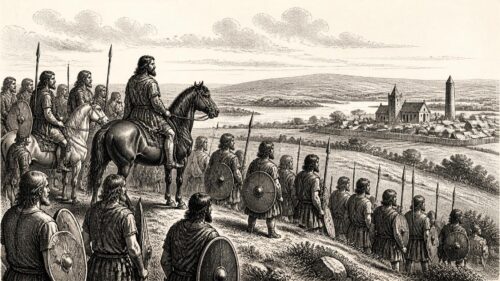
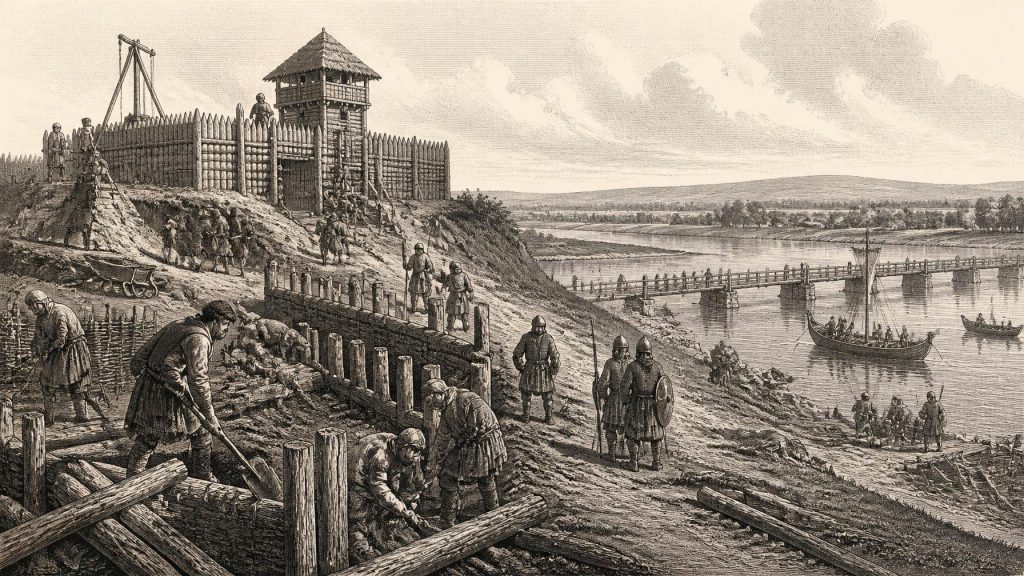
The most striking Irish development associated with 1213 was the drive to secure routes and crossings by fortification. The Annals of the Four Masters record that the English of Ireland mounted a major expedition against Cormac son of Art Ó Máel Sechlainn, a Gaelic ruler active in Mide and Delbna. It places their encounter at Droichead Tine, or Tine Bridge, where Cormac was defeated; Ruaidrí Ó Cíarda was killed, Cormac was expelled from Delbna, and his followers were plundered. The annal continues that the force went to Athlone and built a castle, then made castles at Kinnitty, Birr and Durrow.
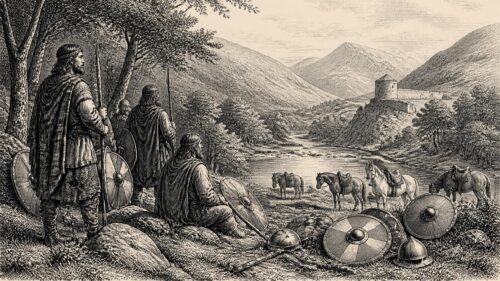
These notices should not be imagined as a neat, single day’s conquest. Medieval annals commonly compress campaigns, building works and their consequences into brief annual entries. Nor are their year-labels perfectly synchronised: related notices occur under 1212 in the Annals of Ulster and in other annalistic traditions. Yet they securely illuminate the military and political atmosphere of 1213. Royal and settler power was being advanced through defended positions at strategic points in the midlands, while Gaelic rulers resisted, raided and sought to recover local dominance.
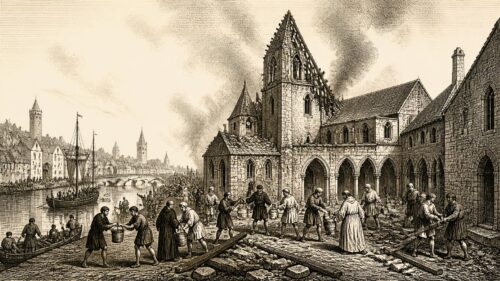
Athlone mattered above all. Positioned at a crossing of the Shannon, it was a gateway between the English-held east and Connacht. Its castle represented not merely a building but an attempt to regulate movement, secure communications and project force into the west. Birr, Durrow and Kinnitty similarly lay in a contested central zone, where control of roads, pasture, tribute and local communities could change quickly. Construction demanded timber, earth, stone where available, food, transport animals and labour. For neighbouring inhabitants, a new castle could mean requisitions and garrison demands as well as a new market or focus of administration. The political map was being altered physically, one enclosure and defended crossing at a time.
Cormac did not simply disappear after the defeat at Tine Bridge. The same annal says that he raided Delbna, drove out Máel Sechlainn Bec and killed William Muilenn before taking lordship there. This sequence conveys the instability of a frontier society. A royal army could disperse an opponent and install or support allies, but durable control still rested on local followings, kinship ties and the capacity to protect clients. The Annals of Ulster also attribute a victory at ‘the Wood of the High Trees’ to Cormac against the Foreigners. Its term ‘Foreigners’ conventionally denotes the English or Anglo-Norman forces in this context; it should not obscure the many Irish alliances within and around those forces.
Violence in the North
Ulster was no less unsettled. The year’s entries show warfare among Gaelic kindreds, Anglo-Norman pressure, maritime connections and attacks upon churches occurring together. Donnchadh Mac Cana, chief of Cenél nÉngusa, died. A raid by Gilla Fiachlach Ua Baigill and men of Cenél Conaill into Cenél nEógain brought a counter-attack in which Gilla Riabhach Ua Tairchert was killed defending people said to be under his protection. Such language is important: lordship was understood not only as command in war, but as an obligation to safeguard dependants and guests.
The burning of Druim Cain and its church, reportedly undertaken by Cenél nEógain without the permission of Áed Ó Néill, indicates both local indiscipline and the king’s expected authority over violence. Ferghal Ua Catháin, ruler of Ciannachta and Fir na Craibhe, was killed by the Foreigners. Domnall Ua Daimín was killed at the door of the monastery of Derry, St Columba’s great ecclesiastical site. These brief records show that churches did not stand outside politics. Their precincts could offer sanctuary, contain accumulated treasure, or become the scene of killing.
The Four Masters adds a fuller, though much later compiled, account of events around Derry and Coleraine. It records the plundering of Derry’s church treasures by Thomas Mac Uchtraigh and Ruaidrí Mac Ragnaill, and violent confrontation involving Ua Catháin and Fir na Craibhe. It also states that Thomas Mac Uchtraigh and the English of Ulidia built Coleraine Castle, demolishing cemeteries and the town’s buildings for material, while leaving the church standing. Whether read as an exact account of every demolished structure or as an annalist’s powerful summary, the notice captures the human cost of castle-building: sacred ground and an existing settlement were subordinated to military necessity.
In the same year the Four Masters credits Áed Ó Néill with a victory over the English and the burning of Carlingford, including people and cattle. The wording is stark, and it is a reminder that raids were directed at livelihood as well as territory. Cattle were portable wealth, while the destruction of a settlement struck at food stores, homes, commerce and lordly prestige. The northern coastline and sea-loughs connected these conflicts to the Isles, Scotland and the Irish Sea world; Ulster’s politics could not be understood as isolated from those wider routes.
Church, Learning and Loss
Religion entered the record in quieter ways as well. Gilla na Naem Ua Ruadáin, bishop of Luighne, and Muirigen Ua Muiregáin, bishop of Clonmacnoise, died in 1213 according to the Four Masters. So too did Ainmire Ua Cobthaig, abbot of Derry, praised as a distinguished cleric of piety, charity and learning. Such obituary notices reveal the continued importance of Irish ecclesiastical lineages and centres of learning alongside the expanding structures of the English lordship. Clonmacnoise remained a major religious and intellectual centre on the Shannon; Derry’s community remained central to the prestige and wealth of the north.
The contrast between these deaths and the attacks on Derry’s church is instructive. Monasteries and episcopal churches were spiritual communities, but also landholders, employers, storehouses of valuables and places where memory, literacy and political legitimacy were cultivated. The same institutions that prayed for rulers could be drawn into their disputes. In 1213, sacred status offered no complete immunity, though churches remained indispensable arenas for negotiation, commemoration and authority.
An Island of Linked but Unequal Powers
The evidence for 1213 does not justify a simple story of an advancing English conquest or an undifferentiated Irish resistance. King John’s government was strengthening castles and administrative centres, but did so through magnates, local allies and military expeditions whose success was limited and reversible. Gaelic rulers such as Áed Ó Néill and Cormac Ó Máel Sechlainn retained the ability to defeat forces, burn strongholds or settlements, and reassert themselves after setbacks. In Connacht, Cathal Crobderg Ua Conchobair remained a client-king of the English crown while preserving substantial practical independence, a relationship that demonstrates the importance of diplomacy as well as force.
For most people, the year’s grand politics were experienced through immediate pressures: military hosting, cattle-raiding, construction labour, disrupted worship, damaged homes, travel along guarded crossings and the demands of competing lords. Yet 1213 also left enduring marks. Athlone and other central fortifications signalled a more determined royal presence; Dublin acquired a new archbishop-justiciar; and John’s papal settlement placed the lordship of Ireland within an altered international framework. Ireland remained politically plural, but its frontiers were being made more visible in timber, earth, stone and fire.
Primary Sources
- The Annals of Ulster: Year U1213
- The Annals of Ulster: Years U1211–U1213
- Annals of the Four Masters: Annal M1213 (English translation)
- Annals of the Four Masters: Annal M1213 (Irish text)
- Annals of Loch Cé: Years LC1205–LC1216
- Mac Carthaigh’s Book: Annals MCB1212–MCB1215
- CELT: Annals of Loch Cé
- CELT: Annals of the Four Masters
- John, Dictionary of Irish Biography
- Henry of London, Dictionary of Irish Biography
- William Marshal, Dictionary of Irish Biography
- Cathal Mór Crobderg Ua Conchobair, Dictionary of Irish Biography
- Áed Ó Néill, Dictionary of Irish Biography
- Domnall Mór Ó Domnaill, Dictionary of Irish Biography
- King John’s surrender of England and Ireland (1213) to the See of Rome, National Library of Ireland catalogue
- John’s Concession of England to the Pope, 1213
- Magna Carta Project: Clause 14 Commentary
- Magna Carta Project: Invitation to the Prior and Monks of Christ Church Cathedral Priory, Canterbury, 24 May 1213
- H. G. Richardson, ‘Norman Ireland in 1212’
- D. W. Dykes, ‘King John’s Irish Rex Coinage Revisited: Part I: The Dating of the Coinage’
- RTE Brainstorm: ‘Who were the powerful men known as “barons of Ireland”?’
- National Library of Ireland catalogue: ‘Norman Ireland in 1212’