Kings at Mellifont1157 CE
In 1157, following Tairdelbach Ua Conchobair’s death, Muirchertach Mac Lochlainn asserted a contested high kingship through alliances, hostages and campaigns. Mellifont’s church consecration gathered leading clerics and rulers, displayed lavish patronage, and enabled the excommunication and deposition of Donnchad Ua Máel Sechlainn for violating a safeguard. Mac Lochlainn secured submissions in Leinster and Munster, but his settlements remained precarious. Ruaidrí Ua Conchobair raided Tír Eógain, contested Munster and assembled a Shannon fleet. Mac Lochlainn’s Newry charter linked royal authority with ecclesiastical reform. Records also show wealth in cattle and gold, vulnerable communities, fires, deaths, and persistent local conflict across Ireland.
Dateline
Ireland entered the year with its political balance newly unsettled. Tairdelbach Ua Conchobair, the formidable king of Connacht who had dominated much of the island, had died in 1156. His northern rival, Muirchertach Mac Lochlainn of Cenél nÉogain, consequently stood as the leading claimant to the kingship of Ireland. Yet the annalists’ qualifications matter: one tradition called him king of Ireland, while another described him as king “with opposition”. His authority depended not on a permanent national administration but on alliances, hostages, military circuits and the cooperation of provincial and regional rulers.
Two connected developments defined the year. The first was the consecration of Mellifont’s Cistercian church, where religious ceremony became the setting for royal patronage and political judgement. The second was Mac Lochlainn’s campaign through Leinster and Munster, followed by counter-moves from Ruaidrí Ua Conchobair, Tairdelbach’s son and successor in Connacht. Together they reveal a country whose rulers sought both spiritual legitimacy and practical supremacy.
The Assembly at Mellifont
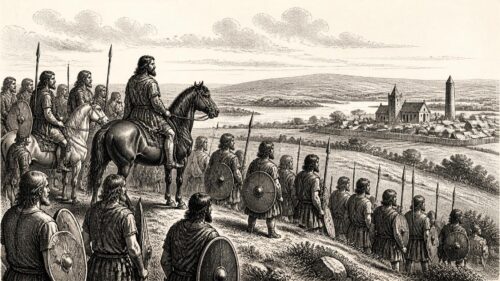
The most celebrated firmly dated event was the consecration of the church at Mellifont, near Drogheda. No trustworthy source supplies an exact day. Founded in 1142 through the cooperation of St Malachy and Donnchad Ua Cerbaill, king of Airgialla, Mellifont was Ireland’s first Cistercian monastery. Its buildings embodied a form of organised monasticism closely connected to Clairvaux and the wider reforming Church of western Europe.
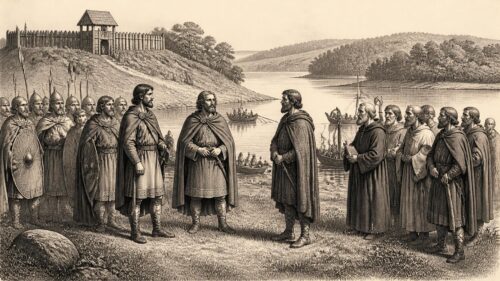
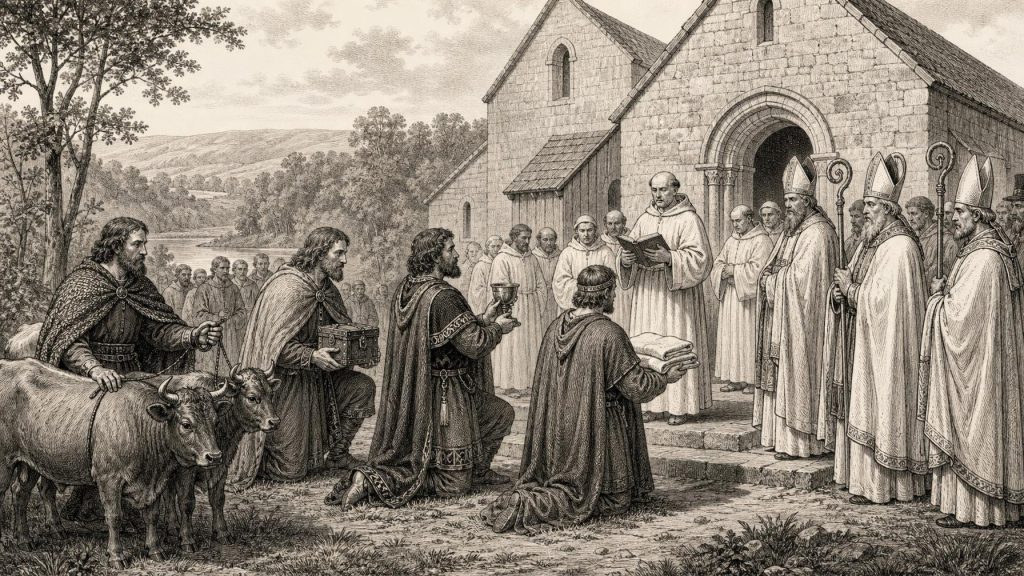
Gilla meic Liac, archbishop of Armagh and successor of Patrick, consecrated the church before a large gathering. Christian Ua Conairche, bishop of Lismore and papal legate, attended, as did numerous bishops, clergy and lay rulers. The Annals of the Four Masters count seventeen bishops in addition to the legate and archbishop. Among the political leaders were Muirchertach Mac Lochlainn, Donnchad Ua Cerbaill and Tigernán Ua Ruairc of Bréifne. The occasion was therefore more than a local dedication. Mellifont briefly served as a stage upon which the leading powers of the Irish Church and secular society appeared together.
The donations were conspicuously large. Mac Lochlainn gave sixty ounces of gold, land at Finnabair na nIngen near Drogheda and either 140 or 160 cattle, depending on the annalistic tradition followed. Ua Cerbaill gave another sixty ounces of gold. Derbforgaill, daughter of a king of Meath and wife of Tigernán Ua Ruairc, gave sixty ounces more, together with a gold chalice for an altar dedicated to Mary and cloth for nine other altars. Her independent appearance among the benefactors is important evidence for the wealth, religious agency and public role available to an exceptionally prominent royal woman.
A Safeguard Broken
The splendour at Mellifont was accompanied by a severe political judgement. Cú Ulad Ua Caindelbáin, ruler of Loegaire in Meath, had been killed treacherously by Donnchad Ua Máel Sechlainn. The victim had supposedly been protected by an unusually impressive body of guarantors: the archbishop of Armagh, the papal legate, major ecclesiastical communities and relics, Mac Lochlainn, Ua Cerbaill, Ua Ruairc, Diarmait Mac Murchada of Leinster and leading men of Meath.
Guarantees were central to political negotiation. Clerics, kings and sacred objects did not merely witness settlements; their honour and authority underwrote them. Killing a protected person was therefore an attack upon the standing of every guarantor. Ua Cerbaill and Ua Ruairc raided the Saithne in retaliation, although their force suffered losses. At Mellifont the clergy excommunicated Donnchad, while the assembled rulers expelled him from the kingship of Meath. His brother Diarmait was installed in his place.
This episode demonstrates that ecclesiastical sanctions could have immediate political force when supported by powerful kings. It should not, however, be mistaken for the operation of a modern court. The judgement worked because religious condemnation, dynastic rivalry and armed power converged at the same moment.
Mac Lochlainn’s Southern Circuit
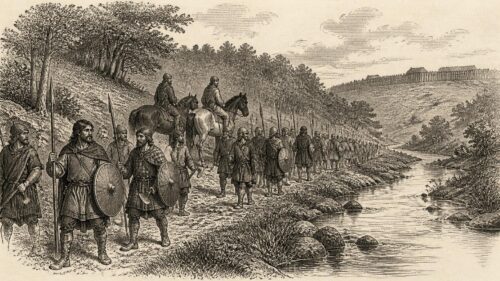
Mac Lochlainn followed the assembly with a major expedition. He entered Leinster with northern forces and received hostages from Diarmait Mac Murchada. Groups from Laois, Uí Fhailge and part of Osraige fled towards Connacht, suggesting that not every Leinster dynasty accepted the arrangement. Mac Murchada retained his provincial kingship by acknowledging the northern ruler’s superiority.
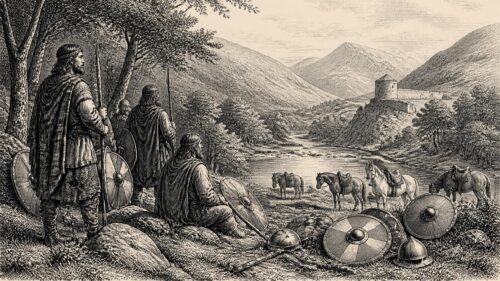
The army then moved into Desmond, where Mac Lochlainn obtained hostages, before turning towards Thomond and Limerick. The sources describe attacks upon the Dál Cais and a siege or encampment at Limerick. The town’s Hiberno-Norse inhabitants submitted and expelled Tairdelbach Ua Briain. Mac Lochlainn proceeded to divide authority in Munster between Diarmait Mac Carthaig in the south and Conchobar Ua Briain in the north or east.
Such a partition was a declaration of overlordship, but not necessarily a durable settlement. Mac Lochlainn could recognise competing provincial dynasties and demand hostages; he could not remove their local followings or prevent future struggles. Parts of Síol Anmchada were raided, some northern warriors were killed and Roscrea was plundered before the expedition returned north. The campaign was impressive in reach, yet its dependence on movement, intimidation and temporary submission exposed the limits of island-wide kingship.
Ruaidrí’s Reply
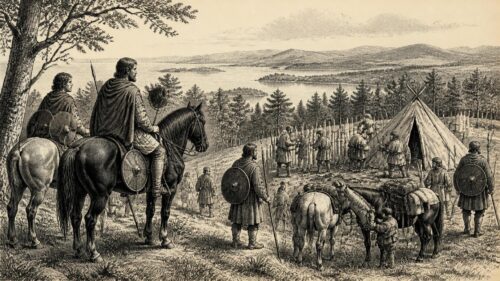
Ruaidrí Ua Conchobair did not accept Mac Lochlainn’s ascendancy passively. While the northern king was campaigning in the south, Ruaidrí entered Tír Eógain, burned Inis Eanaigh, cut down its orchard and raided towards Cianachta. The destruction of an orchard was economically and symbolically significant: fruit trees represented years of cultivation and settled investment rather than quickly replaceable plunder.
Ruaidrí also intervened in Munster. He supported Tairdelbach Ua Briain’s claim to half the province and received conditional hostages from Diarmait Mac Carthaig. The recorded condition—that the hostages would belong to Ruaidrí unless Mac Lochlainn came to defend them—captures the uncertainty of Munster’s position between rival overkings.
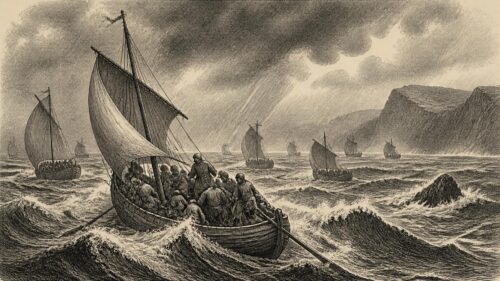
A very large fleet was assembled for Ruaidrí on the Shannon. The annals do not attach a decisive battle to this mobilisation, but the notice shows the strategic importance of rivers and lakes. Boats transported warriors, supplies and raiding parties through regions where overland movement could be slow. Connacht’s naval resources allowed Ruaidrí to answer a rival whose power base lay far to the north.
Charters and Reform
A royal charter for Newry Abbey is generally dated to 1157, or to 1156–57. It survives only through much later copies, so its transmission requires caution, but modern scholarship broadly treats it as genuine. In it Mac Lochlainn styled himself rex totius Hiberniae, “king of all Ireland”, and confirmed lands and privileges for the religious community at Newry.
The document is among the earliest surviving Latin royal charters from Ireland. It did not mean that oral declarations, customary law or collective witnessing were being displaced. Instead, it shows Gaelic rulers adopting an additional documentary form shared across Latin Christendom. The charter, Mellifont’s consecration and the archbishop of Armagh’s involvement all connected Mac Lochlainn’s kingship to ecclesiastical reform and written expressions of authority.
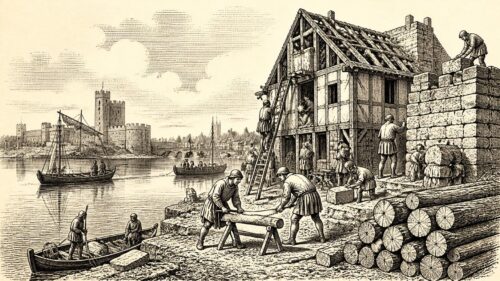
Mellifont itself represented substantial cultural and architectural change. Its community followed the Cistercian ideal of regulated prayer, communal discipline and labour within a planned monastic precinct. The abbey’s church and domestic ranges drew upon continental models while depending upon Irish patrons, workers, materials and landscapes. By this date Mellifont had already begun producing daughter houses, placing Ireland within a network through which monks, customs, books and architectural knowledge travelled.
Wealth, Towns and Countryside
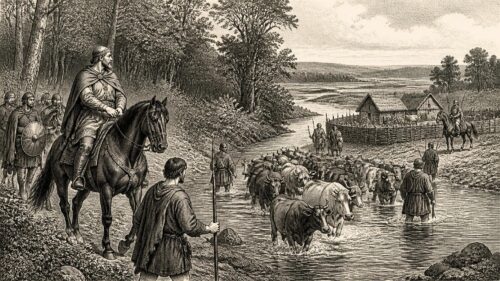
The year’s records illuminate an economy in which cattle remained a principal measure of movable wealth. Herds fed households, rewarded supporters, endowed churches and became the preferred prize of raiding armies. Gold nevertheless circulated among royal elites and ecclesiastical institutions in impressive quantities. Mellifont’s gifts also included worked objects and textiles, reminding us that wealth could be displayed through craftsmanship as well as livestock and land.
Limerick and Dublin retained distinctive Hiberno-Norse populations and maritime connections. Their rulers and merchants could not ignore inland kings, but neither were the towns merely passive possessions. Mac Lochlainn sought Limerick’s submission because command of a port offered revenue, shipping and access to regional trade. Drogheda’s crossing of the Boyne likewise helped make the Mellifont district strategically important, although the later borough should not be projected fully formed into this year.
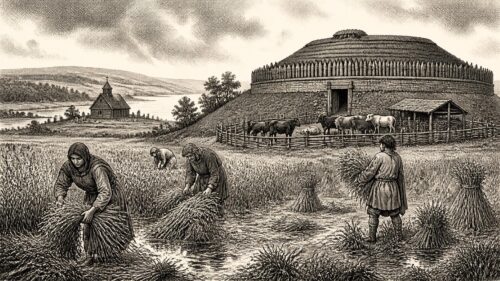
For most people, life remained rural and local. Communities cultivated grain, managed cattle, cut timber and maintained obligations to kindred, lord and church. Royal campaigns could transform this routine abruptly. Armies consumed provisions, removed herds, damaged crops and churches, and took hostages or captives. The annals concentrate on rulers, but the costs of their ambitions fell heavily upon unnamed farmers, labourers, clerics and dependants.
Deaths, Fires and Memory
Several churches suffered destructive fires. Devenish in Lough Erne, Lismore and Lorrha were burned, with buildings and churches affected. The records do not reliably identify the cause in every case, so deliberate attack should not automatically be assumed. Timber construction, hearths, lamps and closely grouped buildings made settlements vulnerable even without warfare.
Gilla Pátraic Mac Carthaig, successor of St Fin Barre at Cork, died. Cú Ulad Ua Duinn Sléibe, king of Ulaid, died after penance at Downpatrick and was buried there. The annals also record violent deaths among the Ua hEagra rulers of Luigne and the killing of Domnall Ua Raghallaig. These shorter entries reveal the constant local contests continuing beneath the grand rivalry for Ireland.
The year ultimately belonged to neither Mac Lochlainn nor Ruaidrí without qualification. Mac Lochlainn displayed extraordinary range, drawing kings and bishops to Mellifont and carrying his army to Limerick. Ruaidrí demonstrated that Connacht remained capable of striking his homeland, contesting Munster and mobilising a formidable fleet. Mellifont’s consecration offered a vision of ordered Christian kingship; the surrounding betrayals, raids and disputed hostages showed how difficult that order was to sustain.
Primary Sources
- The Annals of Ulster: Year U1157
- Annals of the Four Masters: Annal M1157
- The Annals of Tigernach
- Mac Carthaigh’s Book: Annal MCB1157
- The Irish Charters in the Book of Kells
- Mac Lochlainn, Muirchertach
- Ua Conchobair, Ruaidrí
- Ua Cerbaill, Donnchad
- Ua Ruairc, Tigernán
- Gilla meic Liac (Gelasius)
- Mac Murchada, Diarmait (MacMurrough, Dermot)
- Ua Conchobair, Tairdelbach (O’Conor, Turlough)
- Paparo, Iohannes
- Derbforgaill: Twelfth-Century Abductee, Patron and Wife
- From Kingdom to Colony: Framing the English Conquest of Ireland
- Mellifont Cistercian Abbey
- Old Mellifont Cistercian Abbey Monastic Site
- Mellifont Old Cistercian Abbey
- Mellifont Abbey: A Virtual Tour
- Saint Malachy and the Introduction of Cistercian Monasticism to the Irish Church: Some Suggestive Evidence from Newry Abbey
- Irish Kings and Literacy: A Scottish Perspective
- Medieval Ireland: Territorial, Political and Economic Divisions
- Ireland in the Middle Ages
- Heritage Ireland Ezine Issue 6