Membership is completely free, giving members unlimited access to all available resources, services, features, and benefits without any restrictions or fees.
Welcome back. Sign in to continue enjoying unlimited access to all available resources, services, features, and member benefits at no cost.
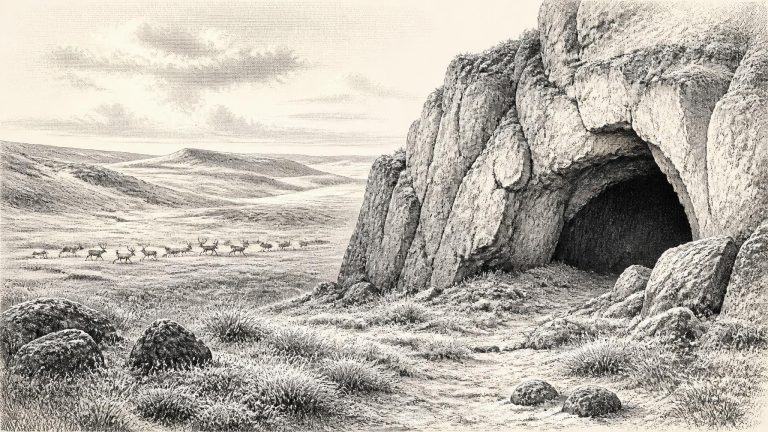
MIS 3, conventionally spanning roughly 57,000 to 29,000 years ago, was not a single uniform climate. North Atlantic temperatures swung sharply between colder episodes and relatively milder interstadials. Ireland lay at the oceanward edge of north-west Europe, exposed to Atlantic weather systems and to shifts in the growth of the British–Irish Ice Sheet. The detailed reconstruction of that ice sheet is strongest from around 31,000 years ago onwards, and even then it presents alternative minimum, optimum and maximum ice limits where direct evidence is lacking. Around the notional date used here, therefore, it is safer to speak of advancing or intermittently expanded ice and of regional uncertainty than to draw a neat line between an icy north and an ice-free south.
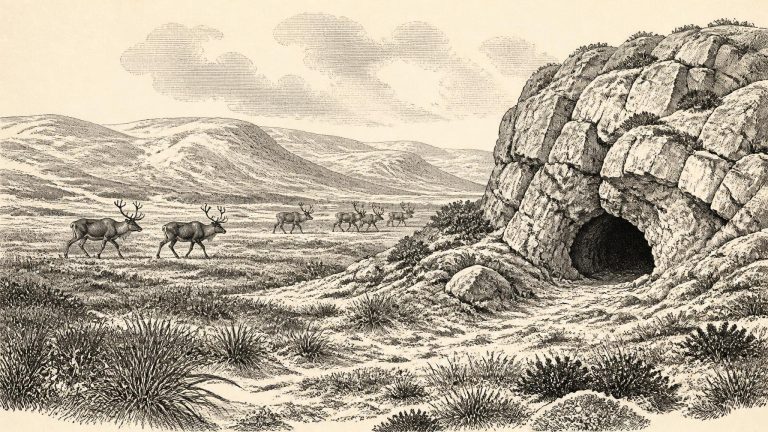
Ireland was not yet necessarily the fully ice-covered land it became during the Last Glacial Maximum, conventionally placed later, broadly between about 26,500 and 19,000 years ago. The British–Irish Ice Sheet was growing and changing, however, while climate shifted abruptly between relatively milder interstadials and severe cold phases. It is misleading to picture a stable “Ice Age Ireland”. Conditions could differ greatly over centuries or millennia, and between exposed Atlantic coasts, uplands, river valleys and limestone lowlands.
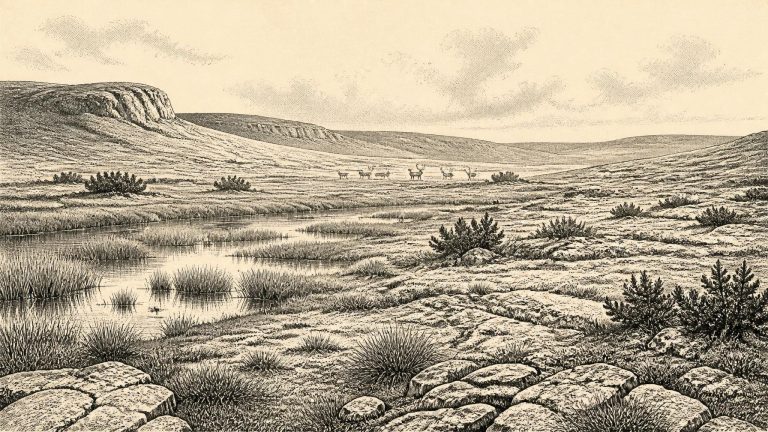
In the wider north-west European sequence, this was not yet the climatic peak of the last glaciation. Reconstructions of the British–Irish Ice Sheet place its major expansion after about 35–32 thousand years ago, with maximum extent much later, broadly between 27 and 21 thousand years ago. That does not mean a uniform, ice-free Ireland in the earlier period. Ice masses grew and shifted in response to changing climate, while exposed ground, valley glaciers, ice margins and cold periglacial landscapes could occur in different regions at different times. The exact extent of ice around 33.7 thousand calibrated years ago remains a matter of reconstruction rather than something directly mapped from a single Irish deposit.
Ireland was approaching, but had not yet reached, the most extensive phase of the last glaciation. The Last Glacial Maximum in the Irish sector came later, broadly after c. 27,000–25,000 calibrated years ago, and major ice-sheet growth and retreat were uneven in both place and time. Reconstructions of the British–Irish Ice Sheet therefore caution against imagining the whole island as a single, permanently ice-covered block in 31,793 BCE. Conditions, ice margins and habitable ground could differ sharply between regions and over periods far shorter than the archaeological resolution available to us.
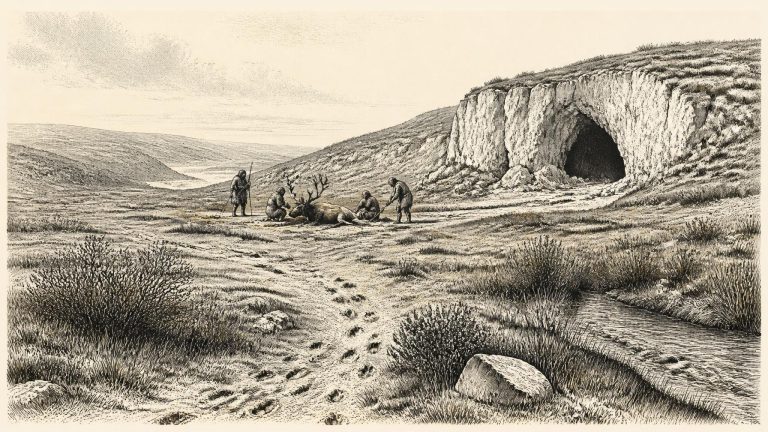
31,798 BCE is a modern way of placing a point far back in the Late Pleistocene. It was not a year that anybody in Ireland could have named, recorded or experienced within a calendar. Archaeology cannot identify an event on this particular year, nor can it supply rulers, battles or settlements for it. The responsible approach is to consider the much broader period around it: roughly 33,700 calibrated years before 1950, within Marine Isotope Stage 3, an unstable interval of the last Ice Age.