Castlepook’s Reindeer Trail31798 BCE
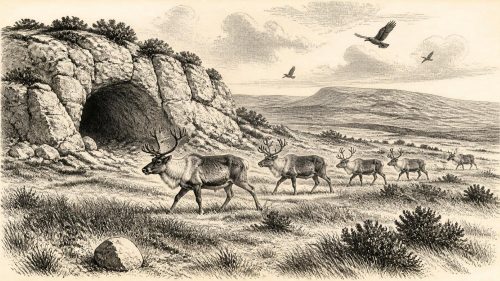
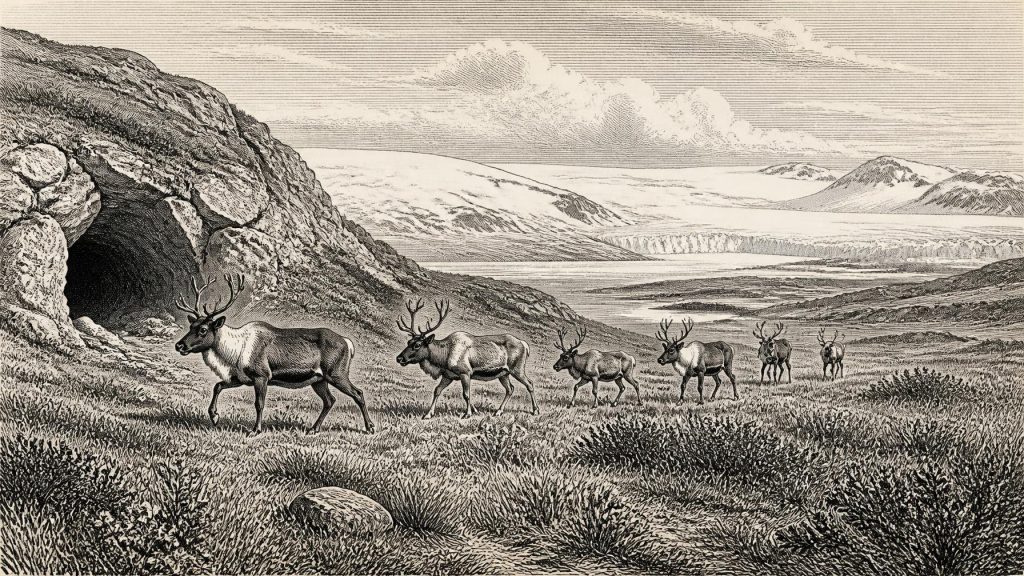
Around 31,798 BCE, Ireland formed part of a changing Late Pleistocene landscape, with fluctuating ice, lower seas and intermittently exposed cold, open terrain. Evidence is regional and uncertain, since later glaciation destroyed or disturbed much of the record. Castlepook Cave in County Cork yielded reindeer, hyaena, bear, fox, hare, lemming and mammoth remains, accumulated at different times through natural and animal processes. A reindeer leg bone, dated roughly 33,000 years ago, bears a possible stone-tool cut mark, suggesting human activity. It cannot prove settlement, population continuity or social life. Castlepook instead highlights Ireland’s Ice-Age fauna and evidence for Palaeolithic visitors.
Dateline
A Date Beyond the Calendar
31,798 BCE is a modern way of placing a point far back in the Late Pleistocene. It was not a year that anybody in Ireland could have named, recorded or experienced within a calendar. Archaeology cannot identify an event on this particular year, nor can it supply rulers, battles or settlements for it. The responsible approach is to consider the much broader period around it: roughly 33,700 calibrated years before 1950, within Marine Isotope Stage 3, an unstable interval of the last Ice Age.
Even that conversion needs care. Radiocarbon dates are measurements with margins of uncertainty, and calibration against changing atmospheric carbon levels produces ranges rather than an exact historical timestamp. A radiocarbon result dates the death of an organism whose bone or charcoal has been tested; it does not automatically date every mark on that object, the deposit in which it was later found, or an imagined human visit. At this depth of time, an apparently precise BCE label is useful for organising a chronology, but it must not be mistaken for year-by-year evidence.
Ireland around this point was not the familiar island of later history. Sea levels were lower than today, coastlines lay differently, and the British–Irish Ice Sheet was changing through episodes of growth and retreat. Yet scholars cannot reconstruct the exact limits of ice, sea and habitable ground for a single year in the early thirty-second millennium BCE. The best evidence is regional and discontinuous: cave bones, organic sediments protected beneath later glacial deposits, landforms, marine cores and the physical traces left by ice.
A Changing Ice-Age Landscape
This was a cold world, but not necessarily one in which every part of Ireland lay continuously under a uniform cover of ice. Recent work emphasises that the British–Irish Ice Sheet had a complex pre-Last Glacial Maximum history, including advances and retreats during Marine Isotope Stage 3. The great, well-dated expansion that covered much of Ireland and the surrounding shelf belongs chiefly to the later part of the last glaciation, after this broad period. Therefore neither a wholly ice-free Ireland nor a wholly ice-covered Ireland should be projected uncritically onto 31,798 BCE.
For people and animals, the important consequence was variability. Open ground could be exposed in some places and seasons while glaciers, permanent snowfields, frozen soils or cold seas limited movement elsewhere. Windswept herb-rich tundra, grasses, sedges, dwarf shrubs and scattered hardy plants are reasonable regional analogies for favourable ice-free terrain, but they are reconstructions rather than a direct botanical census of this year. Much of the older Irish environmental record has been erased, disturbed or buried by later ice advances. That loss is itself a major reason why Ireland’s Palaeolithic record is so slight.
The physical landscape was also larger in some directions than the modern map suggests. Lower global sea levels exposed areas of continental shelf, although the detailed geography of channels, coastal plains and possible crossings changed through time and varied locally with ice loading and relative sea level. It is unsafe to draw a simple land bridge from Ireland to Britain or mainland Europe for this precise date. What can be said is that the geography of movement was different, and that animals reached Ireland during parts of the Late Pleistocene.
The Castlepook Evidence
The most directly relevant Irish evidence comes from Castlepook Cave, also called Mammoth Cave or Doneraile Cave, near the Awbeg Valley in north County Cork. Cave excavations there, especially those undertaken in the late nineteenth and early twentieth centuries and later investigations, produced a remarkable collection of Ice-Age animal remains. The assemblage includes species associated with cold and open environments, among them reindeer, spotted hyaena, brown bear, fox, hare and lemming; mammoth material has also given the cave its alternative name.
These finds are important, but the collection must not be treated as one contemporaneous scene. Many bones were recovered during antiquarian excavations, before modern standards of recording deposits, and cave sediments may be moved by water, scavengers, gravity, frost and later digging. Individual bones can be reliably identified and sometimes directly dated, while the original relationship between bones, layers and cave entrances may remain uncertain. Castlepook was used or entered by animals at different times; it was not necessarily a single stable habitat, a permanent den, or a place continuously occupied by any species.
A reindeer hind-leg bone from the cave has become especially significant. It has been reported as dating to approximately 33,000 years ago and carries a deep linear modification that zooarchaeologist Ruth Carden has interpreted as a cut or chopping mark made with a sharp stone implement while a fresh carcass was being processed. If this interpretation is confirmed and the broad chronology holds, it may indicate that humans reached Ireland during an earlier part of the Upper Palaeolithic than had previously been accepted.
That possibility is relevant to a date such as 31,798 BCE, but it is not evidence for a person living in Ireland in this exact year. Nor does one marked bone establish a permanent population, a named cultural group, an organised hunting territory or a continuous ancestry linking Ice-Age visitors with later inhabitants. The radiocarbon date concerns the reindeer’s death; the mark must be assessed separately, and the old recovery context limits certainty. The lack of a securely associated stone-tool assemblage, hearth, dwelling floor, human burial or stratified food-processing deposit means that the claim should remain carefully framed as possible early human activity, not as a fully documented settlement.
Animals, Caves and Survival
Even without proving human presence, Castlepook and other Irish cave sites reveal a real Pleistocene fauna. Reindeer point to cold, open terrain with forage adequate for grazing herds. Arctic fox, hare and lemmings likewise fit severe northern conditions. Spotted hyaenas, however, are a useful warning against simplistic pictures of a silent frozen wasteland. They were powerful social carnivores and scavengers that could accumulate bones in caves, gnaw and break them, and alter the archaeological record. A bone-bearing cave may preserve the work of predators as readily as the work of people.
The economy of any humans who may have entered Ireland can therefore only be inferred in the most general terms. Mobile Upper Palaeolithic hunter-gatherers elsewhere in north-west Europe used stone tools and drew food, hides, sinew, bone and antler from large mammals. Reindeer would have been a valuable animal, but Castlepook does not demonstrate a planned reindeer-hunting economy on the island. It may represent a brief visit, the transport of a carcass part, opportunistic scavenging, or a much more complicated sequence of animal and natural activity. Evidence supports the presence of animal resources; it does not permit a confident account of meals, trade, seasonal camps or social organisation.
No Kingdoms, No Recorded Beliefs
There is no evidence for political affairs in Ireland at this date. No kingship, territory, alliance, diplomacy, warfare or institution can be recovered from the archaeological record. Equally, there is no Irish evidence of ritual buildings, formal graves, art, symbols, language or religious practice that can responsibly be assigned to this narrow period. Upper Palaeolithic communities elsewhere in Europe possessed rich cultural traditions, but importing their known art, clothing, beliefs or identities into Ireland would be speculation.
The absence of such evidence is not proof that people, if present, had no beliefs, kinship or culture. It reflects the scale and fragility of the surviving record. Small, short-lived groups leave few traces even in favourable circumstances; later glaciation, changing shorelines and Ireland’s often acidic soils greatly reduce the chance that camps, wooden objects, hearths and human remains will survive. Caves are exceptional repositories because they can shelter bone and sediment, but their deposits are also difficult to interpret.
What This Moment Can Mean
The central historical development around 31,798 BCE is therefore not a known event but an archaeological question: whether the changing landscapes of Ice-Age Ireland were visited by people long before the securely established post-glacial colonisation of the island. Castlepook’s reindeer bone makes that question more urgent. It joins wider evidence that Late Pleistocene Ireland supported, at intervals, a varied cold-climate fauna and was not simply an empty blank beyond Europe’s edge.
Future progress depends on work that is necessarily painstaking: locating undisturbed cave deposits, dating bone collagen with improved methods, distinguishing stone-tool damage from carnivore and geological marks, analysing ancient DNA and isotopes, and mapping former ice and coastlines. For now, the clearest picture is restrained but compelling. Around this modern calendar point, Ireland belonged to a dynamic Ice-Age world of shifting ice margins, exposed ground, mobile animals and uncertain human horizons. The reindeer trail at Castlepook is not yet a history of settlement. It is a rare clue to how much deeper Ireland’s human past may eventually prove to be.
Primary Sources
- The Irish Quaternary Fauna Project
- Phylogeographic, Ancient DNA, Fossil and Morphometric Analyses Reveal Ancient and Modern Introductions of a Large Mammal: The Complex Case of Red Deer (Cervus elaphus) in Ireland
- First Evidence of a Late Upper Palaeolithic Human Presence in Ireland
- New Insights on the Fauna of Ireland’s Younger Dryas and Early Holocene from Alice & Gwendoline Cave
- Growth and Retreat of the Last British–Irish Ice Sheet, 31,000 to 15,000 Years Ago: The BRITICE-CHRONO Reconstruction
- The Timing and Magnitude of the British–Irish Ice Sheet Between Marine Isotope Stages 5d and 2: Implications for Glacio-Isostatic Adjustment, High Relative Sea Levels and ‘Giant Erratic’ Emplacement
- Timing and Pace of Ice-Sheet Withdrawal Across the Marine–Terrestrial Transition West of Ireland During the Last Glaciation
- Maximum Extent and Dynamic Behaviour of the Last British–Irish Ice Sheet West of Ireland
- Radiocarbon Constraints on the Age of the Maximum Advance of the British-Irish Ice Sheet in the Celtic Sea
- Maximum Extent and Readvance Dynamics of the Irish Sea Ice Stream and Irish Sea Glacier Since the Last Glacial Maximum
- New Age Constraints for the Limit of the British–Irish Ice Sheet on the Isles of Scilly
- Exposure-Age Constraints on the Extent, Timing and Rate of Retreat of the Last Irish Sea Ice Stream
- The IntCal20 Northern Hemisphere Radiocarbon Age Calibration Curve (0–55 cal kBP)
- Lateglacial Vegetation and Environment in Ireland: First Results from Four Western Sites
- Ireland: Submerged Prehistoric Sites and Landscapes
- The Quaternary of Northern Ireland and North West Ireland: Palaeoecology
- The Quaternary of Northern Ireland and North West Ireland: The Subdivision of the Quaternary Period in Ireland
- Archaeological Heritage of County Cork
- Heritage Artefacts of County Cork
- Our Ancient Landscapes: Hunter-Gatherers in Ireland
- First Evidence of a Late Upper Palaeolithic Human Presence in Ireland (author manuscript)
- New Insights on the Fauna of Ireland’s Younger Dryas and Early Holocene from Alice & Gwendoline Cave (author manuscript)
- Radiocarbon Constraints on the Age of the Maximum Advance of the British-Irish Ice Sheet in the Celtic Sea