Doneraile’s Contested Reindeer Femur31793 BCE
31,793 BCE is a modern filing date, roughly 33,700 years before present, within climatically unstable Marine Isotope Stage 3. Ireland was cold, treeless and regionally varied, with tundra-like wetlands, periglacial terrain and advancing, uneven ice. Castlepook Cave, County Cork, preserves fauna including mammoth, giant deer, reindeer, bears, hyaenas, wolves, foxes and lemmings, showing ecological links beyond Ireland. A marked reindeer femur may record stone-tool use and an early human visit, but disturbed deposits and uncertain dating prevent firm conclusions. Secure butchery evidence at Clare is far later. No settlement, culture, trade or society can be reconstructed; faunal evidence remains paramount.
Dateline
“31,793 BCE” is a useful filing point, not a date at which an Irish event can be placed. No written record, calendar or securely annual archaeological sequence exists for Ireland at this depth of time. In modern chronological terms it falls roughly 33,700 years before present (where “present” conventionally means 1950), within Marine Isotope Stage 3, a long and climatically unstable part of the Late Pleistocene. Radiocarbon determinations from this era must be calibrated and normally yield ranges rather than a single historical year. The responsible history of Ireland at this point is therefore a history of sediments, animal bones, caves and changing ice—not of named peoples, rulers or battles.
A Cold Country Before the Ice Peak
Ireland was approaching, but had not yet reached, the most extensive phase of the last glaciation. The Last Glacial Maximum in the Irish sector came later, broadly after c. 27,000–25,000 calibrated years ago, and major ice-sheet growth and retreat were uneven in both place and time. Reconstructions of the British–Irish Ice Sheet therefore caution against imagining the whole island as a single, permanently ice-covered block in 31,793 BCE. Conditions, ice margins and habitable ground could differ sharply between regions and over periods far shorter than the archaeological resolution available to us.
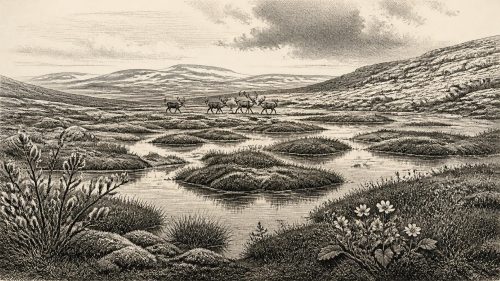
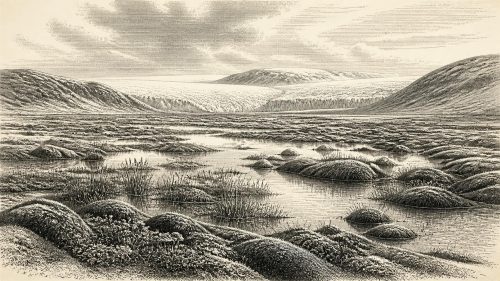
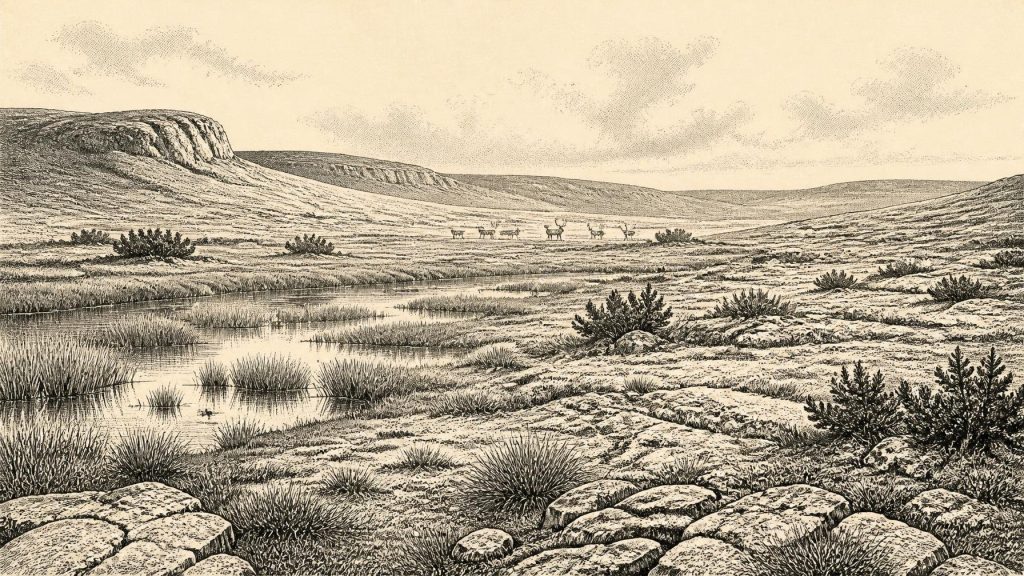
The wider climate was cold, dry and highly seasonal by modern Irish standards. Woodland was absent or extremely restricted. Evidence from Irish deposits attributed to the Middle Midlandian cold phase, especially organic silts beneath drumlins at Derryvree in County Fermanagh, indicates a treeless landscape of grasses, sedges, herbs, juniper and mosses. Archaeologists and palaeoecologists describe it as open tundra or muskeg: wet, low-lying ground with pools and marshy vegetation, rather than a smooth blanket of snow. Such evidence belongs to broad intervals, not to the numbered year itself, but it offers the best available guide to the environments of Ireland around the later part of MIS 3.
Wind, frost, seasonal thaw and flowing water shaped the ground. Bare mineral surfaces, shallow soils and sedge-rich hollows would have alternated with more sheltered patches of vegetation. In the uplands, periglacial processes—repeated freezing and thawing of soil and rock—were important. River valleys and limestone country could provide local shelter and routes for animals. The familiar green, wooded and densely settled Ireland of later millennia did not exist. Nor can the evidence support a uniform reconstruction of every coast, valley or mountain: what survives is fragmentary and has often been disturbed by later ice, water and excavation.
Castlepook’s Animal Archive
The central Irish site for this period is Castlepook Cave, also called Mammoth Cave or Doneraile Cave, in the Awbeg Valley of north County Cork. Its chambers and passages produced a remarkable collection of Late Pleistocene bones during excavations in the early twentieth century, while further work has continued intermittently since. Geological Survey Ireland describes Castlepook as the country’s richest known archive for vertebrate fauna from the period leading up to the Last Glacial Maximum. The assemblage includes woolly mammoth, giant deer, reindeer, brown bear, spotted hyaena, wolf, Arctic fox and lemmings.
This is strong evidence that, during suitable phases of the Ice Age, Ireland supported a varied large-mammal community. Reindeer and lemmings point to cold open habitats; mammoth and giant deer suggest substantial grazing landscapes; predators such as wolf and spotted hyaena show that carcasses and herbivore herds formed part of a functioning food web. But the bones do not amount to a census of animals living together on one day, season or even century. Castlepook was a cave repository accumulated over a very long interval. Carnivores, natural deaths, water movement, collapse and human excavation all affected what entered, remained or was recovered from its deposits.
That qualification matters especially because the cave’s early excavation history was not conducted to modern stratigraphic standards. Many finds came from disturbed deposits, and later work has shown that older radiocarbon measurements on Irish cave bones can be unreliable when compared with results obtained using improved collagen purification and accelerator methods. Re-dating at Castlepook, Shandon and Foley caves produced substantially older results in several instances. Consequently, individual bones need direct dating and their physical context must be assessed before they are used to build a precise chronological story.
The Femur and Its Limits
A reindeer femur fragment from Castlepook has made the period around this nominal year unusually important. The bone bears a linear modification interpreted by zooarchaeologist Ruth Carden as a cut or chopping mark made on fresh bone with a sharp stone tool. Its reported age, about 33,000 years ago, lies broadly close to the chronological horizon represented by 31,793 BCE. If that interpretation is sustained, it would indicate that people reached Ireland during the earlier Upper Palaeolithic, far earlier than the previously secure evidence for human presence.
It must not, however, be turned into a story of a settled Ice-Age community. One modified bone is not a house, hearth, tool kit, burial ground or repeatedly occupied camp. No stone artefact or bone tool from Castlepook has yet been demonstrated beyond doubt to belong to a human occupation of this age. The 2022 Castlepook Caves Project explicitly noted that no such certain tool had been identified, while renewed excavation, sediment study, dating and ancient-DNA work were intended to test what undisturbed evidence survives. The femur is best understood as significant and suggestive, rather than final proof of a known population, culture or route into Ireland.
There is a useful contrast with later evidence from Alice and Gwendoline Cave in County Clare. There, a brown-bear kneecap bearing butchery marks was independently dated to calibrated ranges of 12,810–12,590 and 12,810–12,685 years before present. That find provides accepted evidence of a Late Upper Palaeolithic human presence in Ireland, but it is around twenty millennia younger than the Castlepook question. It cannot demonstrate that people lived in Ireland in 31,793 BCE; rather, it shows why careful dating and direct physical traces are essential.
People, Society and Belief
There is no responsible basis for describing political affairs, diplomacy, territorial rule, warfare, religion, language or learning in Ireland at this time. No Irish human burial, settlement plan, artwork, ceremonial structure or securely associated artefact assemblage is known from this horizon. It is equally unsafe to assign the Castlepook femur to a named archaeological culture merely because Upper Palaeolithic communities elsewhere in Europe made sophisticated tools, art and ornaments. Ireland’s evidence must speak for Ireland.
If people did visit, the most defensible interpretation is of small, mobile parties operating in a difficult northern landscape, perhaps following animal movements or exploiting a carcass. That is an inference from the bone and from the ecology, not a fact established by an excavated camp. Their numbers, sex and age, language, beliefs, social organisation, means of travel and length of stay are unknown. They may have made only a brief incursion; alternatively, the trace may yet prove non-human or undatable in the archaeological sense. The distinction between evidence and possibility is the central historical fact here.
Movement Without Proven Trade
The animal record nevertheless establishes regional connectivity. Mammals capable of ranging across open cold landscapes reached Ireland during MIS 3, implying access through changing northern and western European environments. Lower global sea levels altered coastlines and continental shelves, but the precise routes available at any particular point depended on local sea level, ice, rivers and terrain. It is not justified to call this “trade”, or to infer regular human traffic between Ireland and Britain or the continent. There is no Irish evidence for exchanged goods, established ports, boats or diplomatic contact in this period.
What can be said is that Ireland was not ecologically isolated. Its large mammals belonged to wider Pleistocene populations, while cave deposits preserve evidence of movements into and through the island before later ice expansion transformed the landscape. The apparent disappearance of some species before the glacial maximum may reflect local extinction, retreat from deteriorating habitats, or gaps in survival and sampling. In particular, re-dating research has proposed that giant deer and spotted hyaena were locally lost before the Last Glacial Maximum, though the timing remains subject to refinement.
How This Date Is Known
The precision of “31,793 BCE” should therefore not mislead. At roughly 33,743 years before 1950, it falls within the range where radiocarbon calibration is indispensable and where single determinations can have wide probability distributions. IntCal20, the Northern Hemisphere calibration curve, extends to 55,000 calibrated years before present and incorporates evidence from tree rings and independently dated cave formations; it enables better conversion of radiocarbon ages, but does not turn cave deposits into annual chronicles.
For Ireland, the most important development around this notional year was not a recorded human deed but the existence of a cold, open and ecologically connected Ice-Age landscape, increasingly vulnerable to the advance of the British–Irish Ice Sheet. Castlepook’s bones, Derryvree’s buried wetland sediments and continuing fieldwork offer glimpses of that world. They also impose a discipline: at 31,793 BCE, Irish history is not silent, but its surviving voice is geological and faunal, and it must not be made to say more than the evidence permits.
Primary Sources
- A reconsideration of the radiocarbon dating of the Marine Isotope Stage 3 fauna from southern Ireland
- The Irish Quaternary Fauna Project
- New insights on the fauna of Ireland's Younger Dryas and Early Holocene from Alice & Gwendoline Cave
- First evidence of a Late Upper Palaeolithic human presence in Ireland
- The IntCal20 Northern Hemisphere radiocarbon age calibration curve (0–55 kcal BP)
- IntCal History
- Growth and retreat of the last British–Irish Ice Sheet, 31,000 to 15,000 years ago: the BRITICE-CHRONO reconstruction
- Pattern and timing of retreat of the last British-Irish Ice Sheet
- Maximum extent and dynamic behaviour of the last British–Irish Ice Sheet west of Ireland
- Timing and pace of ice-sheet withdrawal across the marine–terrestrial transition west of Ireland during the last glaciation
- Character of advance and retreat of the southwest sector of the British-Irish Ice Sheet during the last glaciation
- Castlepook Cave: Cork County Geological Site Report
- 2022:564 – Castlepook Cave, Castlepook South, Cork
- Archaeology Research Excavation Grant 2022: Castlepook Caves Project Final Report
- Mammoth Cave, County Cork
- Irish Caves Database
- Landscapes and environments of the last glacial-interglacial transition: a time of amazingly rapid change in Ireland
- Irish Pleistocene biostratigraphy
- Archaeological Heritage of County Cork
- Heritage Artefacts of County Cork
- Castlepook Caves, Areas of Scientific Interest in County Cork
- The mammoth caves of Castlepook, near Doneraile