Membership is completely free, giving members unlimited access to all available resources, services, features, and benefits without any restrictions or fees.
Welcome back. Sign in to continue enjoying unlimited access to all available resources, services, features, and member benefits at no cost.
The appropriate chronological frame is not an Irish “year” in the ordinary historical sense, but a broad interval around the mid-30th millennium before present. MIS 3 was a long, climatically unstable part of the last glacial cycle, extending well beyond any one human lifetime or archaeological generation. Conditions across the North Atlantic world altered repeatedly between colder stadials and relatively milder interstadials. Ireland’s surviving evidence is too discontinuous to identify which precise climatic oscillation prevailed at Castlepook on a particular year, still less to map local snow cover, coastlines or ice margins with confidence.
The closest firm environmental chronology comes from Derryvree. Roadworks in 1969 cut through a drumlin and exposed fine sands, silts and organic-rich material sealed between two deposits of till, the unsorted debris left by glacier ice. The organic layer produced a conventional radiocarbon determination of 30,500 ± 1,100 radiocarbon years BP, known as BIRM-166. Calibration converts radiocarbon measurements into estimated calendar ages, but it does not create annual precision. Published calibrations place this determination broadly around 36,900–31,700 calibrated years BP, approximately 34,950–29,750 BCE. The requested year lies within that large range, not at a securely identifiable point within it.
At this depth of time, calendar conversion demands care. Radiocarbon ages are not calendar years: atmospheric carbon-14 levels changed markedly through the Ice Age, and a single measurement can calibrate to a broad or even discontinuous span of possible dates. IntCal20, the current Northern Hemisphere calibration curve, reaches back to 55,000 calibrated years before present, but it does not turn every find into a precisely dated historical episode. The numbered year should thus be understood as standing within a wider interval, approximately the early thirty-third millennium before present, rather than as a moment to which an Irish event can securely be attached.
Ireland was not yet the familiar island of modern geography. Global sea level was much lower during the Ice Age, exposing broad continental shelves and greatly altering the coastlines and sea passages between Ireland and Britain. Whether every route was continuously practicable at any one moment is another matter: changing shorelines, rivers, marshes, hills and marine channels made the north-western edge of Europe a variable, demanding landscape. Ireland was connected to the wider landmass of Britain and continental Europe in ways later drowned by the post-glacial rise of the sea, but its western position remained ecologically marginal.
31,375 BCE is a modern calendar label, not a year that can be identified in Ireland’s archaeological record. No community on the island kept a written calendar, named a ruler, recorded a battle or marked an event at this point in the Late Pleistocene. The responsible way to approach the date is therefore through broad, calibrated scientific ranges and through the environmental evidence that survives. It falls within Marine Isotope Stage 3, the long and climatically unstable part of the last glacial cycle before the Last Glacial Maximum. In calendar terms it sits roughly 33,000 years before the present, but even that phrasing should not imply precision to a single season, let alone a single year.
Derryvree was exposed in a road cutting through a drumlin, one of the streamlined hills which now characterise much of Fermanagh. Its importance lies in the order of the layers. A lower sheet of glacial till, debris deposited directly by ice, was followed by fine sands, freshwater silts and organic material. These were later sealed beneath another thick till. The sequence demonstrates an ice-free interval between glacial advances. It is direct evidence for profound environmental change in northern Ireland, although it does not show that the entire island was simultaneously free of ice.
Ireland was not yet the familiar green and wooded island of later prehistory. It lay within the north-western margin of an Ice Age world in which cold episodes alternated with comparatively milder intervals over remarkably short geological timescales. At about this horizon, the evidence does not show the whole island sealed beneath the maximum ice sheet that would later expand during MIS 2. Nor does it support a picture of a temperate, stable landscape. Conditions varied by region, elevation and time, while advancing ice, frozen ground, wind, snowmelt and shifting drainage repeatedly altered local environments.
For Ireland, the period belongs to the Middle Midlandian, the local name often used for part of the Late Pleistocene glaciation. It was neither a simple age of permanent ice nor a settled countryside awaiting later history. Climate in the North Atlantic region swung sharply between colder and relatively milder phases. Ice expanded and contracted; sea levels, coastlines and animal routes altered; and later glaciers repeatedly eroded or buried the evidence. That destruction is a major reason why Ireland’s deep prehistory is known from a small number of unusually fortunate survival sites rather than from a continuous archaeological record.
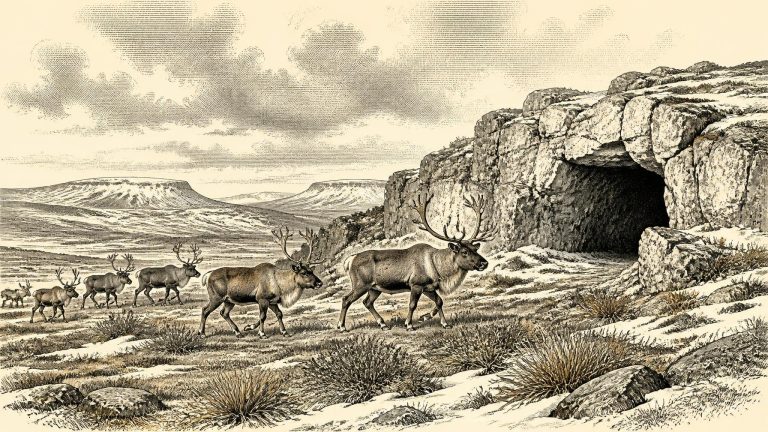
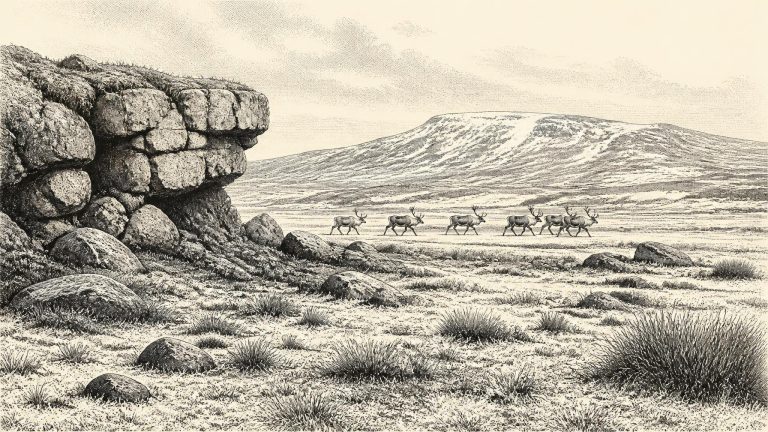
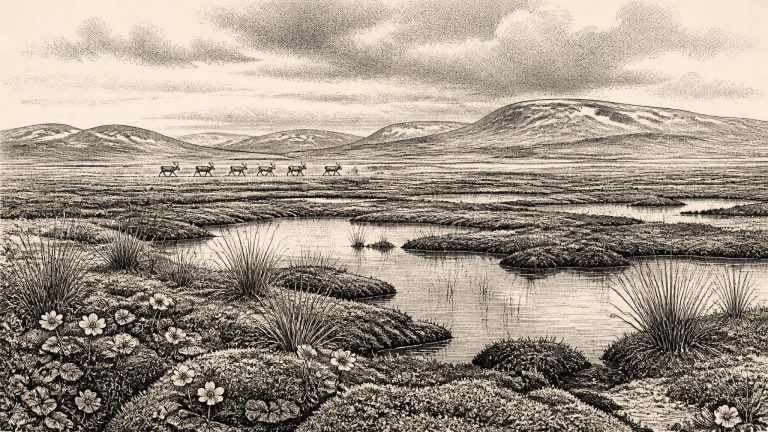
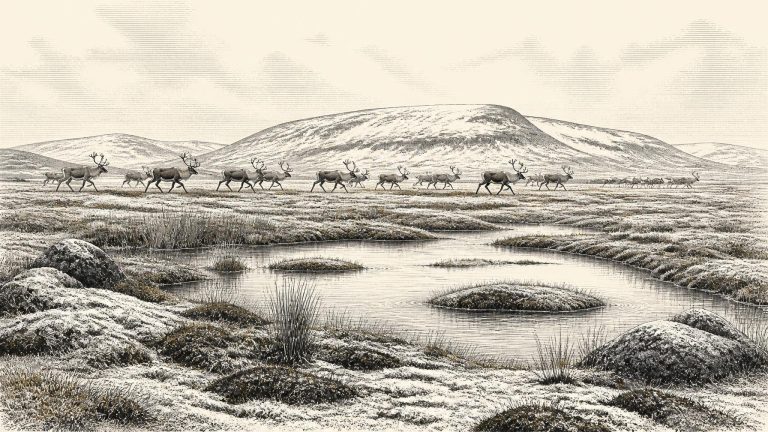
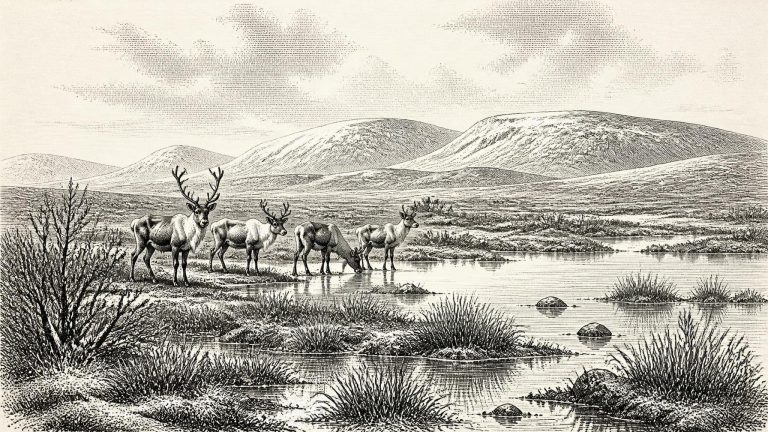
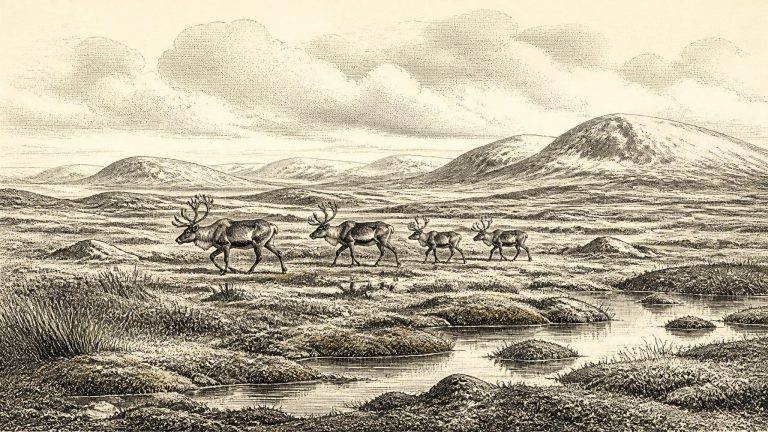
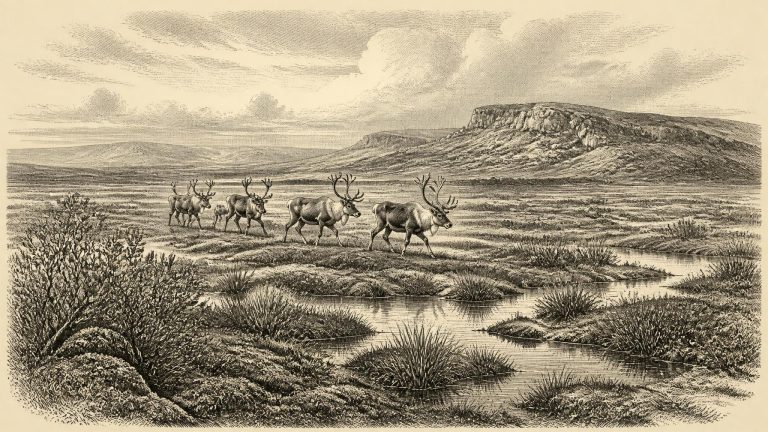
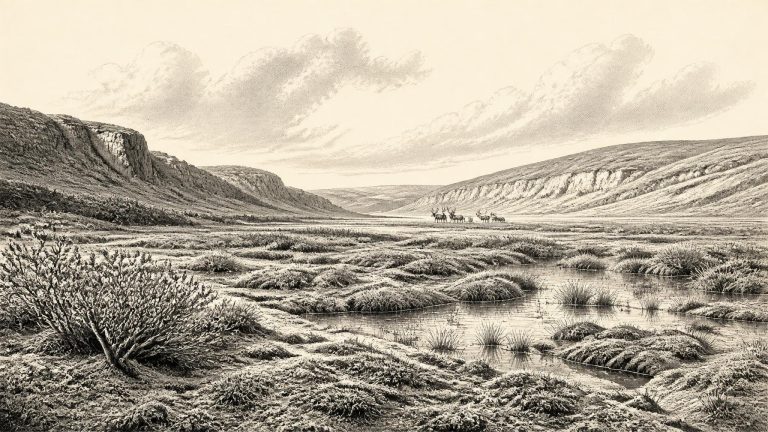
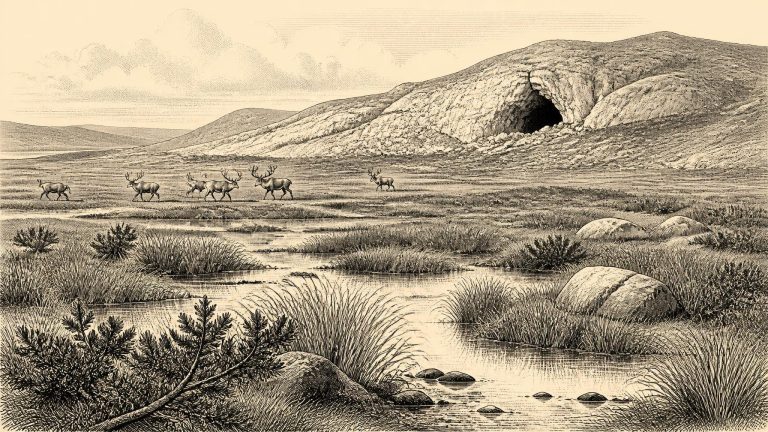
Derryvree is especially important because organic sediments were sealed beneath a drumlin by later glacial deposits. Such a position makes the site an unusually valuable witness to an earlier interval: a body of freshwater and waterlogged ground existed before ice again crossed the district. Plant remains, pollen, mosses and insect evidence point not to woodland but to an open, treeless and periglacial environment. Grasses, sedges, juniper and herbs are recorded, alongside plants associated with cold, wet ground, including mountain clubmoss and bogbean. The evidence has often been described as tundra or tundra-like muskeg: uneven, saturated ground with pools, mosses, sedges and sparse low vegetation.
The conversion itself needs caution. Radiocarbon years are not the same as calendar years: atmospheric radiocarbon levels varied substantially in the distant past, and samples must be calibrated against independently constructed curves. At ages beyond 30,000 years, the resulting ranges are broad and may be refined as calibration datasets and laboratory methods improve. The closest especially useful Irish environmental sequence, at Derryvree near Maguiresbridge in County Fermanagh, produced an original radiocarbon determination of 30,500 ± 1,100 radiocarbon years BP from organic sediment. In calibrated terms, this represents a broad interval spanning parts of roughly 35,000–33,000 calendar years BP, rather than a single moment. It can therefore responsibly inform conditions around 31,414 BCE, but cannot prove what occurred in that numbered year.
Around this broad interval, Ireland was in a cold world moving towards the Last Glacial Maximum, not yet at the fullest, best-documented extent of the last ice sheet. Later evidence shows that the British–Irish Ice Sheet expanded substantially from about 30,000 years ago and that its marine margins reached maximum positions in different sectors at different times, commonly around 26,500–23,000 years ago. This means that “Ireland under ice” is too blunt a description for 31,415 BCE. Ice cover, sea level, coastlines and habitable ground varied by region and through time; the sequence remains actively researched.
Ireland at this depth in time belonged to a changing Ice Age world, rather than to the familiar green and wooded island of later millennia. Temperatures fluctuated sharply across the North Atlantic region during MIS 3. The Last Glacial Maximum, when the British–Irish Ice Sheet later reached its greatest extent, lay ahead: its global peak is conventionally placed around 26,500–19,000 years ago. Around 31,428 BCE, therefore, the island’s landscapes were already exposed to severe cold and advancing ice systems, but should not be imagined as uniformly buried beneath ice. The Derryvree evidence demonstrates that at least one Fermanagh locality experienced a non-glacial interval with standing or slow-moving freshwater, vegetation and animal life before later ice sealed the deposits beneath till.
The nearest useful Irish environmental archive is at Derryvree, near Maguiresbridge in County Fermanagh. Roadworks exposed organic silts and fine sands between two separate beds of glacial till. Their order is crucial. An earlier glacier deposited the lower till; during a subsequent ice-free interval, freshwater sediments, plants and small animals accumulated; then another advance buried the deposit beneath fresh glacial debris. A conventional radiocarbon result of 30,500 years before present, with a substantial uncertainty, has been recalibrated in later discussion to a broad range of about 36,900–31,700 calibrated years before present, or approximately 34,950–29,750 BCE.
31,459 BCE is a modern chronological label, not a year that could have been recognised in prehistoric Ireland. No calendar, written record, named ruler or dated event exists for the island at this depth of time. Converted only as a convenient point on the archaeological timescale, it lies roughly 33,400 calendar years before the conventional “present” of AD 1950, in the Late Pleistocene and Marine Isotope Stage 3 (MIS 3). That apparent precision is misleading. Radiocarbon measurements must be calibrated against changing atmospheric carbon levels, and their results are expressed as probability ranges rather than single certainties. The responsible question is therefore not what happened in Ireland in one particular year, but what securely dated deposits and animal remains can tell us about the island during the broad interval surrounding it.
Ireland at this point was not the familiar green, wooded island of later prehistory. It belonged to the Middle Midlandian, or middle part of the last glacial period. Yet it should not simply be imagined as a country buried uniformly beneath ice. Ice expanded and contracted over long timescales, while climate swung abruptly between colder stadials and relatively milder interstadials. Conditions differed sharply by region, elevation and season. The later Last Glacial Maximum, when an extensive Irish Ice Sheet covered much of the island and adjacent continental shelf, still lay ahead. Around this notional year, parts of Ireland could support ice-free ground, freshwater and animal life, even as glaciers and ice sheets shaped other districts and threatened to advance again.
“Midlandian” is the Irish term for the last glacial stage. It should not be imagined as one unbroken age of ice. Climate and ice margins altered repeatedly over millennia. The global Last Glacial Maximum, when the British–Irish Ice Sheet attained its greatest overall extent, belongs chiefly to a later period. Recent ice-sheet synthesis places maximum ice volume at about 23,000 years BP, while showing that different sectors advanced and retreated at different times. For the earlier span around 33,400 BP, researchers expressly acknowledge substantial uncertainty about where ice lay in every region at every moment.
The closest securely relevant Irish environmental sequence is at Derryvree, near Maguiresbridge in County Fermanagh. There, organic silts and fine sands lay between two layers of glacial till in a drumlin exposure. The order is important: ice had deposited the lower till, an interval without local overriding ice allowed freshwater sediments and organic matter to accumulate, and a subsequent ice advance sealed the deposit beneath another till. A conventional radiocarbon result of 30,500 ± 1,170 radiocarbon years before present has been recalibrated in later discussion to a broad range of roughly 31,700–36,900 calibrated years before present. In calendar terms, that is approximately 34,950–29,750 BCE. The requested year lies within that range, but it cannot be isolated from it.
Radiocarbon dates are not calendar dates. They measure residual radioactive carbon and must be calibrated against changing atmospheric concentrations of carbon-14. The internationally used IntCal20 curve extends to 55,000 calibrated years before present, but uncertainty grows markedly in the deeper part of its range. A number such as 31,488 BCE is consequently best treated as a point within a broad calendar framework, not as a precisely dated Irish episode.
The closest useful Irish chronological anchor is the Derryvree deposit near Maguiresbridge, County Fermanagh. Roadworks exposed fine freshwater silts and sands beneath a drumlin, lying between two tills: unsorted sediment left by separate glacier advances. Organic material from the deposit produced the radiocarbon determination BIRM-166, conventionally dated to 30,500 ± 1,100 radiocarbon years before present. Subsequent modelling and calibration place this evidence broadly around 33.5 ± 1.2 thousand calendar years before present. That wide interval encompasses 31,502 BCE, but it does not prove that every fossil in the bed, or every part of Ireland, belonged to that exact moment.
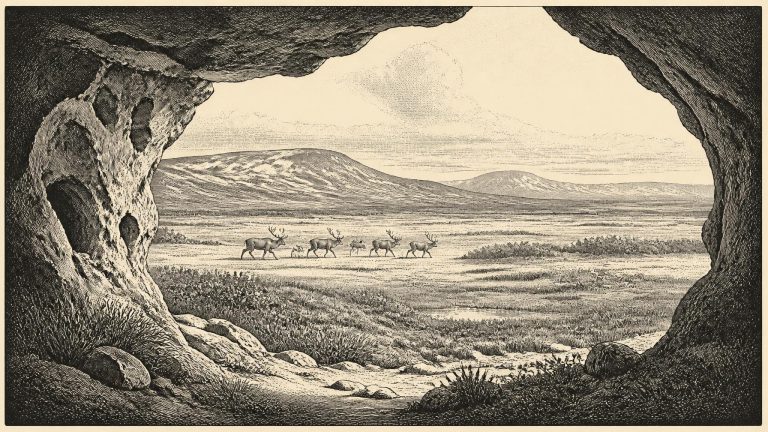
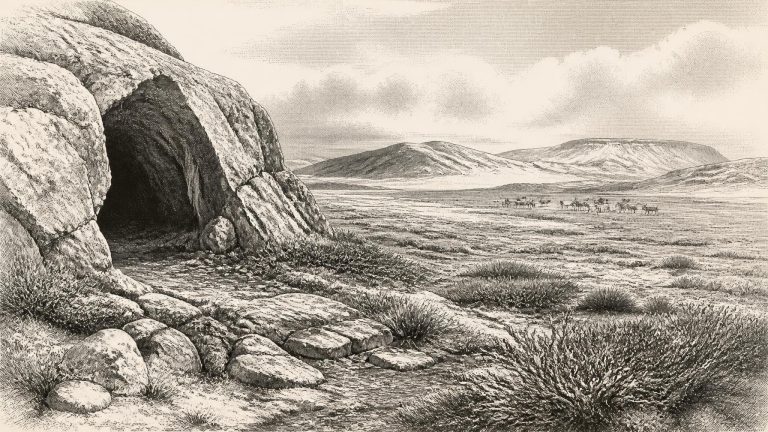
31,505 BCE is not a year that can be recovered from an Irish calendar, an annal or an excavation diary. It is a modern way of marking a point roughly 33,450 calibrated years before present (cal BP, where “present” is 1950). At this depth of time, modern calendar-year precision is unavailable. Radiocarbon results have statistical errors, calibration produces ranges rather than single moments, and deposits may represent repeated episodes rather than one season. The responsible question is therefore not “what happened in Ireland in 31,505 BCE?” but what evidence can illuminate conditions in and around Ireland during this part of the Middle Upper Palaeolithic and Marine Isotope Stage 3. The answer is fragmentary but important: buried wetland sediments, glacial layers, cave bones and a disputed-looking yet potentially consequential trace of animal processing.
Ireland was not yet the uniformly ice-covered landscape often imagined by reference to the later peak of the last glaciation. The maximum expansion of the last British–Irish Ice Sheet lay later, principally around 26,000–21,000 years ago, although its precise growth and regional configuration remain matters of active research. Around the notional date represented here, ice, snowfields, meltwater and frost processes were important forces, but local conditions could differ greatly from one part of the island to another. An ice-free wetland in Fermanagh does not prove that all Ireland was simultaneously ice-free; equally, evidence for advancing ice elsewhere cannot by itself describe every valley or lowland.
Dating such evidence needs care. Radiocarbon ages are not calendar dates: they measure the surviving radioactive carbon in an organic specimen and must be calibrated against independently dated records. At ages beyond 30,000 years, calibration ranges can be broad, while contamination and earlier laboratory methods can substantially affect results. The conventional “present” in radiocarbon terminology is AD 1950, rather than the present day. Thus a numbered BCE year cannot be treated as a precise match for a bone, cave layer or climatic episode.
At this time Ireland was not the green, wooded Atlantic island of later millennia. It lay in a cold-stage world whose coastlines, vegetation and ice margins changed repeatedly. Global sea level was considerably lower than today because large volumes of water were locked into northern ice sheets. The exposed continental shelf made the landmass geographically larger, and routes between Ireland, Britain and the European mainland may at intervals have been easier than in the modern seascape. Yet the exact character and continuity of any crossing route remain matters for geological reconstruction, not assumptions to be filled with a convenient “land bridge”.
Modern calibration is essential to this story. Archaeologists conventionally count radiocarbon years “before present”, with present fixed at AD 1950, rather than simply subtracting a number from the current year. At more than 30,000 years ago, the relationship between radiocarbon and calendar age is not a straight line. The IntCal20 calibration curve, built from independently dated natural records, improves the conversion but does not turn a single sample into a precise calendar event. Accordingly, 31,529 BCE should be treated as a point within a broad late-Pleistocene span, not as the date of a hunt, a migration or an ice advance.
The distinction between a radiocarbon age and a calendar age matters particularly here. Radiocarbon years are calculated from the residual carbon-14 in once-living material; calibration converts that measurement into calendar probabilities using independently dated records. At more than 30,000 years ago those probabilities can be broad, and the dates of old cave collections must also be considered alongside uncertainty over their original archaeological context. A label such as 31,543 BCE is therefore a useful point on a modern timeline, not a claim that scholarship can isolate a particular season, generation or occurrence in Ireland.
About 31,554 BCE, Ireland was not yet in the full Last Glacial Maximum, generally placed in Britain and Ireland between roughly 27,000 and 21,000 years ago. Ice was nevertheless an active force in the wider region. The growth of the British–Irish Ice Sheet is commonly assigned to the period after about 35,000–32,000 years ago, but its margins repeatedly advanced and retreated. Conditions differed markedly between regions and over comparatively short geological intervals. It would be misleading to picture the whole island as either uniformly ice-covered or uniformly habitable on this particular notional year.
The nearest securely relevant environmental sequence comes from Derryvree, near Maguiresbridge in County Fermanagh. Road construction in 1969 cut through a drumlin and exposed organic freshwater silts and fine sands enclosed between two tills: unsorted sediment deposited by glacier ice. The sequence records an earlier glacial episode, a subsequent interval in which freshwater sediment and organic material accumulated locally, and a later advance that buried the deposit beneath fresh till.
Around this notional date Ireland stood in the long cold interval generally called the Midlandian in Irish Quaternary studies and the Devensian in Britain. MIS 3 was not a single, uniform winter. It lasted roughly from 59,000 to 25,000 years ago and contained repeated abrupt shifts between colder stadials and relatively milder interstadials. The precise condition of every Irish region at 31,579 BCE cannot be reconstructed. Nor can a climatic change recorded in Greenland ice necessarily be transferred, year for year, to Cork, Fermanagh or the western seaboard.
The most useful local chronological bracket is provided by the organic silts found beneath a drumlin at Derryvree, near Maguiresbridge in County Fermanagh. Excavated from between two distinct till sheets, the deposits produced the radiocarbon measurement Birm-166, 30,500 radiocarbon years BP, with a substantial uncertainty. Later calibration places its likely calendar age broadly between about 31,700 and 36,900 cal BP. Thus 31,581 BCE falls within the wide interval represented by this remarkable deposit, but it cannot be assigned to a particular season, generation, or even century within it.
Radiocarbon dates are not calendar dates. A measurement reported as years “BP” means years before 1950, and must be calibrated against changing levels of atmospheric carbon-14 to produce a calendar-age range. At more than 30,000 years ago, the ranges are broad and the relation between a radiocarbon determination and calendar time is especially uneven. Nor can a date on a bone establish the precise day, season or even necessarily the exact year in which an animal died.