Elephant Hall’s Reindeer Horizon31792 BCE
Around 33,700 calibrated years before present, Ireland lay within the unstable Late Pleistocene, as ice advanced towards the Last Glacial Maximum. Open grasslands, shrubs and bare ground supported grazing animals, while lower sea levels altered coastlines without proving migration routes. Castlepook Cave, County Cork, preserves Ireland’s richest pre-maximum vertebrate archive, including mammoth, reindeer, giant deer, bear and hyaena, though its disturbed bones represent episodes. A 33,000-year-old reindeer femur bears a possible stone-tool cut mark, suggesting but not confirming an early human visit. No occupation evidence establishes settlement, hunting practices or continuity. It chiefly records environmental change and unresolved human presence.
Dateline
The numbered year 31,792 BCE cannot be treated as an anniversary in Irish history. No settlement, ruler, battle, ritual or journey can be placed in that single modern calendar year. At this depth in time, the useful scale is a broad calibrated horizon: roughly 33.7 thousand calendar years before present, within Marine Isotope Stage 3 of the Late Pleistocene. Radiocarbon ages are measured against AD 1950 and converted through calibration curves; at such antiquity, their ranges and uncertainties matter far more than a nominal BCE year. What can responsibly be said is that Ireland was entering a profoundly cold and unstable phase before the Last Glacial Maximum, and that a handful of caves, animal bones and buried sediments preserve glimpses of the land.
A Landscape Before the Ice Peak
In the wider north-west European sequence, this was not yet the climatic peak of the last glaciation. Reconstructions of the British–Irish Ice Sheet place its major expansion after about 35–32 thousand years ago, with maximum extent much later, broadly between 27 and 21 thousand years ago. That does not mean a uniform, ice-free Ireland in the earlier period. Ice masses grew and shifted in response to changing climate, while exposed ground, valley glaciers, ice margins and cold periglacial landscapes could occur in different regions at different times. The exact extent of ice around 33.7 thousand calibrated years ago remains a matter of reconstruction rather than something directly mapped from a single Irish deposit.
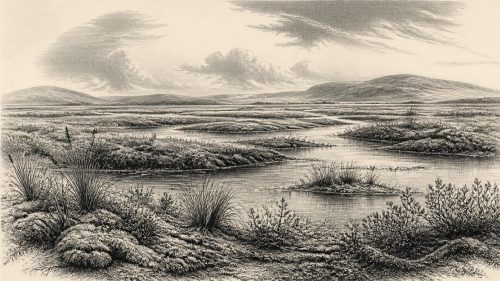
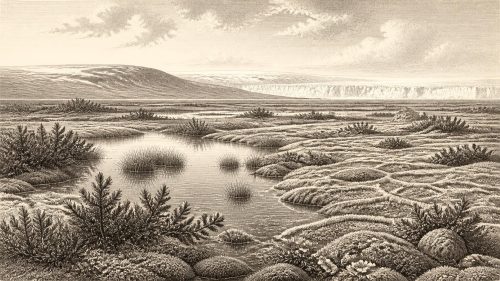
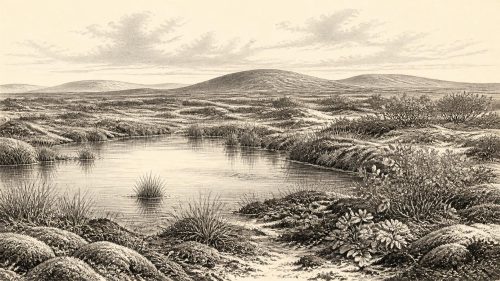
For people accustomed to the later green, wooded island, the most important correction is environmental. Ireland’s vegetation did not resemble the modern patchwork of pasture, hedgerow and Atlantic woodland. The evidence available for Late Pleistocene Ireland points instead towards open, cold-country habitats: grassland, herbs, low shrubs, bare mineral ground, wet hollows and seasonally severe conditions. Plant remains, pollen, insects and animal bones from different Irish localities document changing episodes rather than one continuous national landscape. They nevertheless establish that the island, or its then differently shaped landmass and coasts, could support large grazing mammals during favourable intervals.
Sea level was markedly lower than it is today, so the outlines of coasts, estuaries and shelves were very different. But lower sea level should not automatically be turned into a simple land bridge or an assured migration route. The changing Irish Sea basin, the position of glaciers and the nature of any crossing are questions requiring local evidence. No excavated camp of this age tells us whether a human visitor, if one came, travelled over exposed ground, crossed narrow water, used watercraft, or approached at another time when geography differed.
The Cave Record at Castlepook
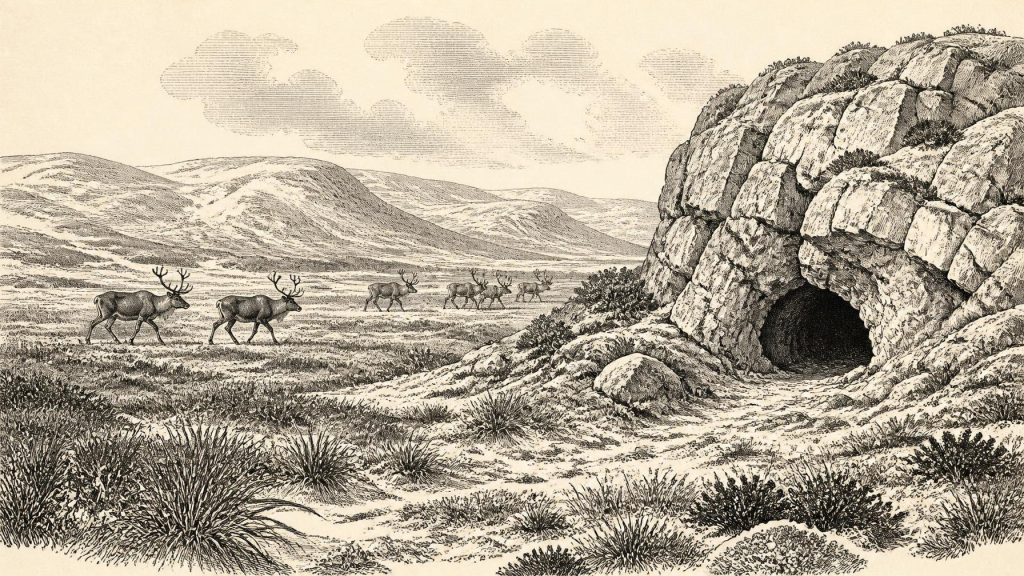
The most illuminating Irish archive for this broad period lies at Castlepook Cave, also called Mammoth Cave, near Doneraile in north County Cork. Its limestone passages include Elephant Hall, Hyaena Hall and other galleries named by early investigators. Excavations in the early twentieth century recovered a remarkable quantity of animal bone, while later re-examination and radiocarbon dating showed that the collection represents a long and complicated history rather than a single moment. Geological Survey Ireland describes Castlepook as Ireland’s richest vertebrate-fauna site for the period leading towards the Last Glacial Maximum.
That distinction is essential. Castlepook is a repository, not a frozen snapshot of one community. Bones reached caves through more than one process: carnivores could drag in prey; animals might die in or near entrances; water could move material; later collapse, excavation and collecting could disturb layers. The old excavations also predated modern recording standards. A mammoth rib, a reindeer bone and a hyaena skull from the same named cave do not necessarily demonstrate that those animals met there in the same season, or even the same millennium.
Even with those cautions, the fauna is striking. Castlepook has yielded woolly mammoth, reindeer, giant deer, brown bear and spotted hyaena, with wolf, Arctic fox, mountain hare and both Norwegian and collared lemmings represented in the wider Ice Age record. Shandon Cave in County Waterford supplies an important comparison, having produced mammoth, reindeer, horse, bear and wolf. Radiocarbon reassessment has made some southern Irish cave-animal dates significantly older than earlier results suggested. It has also supported the conclusion that some species, especially giant deer and spotted hyaena, may have disappeared locally before the Last Glacial Maximum. The lesson is not that every species listed lived beside Doneraile in 31,792 BCE, but that Ireland was repeatedly part of a wider Late Pleistocene faunal world.
Reindeer and the Human Question
A reindeer femur from the Castlepook collection gives this period unusual historical importance. It has been reported as roughly 33,000 years old and bears a deep incision which zooarchaeologist Ruth Carden has interpreted as a cut made by a sharp stone tool during carcass processing. If both the age and the anthropogenic interpretation are sustained, the specimen may indicate that one or more Upper Palaeolithic people handled a reindeer in Ireland tens of millennia before the long-recognised terminal Pleistocene evidence from County Clare.
The appropriate language is deliberately conditional. The femur itself is physical evidence; its date concerns the animal’s death within a range. Whether the mark was made by a human tool is a separate microscopic and taphonomic judgement. The bone derives from an old cave collection rather than a modernly excavated occupation surface with associated hearths, stone tools, food waste, shelters or burials. A single possible cut mark cannot identify the number of people involved, where the animal was killed, whether it was hunted or scavenged, how long anyone remained, or whether visitors returned. It does not establish a settled population or a line of descent to later inhabitants of Ireland.
Comparison shows why this caution matters. At Alice and Gwendoline Cave in County Clare, a brown-bear kneecap with fresh-bone cut marks was independently dated to calibrated ranges of about 12,810–12,590 and 12,810–12,685 years before present. That is secure evidence of human processing far later than the Castlepook claim, after the glacial maximum. By contrast, the Castlepook reindeer offers an earlier possibility requiring continuing expert scrutiny. Renewed fieldwork has sought surviving undisturbed Pleistocene sediments in portions of the cave missed or disturbed by earlier exploration. Such work may eventually provide the contextual evidence that an isolated museum specimen cannot.
Life, If Visitors Reached Ireland
There is no defensible basis for describing political affairs, diplomacy, named groups, territories, warfare, leaders or institutions in Ireland at this time. There is equally no Irish evidence for buildings, graves, formal religion, art, writing or teaching. The absence of such evidence is not proof that visitors had no beliefs, stories, kin networks or practical knowledge; Upper Palaeolithic people elsewhere in Europe certainly possessed elaborate social and cultural lives. It does mean that these cannot be transferred wholesale to Ireland.
If the reindeer mark records human action, the smallest responsible interpretation is economic and practical: a mobile party gained access to a carcass and used a sharp edge to cut it. Reindeer could provide meat, fat, hide, sinew, antler and bone, resources of great value in a cold environment. Yet the bone does not show whether the animal was deliberately hunted, found dead, or taken after another predator had killed it. Nor can it demonstrate regular seasonal hunting, exchange networks, a camp economy or a permanent settlement. “Trade” and “diplomacy” are therefore not hidden chapters awaiting imaginative reconstruction; for Ireland around this horizon, they are simply undocumented.
The cave fauna does, however, show an ecological setting in which predators and people, if present, would have negotiated risk as well as opportunity. Spotted hyaenas used Castlepook as a den or bone-accumulating place during parts of its history. Wolves and bears were also among the large animals of the Ice Age landscape. A cave might offer brief shelter, but it could also be dangerous, occupied, flooded or inaccessible. The evidence does not permit a picturesque scene of families living permanently underground. It points instead to a harsh and fluctuating country in which caves were natural archives precisely because animals, water and sediment repeatedly used them.
What This Date Can Mean
The principal development around 31,792 BCE was environmental, not political: the approach towards the glacial maximum was reshaping habitats, coastlines and the possibilities for animal and human movement. Ireland’s surviving record is exceptionally fragmentary because subsequent ice advance, erosion, rising seas and the limited survival of datable deposits have removed or concealed much evidence. That makes every securely dated bone, preserved sediment and carefully recorded cave layer valuable, while making overconfident stories especially hazardous.
Thus this year belongs to an archaeological horizon, not a conventional chronicle. Around 33.7 thousand calibrated years before present, Ireland was part of the cold Late Pleistocene north-west European world. Reindeer and other large mammals reached its landscapes at intervals; ice was growing towards its later maximum; and a marked Castlepook femur raises the serious but still unconfirmed possibility of a very early human visit. The enduring historical fact is not a dateable event but the evidence itself: a cave archive in north Cork, a changing glacial landscape, and a question about the first human footsteps that remains open.
Primary Sources
- A reconsideration of the radiocarbon dating of the Marine Isotope Stage 3 fauna from southern Ireland
- The Irish Quaternary Fauna Project
- Cork County Geological Site Report: Castlepook Cave
- Figure 6: The Subdivision of the Quaternary Period in Ireland
- Quaternary Site Descriptions
- Extent and timing of the Last Glacial Maximum in Britain and Ireland: a review
- Growth and retreat of the last British–Irish Ice Sheet, 31,000 to 15,000 years ago: the BRITICE-CHRONO reconstruction
- Growth and retreat of the last British–Irish Ice Sheet, 31,000 to 15,000 years ago: the BRITICE-CHRONO reconstruction
- Maximum extent and dynamic behaviour of the last British–Irish Ice Sheet west of Ireland
- Stratigraphic and palaeo-geomorphological evidence for the glacial-deglacial history of the last British-Irish Ice Sheet in the north-western Irish Sea
- Late Pleistocene chronostratigraphy and ice sheet limits, southern Ireland
- The timing and magnitude of the British–Irish Ice Sheet between Marine Isotope Stages 5d and 2
- Behavioural tendencies of the last British–Irish Ice Sheet revealed by data–model comparison
- Dynamic cycles, ice streams and their impact on the extent, chronology and deglaciation of the British-Irish ice sheet
- The IntCal20 Northern Hemisphere Radiocarbon Age Calibration Curve (0–55 cal kBP)
- IntCal Publications
- IntCal History
- First evidence of a Late Upper Palaeolithic human presence in Ireland
- New insights on the fauna of Ireland's Younger Dryas and Early Holocene from Alice & Gwendoline Cave
- Red deer in Ireland: phylogeography and palaeoecology
- Irish Cave Exploration
- The Mammoth Caves of Castlepook, Near Doneraile
- 2022:564 — Castlepook Cave, Castlepook South, Cork
- Heritage Artefacts of County Cork